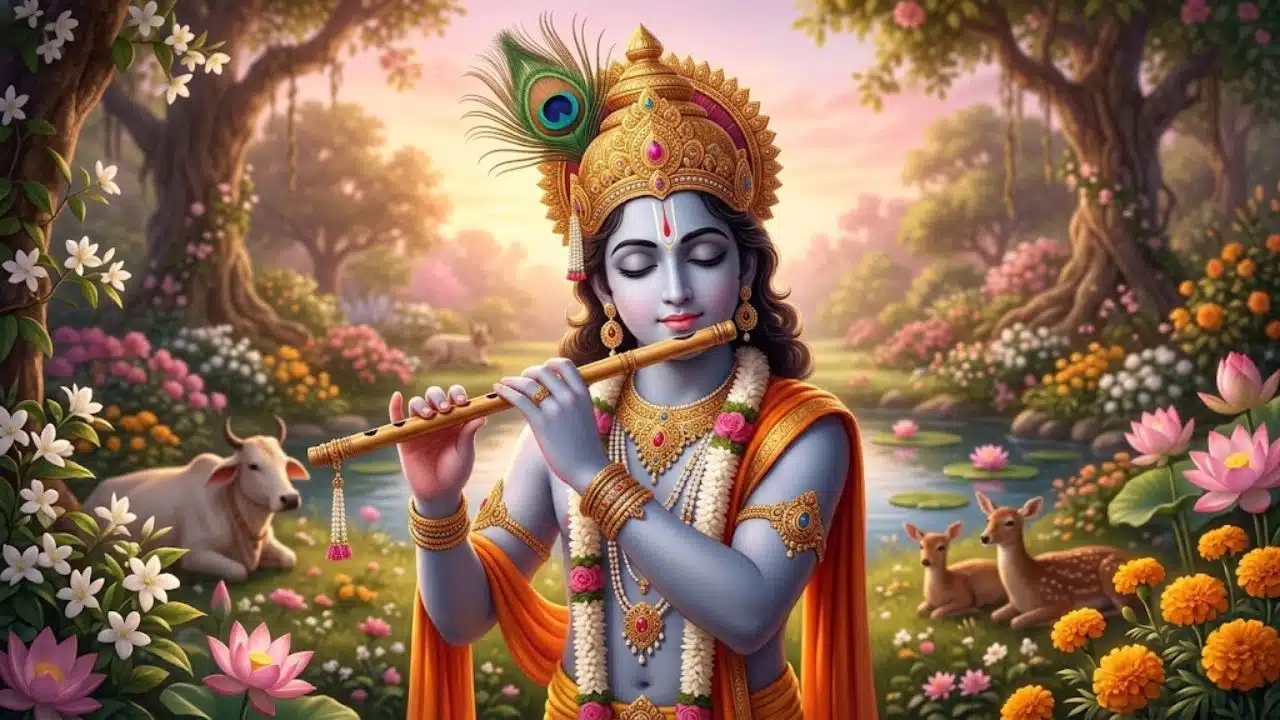
Janmashtami is easy to recognize by its outward traditions: fasting, bhajans, decorated temples, midnight worship, small Krishna idols placed in cradles, and Dahi Handi celebrations in some parts of India. But those customs make more sense when we understand what the festival is actually celebrating.
Janmashtami marks the birth, or divine appearance, of Lord Krishna, one of the most widely worshipped figures in Hindu tradition. For many Hindus, Krishna is an avatar of Vishnu. In several Krishna-centred Vaishnava traditions, he is worshipped as the Supreme Lord himself.
His birth is celebrated not simply because an important religious figure was born. The Janmashtami story presents Krishna’s arrival as divine intervention during a time of fear, injustice, and disorder. His later teachings deepen that meaning, particularly through the Bhagavad Gita’s discussions of dharma, action, devotion, knowledge, and spiritual responsibility.
That is why Janmashtami remains much more than an annual retelling of Krishna’s childhood.
The Story Behind Lord Krishna’s Birth
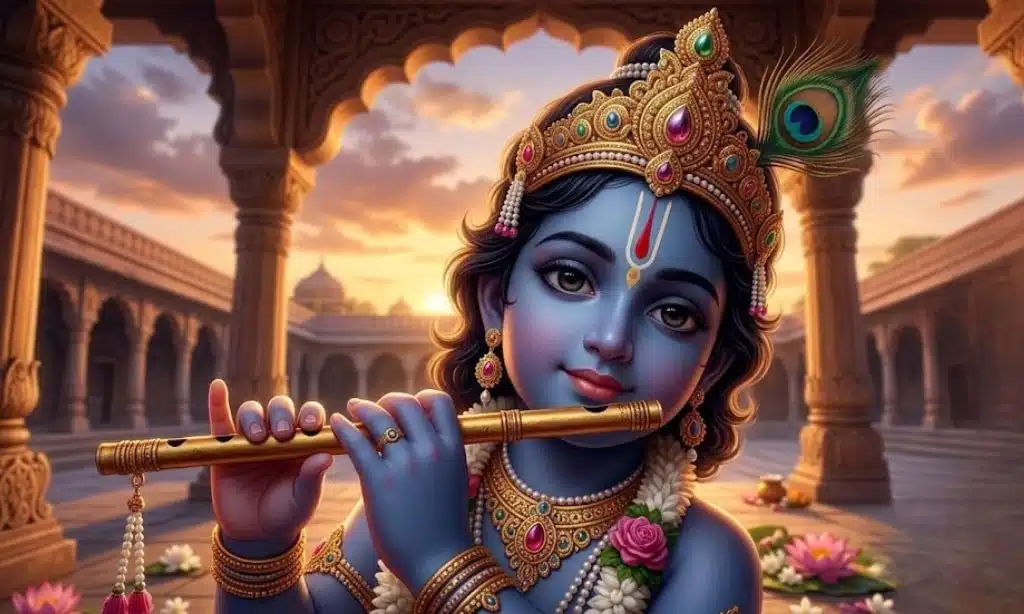
According to the Bhagavata tradition, Krishna was born in Mathura to Devaki and Vasudeva.
Devaki’s brother, Kamsa, had taken control of Mathura. A prophecy warned him that Devaki’s eighth child would eventually cause his downfall. Driven by fear, Kamsa imprisoned Devaki and Vasudeva and killed their earlier children.
Krishna was the eighth child.
The traditional account describes his birth taking place at night while his parents remained imprisoned. Vasudeva then carried the newborn Krishna away from Mathura and across the Yamuna to safety.
Krishna was taken to Gokul, where he grew up in the household of Nanda and Yashoda.
This beginning matters because Krishna does not enter the story in comfortable circumstances. His birth takes place against a background of oppression and danger. Yet the child whom Kamsa fears becomes the figure who will eventually defeat him.
That contrast has helped shape one of the most familiar interpretations of Janmashtami: adharma may become powerful, but it is not permanent.
Why Krishna’s Birth Has Spiritual Significance
The spiritual meaning of Janmashtami becomes clearer when Krishna’s birth is considered alongside his later role in Hindu tradition.
In the Bhagavad Gita, Krishna explains that when dharma declines and adharma rises, he manifests to protect the righteous, confront destructive forces, and re-establish dharma.
Janmashtami is therefore closely connected with the idea of the restoration of moral and spiritual order.
But “good defeating evil” is only part of the picture. Reducing the festival to that phrase can make its meaning sound simpler than it is.
Krishna’s life and teachings deal with harder questions: What is a person’s duty when every available choice feels difficult? How should someone act without being consumed by the result? What is the place of devotion alongside knowledge and disciplined action? How should a person respond when responsibility conflicts with personal attachment?
Those are some of the questions that make Krishna significant far beyond the circumstances of his birth.
Krishna’s Birth Represents the Restoration of Dharma
One of the strongest themes associated with Krishna is dharma.
The word is difficult to reduce to a single English equivalent. Depending on context, it can refer to duty, righteousness, moral order, proper conduct, or a way of living in accordance with a deeper spiritual order.
Krishna’s birth narrative begins at a point when that order has been disturbed. Kamsa rules through fear, imprisons members of his own family, and tries to prevent a prophecy through violence.
Krishna’s arrival signals that such power has limits.
His later role in the Mahabharata develops the theme further. Krishna does not simply tell people that being “good” is enough. The Bhagavad Gita places Arjuna in a situation where responsibility is painful and moral choices cannot be reduced to comfortable slogans.
That makes the idea of dharma particularly relevant to Janmashtami. The festival celebrates not only the arrival of Krishna, but what his presence represents: the return of moral direction when circumstances have become confused or unjust.
Why Is Krishna Born at Midnight?
Janmashtami worship traditionally reaches its peak around midnight because Krishna’s birth is associated with the middle of the night.
This explains why devotees may fast through the day, gather in temples during the evening, sing bhajans and kirtans, and wait for the midnight celebration.
At the appointed time, temples may perform special arati and abhisheka, while an infant form of Krishna is ceremonially welcomed.
The darkness surrounding Krishna’s birth has also acquired powerful devotional meaning. Krishna arrives while his parents are imprisoned and his life is immediately threatened. Yet the night does not end with Kamsa’s victory. The infant escapes his reach.
It is understandable that devotees see hope in that story.
Still, Janmashtami does not need to be turned into a collection of invented symbols. Its traditional narrative already carries enough meaning: danger is present, injustice appears dominant, and Krishna’s arrival changes the direction of the story.
Why Devotees Fast on Janmashtami
Fasting is one of the most familiar Janmashtami practices, although the exact rules differ between traditions.
Some devotees observe a complete fast. Others take fruit, milk, water, or foods permitted under their particular vrata tradition. In several Vaishnava communities, the fast continues until the midnight celebration.
The purpose is not simply to go without food.
A religious fast creates a deliberate interruption in an ordinary day. Meals, routines, and other normal activities are reduced so that more attention can be given to prayer, chanting, scripture, and worship.
That distinction matters. Treating a Janmashtami fast as an endurance challenge misses much of its religious purpose.
Fasting practices also should not be treated as identical across Hindu traditions. Families and temples may follow different rules, and health considerations should take priority when a strict fast would be unsafe.
Why Butter Appears Everywhere During Janmashtami
Butter, milk, curd, and other dairy foods are closely associated with stories of Krishna’s childhood.
Krishna’s playful attempts to steal butter are among the best-known episodes from his early life. Images of Makhan Chor, or the butter thief, present a very different Krishna from the philosophical teacher of the Bhagavad Gita.
That contrast is part of his enduring appeal.
Krishna can appear as a mischievous child in one story and as a profound spiritual teacher in another. Hindu artistic and devotional traditions have represented both sides for centuries.
This childhood association helps explain why butter and milk-based preparations frequently appear among Janmashtami offerings.
It also sits behind the popular Dahi Handi tradition, especially associated with Maharashtra, in which groups form human pyramids to reach a pot suspended above the ground.
Dahi Handi recalls stories of Krishna and his companions trying to reach pots of butter or curd placed beyond their reach. It has become a major public celebration, although it is a regional expression of Janmashtami rather than a ritual observed everywhere.
Bhakti Is at the Heart of Janmashtami
If there is one idea that ties many Janmashtami customs together, it is bhakti, or devotion.
People sing Krishna’s names rather than merely discussing him. Temples perform kirtan. Food is prepared as an offering before becoming prasada. Murtis are bathed, clothed, decorated, and placed in cradles. Families stay awake waiting for the midnight celebration.
These practices turn remembrance into participation.
That is important because Krishna devotion is not limited to accepting a set of philosophical ideas. Bhakti traditions emphasise a personal relationship with the divine expressed through prayer, service, chanting, remembrance, and love.
The festival therefore works on more than one level. Someone may come to Krishna through the philosophical teachings of the Gita, the devotional poetry associated with Radha and Krishna, the childhood stories of Gokul, or the simple experience of singing Krishna’s names with a community.
Janmashtami brings many of those forms together in a single celebration.
What the Bhagavad Gita Adds to the Meaning of Janmashtami
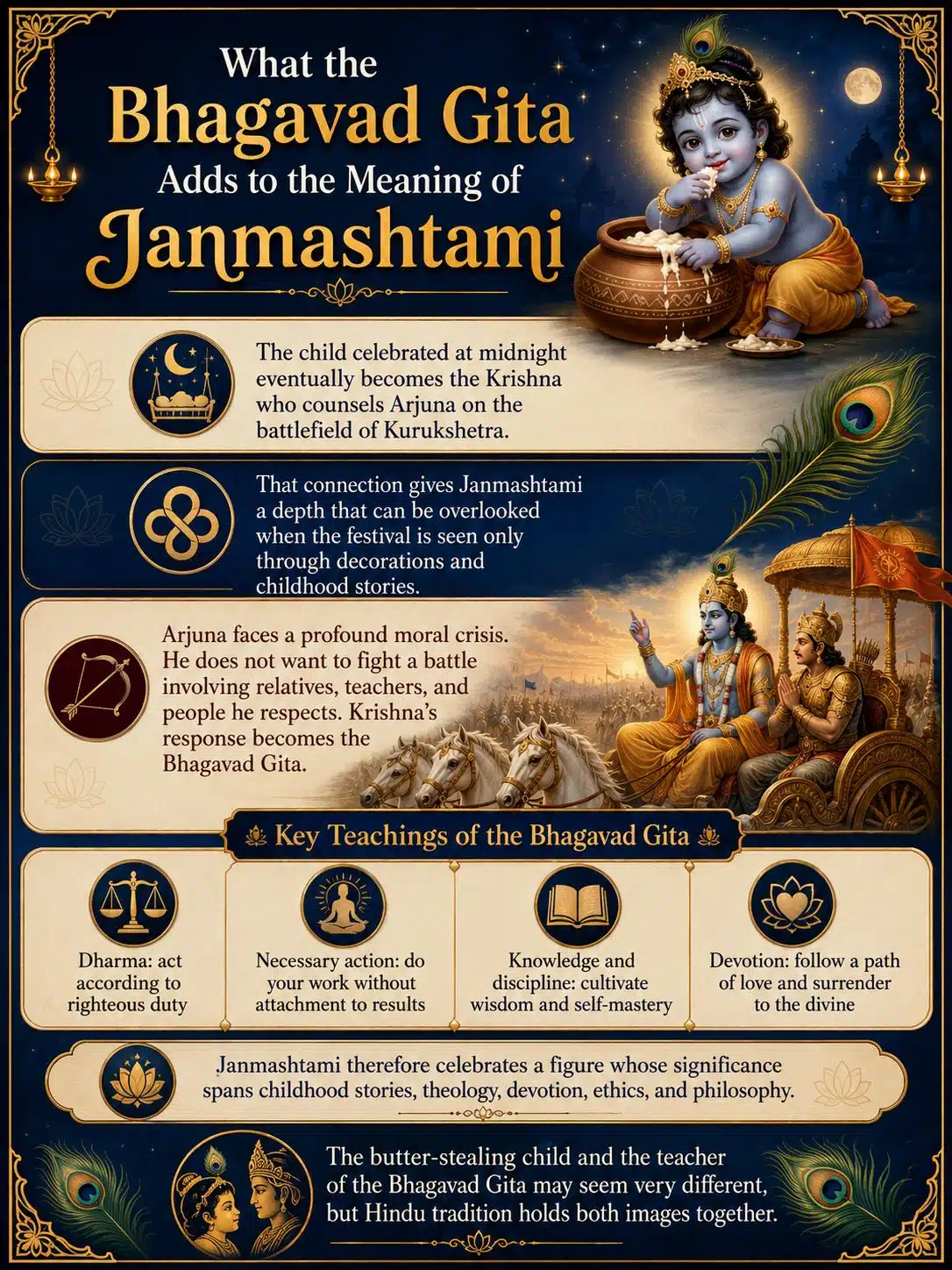
The child celebrated at midnight eventually becomes the Krishna who counsels Arjuna on the battlefield of Kurukshetra.
That connection gives Janmashtami a depth that can be overlooked when the festival is presented only through decorations and childhood stories.
Arjuna faces a profound moral crisis. He does not want to fight a battle involving relatives, teachers, and people he respects. Krishna’s response becomes the Bhagavad Gita.
Its teachings include several ideas that remain central to Hindu philosophical and devotional thought: acting according to dharma, performing necessary action without obsessive attachment to its results, cultivating knowledge and discipline, and following a path of devotion to the divine.
Janmashtami therefore celebrates a figure whose significance spans childhood stories, theology, devotion, ethics, and philosophy.
A butter-stealing child and the teacher of the Bhagavad Gita might seem like very different figures. Hindu tradition holds both images together.
Why Mathura, Gokul, and Vrindavan Matter
Geography also shapes the festival.
Mathura is traditionally regarded as Krishna’s birthplace. Gokul is associated with his early childhood after Vasudeva carried him away from Mathura. Vrindavan is deeply connected with Krishna’s childhood and youth and has become one of the most important centres of Krishna devotion.
These places therefore experience Janmashtami with particular intensity.
Temples fill with devotional singing and worship. Krishna’s life is retold through performances. Pilgrims gather for darshan, and the midnight celebration becomes the centre of a much larger religious programme.
But visiting these places is not necessary to understand Janmashtami.
The same basic story is recreated in much smaller ways inside homes: an infant Krishna, a cradle, flowers, food offerings, songs, scripture, and people waiting together for midnight.
Why Janmashtami Still Matters
A festival can survive for centuries while gradually becoming detached from its original meaning. Janmashtami has certainly developed enormous cultural expressions, from large temple gatherings to Dahi Handi events and elaborate decorations.
But its religious centre remains remarkably clear.
It remembers Krishna.
More specifically, it remembers Krishna arriving at a moment when fear and injustice seem to control the situation. It celebrates dharma without pretending that moral choices are always easy. It gives devotion a joyful form through music, food, stories, and worship. And through the Bhagavad Gita, it connects celebration with serious reflection on how a person should act.
For families, there is another layer. Festivals are one of the ways religious memory moves between generations.
A child may first meet Krishna as the mischievous boy stealing butter. Later, the same person may encounter Krishna again through the Bhagavad Gita and find an entirely different depth in the tradition.
Janmashtami makes room for both.
Final Thoughts
Janmashtami celebrates Lord Krishna’s birth because his appearance represents far more than the arrival of a revered religious figure. Within Hindu traditions, Krishna is connected with the restoration of dharma, divine protection, bhakti, wisdom, loving relationships with the divine, and the difficult responsibility of acting rightly.
That is why the festival can contain both celebration and reflection.
The midnight arati, fasting, Krishna’s cradle, bhajans, butter offerings, scripture readings, and community gatherings are not isolated customs. Each points back, in a different way, to the life and meaning of Krishna.
Understanding that connection makes Janmashtami more than a festival to observe. It explains why Krishna’s birth continues to be remembered with such devotion.
FAQs About Janmashtami
Why do Hindus celebrate Lord Krishna’s birth?
Krishna’s birth is celebrated because of his central religious significance in Hindu and particularly Vaishnava traditions. His appearance is associated with the protection of dharma and the defeat of destructive forces, while his later teachings in the Bhagavad Gita address duty, devotion, knowledge, and spiritual life.
Why is Janmashtami celebrated at midnight?
Krishna is traditionally believed to have been born at midnight in Mathura. Devotees therefore often spend the evening fasting, praying, chanting, or attending temple programmes before the main celebration takes place around midnight.
What is the main spiritual message of Janmashtami?
There is no single interpretation shared identically by every Hindu tradition, but dharma and bhakti are central themes. Krishna’s birth represents divine intervention against injustice, while his life and teachings emphasise devotion, responsibility, disciplined action, and spiritual understanding.
Why is Krishna worshipped as a baby on Janmashtami?
Janmashtami specifically commemorates Krishna’s birth, so Bal Krishna naturally becomes central to the festival. Worship of the child Krishna also reflects the devotional idea that a person can relate to the divine through parental tenderness and affection, not only formal reverence.
Is Janmashtami only about Krishna’s childhood?
No. Krishna’s childhood stories shape many of the festival’s visible traditions, but his importance extends much further. The Krishna of the Bhagavad Gita is a teacher and guide whose discussions of dharma, action, knowledge, and devotion are central to his religious significance.