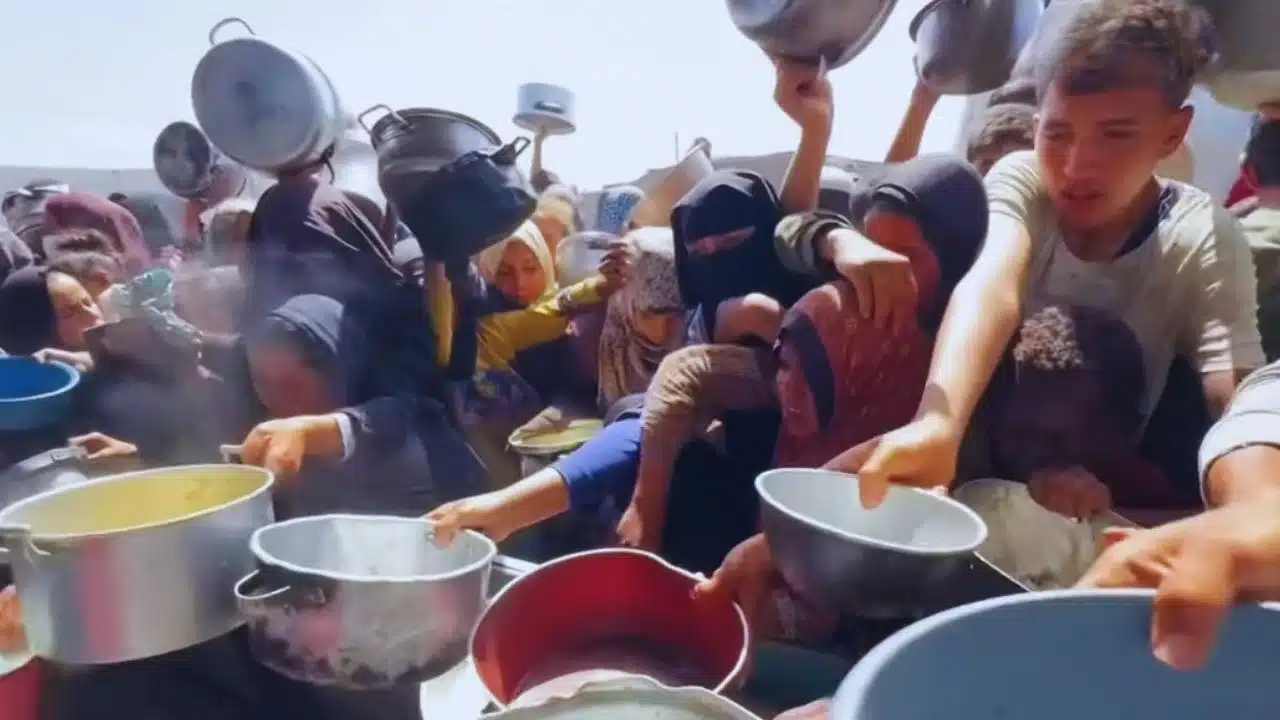
After more than two months of a full blockade on Gaza, the Israeli government has announced it will now allow a “basic amount” of food into the besieged Palestinian territory. The decision, confirmed by the office of Prime Minister Benjamin Netanyahu on Sunday, comes after growing international pressure and worsening humanitarian conditions in Gaza, where 2.1 million people remain trapped with limited access to essentials like food, water, fuel, and medical supplies.
According to Israel, the move follows a recommendation from the Israeli Defense Forces (IDF) and is aimed at ensuring that a full-scale starvation crisis does not unfold—a scenario that could complicate or destabilize Israel’s ongoing military operation against Hamas, which it has named Operation Gideon’s Chariot.
Strategic Decision Tied to Military Objectives
The prime minister’s office made it clear that humanitarian aid is being allowed not solely out of humanitarian concerns but also to support military goals. In the statement, Israel emphasized that preventing a famine is necessary to maintain the integrity and effectiveness of its military campaign. Simultaneously, it vowed to prevent Hamas from seizing or manipulating aid for its own use.
Israel has accused Hamas of using civilian infrastructure—including schools, mosques, and hospitals—for military purposes and has previously expressed concerns that humanitarian aid could be diverted to support militant activities. As a result, the distribution of aid will be closely monitored, with Israel indicating that it will “act to deny Hamas’s ability to take control of humanitarian assistance.
Ground Assault Across Gaza Intensifies
The aid announcement came just hours after the IDF initiated what it called “extensive ground operations” across Gaza, with simultaneous attacks on northern and southern regions of the strip. Strikes were reported in multiple locations, including the densely populated areas of Khan Younis, Beit Lahia, and the Jabalia refugee camp.
According to Gaza’s Hamas-run Health Ministry, at least 67 people were killed and 361 others injured in the last 24 hours alone as a result of airstrikes and artillery shelling. Israeli forces also confirmed strikes targeting what they described as Hamas infrastructure.
The renewed offensive marks a significant escalation in the conflict, following the breakdown of a temporary ceasefire in March. Israel’s stated military goals include destroying Hamas’s operational capabilities, recovering the remaining hostages taken during the October 7, 2023 attacks, and preventing future militant threats from Gaza.
Hospitals, Once Safe Havens, Now Under Fire
In the midst of the offensive, hospitals in Gaza—already operating under extreme pressure—have been heavily impacted. According to reports from Gaza’s health authorities, three public hospitals in the North Gaza governorate are now completely out of service.
One of the most alarming incidents involved the Indonesian Hospital in Beit Lahia, where medical personnel reported that Israeli tanks surrounded the facility and opened fire. At the time of the attack, approximately 55 people were inside, including four doctors, eight nurses, and dozens of immobilized patients. The staff told the BBC that they had received no evacuation notice and that the hospital had not been used for any military activity, contrary to Israeli claims of targeting terrorist infrastructure nearby.
Later, staff confirmed that the tanks withdrew from the area, but the hospital had sustained enough damage to render it unusable.
Meanwhile, al-Mawasi camp—previously designated by Israeli forces as a safe zone—was also struck overnight. Gaza’s Civil Defence reported 22 people killed and 100 injured in the attack, many of them displaced families who had sought refuge in the area.
Aid Groups Warn of Famine, Call for Immediate Access
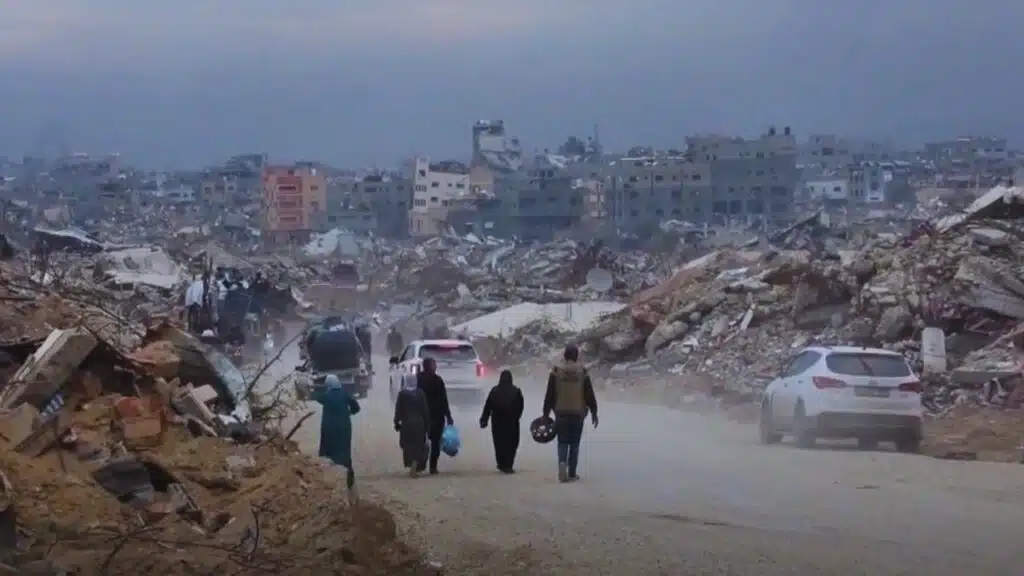
Humanitarian organizations, including the United Nations and international NGOs, have issued urgent warnings over Gaza’s deepening food crisis. The UN’s World Food Programme has classified the situation as a Level 5 emergency, the highest on its scale. A recent analysis from the Integrated Food Security Phase Classification (IPC) system estimates that more than half a million people in Gaza face imminent famine-like conditions.
International calls for unrestricted humanitarian access have grown louder. French Foreign Minister Jean-Noel Barrot called for Israel to immediately resume the “massive and unhampered” delivery of aid to prevent mass starvation.
The aid that Israel has now agreed to permit is described as a “basic quantity” of food—but no clear figures were provided. Aid organizations say this minimal aid falls short of meeting the critical needs on the ground. Deliveries of fuel and medicine—equally essential—remain restricted.
Ceasefire Talks Resume in Doha, But No Breakthrough
While military activity continues, negotiators from Israel and Hamas have resumed indirect ceasefire discussions in Doha, Qatar. According to Israeli media reports, Netanyahu’s team is actively exploring every option to secure a deal that would lead to the release of all Israeli hostages. The government’s conditions reportedly include the exile of top Hamas leaders, full disarmament of the group, and the demilitarization of Gaza.
However, a senior Hamas official speaking to the BBC said no meaningful progress has been made. Hamas insists that any hostage release must be part of a permanent and comprehensive ceasefire agreement, which Israel continues to reject. Hamas has proposed a prisoner exchange, full Israeli withdrawal from Gaza, and unimpeded humanitarian access in return for the release of hostages.
“There is no room for partial or temporary deals,” said the Hamas source, accusing Israel of negotiating in bad faith and lacking the political will to reach a lasting resolution.
Families of Hostages Voice Growing Concerns
As military operations expand, families of the remaining hostages have voiced their distress over the deteriorating conditions and the impact of ongoing strikes. The Hostages and Missing Families Forum, a coalition advocating for the release of Israeli hostages, warned that hostages still held in Gaza are facing worsening treatment.
“Testimonies from released hostages describe significantly worsened treatment following military strikes, including physical abuse, restraint, and reduced food,” the group said in a statement.
According to Israeli officials, 58 hostages remain in Gaza, although only 23 are confirmed to be alive. The status of the others remains unknown, adding urgency to the push for a ceasefire that includes hostage negotiations.
Background: What Sparked the War
The current conflict began after the Hamas-led attack on southern Israel on October 7, 2023, during which more than 1,200 Israelis were killed and over 250 were taken hostage, according to Israeli government figures. That incident marked one of the deadliest days in Israel’s history and led to an immediate and forceful military response.
Since then, Israel’s air and ground operations have resulted in devastating destruction across Gaza. According to the Gaza Health Ministry, more than 53,000 Palestinians have been killed during the military campaign, including a large number of women and children. Civilian infrastructure—including schools, hospitals, shelters, and water treatment facilities—has been heavily damaged or destroyed.
Humanitarian and Diplomatic Urgency Grows
While the partial easing of the blockade may provide momentary relief to some in Gaza, the humanitarian situation remains dire. With hospitals shut, aid bottlenecked, and bombings intensifying, the need for a sustained ceasefire and comprehensive humanitarian strategy has never been more urgent.
As international negotiators continue efforts in Qatar, the world watches closely—hoping for a deal that could not only bring relief to Gaza’s suffering civilians but also pave the way toward lasting peace in a region long plagued by cycles of violence.
The Information is Collected from BBC and Sky News.