You know that heavy, stuffy feeling a room gets when it hasn’t been aired out in a while? That is often the first sign of poor indoor air quality. While we worry about smog outside, the Environmental Protection Agency (EPA) reports that indoor air in the U.S. can actually be two to five times more polluted than outdoor air.
For years, many of us filled our shelves with greenery, hoping to clean up that air naturally. This trend largely stems from a 1989 NASA study that suggested houseplants could scrub chemicals from the air.
However, newer data tells a different story. Recent studies, including a major review from Drexel University, reveal that while plants are wonderful for mood, they struggle to compete with modern technology for actual purification.
So, do you need a machine, a fern, or both? Let’s look at the data, see what the science actually says, and figure out the best setup for your home.
Inside Indoor Air Quality
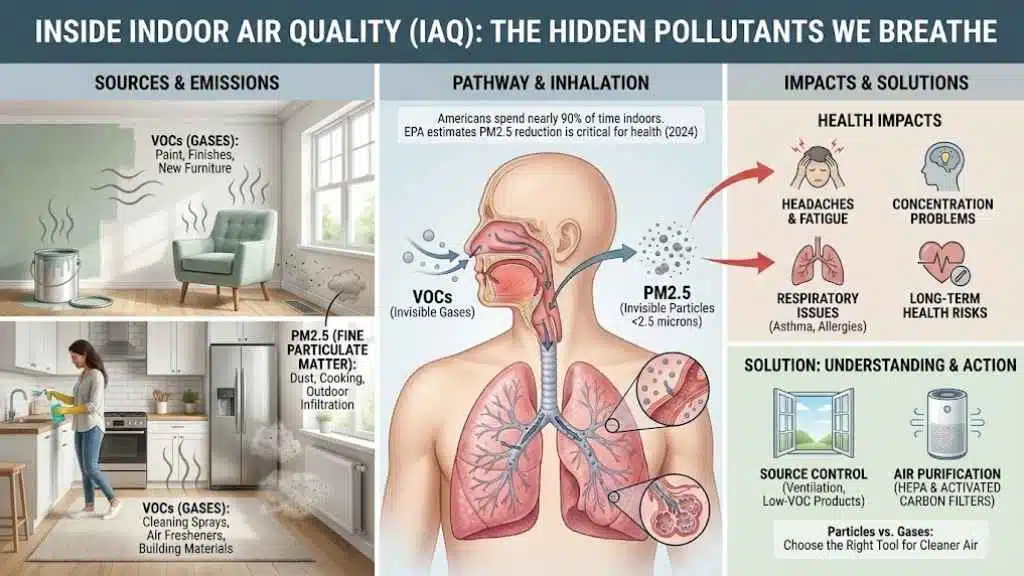
Indoor air quality (IAQ) refers to the condition of the air inside buildings, where Americans spend nearly 90% of their time. It is not just about temperature; it is about the invisible particles you breathe every minute.
The main villains here are particulate matter and gases. Fine particulate matter, known as PM2.5, consists of tiny particles 2.5 microns or smaller that can travel deep into your lungs. According to 2024 EPA estimates, reducing these particles is critical for preventing respiratory issues and long-term health costs.
Then you have Volatile Organic Compounds (VOCs). These are invisible gases emitted by everyday items:
- Paint and finishes on your walls or furniture.
- Cleaning sprays and air fresheners.
- Building materials like pressed wood or new carpets.
While dust triggers sneezes, these VOCs can cause headaches, fatigue, and concentration problems. Understanding this difference—particles vs. gases—is the first step in choosing the right tool to fix it.
The Science Behind Indoor Plants
We all want to believe our potted friends are scrubbing the air clean. While they do absorb some chemicals, the reality in a typical home is quite different from a laboratory.
How plants absorb VOCs
Plants are biologically capable of taking in gases. They absorb VOCs through tiny pores on their leaves called stomata. The microorganisms in the potting soil also play a role, helping to break down these contaminants into safer byproducts.
This process prompted the famous 1989 NASA Clean Air Study. In that controlled experiment, plants like the Spider Plant and Peace Lily successfully removed chemicals like benzene and formaldehyde from a sealed chamber.
Limitations of plants in air purification
Here is the catch that often gets missed: your home is not a sealed NASA test chamber. In 2019, researchers Michael Waring and Bryan Cummings from Drexel University reviewed decades of plant studies. Their findings were stark.
They discovered that natural air exchange—like air leaking through cracks or opening a window—removes VOCs far faster than plants can. To match the air-cleaning capacity of a standard building ventilation system, you would need between 10 and 1,000 plants per square meter of floor space.
“Plants are great, but they don’t actually clean indoor air quickly enough to have an effect on the air quality of your home or office environment.” — Michael Waring, Drexel University College of Engineering.
Basically, a few succulents on your desk cannot keep up with the constant off-gassing of modern furniture or the dust settling in your carpets.
The Technology of Air Purifiers
If plants are the passive approach, air purifiers are the active aggressors. They use fans to force air through dense filters, trapping pollutants physically or chemically.
HEPA filters and their efficiency
High-Efficiency Particulate Air (HEPA) filters are the gold standard. To carry the “True HEPA” label in the US, a filter must meet the Department of Energy standard of removing 99.97% of particles that are 0.3 microns in diameter.
Why 0.3 microns? Scientists call this the “Most Penetrating Particle Size” (MPPS) because it is the hardest to catch. HEPA filters are actually more efficient at capturing particles both larger (like pollen) and smaller (like viruses) than this size. This makes them incredibly effective against wildfire smoke, dust mites, and pet dander.
Activated carbon filters for VOC removal
While HEPA handles solids, activated carbon handles gases. These filters contain pounds of treated charcoal with a massive surface area. One gram of activated carbon can have a surface area greater than 32,000 square feet.
This huge surface area adsorbs odors, smoke, and VOCs that pass right through a HEPA filter. If you are painting a room or live near a busy highway, this is the feature you need. A pro tip from industry experts: look for filters that list the actual weight of the carbon; a flimsy sheet will saturate in weeks, while a canister with 5+ lbs of carbon can last for over a year.
Advanced technologies like PECO
Newer tech like Photo Electrochemical Oxidation (PECO), used by brands like Molekule, takes a different approach. Instead of just trapping pollutants, PECO uses a light-activated catalyst to destroy them at a molecular level.
This technology claims to break down VOCs, bacteria, and viruses into harmless carbon dioxide and water. While traditional HEPA is often sufficient for dust, technologies like PECO offer an alternative for those specifically worried about destroying biological contaminants rather than just capturing them.
Plants vs Air Purifiers: A Direct Comparison
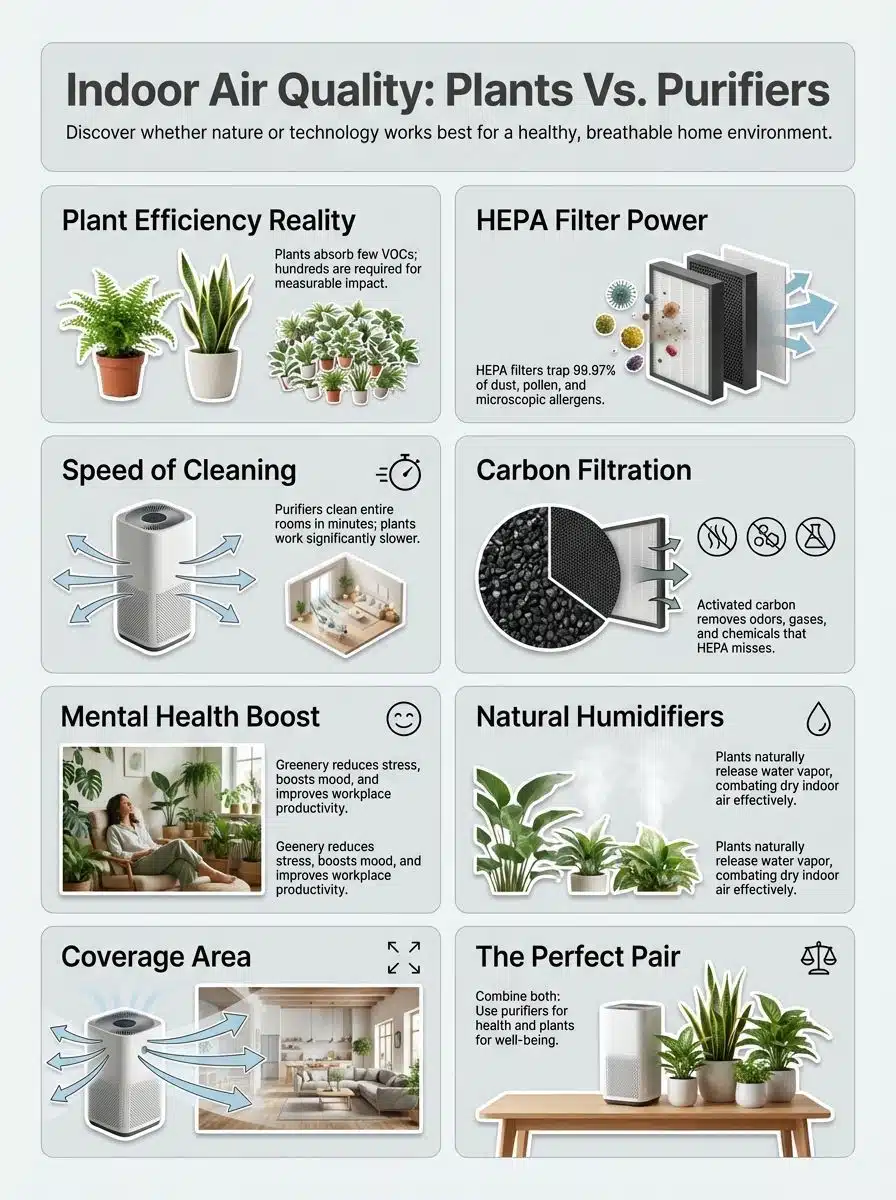
When you stack them side-by-side, the difference in performance becomes clear. It usually comes down to what you value more: aesthetics or raw performance.
To help you decide, here is how they compare on the key metrics that matter for a healthy home:
| Feature | Houseplants | Air Purifiers |
|---|---|---|
| Primary Function | Aesthetics & Mood | Particle & Gas Removal |
| Speed of Cleaning | Very Slow (Hours/Days) | Fast (Minutes) |
| Removal Efficiency | <1% in real homes | 99.97% (HEPA models) |
| Maintenance | Watering, Soil Care | Filter Changes (6-12 mos) |
| Cost | $20 – $100+ (One-time) | $100 – $800+ (Plus filters) |
Efficiency in removing pollutants
Plants have a very low Clean Air Delivery Rate (CADR), which is the industry metric for how fast a cleaner works. In fact, a single air purifier often provides more clean air than a forest of indoor plants.
The Association of Home Appliance Manufacturers (AHAM) recommends the “2/3 Rule” for purifiers: the unit’s Smoke CADR number should be at least two-thirds of the room’s square footage. Plants do not even register on this scale.
Speed of air purification
Speed is critical when you burn toast or a neighbor is smoking. A properly sized air purifier can cycle all the air in a room 4 to 5 times per hour. It clears smoke and odors in minutes.
Plants work passively and slowly. By the time a Peace Lily absorbs a noticeable amount of smoke, the smell will have already settled into your furniture and curtains.
Coverage area differences
A single medium-sized air purifier can cover 300 to 500 square feet effectively. It pushes clean air into far corners using its fan.
A plant only affects the air immediately around its leaves. To get “whole room” coverage, you would need to turn your living room into a jungle, which might introduce new problems like humidity and mold.
Benefits of Indoor Plants
Just because plants are not industrial air scrubbers does not mean they aren’t vital for a healthy home. Their benefits are just different.
Productivity and stress reduction
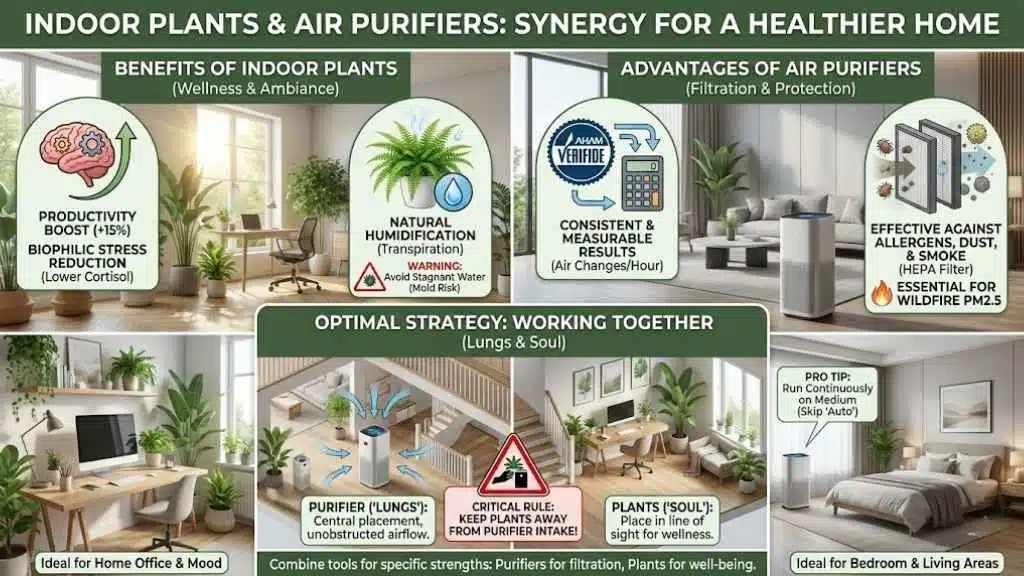
This is where plants truly shine. A study from the University of Exeter found that adding plants to a “lean” office increased productivity by 15%. The researchers noted that employees felt more physically, cognitively, and emotionally involved in their work.
Biophilic design—incorporating nature into our buildings—is proven to lower cortisol levels and reduce stress. Simply looking at greenery can help your brain reset after a long period of focus.
Natural humidification
Plants release moisture vapor through transpiration. In dry winter months or arid climates, a group of plants can help raise the humidity slightly, making the air feel less harsh on your throat and skin. Boston Ferns are particularly good at this.
A Warning on Humidity: Be careful not to overwater. Stagnant water in plant saucers is a prime breeding ground for mold, which releases spores that worsen air quality. The goal is moist soil, not wet feet.
Advantages of Air Purifiers
For consistent, measurable protection, machinery wins. If you suffer from allergies or live in a polluted city, a purifier is a medical necessity, not a decor choice.
Consistent and measurable results
When you buy a purifier with an “AHAM Verifide” seal, you know exactly what you are getting. You can calculate the air changes per hour for your specific room size. There is no guessing game about whether it is working.
Effective against allergens, dust, and smoke
If you have pets, an air purifier is the only way to significantly reduce floating dander. During wildfire season, which is becoming longer in many parts of the US, a HEPA filter is essential for keeping hazardous PM2.5 smoke particles out of your lungs.
Insider Tip: Don’t rely on the “Auto” mode found on many cheaper purifiers. The sensors are often slow to react. For the best health outcomes, run your purifier on a medium speed continuously, especially while you sleep.
Can They Work Together?
Absolutely. The best indoor environment strategy uses both tools for their specific strengths.
Combining plants and purifiers for optimal results
Think of the air purifier as the “lungs” of the room and the plants as the “soul.”
- Zone Your Placement: Put the air purifier in a central location where airflow is unobstructed. Keep it at least 12 inches away from walls or furniture to let it breathe.
- Add Plants for Wellness: Place plants on your desk or near your favorite reading chair. This puts them in your line of sight for the mood boost, even if they aren’t filtering the whole room.
- The “High Traffic” Strategy: Use a purifier in the bedroom for sleep health and in the living room for general dust control. Use plants in the home office to reduce stress during the workday.
One critical rule: Never place plants directly on top of or immediately next to the air purifier’s intake. The moisture from the plant can damage the filter, and spilled water is a major electrical hazard.
Final Thoughts
Choosing between plants and air purifiers is not really a fair fight—they are in different weight classes. If your goal is to drastically reduce dust, allergens, and dangerous pollutants like VOCs, you need the horsepower of a HEPA air purifier. Plants simply cannot compete with a motor and a filter.
However, a sterile room with clean air is not necessarily a pleasant one. Plants add vital moisture, reduce stress, and make a house feel like a home. The smartest approach is to stop viewing them as competitors. Buy a quality purifier to protect your lungs, and buy beautiful plants to protect your peace of mind.
Start with one good purifier for your bedroom, add a sturdy Snake Plant to the corner, and you will have built a healthier space than either could create alone.