
Studying for seven hours once is mostly a scheduling problem. Doing it day after day for three months is different. The routine has to survive low mock-test scores, family interruptions, slow chapters, poor sleep, headaches, and mornings when motivation simply does not show up.
That is why a perfect-looking timetable is not enough. A study plan is only useful if it still works on an ordinary, messy day. Anyone learning how to study 7 hours a day should also be honest about what those seven hours mean. They are 420 minutes of focused academic work: solving problems, recalling information, writing answers, reviewing mistakes, reading with a clear purpose, or completing exam practice.
Lunch does not count. Neither does scrolling through a phone, arranging stationery, rewriting headings, searching endlessly for better resources, or sitting with a book open while understanding very little. Once breaks and meals are included, seven productive hours will usually occupy nine hours or more. That is a serious daily commitment, not a casual productivity challenge.
Decide Whether Seven Hours Makes Sense
Seven hours is not a requirement for being a serious student. It may be appropriate during a dedicated exam-preparation period, but it will not suit every schedule. A student attending university classes all day may only have three or four focused hours available afterward. Someone with a job, a long commute, caring responsibilities, or health limitations may need to track weekly progress instead of forcing the same daily total.
A seven-hour routine is most realistic when:
- A major exam or certification is approaching.
- The syllabus is large enough to justify the workload.
- The student controls most of the daily timetable.
- Sleep and basic health are reasonably stable.
- There is enough time to increase the workload gradually.
More hours will not repair a weak plan. A student who spends seven hours copying notes may achieve less than someone who spends five hours answering questions, correcting errors, and revisiting weak topics. The number matters less than the quality of the work inside it.
A Realistic Seven-Hour Study Schedule
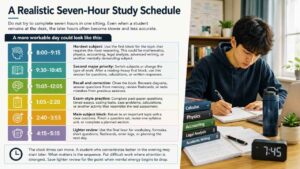
Do not try to complete seven hours in one sitting. Even when a student remains at the desk, the later hours often become slower and less accurate.
A more workable day could look like this:
- 8:00–9:15: Hardest subject: Use the first block for the topic that requires the most reasoning. This could be mathematics, physics, accounting, legal analysis, advanced writing, or another mentally demanding subject.
- 9:30–10:45: Second major priority: Switch subjects or change the type of work. After a reading-heavy first block, use this session for questions, calculations, or written responses.
- 11:05–12:05: Recall and correction: Close the book. Recreate diagrams, answer questions from memory, review flashcards, or redo mistakes from previous sessions.
- 1:05–2:20: Exam-style practice: Complete past-paper questions, timed essays, coding tasks, case problems, calculations, or another activity that resembles the real assessment.
- 2:40–3:55: Main subject block: Return to an important topic with a clear outcome. Finish a question set, revise one syllabus unit, or complete a planned section.
- 4:15–5:15: Lighter review: Use the final hour for vocabulary, formulas, short questions, flashcards, error logs, or planning the next day.
The clock times can move. A student who concentrates better in the evening may start later. What matters is the sequence. Put difficult work where attention is strongest. Save lighter review for the point when mental energy begins to drop.
Give Each Session a Clear Finish Line
“Study chemistry for 75 minutes” tells you when to sit down, but not what progress should look like.
A better plan would be:
- Review alkene reaction mechanisms.
- Complete 15 related questions.
- Mark every answer.
- Record mistakes for another attempt.
For an essay-based subject the finish line might be different:
- Review one topic.
- Write a timed outline.
- Complete one full answer.
- Compare it with the marking criteria.
Specific targets prevent two common problems. The first is spending too long on work that feels comfortable. The second is reaching the end of the day without knowing what was actually completed. Targets should still be realistic. “Finish organic chemistry” is not a useful goal for one session. “Learn two reaction types and answer 15 questions” is measurable and achievable.
Build Up Over Two Weeks
Jumping from two or three hours to seven may work briefly. Then the tiredness catches up. A student may complete several ambitious days, sleep badly, fall behind on corrections, and spend the weekend trying to recover. By the second week, the timetable already feels like a failure.
A better approach is to increase the workload in stages. Begin with four or five focused hours for several days. Move to five and a half or six when the routine feels manageable. Add the final hour only when concentration, sleep, and accuracy remain steady.
Some students will need more than two weeks. Others may already be used to long academic days. The important question is not whether you can stay in a chair for seven hours. Ask whether you can remember what you studied, begin again the next morning, and continue without becoming increasingly irritable or exhausted.
Do Not Fill the Day With Passive Study
Long study schedules often create the illusion of progress because the student remains busy. Reading, highlighting, watching lectures, and reviewing worked examples all have a place, especially when a topic is new. They become a problem when they fill most of the day.
Familiar material feels easier to process. That can be mistaken for mastery. Active study forces the brain to produce an answer before seeing it. This includes:
- Solving a problem without copying the example.
- Explaining a process aloud in the correct order.
- Writing what you remember on a blank page.
- Drawing a diagram from memory.
- Completing a timed answer.
- Answering questions before checking the notes.
- Returning to missed questions several days later.
At the end of a study block, ask one simple question: What did I produce? The answer should usually be something visible, such as a solution, written response, diagram, score, explanation, or corrected mistake. “I read for an hour” is harder to evaluate.
Divide the Day Into Learning, Applying, and Retaining
Not every block should demand the same kind of concentration.
- Learning includes reading a new chapter, watching a necessary lecture, understanding a worked example, or studying an unfamiliar concept.
- Applying means using that knowledge. This may involve problem sets, essays, case studies, coding exercises, oral responses, or past-paper questions.
- Retaining includes flashcards, cumulative quizzes, formula review, blank-page recall, and revisiting old mistakes.
During the first few weeks, new learning may take a larger share of the timetable. Later, practice and correction should become more important. Many students remain in the learning stage because it feels controlled. Applying the material is less comfortable because gaps become obvious. That discomfort is useful. It shows what still needs attention.
Limit Daily Subject Switching
Studying six or seven subjects every day may look organized on a timetable, but constant switching carries a cost. Each new subject requires setup time and a change in thinking. For most students, two or three main subjects in one day are enough. A short cumulative review can cover older material.
A student preparing for mathematics, physics, chemistry, and English might study mathematics, physics, and essay writing on Monday. Tuesday could focus on chemistry, mathematics, and vocabulary review. This gives each subject enough space for meaningful work without allowing it to disappear for a week.
Make Breaks Restorative
A useful break should make it easier to return to work. Walk around. Stretch. Eat a proper meal. Refill water. Wash your face. Sit in another room. Look away from the screen. None of these activities is exciting, which is partly why they work.
Short-form videos and social feeds are riskier. A planned 15-minute break can quickly become 40 minutes, and a difficult chapter may feel even less appealing afterward. Most students can begin with 10 to 20 minutes between longer sessions and a proper lunch break in the middle of the day.
There is no perfect study-block length for everyone. A 45-minute session may suit dense reading. A 90-minute block may be better for a mock test. Choose the length according to the task, not because a timer method is popular online.
Protect Sleep Before Adding Hours

Cutting sleep is one of the quickest ways to damage a demanding study plan. Sleep supports attention, recall, decision-making, and problem-solving. These are not separate from studying. They determine whether the studying works.
Set a realistic stopping time. The final block should usually be lighter than the first. Reviewing formulas or organizing tomorrow’s question set makes more sense late in the day than beginning the hardest chapter at midnight. An all-nighter creates more time with the material, but it often weakens the following day. It is a poor solution to unfinished work.
Repeatedly waking tired, struggling to concentrate, or relying heavily on caffeine may indicate that the schedule is taking more than it gives back. Persistent sleep problems or exhaustion should be discussed with a qualified healthcare professional.
Keep Food, Water, and Caffeine Ordinary
A long study routine does not require expensive supplements or a collection of “brain foods.” Regular meals are more useful than skipping food during the day and eating heavily at night. Choose familiar foods that provide enough energy and do not leave you uncomfortable or sleepy.
Keep water nearby, particularly in hot weather. There is no single perfect intake for everyone because needs vary with temperature, activity, diet, and health. Coffee or tea may improve alertness temporarily, but neither can replace sleep. More caffeine is not always better. Too much may lead to anxiety, headaches, stomach discomfort, a racing heartbeat, or difficulty sleeping.
Remember that caffeine may also appear in energy drinks, soft drinks, chocolate, supplements, and some medicines. Concentrated caffeine powders and liquids should not be treated as study aids.
Move Without Turning Fitness Into Another Exam
Seven hours of studying involves a great deal of sitting. A walk after lunch, a short mobility routine, a bicycle ride, or a normal gym session can help break up the day.
Movement does not need to become another demanding target. Exam preparation is usually a poor time to begin an exhausting training program. If a workout leaves you too sore or tired to concentrate the next morning, reduce the intensity.
The goal is to support the study routine, not compete with it.
Review the Week, Not Every Bad Afternoon
One poor session does not require a new timetable. Maybe a mock test went badly. Perhaps a family obligation removed two hours from the afternoon. A difficult chapter may have taken twice as long as expected. These problems are frustrating, but they are normal.
Review the plan once a week instead of reacting to every setback. Check the focused hours completed, topics finished, recurring mistakes, practice scores, sleep consistency, and sessions repeatedly lost to distraction. Then make one or two adjustments.
Move a difficult subject earlier. Shorten a block that produces careless work. Remove a duplicate textbook. Add time for marking answers. Do not change the entire system at once. Replacing the timer, app, notebook, schedule, and resource list creates activity, but it does not reveal which change actually helped.
Change the Focus Across the Three Months
The same timetable should not continue unchanged for 12 weeks.
Weeks 1–3: Build the Base
Map the syllabus. Identify prerequisite topics. Choose the main books, courses, and question banks, then remove unnecessary duplicates.
Begin recall and question practice early. Do not wait until the final month to discover that reading has not produced usable knowledge.
Weeks 4–8: Increase Application
Spend more time on problem sets, essays, case questions, coding tasks, and cumulative quizzes. Continue reviewing older topics each week. Without planned revision, the material from the first month may fade while new chapters take over.
Introduce timed work gradually. Not everything needs to be timed. Slow correction is often where the most valuable learning happens.
Weeks 9–11: Rehearse the Assessment
Complete full or partial mock exams under realistic conditions. Afterward, examine why marks were lost. Was the problem missing knowledge, poor timing, weak structure, misreading the question, careless calculation, or incomplete explanation?
A mock test without review is mostly a score. It becomes useful when the mistakes change the next week’s plan.
Week 12: Narrow the Work
Reduce new material unless it is essential. Concentrate on recurring errors, core formulas, important facts, essay structures, and exam procedures. Keep meals, sleep, and study start times stable.
The final week should not become a competition to collect the most hours. Clear thinking matters more than squeezing in one last exhausted night.
Know When to Reduce the Load
Tiredness after a long day is expected. Ongoing deterioration is not. Pay attention if you experience persistent sleep problems, constant dread before studying, frequent headaches, unusual irritability, loss of interest in ordinary activities, worsening performance, or difficulty concentrating even after rest.
The first step is not always to abandon the plan. Remove low-value work first. Stop rewriting neat notes. Drop duplicate resources. Correct old mock tests before taking new ones. Do not carry missed hours into the middle of the night. At least one day each week should be lighter. That may mean two or three hours of review and planning. For students balancing employment or full-time classes, it may need to be a complete rest day.
When stress begins to interfere with everyday functioning, reduce the workload and seek appropriate support. Severe or persistent symptoms should be discussed with a doctor, counselor, psychologist, or another qualified professional.
Final Thoughts
Learning how to study 7 hours a day begins with the first useful hour, not the full timetable. Choose one important task. Remove the phone. Decide what must be finished. Complete the session, review the result, and return the next day.
Seven hours only helps when the work remains active, accurate, and repeatable. If five focused hours produce stronger recall, better practice scores, and more consistent sleep, then five hours is the better plan.
Over three months, the student who keeps returning usually outperforms the student who begins with an extreme schedule and collapses after two weeks. Protect sleep, correct mistakes, use fewer resources, and adjust the routine gradually. A good study plan should make the exam feel more manageable as the weeks pass. If it only makes you more exhausted, change it.
Frequently Asked Questions (FAQs) About How to Study 7 Hours a Day
Is Studying Seven Hours a Day Too Much?
It can be manageable for a limited period when the day includes breaks, enough sleep, regular meals, and a lighter day each week. Reduce the hours if concentration, mood, sleep, or results continue to worsen.
Should Breaks Count Toward the Seven Hours?
No. Count only focused academic work. Meals, exercise, phone use, and rest sit outside the total, so the complete routine may occupy nine hours or more.
Is It Better to Study Seven Hours Every Day?
Not always. One lighter day each week can support recovery and provide time for planning or correcting mistakes. Weekly consistency matters more than forcing the same total every day.
What If I Cannot Concentrate for 75 Minutes?
Use shorter blocks of 40 to 50 minutes. Keep the task specific and increase the length only when you can maintain accuracy without repeatedly checking your phone or rereading the same passage.
Can Five Focused Hours Be Better Than Seven?
Yes. Five hours of recall, problem-solving, and correction can be more useful than seven hours of passive reading. Measure progress through retention, completed work, and practice performance, not time alone.