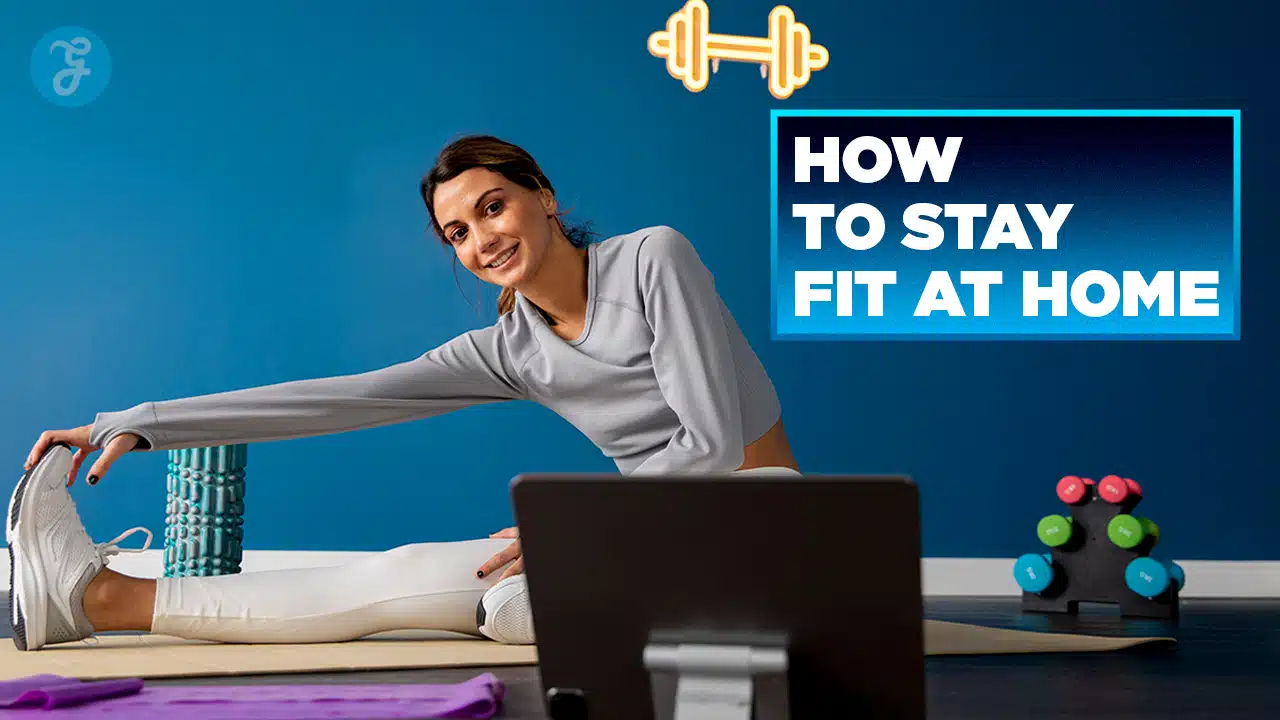
My friend, look around you. The world has changed, hasn’t it? We used to think fitness was a destination, a place we drove to, a card we swiped, a locker we rented. But here we are in 2026, and the old “gym rat” model feels… obsolete. It feels heavy. Between the skyrocketing membership fees, the commute that eats into your hybrid work schedule, and the simple desire for safety and privacy, the gym has lost its luster. Ultimately, learning how to stay fit at home has evolved from a backup plan into the ultimate strategy for modern longevity.
But here is the hard truth I need you to hear: Your health cannot wait for the world to get simpler. It won’t.
We are shifting from the era of “gym culture” to the era of the “home sanctuary.” This isn’t just about doing push-ups next to the sofa because you have to. It’s about reclaiming your time. It’s about realizing that the friction of the “old way,” the packing, the driving, and the waiting, was the very thing killing your consistency.
You might be thinking, “But I don’t have the space,” or “I get distracted by the laundry.” I know. Those are valid feelings. But staying fit at home isn’t a compromise anymore; it is your biggest competitive advantage. It is the only way to bulletproof your body and your wallet simultaneously.
In this conversation, we are going to fix this together. We will rebuild your mindset, redesign your environment, and give you the exact tools (ranking the best 2026 tech) to turn your home into a powerhouse of vitality.
The Psychology of the Home Athlete: Designing the “Zero Friction” Life
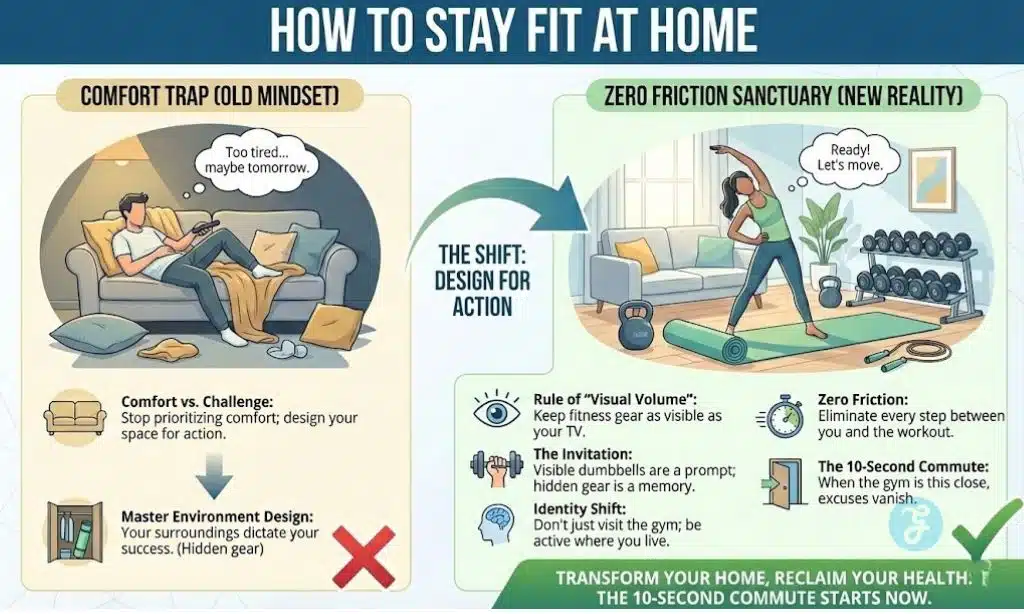
Let’s talk psychology. Why do we fail at home? It’s not because you are lazy. It’s because your home is designed for comfort, not challenge.
You need to master environment design. If your yoga mat is rolled up in a closet, you have already lost. You have created a barrier. The rule for 2026 is “Visual Volume.” Your gear must be as visible as your television. If the dumbbells are sitting by the coffee table, they are an invitation. If they are hidden, they are a memory.
We need to shift your identity. You are no longer “someone who goes to the gym.” You are “someone who is active where they live.” This is the “Zero Friction” rule: eliminating the mental hurdles that stop a workout before it starts. When the commute is ten seconds, you have no excuse not to show up.
Real-World Resilience: A View from the C-Suite
According to Yojana Niwathe, AVP at a leading Fortune 500 financial institution in Mumbai and also a very health-conscious individual:
“In the fast-paced world of financial operations, time is my most volatile currency. I don’t go to a gym; frankly, my schedule doesn’t permit the luxury of a commute. Instead, I’ve integrated movement into my domestic life. By removing the friction of a traditional gym membership, I’ve found that I can maintain peak physical performance exactly where I am. You don’t need a dedicated facility to build discipline, you just need the space you already stand in. Most mornings, I simply stand near my bed and engage in free-hand exercises. It’s effective, it’s immediate, and it removes every excuse.”
The Medical Directive: A Holistic Ecosystem
Dr. Shinjini Ghosh, MBBS, MD, Assistant Professor, West Bengal Medical Education Services, says:

“To stay healthy and fit at home we have to first understand that a gym is not the criteria to be fit. We have to do 30 minutes of brisk walking every day along with free hand exercises and yoga or dance if someone prefers. Gardening is also a very good exercise and a source of relaxation. At home, stay hydrated, drink plenty of water, eat fruits and vegetables, and avoid outside spicy food. Adequate sleep of 7 to 8 hours is very important, as is reducing screen time. One has to understand that staying fit is not only physical fitness; it is a holistic approach which includes both physical and mental fitness.”
The 2026 Fitness Fact Sheet
Before we go deeper, look at where we stand today. This is why you are making the right choice.
- Global Gym Inflation: Average commercial gym memberships have risen 35% since 2023 due to energy costs and real estate surges.
- The Hybrid Factor: 62% of the global workforce now operates on a hybrid model, making fixed-location gyms logistically difficult.
- Tech Integration: Home fitness equipment sales have stabilized, but usage of AI-driven fitness apps has exploded by 200% year-over-year.
- The Longevity Boom: The focus has shifted from “six-pack abs” to “healthspan,” with functional mobility training rising 40% in popularity over traditional bodybuilding.
The Data & The Argument (The Spine)
Why The Old Ways Are Dying
I promised you I would show you the reality of the situation. Let’s look at who is winning in this new economy and who is getting left behind.
Winners vs. Losers (The Status Quo vs. The Home Sanctuary)
| Feature | The “Gym Renter” (The Loser) | The “Home Athlete” (The Winner) |
| Time Investment | Loses 3-5 hours/week on commuting, packing, and waiting for machines. | reclaims ~150 hours/year. Workouts fit into “micro-breaks” between meetings. |
| Financial Cost | Pays ~$1,200–$2,000 annually in fees + travel costs. Renting access. | One-time investment of $300–$500. Owns the asset. ROI is infinite after Year 1. |
| Consistency | High Friction. Misses workouts due to weather, traffic, or “gym anxiety.” | Zero Friction. Consistency increases by 40% because the “gym” never closes. |
| Hygiene & Safety | Exposed to public shared surfaces and poor ventilation. | Controlled environment. Personal hygiene standards. Private. |
| Adaptability | Dependent on facility hours and equipment availability. | Agile. Can train at 5 AM or 11 PM. Immune to lockdowns or closures. |
The Cost of Inaction (Now vs. Future)
What happens if you ignore this shift and keep waiting for the “perfect time” to join a gym?
| Timeline | If You Build Your Home Routine NOW | If You Rely on External Motivation/Gyms |
| 3 Months | Habit solidified. You’ve saved ~40 hours of commute time. Energy levels stabilize. | Inconsistent attendance. Wasted ~$300 on unused fees. Frustration builds. |
| 1 Year | Metabolic Adaptation. Your BMR increases because movement is constant, not episodic. Wallet heavier. | The “Yo-Yo” Cycle. Periods of intensity followed by burnout. No equity built in your health or home setup. |
| 5 Years (2031) | Health Span Extension. Joint mobility is preserved through daily micro-dosing of movement. | Structural Decline. Reliance on machines limits functional stability. Higher risk of sedentary-related issues. |
The Movement Pillars: The Science of “Living Room” Physics
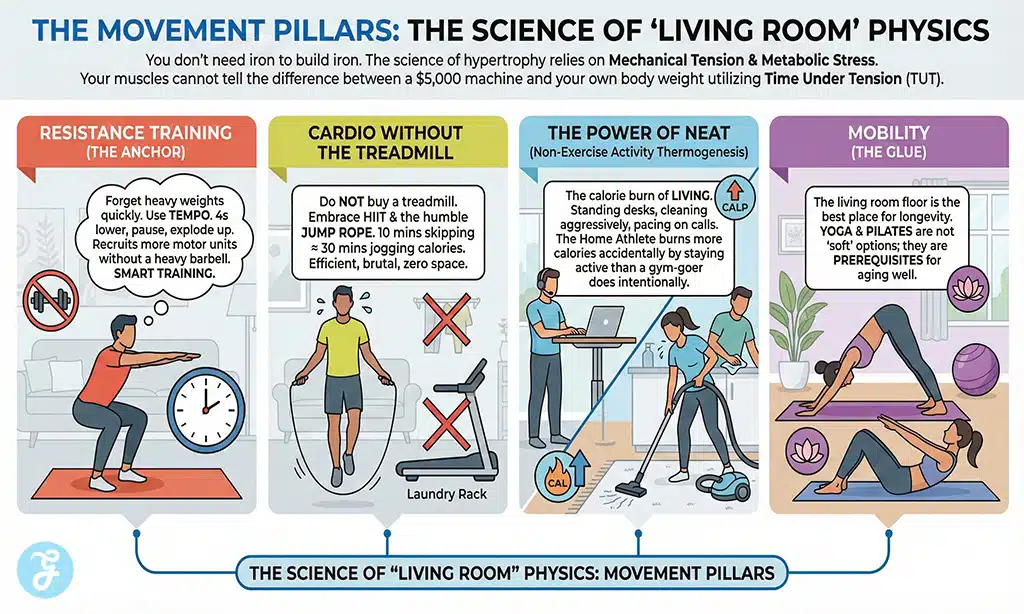
You don’t need iron to build iron. The science of hypertrophy (muscle growth) relies on mechanical tension and metabolic stress. Your muscles cannot tell the difference between a $5,000 machine and your own body weight utilizing Time Under Tension (TUT).
- Resistance Training (The Anchor): Forget throwing heavy weights quickly. At home, we use Tempo. Take 4 seconds to lower into a squat. Pause. Explode up. You are recruiting more motor units without needing a heavy barbell. This is smart training.
- Cardio Without the Treadmill: Do not buy a treadmill. They are laundry racks. Instead, embrace HIIT (High-Intensity Interval Training) and the humble jump rope. Ten minutes of skipping burns roughly the same calories as 30 minutes of jogging. It is efficient, brutal, and takes up zero space.
- The Power of NEAT: Non-Exercise Activity Thermogenesis. This is the calorie burn of living. Standing desks, cleaning aggressively, pacing while on calls. The Home Athlete burns more calories accidentally than the gym-goer does intentionally, simply by staying active all day rather than sitting for 8 hours and training for 1.
- Mobility (The Glue): The living room floor is the best place for longevity. Yoga and Pilates are not “soft” options; they are the prerequisites for aging well.
The Ultimate Rankings (2026 Edition): The Tools You Actually Need
Here is the meat. Based on the current landscape, here is what you need to focus on.
Category A: The Best Home Fitness Apps
Ranked by UI, Community, and AI Integration.
- Nike Training Club (NTC) | Rank: 1
- The Verdict: Still the king. The 2026 update added incredible AI coaching that adjusts your plan based on your fatigue levels. It’s free, premium, and visually stunning.
- Best For: Everyone.
- Centr (By Chris Hemsworth) | Rank: 2
- The Verdict: It’s not just a workout; it’s a lifestyle OS. Meal plans, meditation, and functional training.
- Best For: Those seeking a total holistic overhaul.
- Hevy | Rank: 3
- The Verdict: For the data nerds. Simple, clean tracking of progressive overload. No fluff.
- Best For: Strength athletes tracking numbers.
Category B: The “Essentials” Equipment Tier List
- S-Tier (The “Must-Haves”):
- Adjustable Dumbbells: The single best investment. Replaces a whole rack.
- Resistance Bands (Loop & Tube): Versatile, cheap, and effective for TUT.
- A-Tier (The “Level-Ups”):
- Pull-up Bar: The only way to truly build a strong back at home.
- Kettlebell (16 kg/24 kg): Unlocks dynamic, explosive power movements.
- B-Tier (The “Nice-to-Haves”):
- Weighted Vest: Instantly makes bodyweight moves harder.
- Yoga Block/Foam Roller: Essential for the recovery phase.
Category C: Top YouTube Channels
- Juice & Toya: Best for high-production, no-talking efficiency.
- Yoga with Adriene: The global comforting aunt of fitness.
- FitnessBlender: The reliable, science-based OGs.
Nutrition & The “Ten-Step” Trap: Managing the Proximity Bias
The fridge is too close. That is the danger. You must respect the “Ten-Step” Trap. If you can get to ice cream in ten steps, you will eat it.
- The Protein Priority: Home athletes often under-eat protein. You need it for recovery. Keep hard-boiled eggs or Greek yogurt ready.
- Hydration: Use the “Rubber Band Trick.” Put 4 bands on your water bottle. Remove one every time you finish it. Visual cues save you from dehydration.
Sample 7-Day “Stay Fit” Blueprint: The Schedule
- Mon: Full Body Strength (push/pull focus).
- Tue: HIIT or Active Recovery (Yoga).
- Wed: Lower Body Strength (Lunges/Squats).
- Thu: Zone 2 Cardio (Brisk Walk/Hike).
- Fri: Full Body Challenge (Metabolic Conditioning).
- Sat: “Outdoor Integration” (play a sport, swim, or run).
- Sun: Mobility & Meal Prep.
The Economics of Localized Health
Your home is your most significant asset; it’s time it paid dividends in health. Traditional gym memberships are often “laziness taxes,” fees paid for access you rarely use. By investing in a home setup, you eliminate the hidden costs of fitness: gas, commute time, and the “social friction” of a crowded weight room.
The ROI on a set of adjustable dumbbells or a high-quality yoga mat is realized within months, not years. More importantly, you gain “temporal sovereignty.” This means you no longer work out on the gym’s schedule; you work out on yours. When the barrier to entry is just ten feet from your bed, the cost of starting drops to near zero. You aren’t just saving dollars; you are reclaiming hours.
Bio-Hacking Your Living Environment
Physical fitness is a byproduct of your environment. If your home is designed only for consumption and rest, movement will always feel like an intruder. To stay fit at home, you must treat your floor plan like a laboratory. Simple changes, like a pull-up bar in a doorway or a kettlebell next to the couch, act as “visual nudges.”
These cues trigger “micro-workouts”… short, three-minute bursts of activity that keep your metabolism humming throughout the day. This approach prevents the “Active Couch Potato” syndrome. It ensures your lymphatic system stays active and your posture remains upright. You are essentially turning your home into a 24/7 wellness center. This isn’t about one hour of sweat; it’s about a lifestyle of constant, effortless mobility.
The Mental Edge of Domestic Discipline
The hardest part of home fitness isn’t the physical exertion; it’s the lack of an audience. In a gym, you might work harder because people are watching. At home, it’s just you. This is where true mental toughness is forged. Training in isolation requires a higher level of “internal locus of control. “You learn to rely on discipline rather than the external hype of a loud spin class or a personal trainer’s whistle.
When you master the art of the home workout, you develop a “no-excuse” mindset that bleeds into your professional life. You become the architect of your own energy. There is a profound psychological victory in finishing a grueling HIIT session in the same room where you sleep or work. It proves that you don’t need a special building to be a high performer. You only need a floor and the will to use it.
The Bottom Line
We are playing the long game here. The gym industry wants you to rent your fitness. I want you to own it.
Prediction: By 2028, “Home Health Stations” will be a standard feature in real estate listings, just like a dishwasher. You are simply getting ahead of the curve.
Final Question: If you cannot find 20 minutes to move your body in the comfort of your own home, are you really too busy, or are you just hiding from yourself?