SaaS free tiers look simple: create an account, skip the credit card, and use a limited version of the product. Yet “free” is not a permanent product category. It is a pricing and distribution decision that lasts only while it continues to benefit the company offering it.
I find it more useful to see a free plan as an exchange. The user receives software without paying money. In return, the provider gains potential customers, wider adoption, referrals, product visibility, network value, or an entry point into larger organizations.
That exchange can work well for both sides. It can also change when the costs, customer behavior, or company priorities change.
Free Has a Job to Do
A price of zero is still a deliberate price. The company has decided who can use the product without paying, which parts they can access, and where they should encounter a reason to upgrade.
The calculation is broader than free users versus subscription revenue. A company also considers whether those users invite colleagues, recommend the product, strengthen its ecosystem, or introduce it to a business that later buys hundreds of seats.
The costs are equally varied. Free accounts consume storage, computing power, bandwidth, support time, security resources, and third-party services. They may also attract fraud or satisfy customers who might otherwise have paid.
A provider does not need every free user to convert. It needs the free population as a whole to create enough value to justify what it costs.
Dropbox has publicly acknowledged that most registered users may never become subscribers. At the same time, individual and team adoption can influence larger organizations to purchase the product. That second route is why a free user can still contribute to a successful business model without personally paying.
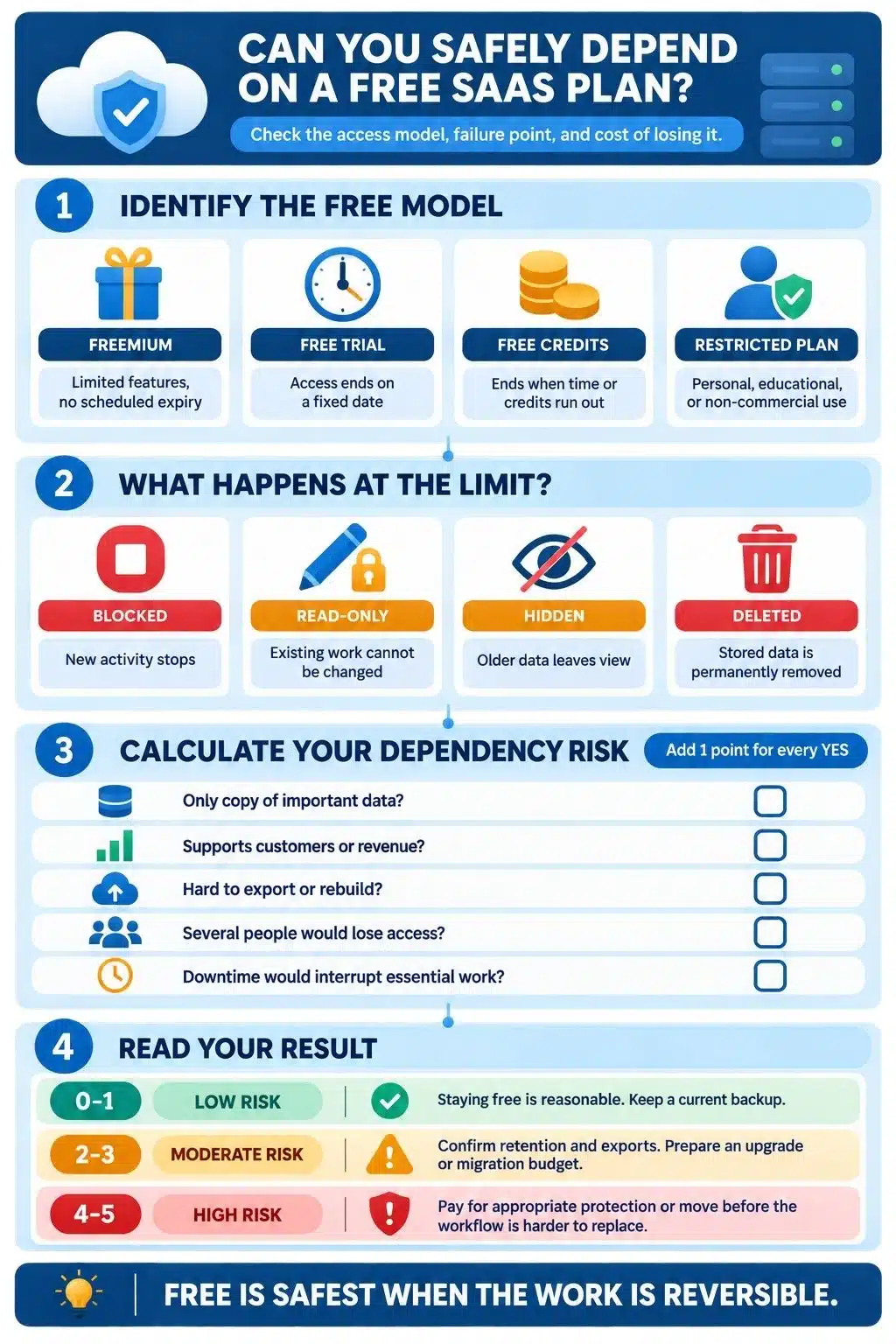
Not Every Free Offer Is the Same
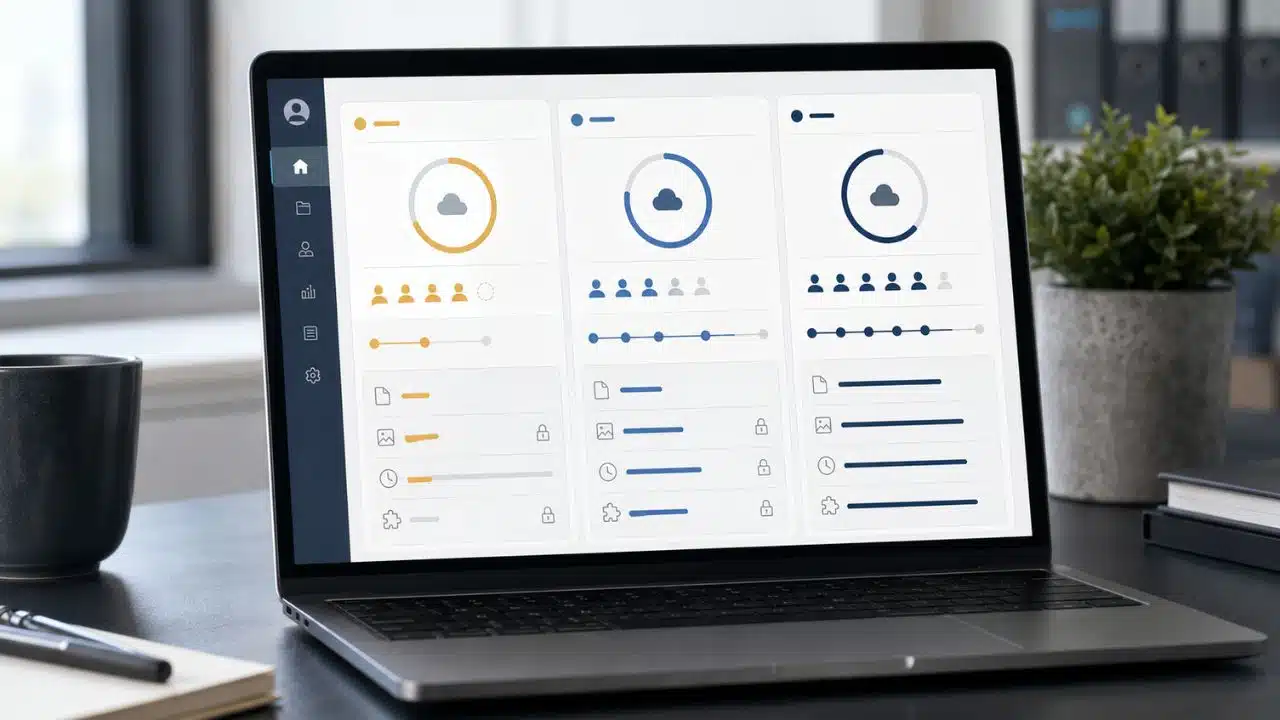
The term “free tier” is commonly used for several different arrangements.
| Type of free access | How it works |
| Freemium plan | A limited product can normally be used without a scheduled expiry |
| Free trial | Full or expanded access ends after a fixed period |
| Free credits | Usage remains free until the credits expire or run out |
| Always-free allowance | A small quantity remains free, often with a monthly reset |
| Hobby or developer plan | Access is limited to personal, testing, development, or non-commercial use |
| Eligibility-based plan | Free access is available only to groups such as students, nonprofits, or open-source maintainers |
Some products combine these models. A cloud platform might provide expiring credits to new customers, short trials for selected services, and a separate allowance that remains free within monthly limits.
This is why I do not read “free forever” as a guarantee that a plan will never change. It generally means there is no scheduled billing date under the current package. Features, limits, retention rules, and eligibility can still be revised.
How Companies Benefit When Users Pay Nothing
The most familiar path is conversion. Someone starts on the free plan, learns the product, reaches a meaningful limit, and decides the paid version is worth the cost. But conversion is only part of the model.
Free access reduces the friction of trying a product. People can evaluate it without speaking to sales, requesting a demonstration, or asking for budget approval. For software with a short learning curve, the product itself can handle much of the work that would otherwise fall to advertising and sales teams.
Collaboration tools also benefit from what is often called land and expand. One person begins using a product, invites a few colleagues, and gradually makes it part of the team’s workflow. The organization later needs more seats, centralized billing, stronger security, administrative controls, or compliance features.
Free users can also support templates, integrations, plugins, community resources, and developer familiarity. For certain network and security products, serving more users creates additional operational value. Cloudflare, for example, says protecting more sites helps it gather better information about attacks across its network, while also stating that it does not sell user data for targeted advertising.
That distinction matters. “If you are not paying, you are the product” is too simplistic for SaaS. Advertising, data monetization, enterprise expansion, paid conversion, transaction fees, and ecosystem growth are separate models. A free plan may rely on one or several of them.
Why Free Plans Have Such Specific Limits
A well-designed free tier lets users experience the product’s core value, then restricts the point where that value starts to scale.
For a storage service, the limit might be space. For project management software, it could be collaborators or active projects. Email platforms may count contacts and monthly sends. Developer tools often meter builds, API requests, computing time, or data transfer.
Other common boundaries include integrations, automations, version history, exports, administrative controls, security features, and direct support.
The difficult part is placing the boundary correctly. If the free plan is too restrictive, people leave before understanding why the product is useful. If it is too generous, qualified customers remain free because the paid version solves no additional problem they care about.
That boundary rarely remains perfect. Products gain new features, customers find unexpected use cases, competitors adjust their packages, and operating costs change. Free tiers are therefore revised much like paid plans are.
Why a Free Tier Shrinks or Disappears
Serving costs are one obvious reason. Storage, video, email delivery, data transfer, computing, and customer support all cost money. AI features make the expense particularly visible because every generation, transcription, image, or model request can create a measurable cost.
AI inference may become cheaper over time, but lower unit costs do not automatically make unlimited free access sustainable. Usage can grow faster, and customers may expect more capable models, larger outputs, and higher allowances.
Customer behavior can be just as important. A large number of registrations may look impressive while producing little activation, few referrals, and weak conversion. If the free plan attracts people outside the company’s target market, its apparent growth can hide poor commercial results.
The opposite problem is also possible: the plan works too well. Active target customers may use it for months or years without encountering a meaningful reason to pay. High engagement looks healthy, but it does not support the business if the free product has replaced the paid one.
Fraud and abuse can also change the calculation. Free hosting, storage, automation, email, and computing services attract spam, bot accounts, cryptomining, and other misuse. Preventing that abuse requires security systems, engineering work, account reviews, and support.
Finally, the company itself may change. A provider moving toward enterprise customers will usually put more emphasis on governance, security, compliance, reliability, and sales-assisted contracts. Maintaining a large population of unsupported individual accounts may become less important to its strategy.
A free tier can even shrink because it succeeded. Once a product has strong distribution and a mature customer base, subsidizing more users may offer less value than it did when the company was trying to establish itself.
What Disappearance Looks Like in Practice
A complete shutdown is easy to recognize. Heroku provided a clear example in 2022 when it ended its free Dynos and free database plans. The company cited the engineering and security effort required to handle fraud and abuse, alongside its decision to focus on mission-critical capabilities for paying customers. More often, free access disappears one capability at a time.
Evernote changed its Free plan in December 2023 by limiting accounts to 50 notes and one notebook. Users who already exceeded those limits did not immediately lose their stored notes. They could still view, edit, share, export, and delete existing material. However, the plan became far less practical for anyone who wanted to keep building a long-term collection.
Slack used a different boundary. Free workspaces can view and search only the most recent 90 days of messages and files. Older content becomes hidden, and material more than a year old can be permanently deleted. The product still works for current conversations, but the Free plan is not a dependable long-term archive.
Trello placed the pressure on team size. In 2024, it limited Free Workspaces to 10 collaborators. Workspaces above the limit could become view-only unless collaborators were removed or the plan was upgraded. Guests and pending invitations also counted toward the limit, which made the practical restriction less obvious than the headline number suggested.
A free tier may also become less useful when:
- Automations stop running
- Existing projects become read-only
- Old messages or files are deleted
- Commercial use is prohibited
- Direct support moves behind a paywall
- Integrations become paid features
- New users receive smaller allowances than legacy accounts
- Inactive accounts become eligible for deletion
These outcomes should not be treated as equivalent. Hidden data may reappear after an upgrade; deleted data will not. Read-only access is different from a lockout. An available export is not necessarily a useful backup if another service cannot import it without substantial rebuilding.
What to Check Before Depending on a Free Tool
The pricing-page headline rarely tells the whole story. Before placing important work in a free SaaS product, I would check seven things.
- The type of free access: Is it indefinite, time-limited, credit-based, or restricted by eligibility?
- What counts toward the limits: Guests, inactive contacts, pending invitations, archived records, test emails, and file versions may count even when users do not expect them to.
- What happens at the limit: The provider may block new activity, make content read-only, pause the account, delete older data, or require an upgrade.
- Data retention: Check how long messages, files, revisions, recordings, and logs remain available, and whether older material is hidden or permanently erased.
- Portability: A downloadable file is only useful if it contains the important data in a format that another system can read.
- Permitted use: Some free plans allow only personal or non-commercial projects. A technically capable plan may still be unsuitable for a business.
- The realistic upgrade cost: Calculate the price for the full team, including employees, contractors, guests, required integrations, and usage overages.
That final calculation often changes the decision. A product that looks affordable for one person can become expensive when every collaborator requires a paid seat.
When Staying Free Makes Sense
There is nothing inherently irresponsible about using free SaaS. It is often the sensible choice for learning a product, running a short experiment, managing a personal project, or supporting a workflow that is easy to move elsewhere.
I become more cautious when the service holds the only copy of important data, supports paying customers, runs a production system, contains regulated information, or would be painful to replace.
My practical rule is to consider both the likelihood of a change and the damage that change would cause. A plan with uncertain limits may still be fine if the work is backed up and easily moved. A seemingly stable free plan is a poor choice if one restriction could stop an essential business process.
Paying does not freeze a product in time. Paid plans, prices, and features can change too. What payment usually provides is a clearer commercial relationship, higher limits, stronger support, and a more realistic expectation of reliability.
SaaS free tiers are best used for what they offer today, not what users hope they will offer forever. Keep portable backups, understand the exit route, and judge the product by the cost of depending on it, not merely the price of opening an account.
Frequently Asked Questions on SaaS Free Tiers
1. Are SaaS free tiers really free forever?
Usually, “free forever” means there is no scheduled expiration under the current plan. It does not guarantee permanent features, allowances, eligibility, or data retention. The provider may still change the package.
2. Do SaaS companies lose money on free users?
Free accounts create real costs, but they can also generate conversions, referrals, team adoption, ecosystem growth, and enterprise sales. The model works when the total value created by the free population justifies the expense.
3. Can a SaaS provider delete data from a free account?
Yes, depending on its terms, retention policy, inactivity rules, and applicable laws. Some services hide old data, some provide read-only access, and others permanently delete it after a stated period.
4. Is it safe to use free SaaS for business?
It can be safe for low-risk, reversible work. For an essential business process, check commercial-use rights, security, retention, exports, support, service commitments, and the cost of upgrading the whole team.
5. Is a free tier better than a free trial?
Neither is automatically better. A free tier suits products that benefit from gradual adoption, collaboration, or network effects. A trial works better when users can experience the full value quickly and ongoing free usage would be costly to provide.