Think about the last time you played a mobile game or utilized an app that made you want to play it again. It wasn’t simply the nice visuals or easy-to-use interface that had you hooked. It was undoubtedly that great sense of not knowing what might come next. Modern applications have learned something interesting about how people work: we are designed to find uncertainty exciting, not just scary.
This change is more than just a change in entertainment habits. It’s about how we’re learning to deal with uncertainty instead of running away from it.
When Uncertainty Is Your Friend
For much of history, being unsure meant being in danger. You may die if you didn’t know where your next meal was coming from or if predators were around. Our brains evolved to see the unknown as a danger, and when we couldn’t foresee what would happen next, they flooded us with stress chemicals.
Modern apps have basically broken into this old system and made what we may call “safe uncertainty.” They give us all the brain-boosting excitement of taking risks without the real danger. Uncertainty has a big impact on how we make decisions, and savvy app developers have learnt to work with this inclination instead of against it.
Risk-taking behavior is when you do something that might hurt you or cost you money in order to get something you want. But apps like odds96 apk and many more have figured out how to provide you that thrill of chasing a reward in totally safe settings. You can experience the dopamine rush of not knowing what’s going to happen without putting your rent money or safety at danger.
Your Brain on Digital Risk
The science behind this is very amazing. A huge study of brain scans and genetic data shows how a hereditary tendency to take risks is built into the brain. What the researchers found goes against everything we thought we understood about risk-taking.
It turns out that your brain doesn’t have just one “risk center.” Instead, uncertainty turns on networks in your brain that are connected to memory, emotion, and making decisions. We learn that there isn’t just one part of the brain that is the “risk area.” This is why entertainment based on uncertainty is so interesting and complex.
Apps have made complicated risk experiences available to everyone. In the past, you didn’t have many choices if you wanted to deal with measured uncertainty. You may go to a casino, do extreme sports, or even play the stock market. All of these needed certain conditions, a lot of finances, or physical qualities that not everyone had. Anyone with a smartphone may now look at complicated risk-reward scenarios from the comfort of their own home.
Building Intelligence About Uncertainty
We’re getting what you could term “uncertainty intelligence” out of all this digital risk-taking. This isn’t about being reckless or fearless. It’s about growing better at understanding what’s going on, controlling your emotions when you don’t know what will happen, and making good choices even when you don’t have all the facts.
Consumers who are more optimistic are more likely to focus on the good or bad outcomes of hazardous choices. Well-designed applications are helping consumers find the right balance between these two things. They’re not pushing false optimism or paralyzing pessimism; instead, they’re teaching adaptive thinking, which is the capacity to stay involved in uncertain circumstances while appropriately judging what’s at stake.
This talent works great in real life. People who often deal with gamified uncertainty do better at everything from making career choices to organizing their finances. They’re not taking larger risks; they’re taking wiser ones.
Apps as Labs for Psychology
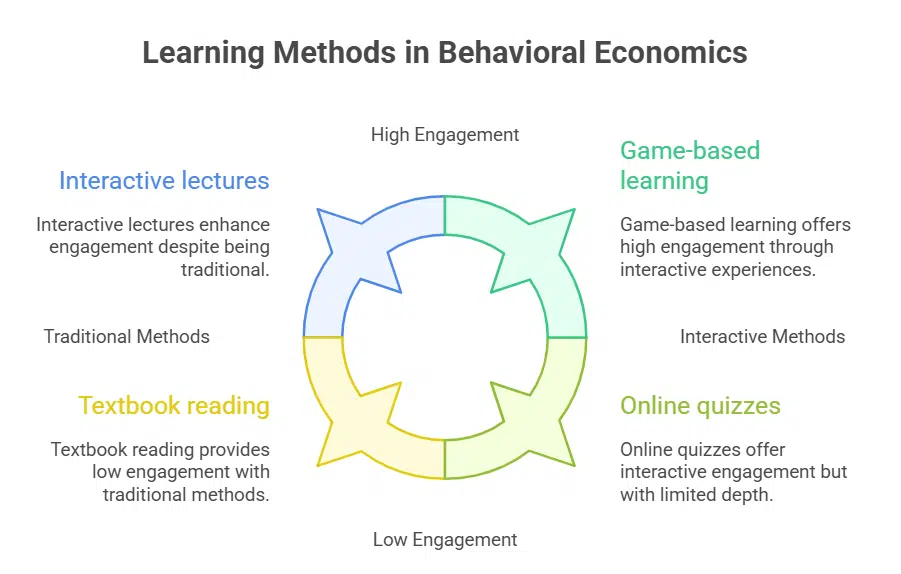
What we’re seeing today is more than just entertainment; we’re seeing applications work as real-time labs for behavioral economics. Behavioral economics tries to fix or change traditional economic theory by looking at how its basic ideas about humans being rational and selfish are wrong. Uncertainty-focused applications allow users to see these ideas in action.
You may learn about your own cognitive biases by playing games instead of reading about them in a book. Loss aversion, anchoring effects, and misunderstanding probabilities become real experiences instead of just ideas. This kind of hands-on learning is much more effective and lasting than traditional ways of teaching.
The Bright Future
By 2030, the worldwide market for gamification is expected to be worth $172.4 billion, which shows that a lot of money is going into this change in how we deal with uncertainty. The main promise, though, isn’t money; it’s people.
We’re getting closer to a future where uncertainty helps us flourish instead of stopping us in our tracks. In near future gamified systems will be more personalized than ever. They will change in real time according to how users behave, making unique uncertainty experiences that help people grow while keeping them safe and engaged.
In the future, applications will let users create individualized uncertainty profiles. This will let them figure out what amount of difficulty is best for them and slowly push their comfort zones. AI will know when users are ready for more difficult tasks, when they need help, and how to make situations that are uncertain fun and help them grow as people.
Accepting the Unknown
One of the most hopeful things about how people deal with uncertainty is the gamification of risk. Modern applications are altering the way we deal with the unpredictability of life by turning the unknown from something that makes us anxious into something that may be entertaining and educational.
Instead of seeing uncertainty as something to get rid of or put up with, we’re learning how to deal with it successfully and even with delight. This change gets us ready for a world that is getting more complicated, where being able to adapt and be okay with not knowing things are important life skills.
We’re not just making better entertainment; we’re making better people who can do well even when things don’t go as planned. And in a world where nothing stays the same, it could be the most important change of all.