

Have your AI projects stalled after a promising start? If How Conventional AI Governance Quietly Kills Its Potential sounds familiar, you are seeing a real pattern.
Most teams do not fail because the model is weak. They fail because ownership is fuzzy, approvals are slow, and the rules stop at launch instead of following the system into daily work.
Gartner said in June 2025 that more than 40% of agentic AI projects would be canceled by the end of 2027 because of rising costs, unclear business value, or inadequate risk controls. I am going to walk you through where conventional governance breaks down, and how clearer leadership, safer experiments, and open visibility can help your AI deliver value.
Keep reading.
The Purpose of AI Governance
Good AI governance is supposed to do one simple job: help you use AI with confidence. It should protect your business from data leakage, compliance issues, and weak decisions, while still giving teams enough room to test, learn, and ship.
That matters because governance is not just a defensive move. In PwC’s 2025 US Responsible AI Survey, 58% of business leaders said responsible AI improved ROI and efficiency, and 55% said it improved customer experience and innovation.
The strongest policy frameworks treat governance as a working system, not a binder on a shelf. NIST’s Generative AI Profile tells teams to evaluate safety risks regularly and make sure systems can fail safely, while ISO/IEC 42001 gives organizations a continuous improvement model for managing AI across the full life cycle.
- Set clear accountability in AI: every model, copilot, or agent needs an owner with real decision rights.
- Create machine learning oversight that stays live: watch behavior after launch, not just before approval.
- Connect AI regulation to daily operations: policies should shape access, logging, review, and rollback.
- Support responsible AI development: teams need guardrails that help them move faster, not freeze in place.
When governance works, AI becomes easier to scale because people know who owns it, what it can touch, and what happens if it drifts.
How Conventional AI Governance Quietly Kills Its Potential: The Flaws in Conventional AI Governance
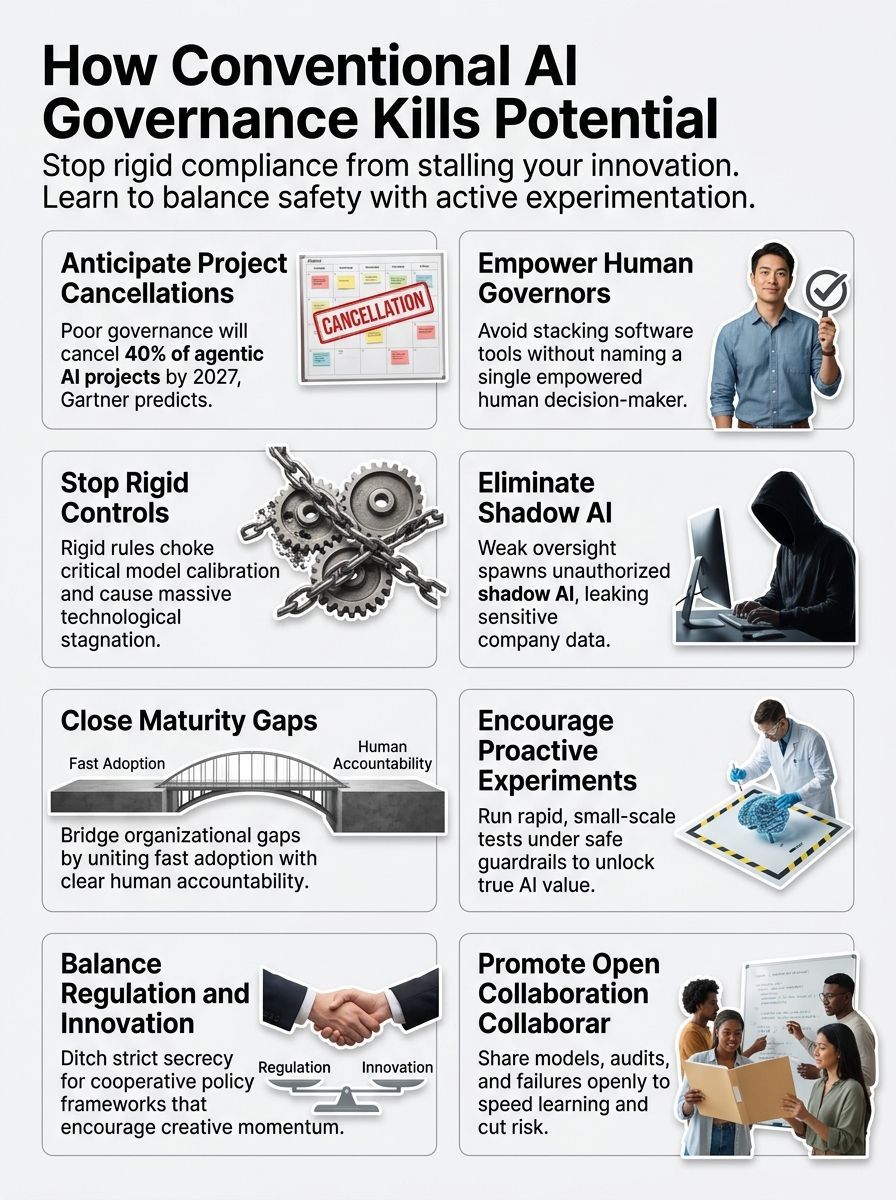
Conventional governance often looks serious and safe. In practice, it can be slow, vague, and disconnected from how AI actually behaves in production.
That is where governance challenges start. The rules focus on control, but the work needs calibration, visibility, and fast learning loops.
Lack of adaptability to rapid AI advancements
AI now moves much faster than the approval models many companies still use. McKinsey’s 2025 State of AI survey found that 88% of organizations report regular AI use in at least one business function, yet only about one-third say they have begun to scale AI at the enterprise level. For agentic AI, 23% say they are scaling a system somewhere in the business, while another 39% are still experimenting.
That gap is the warning sign. If your governance process updates once a quarter, but your vendors, models, prompts, and data flows change every week, your policy frameworks are already behind.
The fix is to build event-based reviews instead of waiting for the next committee meeting. A governance check should trigger when the system changes in a meaningful way.
- Model retrain: review risk again when the behavior may shift.
- New data source: confirm privacy, quality, and permission rules.
- Vendor or model swap: reassess accuracy, security, and output patterns.
- New tool access: check blast radius before the agent gets new permissions.
Overemphasis on control vs. calibration
Some organizations respond to AI uncertainty by tightening every screw. That feels responsible, but it often slows learning so much that teams stop testing useful ideas.
Deloitte’s enterprise survey found regulatory compliance concerns rose to 38% as a barrier to GenAI development and deployment, and 69% of respondents said fully implementing a governance strategy would take more than a year. That is exactly why heavy, one-size-fits-all control becomes a problem, it delays feedback long enough for projects to lose momentum.
NIST’s 2024 Generative AI Profile points teams in a better direction: review guardrails regularly, document risk tolerance, and make sure systems can fail safely when pushed beyond their knowledge limits. That is calibration. You match friction to risk instead of treating every experiment like a crisis.
| Governance style | What it looks like | What usually happens |
|---|---|---|
| Rigid control | Same approval path for every use case, slow reviews, broad restrictions | Teams wait, work around the process, or stop experimenting |
| Calibrated governance | Risk tiers, faster reviews for low-risk tests, clear rollback rules | Safer experiments move faster and high-risk use cases get deeper scrutiny |
| Operational governance | Runtime monitoring, policy enforcement, live inventory, audit trails | Leaders see what AI is doing after launch, not just what it promised before launch |
Insufficient focus on experimentation and innovation
Governance should create a safe lane for experiments. Too often, it creates a parking lot.
Gartner’s 2025 forecast is useful here because it links canceled agentic AI projects to cost, unclear value, and weak risk controls. That means innovation stifling and weak governance can show up at the same time, one kills learning, the other kills trust.
Companies with healthier operating models are moving responsibility closer to the builders. PwC found that 56% of executives now place primary responsibility for Responsible AI with first-line teams such as IT, engineering, data, and AI teams. That does not remove second-line review. It puts daily judgment closer to the work.
- Start with a business hypothesis: define what the system should improve in time, quality, cost, or risk.
- Limit the surface area: use a sandbox, restricted data, or a single workflow first.
- Name the owner: one person or role must be able to pause, revise, or stop the system.
- Set exit rules early: decide what success, failure, and rollback look like before launch.
Hidden Risks of Ineffective AI Governance
Bad governance rarely explodes on day one. It usually leaks value, trust, and control in small ways until the business feels the cost.
Stifled innovation and creativity
When every AI idea faces the same long review path, people stop bringing forward the interesting ones. They either avoid the work or move it off the books.
Deloitte reported that more than two-thirds of surveyed leaders expected 30% or fewer of their GenAI experiments to be fully scaled in the next three to six months. That is a strong sign that the bottleneck is organizational, not just technical.
- Create a fast lane for low-risk internal use cases.
- Reserve deep review for systems that affect customers, money, hiring, safety, or regulated decisions.
- Ask for evidence of value after the pilot, not before the team has real usage data.
- Keep approvals time-boxed so experiments do not die from silence.
Security vulnerabilities and data exposure
Security risk grows fast when AI agents act with broad permissions and no clear owner. In May 2026, SailPoint introduced Agentic Fabric around a simple truth: AI agents behave like non-human identities, and they need visibility, ownership mapping, lifecycle governance, and real-time protection just like privileged human users do.
That is the practical lesson for readers. If an agent can read files, trigger workflows, call tools, or move data, you should treat it like a high-speed identity with a measurable blast radius.
ServiceNow’s April 2026 update on AI Control Tower adds another useful detail. Their governance model ties agents to inventory, risk, compliance, telemetry, cost, latency, and tool usage, which is exactly the sort of runtime evidence most conventional programs miss.
If you cannot see what an agent touched, who approved it, and how to shut it down, you do not have governance. You have hope.
Limited scalability of AI systems
AI does not scale well from spreadsheets and scattered approvals. It scales from live inventory, repeatable controls, and shared visibility across teams.
TechTarget’s 2026 guidance for CIOs boils this down well: build a centralized inventory of AI agents, record ownership, permissions, and system access, then classify each system by risk level and blast radius. That gives you a way to scale without multiplying unknowns.
A practical inventory record should include the system owner, business purpose, data touched, tools it can call, environments where it runs, review date, and kill-switch path. If that sounds basic, good. Scalable governance is usually basic work done consistently.
The Governance Gaps in AI Implementation
Most governance failures are really implementation failures. The policy exists, but the day-to-day system around it does not.
The organizational maturity gap
Many firms have AI tools in production before they have a mature operating model for them. PwC’s 2025 US survey found that 61% of organizations place themselves at the strategic or embedded stage for Responsible AI, while 21% are still in training mode and 18% remain in early-stage policy building.
The quality gap between those groups is hard to ignore. PwC also found that strategic-stage organizations were roughly 1.5 to 2 times more likely than training-stage organizations to say their practices were effective in areas like development standards and AI inventorying.
| Maturity stage | What it usually looks like | What to fix next |
|---|---|---|
| Early | Policy draft, scattered pilots, unclear ownership | Name owners, build inventory, define review workflow |
| Training | Committees exist, teams get guidance, tooling is thin | Add monitoring, incident playbooks, and runtime controls |
| Strategic or embedded | Governance sits inside delivery, risk, and operations | Improve telemetry, value measurement, and cross-team coordination |
The know-your-consumer gap
Teams often test for model performance while skipping a simpler question: what will the user reasonably expect this system to do? If your AI sounds authoritative, acts automatically, or shapes a purchase, a denial, or a recommendation, consumer trust becomes a governance issue.
That point is getting sharper in the US. In July 2026, the FTC sought comment on a proposed policy statement about AI accuracy and whether companies may be deceiving consumers when systems behave contrary to reasonable expectations for objectivity and accuracy.
- State the system’s role clearly: assistant, recommender, drafter, or decision support.
- Show where humans still step in: approval, review, escalation, or override.
- Collect user feedback early: confusion is often your first governance signal.
- Test with real prompts: internal demos are too clean to expose trust failures.
The societal impact gap
Internal controls matter, but they are not enough if your governance never asks who else absorbs the downside. Bias, privacy harm, misinformation, and service denial often appear outside the delivery team that shipped the tool.
The OECD’s Due Diligence Guidance for Responsible AI, released in February 2026, adds two steps that many business playbooks still underweight: communicate actions taken to address impact, and provide or cooperate in remediation when harm occurs. That is a useful reminder that governance is not finished once the dashboard turns green.
The OECD’s incident reporting framework also uses 29 criteria to capture what failed, who was affected, and how severe the impact was. For readers building policy frameworks, that is a smart model because it turns vague ethical AI talk into a repeatable review process.
- Who was affected?
- What changed before the issue appeared?
- Which control failed, policy, data, access, or human review?
- What remediation will prevent the same harm next month?
Rethinking AI Governance for Maximum Potential
If you want AI to create value, governance has to move from a gatekeeping mindset to an operating model. The goal is safer speed, not slower fear.
Encouraging proactive experimentation
Your teams need permission to run small, contained tests before the market moves on. McKinsey found that 39% of organizations are experimenting with AI agents and 23% are already scaling them somewhere in the business, which means the distance between pilot and production is now part of governance work.
A pro tip that shows up again and again in practitioner discussions is simple: design for what happens after approval, not just what happens before it. That means re-evaluation triggers, drift checks, and a kill-switch protocol should exist before the first launch, not after the first incident.
- Give each pilot a fixed scope so risk stays understandable.
- Use event-based reviews when data, models, or permissions change.
- Track business evidence such as hours saved, cases resolved, or error reduction.
- Define shutdown authority before the system touches production workflows.
Balancing regulation with innovation
The best frameworks do different jobs. NIST AI RMF helps teams structure risk management, ISO/IEC 42001 helps build an organization-wide management system, and the OECD guidance helps leaders think through due diligence and remediation.
Pick the framework that solves your real bottleneck. If your problem is poor visibility, start with inventory and monitoring. If your problem is cross-functional confusion, start with ownership and review structure. If your problem is inconsistent operating discipline, use a management-system model.
| Framework | Best use | Why it helps |
|---|---|---|
| NIST AI RMF and the 2024 GenAI Profile | Risk mapping, measurement, and safe deployment | Useful when you need practical controls for testing, monitoring, and failing safely |
| ISO/IEC 42001 | Organization-wide AI management system | Useful when you need repeatable roles, audits, and continuous improvement |
| OECD Due Diligence Guidance for Responsible AI | Stakeholder impact and remediation | Useful when your governance needs stronger accountability beyond compliance checklists |
Promoting transparency and collaboration
Transparency is what keeps governance from turning performative. In April 2025, OMB’s federal AI memo required agencies to maintain AI use case inventories, track high-impact uses centrally, and require independent review before accepting risk. Private companies can borrow that same discipline without copying the entire federal process.
Start by making AI visible across the business. A shared inventory, common review language, and simple decision records will do more for responsible AI development than a thick policy no one opens.
- Publish an internal AI register: owner, purpose, data, tools, and review date.
- Keep decision receipts: who approved the system, under what conditions, and with what limits.
- Share incidents and near misses: one team’s lesson should not stay trapped in one team.
- Separate prompts from policy: the model’s instructions should never be your only compliance control.
When teams can see the same facts, accountability in AI gets much easier. Collaboration stops being a nice idea and becomes part of the control system itself.
Final Thoughts
How Conventional AI Governance Quietly Kills Its Potential is really a story about vague ownership, slow feedback, and policies that stop at launch. The models may be smart, but the operating model around them is still too passive.
Give every system an owner, keep a live inventory, review risk when the system changes, and let teams run safe experiments inside clear guardrails. That is how you cut compliance issues, avoid technological stagnation, and turn governance into a growth tool.
FAQs about How Conventional AI Governance Quietly Kills Its Potential
1. How does conventional AI governance kill AI’s potential?
Conventional AI governance piles on rules, slow reviews, and strict checks that stifle fast learning. It can turn a sprint into a crawl.
2. Why do governance frameworks sometimes harm innovation?
Governance frameworks focus on risk management and compliance, and they can block quick experiments. They protect systems, but at times they overprotect.
3. Can governance and innovation work together?
Yes, with clear goals, human oversight, and light guardrails. Think of rules as lane markers, not concrete walls.
4. What can teams do to stop governance from quietly killing potential?
Set outcome-based rules, let technical teams run small tests, and use fast audits to catch harm early. Keep compliance simple, measure results, and remove rules that block learning.