Let’s be honest. We’ve all seen the dramatic headlines claiming robots are coming for our jobs. It is easy to feel overwhelmed when every news cycle introduces a new, smarter algorithm. But the reality on the ground looks quite different from a science fiction movie. We are currently living through a massive transition, heavily driven by machine learning and automation. This shift is changing how we work, the tools we use, and the value we bring to our employers. The AI job market disruption is not just about replacing human effort; it is about fundamentally rewiring the global economy.
When we look at the data from the World Economic Forum, the numbers paint a clear picture. They project millions of roles will be displaced over the next few years, but millions more will be created. This structural churn means your current job description will likely look entirely different three years from now. If you write code, draft legal documents, analyze spreadsheets, or manage schedules, you are already feeling the pressure. The key is to stop viewing this technology as a direct competitor. Instead, you have to treat it as a highly capable assistant.
Those who refuse to adapt will undoubtedly face tough times. But professionals who learn to collaborate with these digital tools will find themselves doing better work in less time. We are moving away from paying people for rote memorization and repetitive tasks. The future belongs to those who possess critical thinking, emotional intelligence, and technical adaptability.
To understand exactly where we are heading, we need to break down the specific sectors feeling the heat right now.
Analyzing the AI Job Market Disruption Across Industries
The impact of artificial intelligence is not hitting every sector at the same speed. Some industries rely heavily on routine data processing, making them obvious targets for rapid automation. Other fields require intense physical adaptability or high emotional intelligence, offering a bit more short-term security. The AI job market disruption is currently targeting middle-management and entry-level knowledge work faster than anyone predicted. The table below outlines the core industries facing the biggest transformations and the primary technologies driving those changes.
| Industry Sector | Primary Technology Driving Change | Immediate Impact on Workforce |
| Customer Support | Conversational Chatbots | Massive reduction in tier-one agents |
| Administration | Generative Text and Scheduling | Consolidation of clerical roles |
| Finance | Predictive Algorithms | Decreased need for manual bookkeeping |
| Manufacturing | Computer Vision and Robotics | Shift from assembly to machine maintenance |
This sector-by-sector breakdown reveals a distinct pattern of task replacement. Let’s look closely at the specific roles caught in the crosshairs.
1. Customer Service and Support
Call centers used to employ massive floors of people just to answer basic questions about passwords, shipping delays, and billing errors. Today, large language models handle these interactions instantly and accurately. Companies no longer need to hire armies of tier-one agents to read from static scripts. This shift allows businesses to slash overhead costs dramatically. However, when a customer is deeply frustrated or facing a highly unusual problem, algorithms usually fail. They loop back to the same unhelpful responses, infuriating the user. This is why the human element is not entirely gone. The modern customer service worker is now an escalation specialist. They deal exclusively with high-stakes, emotionally charged situations that require genuine understanding and negotiation.
2. Administrative and Clerical Operations
Think about the classic administrative assistant role from ten years ago. It involved typing up meeting notes, responding to generic emails, and updating spreadsheets. Today, meeting software automatically transcribes audio, summarizes the key takeaways, and emails the action items to the team before the meeting even ends. This specific AI job market disruption means companies simply do not need dedicated staff for data entry anymore. The people who used to do these jobs are being forced to pivot. The smart administrative workers are transforming themselves into operations managers. They use the time saved by automation to focus on event planning, team culture, and workflow optimization.
The numbers game is also changing, particularly in fields that track money.
3. Financial Analysis and Bookkeeping
Entry-level accounting used to be a safe, reliable career path. You learned the tax codes, balanced the ledgers, and steadily moved up the corporate ladder. Now, software platforms plug directly into bank accounts, categorize expenses, and generate complete tax reports in seconds. Bookkeeping as a standalone profession is shrinking fast. But this automation is a massive advantage for senior financial planners. Instead of spending fifty hours a week crunching numbers, they spend their time advising clients. They look at the automated reports and help business owners make tough decisions about hiring, expanding, or cutting costs. The math is automated, but the business strategy remains fiercely human.
Beyond the office environment, physical workspaces are also undergoing a quiet revolution.
4. Manufacturing and Assembly Production
When we talk about automation, we often focus on software. But physical robotics powered by machine learning are changing the factory floor. Cameras use computer vision to inspect products for microscopic defects faster than the human eye ever could. Machines predict their own maintenance needs before they break down, reducing factory downtime. This eliminates many repetitive assembly line jobs that cause physical burnout and injury. At the same time, it creates an intense demand for technicians who understand how to fix the robots. The factory worker of the future looks much more like an IT specialist than a manual laborer.
As these traditional roles fade, an entirely new ecosystem of employment is rising to take their place.
Emerging Opportunities Amidst the Shifts
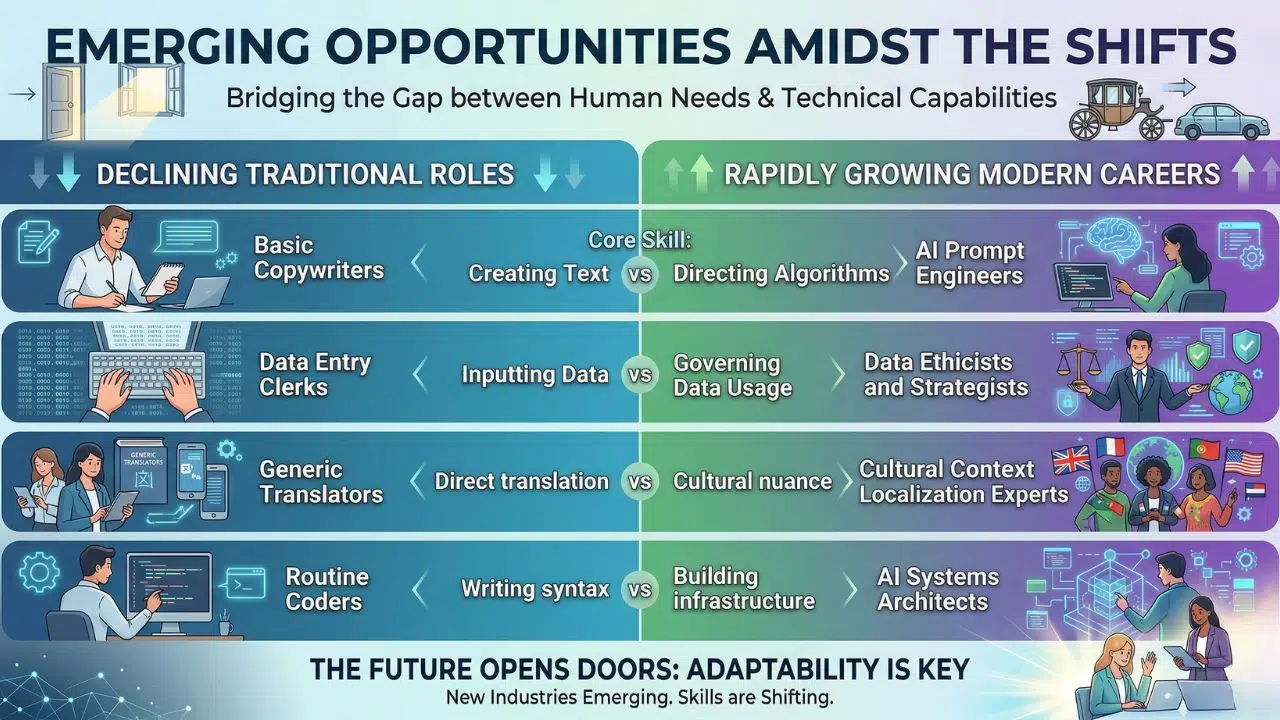
For every door that automation closes, it opens a window somewhere else. The narrative that we are heading toward a jobless future ignores the historical reality of technological advancement. Just as the invention of the automobile eliminated the need for horse carriage drivers, it created entirely new industries around manufacturing, road construction, and travel. We are seeing a similar explosion of new job titles today. Companies are desperate for people who can bridge the gap between human needs and technical capabilities. The table below highlights the stark contrast between the jobs we are losing and the careers we are inventing.
| Declining Traditional Roles | Rapidly Growing Modern Careers | Core Skill Difference |
| Basic Copywriters | AI Prompt Engineers | Creating text vs directing algorithms |
| Data Entry Clerks | Data Ethicists and Strategists | Inputting data vs governing data usage |
| Generic Translators | Cultural Context Localization Experts | Direct translation vs cultural nuance |
| Routine Coders | AI Systems Architects | Writing syntax vs building infrastructure |
These emerging roles require a completely different mindset. Let’s explore exactly what these new jobs entail and why they are so valuable.
5. The Rise of Prompt Engineering
A few years ago, nobody knew what a prompt engineer was. Today, companies pay top dollar for them. A prompt engineer is essentially a whisperer for large language models. If you tell a chatbot to write a marketing email, you usually get a boring, generic response. A prompt engineer knows exactly how to structure the request, set the constraints, and frame the context to force the system to produce high-quality, brand-specific content. They understand the quirks and limitations of the software. This role proves that knowing how to ask the right question is now more valuable than knowing the answer yourself.
Alongside the people talking to the machines, we desperately need people keeping the machines in check.
6. Data Strategy and AI Ethics
Algorithms are biased. They learn from historical data, and historical data is full of human prejudice. If a company uses a machine learning tool to screen resumes, and that tool suddenly starts rejecting all female applicants because of a flawed dataset, the company faces a massive crisis. This is where data ethicists and strategists step in. They audit the systems, check for bias, and ensure the technology aligns with corporate values and legal requirements. They are the human guardrails. As the technology gets more powerful, the people tasked with controlling it become some of the most important employees in any organization.
Knowing where the jobs are going is only half the battle; you also have to prepare yourself to get there.
Actionable Steps to Future-Proof Your Career
Panic is not a strategy. If you want to survive the AI job market disruption, you have to take control of your own professional development. You cannot wait for your employer to train you, because many companies are still figuring this out themselves. The goal is to make yourself indispensable by leaning into the skills that machines lack, while simultaneously mastering the machines themselves. You need a hybrid approach. The table below outlines the most effective strategies for adapting to the new world of work.
| Career Survival Strategy | Practical Application | Expected Outcome |
| Cultivate Soft Skills | Improve public speaking and conflict resolution | Become the human face of technical projects |
| Continuous Upskilling | Take short courses on data analysis tools | Stay relevant as software requirements change |
| Embrace AI Literacy | Use automation tools in your daily workflow | Dramatically increase your personal output |
| Build Personal Branding | Share your unique insights online | Create opportunities outside of traditional resumes |
Taking these steps requires a shift in daily habits. Here is how you can practically apply these concepts starting today.
7. Mastering Human-Centric Skills
If software can do the math, write the code, and draft the email, what are you bringing to the table? You bring the human connection. People buy from people. People trust people. If you are a manager, your job is no longer to track output; your job is to motivate, inspire, and clear roadblocks for your team. You need to become an expert communicator. Focus heavily on conflict resolution, active listening, and strategic foresight. An algorithm cannot sit in a room with a nervous client and convince them everything will be okay. If you become the person who holds the team together and builds trust with clients, you will never lack employment.
But soft skills alone won’t save you if you refuse to touch the new technology.
8. Continuous Technical Upskilling
You do not need to become a machine learning engineer to survive. However, you absolutely must achieve a baseline level of tech literacy. Start experimenting with generative tools immediately. Figure out how to use them to summarize your reading, draft outlines, or organize your calendar. The professional who uses automation to do the work of three people is incredibly valuable. Make it a habit to spend two hours a week learning a new software tool relevant to your industry. Read the patch notes, watch the tutorials, and apply it to your current projects.
As we navigate this complex territory, people naturally have a lot of specific questions about how this all plays out.
9. Will automation permanently lower salaries for entry-level jobs?
The reality is that companies will not pay a premium for skills they can get for free from a software subscription. If an entry-level job solely consists of reading spreadsheets and formatting reports, the salary for that role will stagnate or drop. However, this also means the definition of an entry-level job is changing. Employers now expect junior staff to use these tools to perform at a mid-level capacity almost immediately. If you can walk into an entry-level interview and demonstrate how you use automation to speed up their workflow, you can negotiate a much higher starting salary. You are no longer paid for your time; you are paid for your efficiency.
We also have to re-evaluate the idea that human creativity is untouchable.
10. Are creative jobs actually safe from automation?
Generative image models and text tools have completely disrupted the commercial art and writing industries. If a company needs a generic stock image or a basic SEO blog post, they no longer hire a junior freelancer; they generate it in thirty seconds. The lower tier of the creative market has collapsed. But true, original creativity is thriving. The role of the commercial artist is shifting toward art direction. You have to be the person who comes up with the brilliant concept, uses the AI to generate the raw materials, and then refines it with human taste and cultural awareness. Software has no taste. Taste is now your primary product.
Finally, we must address the demographic that often feels left behind by rapid technological shifts.
11. Can older workers survive this technological shift?
There is a dangerous myth that only twenty-something tech natives can survive the current job market. This is entirely false. Older workers possess something that no software has: decades of context. You have seen market crashes, navigated corporate politics, and built deep networks. An algorithm can draft a business plan, but it does not know the CEO of your rival company personally. If older workers spend just a fraction of their time learning the basics of how to operate new digital tools, they become unstoppable. They combine massive institutional wisdom with modern efficiency.
Final Thoughts
We are standing at the edge of a new economic era. The AI job market disruption is not a passing trend; it is the permanent new reality of how businesses operate. It is perfectly normal to feel a sense of instability as traditional roles disappear. But history shows us that human ingenuity always outpaces the tools we create.
By leaning into our distinctly human traits—our empathy, our adaptability, and our strategic vision—we can navigate this transition successfully. Keep learning, stay curious, and remember that technology is here to work for you, not the other way around.
Frequently Asked Questions (FAQs)
1. How is artificial intelligence changing traditional job markets?
Artificial intelligence is automating repetitive and routine tasks, reducing the need for manual labor in sectors like manufacturing, customer service, and data entry. At the same time, it is creating new opportunities in fields such as data science, machine learning, and AI system management.
2. Which industries are most affected by AI disruption?
Industries like manufacturing, retail, transportation, finance, and customer support are experiencing significant changes due to AI. Automation, chatbots, and predictive analytics are transforming how these sectors operate.
3. Will AI completely replace human jobs?
No, AI is more likely to transform jobs rather than completely replace them. While some roles may become obsolete, many new roles will emerge that require human creativity, critical thinking, and emotional intelligence.
4. What types of jobs are at highest risk due to AI?
Jobs that involve repetitive, rule-based tasks—such as data entry clerks, telemarketers, and assembly line workers—are at higher risk of automation.