Artificial intelligence reached a major milestone recently. Most of us aren’t just typing questions into text boxes and waiting for responses; today, people delegate actual, end-to-end work to software.
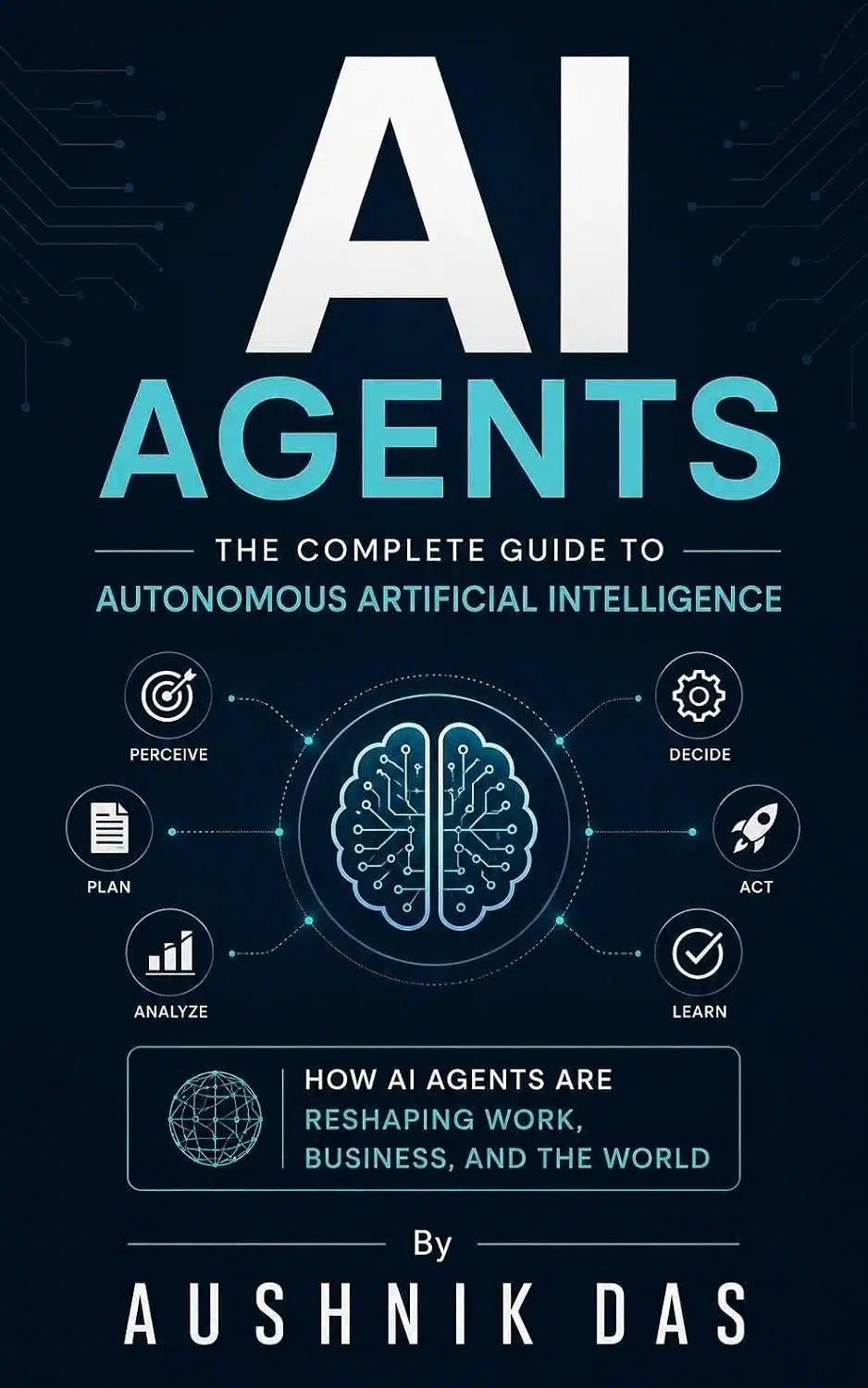
That shift is the core motivation behind a new book about AI agents authored by Editorialge’s Acting CEO Aushnik Das. Titled AI Agents: The Complete Guide to Autonomous Artificial Intelligence: How AI Agents Are Reshaping Work, Business, and the World, the book launched on Amazon Kindle on 4 August 2026.
At 61 pages, this autonomous artificial intelligence book serves as a clear, grounded AI agent guide. Aushnik walks through what these tools actually do, how they process decisions, how readers can build them, where companies deploy them right now, and what liabilities emerge when software acts on its own.
He wrote this text for anyone wanting to get up to speed on this technology without wading through dense academic papers or paying thousands for online masterclasses.
Book Details at a Glance
- Title: AI Agents: The Complete Guide to Autonomous Artificial Intelligence
- Author: Aushnik Das
- Publication date: 4 August 2026
- Format: Kindle eBook
- Length: 61 pages
- Language: English
- ASIN: B0HCWCW4VK
- Amazon US: View the Kindle edition
- Amazon India: View the Kindle edition
Why Aushnik Wrote This Book Now
Most people still view generative AI as an interactive Q&A session with a chatbot. Software agents go far beyond that initial baseline.
When you give an agent a broad objective, it breaks the task into steps, picks appropriate software tools, gathers data, carries out actions, inspects its work, and fixes mistakes whenever an error occurs.
Aushnik summarized this difference in a line from the text: “A chatbot has a mouth. An agent has hands.”
The distinction matters because software is shifting from content generation to actual execution. We see it across industries:
-
Autonomous coding tools that locate and patch bugs
-
Specialized research systems aggregating multi-source datasets
-
Support channels managing multi-step customer workflows
-
Enterprise tools handling actions across separate software environments
This technology has left the research lab and moved into everyday software.
Yet despite the noise around why companies should “deploy agents,” plenty of decision-makers still struggle to grasp what these systems do, where their boundaries lie, or why they fail. This AI Agents book by Aushnik Das was written to address that split directly.
The Market Surge Driving Agentic Technology
The release of this agentic AI book comes at a massive turning point for software infrastructure. AI agents are no longer confined to experimental research labs; they are actively reshaping mainstream enterprise applications.
Industry data highlights the speed of this transition:
-
Market research firm Mordor Intelligence values the agentic AI market near USD 7 billion in 2025, projecting it to scale toward USD 57 billion by 2031.
-
Gartner expects roughly one-third of enterprise software applications to incorporate agentic capabilities by 2028.
From automated coding assistants fixing bugs in real time to research tools managing complex data pipelines, agentic AI is becoming standard software infrastructure. Aushnik wrote the book to provide decision-makers, developers, and students with a clear roadmap for navigating this rapid expansion.
A Practical AI Agent Guide Without the Fluff
Technical writing on this topic usually falls into one of two traps.
On one side, guides jump right into embeddings, model architecture, orchestration, and vector stores without establishing basic concepts. On the other, marketing fluff promises “digital workers” that replace entire departments overnight.
Aushnik chose a different direction.
He explains the underlying mechanics in clear language without ignoring the practical complexities. The book breaks down how AI agents work, how they handle decisions, why they break down, and what safety guardrails look like. No computer science degree required.
While it works as an introductory resource on AI agents for beginners, he added sufficient depth for engineers and founders evaluating production setups.
Aushnik wrote this for a few key audiences:
-
Curious readers tracking where software is heading
-
Students preparing for an automated job market
-
Entrepreneurs looking for new product ideas
-
Business leaders considering AI integration
-
Developers creating their first functional system
-
Professionals wanting to use modern tools with confidence
His intent isn’t turning every reader into a machine learning engineer. It is to give people enough context to follow technical discussions, test tools effectively, ask sharper questions, and make smart decisions.
His background across journalism, content research, digital marketing, and business operations shaped this practical perspective. You can find more about his work on his Editorialge author profile or connect with him on LinkedIn.
Breaking Down Paywalls Around Technology Education
A core motivation behind this book about AI agents is making technical knowledge accessible to everyone, regardless of background or financial resources.
Aushnik highlights that crucial technical skills often get locked behind four-figure masterclasses or overly academic textbooks. This guide serves as an affordable, plain-language alternative designed for:
-
Small-town dreamers and students seeking basic AI literacy to enter a changing job market.
-
Working professionals who want to build career resilience without taking expensive courses.
-
Entrepreneurs looking to understand how AI agents work without hiring high-priced consultants.
The goal is to demystify complex software concepts so that readers can participate in the technological shift as active creators rather than passive observers.
Breakdown of the Chapters
To avoid a rigid section-by-section list, the 13 chapters are structured into four overarching core areas. The text acts as an AI Agents Complete Guide for readers seeking both a solid foundation and actionable building strategies.
Core Concepts and Evolution
The first few chapters explain how agents differ from standard chatbots and basic scripts. Instead of merely responding to input, an agent works toward a goal through continuous loops of perception, planning, action, observation, and correction.
From there, the book breaks down internal anatomy:
-
Planning and Reasoning: Mapping steps and evaluating logic
-
Memory: Keeping short-term and long-term context intact
-
Tools and Action Loops: Connecting APIs, databases, and external apps
-
Feedback: Adjusting when execution steps fail
Aushnik traces how these architectures evolved from 1950s rule-based systems to modern LLM frameworks. He also compares simple reactive bots against deliberative systems that plan and reflect. Complex setups aren’t always superior; matching the architecture to risk tolerance and required human control is what matters.
Design Mechanics and Construction
Next, the book takes a look at the agentic loop, top-down versus bottom-up planning, and self-correction. It shows how agents split massive objectives into small tasks, and why flawed planning causes otherwise smart models to fail.
The text covers memory layers, vector retrieval, and context management, along with why giving an agent too many tools often backfires. In Chapter 8, Aushnik walks through how to build AI agents step by step: defining clear goals, writing system prompts, choosing tools, setting guardrails, testing outputs, handling failures, and preparing for deployment.
He also examines multi-agent setups (orchestrator-worker patterns, pipelines, debate structures) and explains when not to use multiple agents, since extra complexity often brings unwanted latency and higher costs.
Practical Business Applications
Aushnik explores real-world deployments of AI agents in business across customer support, software engineering, research, marketing, finance, healthcare, and education. Beyond the promises, he confronts practical hurdles like system reliability, software integration, data access, costs, and accountability. Successful adoption requires real oversight, not just an API key.
Risk, Security, and Ethics
Autonomy introduces genuine risk. Agents can hallucinate, misread instructions, run buggy code, leak sensitive data, or take unauthorized actions. The final section addresses these issues directly:
-
Latency and cost bottlenecks
-
Prompt injection vulnerabilities and tool abuse
-
Data privacy, permission controls, and corporate governance
-
Closing the gap between a neat demo and production-grade software
Organizations shouldn’t rush deployment just because market trends urge speed. Responsible adoption demands rigorous testing, monitoring, clear permissions, human oversight, and accountable lead ownership.
Balancing Software Autonomy with Human Governance
As software transitions from generating text to executing multi-step actions, questions around accountability become central. The final chapters of the text address the ethical and operational stakes of giving software greater independence.
Key considerations explored include:
-
Security Guardrails: Protecting systems from prompt injection, tool abuse, and data exposure.
-
Human-in-the-Loop Oversight: Ensuring human decision-makers retain ultimate responsibility over automated outcomes.
-
Practical Implementation: Closing the last-mile gap between a successful prototype and safe, production-ready software.
Rather than advocating for unchecked automation, Aushnik emphasizes responsible deployment, clear permission boundaries, and thoughtful governance as prerequisite steps for using AI agents in business.
Beyond Simple Automation
This agentic AI book does not argue that autonomous software solves every operational problem or eliminates human workers. It was written because people deserve clarity during a major technological shift.
Students face a job market where basic technical literacy is expected. Founders are evaluating whether agentic products offer true defensibility. Executives face high-stakes tech choices they don’t fully understand.
Unsurprisingly, many people feel uncertain about AI agents and the future of work.
Too many people get lost in dense jargon, dramatic headlines, and anxiety. Some worry their skills will become obsolete; others wonder if learning this tech can future-proof their careers; many simply don’t know where to start.
This guide provides an accessible entry point for them. Critical knowledge shouldn’t stay locked behind expensive courses or dense academic manuals.
The Personal Journey Behind the Pages
Behind the technical breakdowns lies a deeply personal effort. Aushnik describes writing the text late at night, iteratively rewriting chapters, and drawing parallels between system error handling and personal perseverance.
When detailing how agents handle mistakes through feedback loops, he reflected on his own drafting failures and moments of doubt. That experience shaped a grounded narrative that treats technology as a human tool rather than an intimidating black box.
Getting Started with Autonomous Systems
Along with the core text, the book includes a complete glossary of terms, an architecture overview diagram, and a curated list of resources for further learning.
While software evolves too quickly for any book to be the permanent last word on the topic, everyone needs a solid baseline: understanding how autonomy changes software design, why human oversight remains essential, and how to spot real innovation amidst market noise. That is the main goal behind AI Agents: The Complete Guide to Autonomous Artificial Intelligence.
The Kindle edition launched on 4 August 2026 and is available on Amazon worldwide, including the US, UK, Germany, France, Spain, Italy, Netherlands, Japan, Brazil, Canada, Mexico, Australia, and India.
For anyone looking for an accessible Amazon Kindle AI book, readers in India can find it on Amazon India, while international readers can grab it on Amazon.com. It is also available via Kindle Unlimited.
AI agents mark one of the most significant shifts in software since smartphones. But their ultimate impact won’t depend on pure processing power; it will come down to whether people understand them, use them ethically, and maintain control over decisions that matter.
I hope this AI Agents book helps you join that conversation.