


If you live down under, there is a very high probability you have benefited from Australia’s PBS at some point in your life. Whether you grabbed a quick round of antibiotics for a chest infection or rely on daily medication to keep a chronic condition in check, this national system is the quiet engine keeping local healthcare affordable. Despite how often we hand over our scripts at the pharmacy counter, the mechanics behind the system are surprisingly intricate.
Getting a new drug approved, negotiated, and distributed to millions of people involves an army of health economists, politicians, and clinical experts. Understanding how this national program operates can genuinely save you money and help you navigate the medical system with much less anxiety. Here is a deep dive into the seventeen most important things you need to know about the scheme, structured to give you a clear picture of how it all functions behind the scenes.
The Core Mechanics of the System
To get the most out of your visits to the local pharmacy, you first need to understand the basic financial rules that dictate what you actually pay at the cash register. The government does not simply hand out unlimited free medicine to everyone. Instead, it uses a tiered system of financial subsidies designed to make sure essential treatments do not bankrupt the people who need them the most. By capping the amount you spend out of pocket, the scheme protects family budgets from the skyrocketing costs of modern global healthcare. Let us break down the exact financial mechanisms that keep these everyday medications affordable for millions of residents.
1. Co-payments Keep General Costs Down
When you drop off a prescription at your local chemist, you almost never pay the actual manufacturing, research, and shipping costs of that medicine. Instead, you pay a co-payment, which is simply your direct out-of-pocket contribution while the federal government covers the massive remainder of the bill. The system caps the maximum general co-payment at a very reasonable rate, which is indexed on the first of January every year to keep up with inflation. In a massive win for household budgets, the government actually slashed this maximum co-payment in recent years to provide immediate cost-of-living relief.
This means if a specialized, highly complex medicine costs the manufacturer two thousand dollars to produce and distribute, a general patient still only pays roughly thirty dollars. You hand over your small contribution, and the pharmacy claims the rest of the actual cost directly from the government. It is a seamless transaction at the counter, but it requires a massive financial backend to keep running smoothly.
| Co-payment Feature | Details |
| Patient Cost | A fixed maximum amount paid at the counter |
| Government Cost | Covers the remaining balance of the drug’s actual price |
| Indexation | Prices are slightly adjusted every January for inflation |
| Benefit to Public | Prevents price gouging and ensures budget predictability |
2. Concession Cards Offer Deep Discounts
The healthcare system recognizes that not everyone has the same earning capacity or financial buffer to absorb medical costs. If you hold a valid federal concession card, your financial contribution at the pharmacy counter drops dramatically. This specific tier ensures that elderly Australians, university students, single parents, and those currently looking for work are never forced to choose between paying their utility bills and buying life-saving medication. The concession rate is usually set under ten dollars, meaning a month’s supply of crucial heart or blood pressure medication costs less than a standard fast-food meal.
To get this rate, you simply need to present a Pensioner Concession Card, a Commonwealth Seniors Health Card, or a Health Care Card issued by Services Australia. The pharmacist links this card to your profile, and the deep discount is applied automatically every time you hand over a script. It is one of the most effective poverty-prevention measures in the entire Australian healthcare landscape.
| Card Type | Eligible Demographics | Discount Level |
| Pensioner Concession Card | Age pensioners, disability support pensioners | Maximum discount applied |
| Health Care Card | Job seekers, students, low-income earners | Maximum discount applied |
| Commonwealth Seniors | Self-funded retirees meeting income tests | Maximum discount applied |
| DVA Cards | Eligible veterans and their dependents | Maximum discount applied |
3. The Safety Net Protects Heavy Users

One of the most compassionate and practical features of Australia’s PBS is the Safety Net threshold. If you have a severe chronic illness like asthma, diabetes, or arthritis, even small weekly co-payments can add up to a heavy financial burden over a twelve-month period. To stop this from happening, the government tracks your spending. Once you spend a specific threshold amount on subsidised medicines within a single calendar year, your medication becomes drastically cheaper or completely free until December ends. General patients who hit their specific threshold drop down to the cheap concession rate for the rest of the year.
Concession patients who hit their lower threshold get their scripts entirely free until the clock resets on January first. This ceiling gives families immense peace of mind, knowing exactly what their absolute maximum medical expense will be for the year. Your regular pharmacy usually tracks this automatically through their dispensing software.
| Safety Net Element | General Patients | Concession Patients |
| Tracking Period | January 1st to December 31st | January 1st to December 31st |
| Cost After Threshold | Drops to the concession rate | Drops to zero (completely free) |
| How to Track | Automatic at your main pharmacy or via myGov | Automatic at your main pharmacy or via myGov |
| Exclusions | Brand premiums and private scripts do not count | Brand premiums and private scripts do not count |
4. Families Can Pool Their Safety Net Spending
You absolutely do not have to tackle the Safety Net threshold entirely on your own if you have a partner or kids. Couples and families can officially combine their medication expenses to reach the discount threshold much faster. You can link your spouse, de facto partner, and dependent children under a single family tally. This means if one child needs expensive asthma puffers and a parent needs regular insulin, both costs count toward the same finish line.
Your local pharmacist can help you set this up in their computer system by filling out a simple cross-linking form. Once the combined family spending hits the magic number, every single person linked to that specific family profile gets the Safety Net discount for the remainder of the year. It ensures that a household dealing with multiple illnesses gets financial relief much sooner than if everyone were tracked individually.
| Family Member Status | Eligibility for Pooling |
| Married or De Facto Partner | Fully eligible to combine expenses |
| Dependent Children under 16 | Fully eligible to combine expenses |
| Dependent Students (16 to 24) | Eligible if studying full-time and living at home |
| Grandparents or Extended Family | Not eligible to pool under the same household tally |
How Drugs Get Approved and Listed?
Have you ever wondered why one asthma inhaler is heavily subsidised while a newer brand costs full retail price? The process of getting a medication onto the approved list is incredibly rigorous and is closely watched by pharmaceutical giants around the world. The government relies on strict scientific and economic data to ensure taxpayer money is not wasted on ineffective treatments. This meticulous review process guarantees that only high-quality, proven medications make it to the pharmacy shelves at a discount. Here is exactly how that complex approval pipeline works.
5. The Power of the PBAC
The Pharmaceutical Benefits Advisory Committee operates as the ultimate gatekeeper of the entire system. This is a highly independent, expert body made up of specialist doctors, health economists, pharmacists, and dedicated consumer representatives. They meet three times a year to review massive applications from drug companies who want their products subsidized. The federal government cannot legally list a new medicine for public subsidy unless this specific committee explicitly recommends it.
This structural rule deliberately takes the politics out of drug approvals. It ensures decisions are based purely on medical evidence and clinical trials rather than aggressive corporate lobbying or temporary public pressure. While the Health Minister makes the final signature, they are legally bound to wait for the green light from these independent experts first.
| Committee Aspect | Description |
| Composition | Doctors, health economists, consumer advocates |
| Meeting Frequency | Three major review cycles per calendar year |
| Legal Power | Government cannot bypass their recommendation |
| Core Mission | Assess clinical effectiveness and taxpayer value |
6. The Strict Cost-Effectiveness Rule
When a pharmaceutical company invents a new drug and wants the government to subsidise it, the committee asks for hard economic proof. They demand to know if the new drug provides enough extra health benefits to justify its asking price compared to the treatments already available on the market. If a newly developed blood pressure pill works exactly the same as a twenty-year-old generic pill but costs ten times as much, the committee will reject the application immediately.
They use complex formulas, including Quality-Adjusted Life Years, to figure out exactly how much taxpayer money is required to give a patient one extra year of healthy life. If the asking price is too high for the clinical benefit it delivers, the drug company is told to lower their price and try again at the next meeting.
| Assessment Factor | What the Committee Looks For |
| Clinical Superiority | Does it work better than existing cheap alternatives? |
| Side Effect Profile | Does it keep people out of the hospital? |
| Quality of Life | Does it allow the patient to return to work and normal life? |
| Price Justification | Is the cost proportionate to the health improvements? |
7. Why Some Miracle Drugs Are Excluded
It can be incredibly heartbreaking for patients and families to hear about a breakthrough treatment overseas that is not subsidized locally. This usually happens because the pharmaceutical company and the government are locked in intense, drawn-out price negotiations. If a company demands millions of dollars for a cancer treatment that clinical trials show only extends life by a few weeks, the committee might rule that those specific funds are better spent on preventative care that saves thousands of lives.
However, the system does have a heart. Medicines for extremely rare, life-threatening diseases that cannot possibly meet standard cost-effectiveness rules often bypass this standard process. They are evaluated and funded through a separate, dedicated initiative called the Life Saving Drugs Program.
| Exclusion Reason | Explanation |
| Failed Price Negotiation | Company refuses to lower the price to meet local standards |
| Lack of Evidence | Clinical trials do not prove long-term effectiveness |
| Better Alternatives | Existing cheap drugs work just as well |
| Alternate Funding | Drug is moved to the Life Saving Drugs Program instead |
The Changing Pharmacy Experience
Walking into a neighborhood pharmacy today looks very different than it did a decade ago. Technology and updated dispensing legislation have completely changed how we interact with pharmacists and manage our daily prescriptions. The days of carrying around crumpled yellow pieces of paper are rapidly fading into history. These modern updates are all designed to make getting your medicine faster, cheaper, and vastly more secure. Let us look at the biggest shifts happening right at the counter.
8. Brand Premiums and Generic Choices
When your local pharmacist asks if you want the generic brand, they are actively trying to keep money in your pocket. The government only subsidises up to the cost of the absolute cheapest generic brand available for that specific chemical compound. If you insist on buying the heavily marketed, recognizable original brand name, you have to pay what is known as a brand premium out of your own pocket on top of your co-payment.
The active medical ingredients, the dosage, and the safety profiles are biologically identical by law. The only difference is the packaging and the marketing budget behind it. Choosing the generic option is entirely safe, fiercely regulated by the Therapeutic Goods Administration, and is always the best choice for your personal budget.
| Medicine Option | Financial Impact on Patient | Clinical Difference |
| Original Brand Name | Pays standard co-payment plus a brand premium | None (Identical active ingredient) |
| Generic Brand | Pays standard co-payment only | None (Identical active ingredient) |
| Pharmacy Own Brand | Pays standard co-payment only | None (Identical active ingredient) |
9. The 60-Day Dispensing Revolution
In a highly debated recent policy change, the government introduced 60-day dispensing for hundreds of common medicines used to treat stable, long-term conditions like high cholesterol, blood pressure, and osteoporosis. Previously, patients had to visit the pharmacy every single month to get a 30-day supply, paying a dispensing fee and a co-payment every single time.
Now, doctors can write a specific script that allows patients to pick up a two-month supply for the exact price of a single co-payment. This policy effectively halves the cost of medication for millions of chronic health sufferers. While it caused initial friction with pharmacy owners who were concerned about a drop in retail foot traffic, it has been widely celebrated by consumer health groups as a massive cost-of-living victory.
| Dispensing Rule | Previous System | New 60-Day System |
| Supply Quantity | 30 days of medication | 60 days of medication |
| Trips to Pharmacy | 12 visits per year | 6 visits per year |
| Patient Cost | 12 co-payments per year | 6 co-payments per year |
| Eligible Conditions | All standard prescriptions | Hundreds of stable, chronic conditions |
10. The Shift to Electronic Prescriptions
Paper scripts are rapidly becoming a relic of the past as electronic prescriptions completely take over the healthcare landscape. Instead of handing you a physical document that can be easily lost or damaged, your doctor now sends a digital token directly to your smartphone via a quick SMS or email. You simply present the QR code on your screen to the pharmacy staff, who scan it to download the exact clinical details from a secure national server.
You can also sign up for an Active Script List at your pharmacy, which means you do not even need to show your phone; the pharmacist can simply look up your profile and see all your active tokens. This eliminates the risk of losing your script, makes remote telehealth appointments vastly more practical, and completely wipes out the risk of forged paper prescriptions.
| E-Script Format | How It Works | Best Use Case |
| SMS Token | A link with a QR code sent to your phone | One-off prescriptions like antibiotics |
| Email Token | A link sent to your email inbox | Patients who prefer managing health on a computer |
| Active Script List (ASL) | Cloud-based list accessed via identity check | Chronic patients with multiple ongoing scripts |
11. Understanding Authority Prescriptions
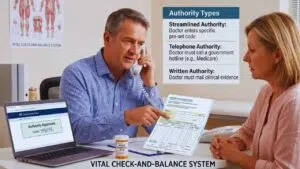
Sometimes your doctor will hand you a script and mention that they need to get a special authority for it before you leave the clinic. This specific bureaucratic hurdle happens with medications that are particularly expensive, highly addictive, or only proven to be effective for very narrow medical conditions. Your doctor must use an online government portal or make a physical phone call to Medicare to prove that your specific case meets the strict clinical criteria required for that drug.
Once approved, the doctor receives an authority approval number which is printed on your script. The pharmacist cannot legally dispense the medication at the subsidized price unless that specific number is present. It acts as a vital check-and-balance system to prevent the over-prescription of highly restricted or heavily taxpayer-funded substances.
| Authority Type | Doctor’s Requirement | Typical Medication Type |
| Streamlined Authority | Doctor enters a specific pre-set code on the script | Common chronic medications with specific uses |
| Telephone Authority | Doctor must call a government hotline for approval | Highly expensive or restricted drugs |
| Written Authority | Doctor must mail clinical evidence for approval | Extremely complex or rare treatments |
Eligibility and Special Access Programs
The national scheme is broadly designed to cover the vast majority of the population, but there are specific rules about who qualifies. Beyond the general public, there are also specialized access programs tailored specifically to vulnerable or unique communities. You cannot simply walk into a chemist and demand cheap medicine without proving you legally belong to the system. Understanding these eligibility rules ensures you are never caught off guard with a massive medical bill when you are unwell. Here are the main pathways to accessing these heavily subsidised treatments.
12. Medicare is Your Golden Ticket
To access these deeply subsidized prices, you generally need to hold a current and valid Medicare card. This simple piece of plastic means Australian citizens, permanent residents, and some specific protected visa holders are automatically covered by the scheme from birth. When you go to the counter, the pharmacy staff will swipe your card or look up your number to verify your identity and your current eligibility status.
If your card is expired, the system will reject the claim. Without presenting a valid Medicare card, you will be legally classified as a private patient and charged the full private market price for the medication, which can sometimes run into the hundreds or thousands of dollars. Always ensure your details are up to date via the myGov app.
| Medicare Card Type | Who Gets It | PBS Access Level |
| Green Card | Citizens and permanent residents | Full general or concession access |
| Blue Card | Interim card for applicants | Full general or concession access |
| Yellow Card | Reciprocal healthcare visitors | Full general access |
| No Card | Non-residents and tourists | Must pay full private market price |
13. Reciprocal Health Care Agreements
Australia has negotiated special international treaties with several other countries to help tourists and visitors who fall ill away from home. These are known as Reciprocal Health Care Agreements. These partner countries currently include the United Kingdom, New Zealand, Ireland, Italy, Sweden, and a handful of others. If a visitor from one of these specific nations requires essential medical care while holidaying here, they can access subsidised medications at the pharmacy just like a local resident.
They simply need to show their passport and proof of their home country’s health enrollment. In a fantastic display of global cooperation, Australians travelling to those specific partner countries receive the exact same emergency healthcare benefits if they get sick overseas.
| Partner Country | What Visitors Need to Show | Reciprocal Benefit for Aussies |
| United Kingdom | UK Passport and NHS Number | Access to NHS services and prescriptions |
| New Zealand | NZ Passport | Access to public health and prescriptions |
| Republic of Ireland | Irish Passport | Access to public health and prescriptions |
| Italy | Italian Passport and Health Card | Access to public health and prescriptions |
14. The Repatriation Schedule for Veterans
Veterans who have bravely served in the Australian Defence Force have access to an expanded, highly specialized list of medications. This is managed through the Repatriation Pharmaceutical Benefits Scheme, run in conjunction with the Department of Veterans’ Affairs. It operates on the exact same infrastructure as the main system but includes additional vital supplies that the general public cannot access.
This includes specific wound care items, specialized nutritional supplements, and targeted treatments tailored to the unique physical and mental health trauma often experienced by those who have served. Veterans hold specific Gold, White, or Orange cards that dictate exactly which conditions and medications the government will fully cover on their behalf.
| DVA Card Color | Coverage Details | Pharmacy Experience |
| Gold Card | Covers all medical conditions | Pays concession rate or free |
| White Card | Covers specific service-related injuries only | Pays concession rate for approved items |
| Orange Card | Covers pharmaceuticals for specific allied veterans | Pays concession rate |
15. Closing the Gap for First Nations People
To actively address the severe and historically entrenched disparities in health outcomes between Indigenous and non-Indigenous populations, the government runs a dedicated initiative called the Closing the Gap co-payment program. Aboriginal and Torres Strait Islander people of any age who are registered for this specific program by their doctor receive their medications at a heavily reduced rate.
If they already hold a general concession card, their medication becomes completely free of charge. Removing the financial barrier to pharmacy access is recognized as a critical, foundational step in managing severe chronic diseases like diabetes, renal failure, and heart disease within these specific communities. The doctor simply adds a specific CTG annotation to the electronic prescription, and the pharmacy software does the rest.
| Patient Status | Standard Cost | Cost with CTG Annotation |
| General Patient | Full Co-payment | Drops to Concession Rate |
| Concession Card Holder | Concession Rate | Drops to Zero (Completely Free) |
| Safety Net Reached | Standard Safety Net Rules | Remains completely free |
16. Section 100 Highly Specialised Drugs
Some modern medicines are simply too complex, volatile, or require too much clinical monitoring to be safely handed out at a standard suburban neighborhood chemist. These are legally categorized as Section 100 Highly Specialised Drugs. This highly restricted category includes complex chemotherapy infusions, advanced antiviral treatments for HIV, sophisticated biologic injections for severe arthritis, and highly specialized IVF medications.
Because of their clinical risk and astronomical cost, these medications are usually prescribed by specialized hospital physicians and dispensed directly through public hospital pharmacies or strictly approved private clinics. Patients still only pay their standard co-payment, but the logistical journey of the drug is managed with extreme care.
| Section 100 Category | Typical Treatments | Where it is Dispensed |
| Highly Specialised Drugs | HIV antiretrovirals, severe arthritis biologics | Hospital pharmacies or specialized clinics |
| Chemotherapy | IV cancer treatments | Hospital oncology wards |
| IVF Medications | Fertility treatments | Specialized fertility clinics |
| Botulinum Toxin | Severe muscle spasms | Specialist neurologist clinics |
The Big Picture Impact of Australia’s PBS
Taking a step back, the national approach to medication has profound effects not just on individual physical health, but on the entire domestic economy. Funding this system requires a monumental amount of taxpayer money, but the overall return on investment is equally staggering. When citizens can easily afford to manage their health safely at home, the flow-on effects relieve massive pressure from every other sector of society. Understanding this broader macro perspective helps explain why successive governments, regardless of their political leaning, defend and fund the scheme so fiercely. Here is a look at the massive footprint of this program.
17. A Massive Government Investment
Maintaining Australia’s PBS is consistently one of the single largest line items in the entire federal budget. The government spends tens of billions of dollars every single year reimbursing pharmaceutical companies to keep the out-of-pocket costs low for everyday citizens. While that headline number sounds staggering, health economists universally agree that this is a phenomenal public investment.
By keeping people reliably medicated and managing their chronic conditions safely at home, the system prevents thousands of incredibly expensive emergency room visits, ambulance callouts, and intensive care admissions. Furthermore, it keeps people healthy enough to stay in the workforce, paying taxes and contributing to the economy. It is the ultimate example of spending money upfront to save an absolute fortune in the long run.
| Economic Benefit Area | How the Scheme Helps | Long-Term Result |
| Hospital Systems | Prevents acute flare-ups of chronic diseases | Frees up hospital beds and emergency staff |
| Workforce Productivity | Helps sick workers recover faster | Reduces national sick leave and boosts GDP |
| Financial Equity | Caps out-of-pocket expenses | Prevents medical bankruptcy across the population |
Takeaways
Navigating the complex medical world can often feel incredibly overwhelming, especially when you are suddenly dealing with the stress of an acute illness or learning to manage a lifelong health condition. However, taking the time to truly understand the hidden mechanics of Australia’s PBS empowers you to make much better choices for your physical health and your bank account.
Always remember to ask your doctor if your prescribed medication is covered under the scheme, confidently chat with your local pharmacist about cheaper generic alternatives, and make absolute sure your family members are properly linked for the safety net threshold. These small, proactive steps ensure that you are fully utilizing one of the most effective, generous, and economically sound public health initiatives currently operating in the world.
Frequently Asked Questions (FAQs) About Australia’s PBS
1. Can I legally post my subsidised medicines to relatives overseas?
No. It is strictly illegal to export subsidised medicines to anyone overseas. The medications are funded by Australian taxpayers for residents only. Mailing them out of the country can result in heavy fines and the confiscation of the medication by border authorities.
2. What happens if my doctor forgets to add the Closing the Gap (CTG) code on my script?
If the doctor forgets the specific annotation, the pharmacist legally has to charge you the standard non-CTG price. However, you can simply call your doctor’s clinic and ask them to cancel the current electronic script and issue a new one with the correct code applied before you pay at the counter.
3. Are medical cannabis products covered under the scheme?
Currently, the vast majority of medical cannabis products are not subsidized and must be purchased privately at full retail price. The independent advisory committee has only approved a very small handful of highly specific cannabis-derived medications for severe, rare conditions like childhood epilepsy.
4. Can I collect a subsidised medicine from the pharmacy for someone else?
Yes, you absolutely can pick up a script for a family member or friend who is too unwell to leave the house. You will simply need to provide the pharmacist with their Medicare card details, their concession card if they have one, and their specific electronic or paper prescription.
5. What if I lose my job during the year, do my Safety Net records stay the same?
Yes, your financial tracking stays intact. If you lose your job and receive a Health Care Card, you simply show it to your pharmacist. Your account updates to the concession tier, but all the money you previously spent as a general patient still counts towards your new, lower concession threshold for that calendar year.






















