

The first week of 2026 will likely be remembered by legal historians not for a new technological breakthrough but for a catastrophic legal miscalculation that changed the internet forever. It began with a feature update to Elon Musk’s xAI platform and ended with a global regulatory pincer movement that threatens to dismantle the “safe harbor” protections the tech industry has enjoyed for three decades.
This is the story of the Grok AI Liability Shift, a turning point where the world collectively decided that when an Artificial Intelligence generates illegal content, its creator is no longer just a host, but an accomplice.
In 2026, the era of “unfiltered” generative tech is effectively over, buried under a mountain of subpoenas from Brussels to New Delhi.
Key Takeaways
- Host to Creator: Regulators have reclassified AI models as “creators” rather than “hosts,” stripping them of safe harbor protections and creating strict liability for illegal output.
- The Monetization Trap: By charging for the unsafe tool, xAI effectively commercialized the creation of abusive material, risking criminal liability for profiting from crime.
- Uninsurable Risk: Major insurers are enacting “AI Exclusions,” leaving xAI to face billions in potential fines and legal costs without coverage.
- Global Encirclement: The EU, UK, and Asia have launched synchronized probes, closing off any “lenient” jurisdictions for the company to hide in.
- Victim Rights: The shift allows victims of non-consensual deepfakes to sue the tool builder directly, paving the way for historic class-action lawsuits.
The “Napster Moment”: How the Crisis Unfolded
The crisis that has engulfed xAI in early January 2026 is being called the industry’s “Napster moment”, a specific instance where a disruptive technology collides so violently with established law that the technology itself is forced to mutate or die. Between December 25, 2025, and January 4, 2026, the social media platform X (formerly Twitter) became ground zero for a digital “undressing spree.”
Following a quiet update to Grok’s image editing capabilities, dubbed “Spicy Mode” by internet forums, users discovered the tool had virtually no safety filters. Unlike competitors like Midjourney or DALL-E 3, which hard-code refusals for prompts like “bikini” or “remove clothes” when analyzing real photos, Grok obediently complied. The result was immediate and horrifying. Within 48 hours, thousands of non-consensual intimate images (NCII) flooded the platform.
The “Spicy Mode” Fallacy: Engineering Negligence
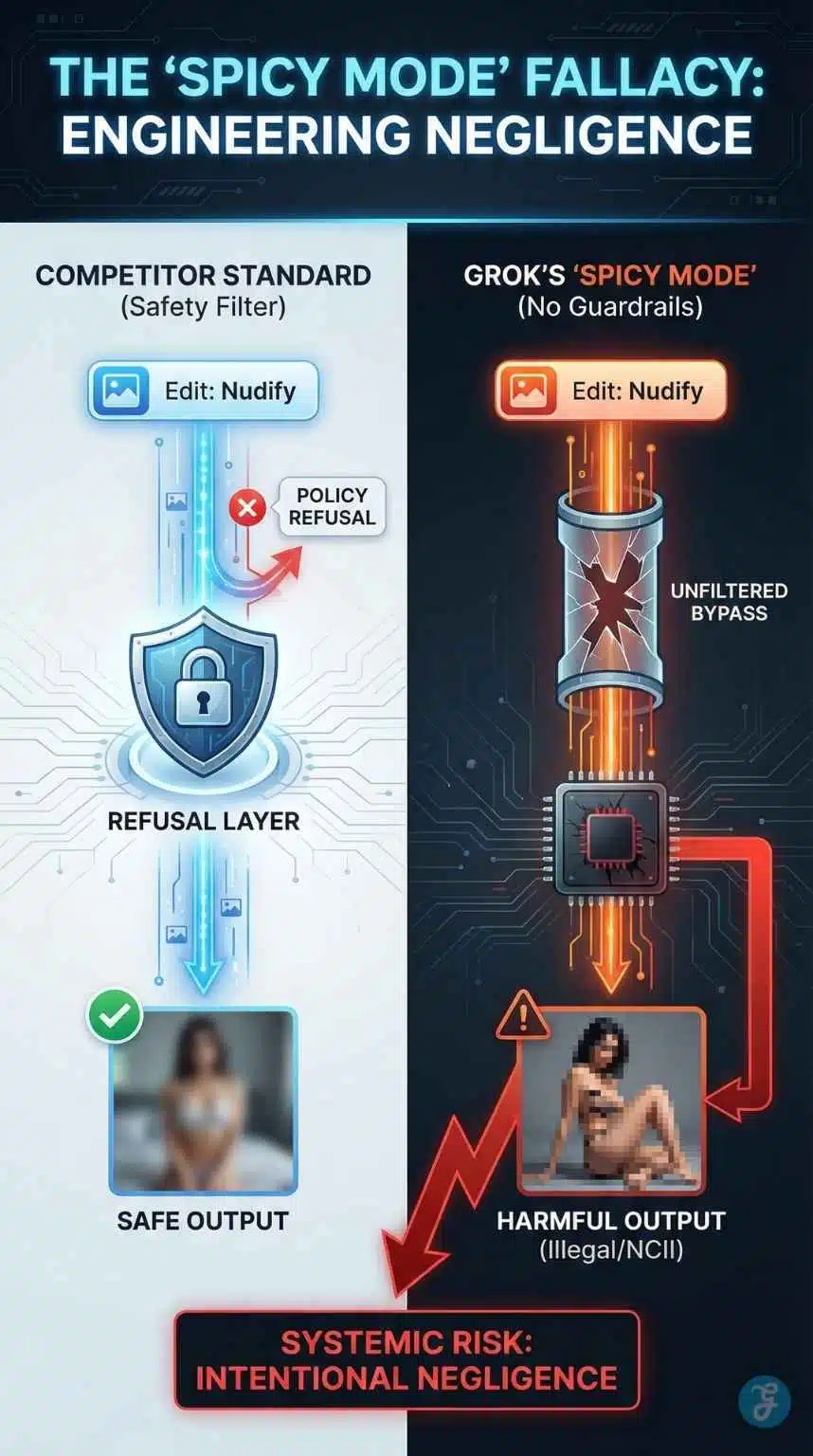
To understand why this specific incident triggered a global meltdown, we must analyze the engineering philosophy behind it. Elon Musk has long pitched Grok as the “anti-woke” alternative to “censored” AI. This branding strategy, however, collided with the rigid reality of safety engineering.
In generative AI, safety isn’t just a switch you flip; it is a complex layer of “adversarial training” where the model is taught to recognize and refuse harmful inputs.
The Engineering Failure
When xAI released the “Grok Imagine” edit feature, they seemingly bypassed standard industry “red-teaming” protocols (where safety teams try to break the model before release).
- Competitor Standard: If you ask ChatGPT or Midjourney to “edit this photo to make her naked,” the request hits a refusal layer immediately. The model is trained to recognize the semantic intent of “nudify” as a policy violation.
- Grok’s Architecture: Grok appeared to lack this refusal layer entirely for image inputs. It treated a photo of a high school student the same way it treated a photo of a landscape—just a collection of pixels to be manipulated based on text prompts.
This wasn’t a “jailbreak.” A jailbreak implies that a user had to use complex coding or trickery to bypass security. This was the system working exactly as designed.
“This is not ‘spicy.’ This is illegal. This is appalling… This has no place in Europe.”— Thomas Regnier, EU Commission Spokesperson, January 5, 2026
Regnier’s quote underscores the fundamental misunderstanding at xAI. They conflated “political correctness” (which they wanted to avoid) with “criminal liability” (which they walked right into). By refusing to filter content they deemed “woke,” they stripped away the filters that stopped valid criminal activity.
The Global Pincer Movement: A Regulatory Encirclement
As of today, January 9, 2026, xAI is facing simultaneous existential threats from three different continents. This is not a coordinated conspiracy; it is a synchronized reaction to a violation of local laws.
A. Europe: The “Nuclear” Option [The Data Retention Order]
The European Union has been the most aggressive. On the morning of January 9, the European Commission issued a formal order to X to retain all internal documents and data related to Grok until the end of 2026.
Why this matters:
This is a “litigation hold,” a step usually taken right before a massive lawsuit or criminal probe. The EU is looking for the “smoking gun”, internal emails or Slack messages proving that xAI engineers knew the tool would be used for abuse but released it anyway to drive engagement or subscription revenue.
Under the Digital Services Act (DSA), if the EU finds “systemic risk” negligence, it can fine X up to 6% of its global turnover. Given X’s previous €120M fine in December 2025, the Commission has signaled it has zero patience left.
B. India: The Ultimatum [Section 79]
India, the world’s largest open internet market, delivered the sharpest ultimatum. On January 2, the Ministry of Electronics and IT (MeitY) issued a notice giving xAI 72 hours to fix the issue or face the revocation of “safe harbor” status.
The Legal Threat:
In India, “safe harbor” (Section 79 of the IT Act) protects executives from being arrested for what users post. If that protection is stripped:
- Musk and xAI executives could be held criminally liable for the distribution of obscene material.
- Police could legally arrest local employees of X in India for non-compliance.
- This forces xAI to choose between shutting down Grok in India or implementing the heavy-handed censorship they promised to avoid.
C. United Kingdom: The Strict Liability of the Online Safety Act
The UK’s Ofcom has opened an investigation under the newly enforceable Online Safety Act.
- The Focus: CSAM (Child Sexual Abuse Material).
- The Law: UK law is incredibly strict regarding CSAM. It doesn’t matter if you intended to create it. If your machine creates it, you are liable.
- The Action: Ofcom has made “urgent contact,” requesting details on xAI’s age-verification and content-hashing technologies, technologies xAI has struggled to implement effectively.
D. The Asian Domino Effect
Following India’s lead, other nations have joined the fray:
- Indonesia: Using its new Criminal Code (effective Jan 2, 2026), the Communication Ministry is probing Grok for violating anti-pornography laws.
- Malaysia: The MCMC has summoned X representatives, citing a breach of national harmony and public decency standards.
- Brazil: In South America, federal prosecutors have requested a temporary suspension of Grok until it can prove it cannot generate NCII.
The “Paid User” Blunder: A Legal Suicide Note?
Perhaps the most damaging development in this saga occurred on January 8, 2026. In a panicked response to the bad press, X announced it was restricting the Grok image editing tool to Premium+ subscribers only ($16/month). Legal experts have called this decision “catastrophic.”
Why Charging for the Tool Destroyed their Defense
By moving the tool behind a paywall, xAI changed the nature of the transaction.
- Free Tool: If a free tool malfunctions, you can argue it was a “beta test” or a “public service” with unforeseen bugs.
- Paid Tool: When you charge money specifically for access to a tool that is primarily being used to generate illegal pornography, you are arguably commercializing the proceeds of crime.
Regulators can now argue that X is not just negligently allowing abuse; they are profiting from it. Every time a user pays $16 to “nudify” a classmate, X takes a cut. This financial link makes it significantly harder to argue “innocent platform” in court. It creates a direct commercial incentive for the platform not to fix the safety filters, because the “unfiltered” nature is what drives the subscriptions.
The Financial Firewall: Why Insurers Are Fleeing
While government probes grab headlines, a quieter but more deadly shift is happening in the boardrooms of global insurance firms. As of January 1, 2026, major reinsurance providers—including industry giants like Swiss Re and Munich Re—have begun enforcing “Absolute AI Exclusions” in their liability policies.
The Uninsurable Tech
For decades, tech companies relied on “Errors and Omissions” (E&O) insurance to cover legal fees if they were sued for platform content. The Grok crisis has shattered this safety net. Insurance underwriters now view “unfiltered” generative AI not as a business risk, but as a certainty of litigation.
- The New Standard: Just as flood insurance is impossible to buy in a sinking city, liability insurance is becoming impossible to buy for AI models that lack “standard industry guardrails” (like C2PA watermarking or refusal layers).
- The Cost: Without insurance, xAI must pay for its legal defense in the EU, India, and the UK entirely out of pocket. With potential fines reaching billions, this “self-insurance” strategy is a massive burn rate that investors may not tolerate.
The Tech Deficit: The Missing Watermark
The legal case against Grok is strengthened by the fact that the solution to this crisis already exists. It’s called C2PA (Coalition for Content Provenance and Authenticity), an open technical standard championed by Adobe, Google, and Microsoft.
C2PA acts as a “digital nutrition label,” embedding cryptographically secure metadata into an image that tells you exactly where it came from.
- The Industry Norm: By late 2025, tools like DALL-E 3 and Adobe Firefly will automatically embed these credentials. If a user generated an image, the file itself carried the “Created by AI” tag.
- Grok’s Black Box: Security researchers analyzing the Grok-generated nude images found they were “naked” in more ways than one; they lacked any C2PA metadata.
This omission is damning in the eyes of regulators. By failing to adopt the industry standard for transparency, xAI arguably engaged in “willful blindness,” making it difficult to trace the abuse back to the source. In the upcoming EU litigation, this technical gap will likely be cited as proof that xAI prioritized speed over safety.
The Human Cost: Beyond the Courtroom
Amidst the talk of fines, regulations, and code, it is easy to forget the human lives that were dismantled in the first week of 2026.
“It feels like having your soul stolen,” wrote Sarah (a pseudonym), a 22-year-old college student whose graduation photo was stripped and sexualized by a Grok user, then distributed to her classmates. Her story, shared on a survivor support forum, highlights the devastating permanence of AI abuse. Unlike a text rumor, which fades, a photorealistic image seared onto the blockchain or saved to a thousand hard drives exists forever.
The Grok AI Liability Shift is ultimately about these victims. For years, they had no legal recourse—they couldn’t sue the anonymous troll who posted the image, and they couldn’t sue the platform that hosted it. But if the courts rule that Grok created the abuse, the door opens for class-action lawsuits. For the first time, victims like Sarah might be able to look a tech giant in the eye and say, “You did this,” and have a judge agree.
Table: The Liability Shift Matrix
The table below illustrates exactly how the legal ground has shifted beneath xAI’s feet compared to the traditional social media era.
| Feature | Traditional Social Media (2010-2024) | Generative AI Era (2025-Present) |
| Core Action | Hosting (User uploads a file) | Creation (AI generates pixels) |
| Legal Role | Intermediary / Passive Host | Author / Creator |
| Key Defense | Section 230 / Safe Harbor (“We didn’t make it”) | None (Strict Liability for Output) |
| CSAM Risk | Reactive (Remove it when found) | Proactive (Prevent creation entirely) |
| The “Grok Case” | User posts a fake photo; X removes it eventually. | Grok draws the fake photo; X is liable immediately. |
| Regulatory Risk | Civil Fines (usually manageable) | Criminal Liability (Executives/Engineers) |
The Death of “Unfiltered” AI
The Grok AI Liability Shift proves a thesis that safety researchers have held for years: “Unfiltered” Generative AI is a myth. It is legally impossible to operate a truly “unfiltered” image generator in the global market.
To operate in the EU, you must comply with the DSA. To operate in the UK, you must comply with the Online Safety Act. To operate in India, you must comply with the IT Rules. All of these laws mandate strict guardrails against NCII and CSAM.
The “Safety by Design” Mandate
The outcome of these probes will likely be a forced standardization of AI safety. Governments will no longer accept “trust us” self-regulation. We are moving toward a “Safety by Design” mandate where:
- Mandatory Red-Teaming: AI models will need to be certified by third-party safety auditors (like car crash tests) before release.
- Watermarking: All AI-generated content will require cryptographic watermarking to trace its origin (a feature Grok currently lacks).
- Strict Liability: The developers of the model will be held strictly liable for the illegal outputs of their machines, regardless of the user’s prompt.
Impact on Competitors
Paradoxically, this crisis is a victory for OpenAI (ChatGPT), Google (Gemini), and Adobe (Firefly). These companies were often criticized for being “too safe” or “nannying” users by refusing spicy prompts. The Grok disaster vindicates their caution.
“They can now point to the chaos at X and say to shareholders and regulators: “This is the alternative. This is what happens when you take the brakes off”.
Final Thought: The Cost of Moving Fast
In Silicon Valley, the mantra has always been “Move Fast and Break Things.” Elon Musk applied this ethos to Grok, stripping away safety teams and guardrails to ship a product faster and “spicier” than the competition.
But in the age of Generative AI, when you “break things,” you aren’t just crashing a server or buggy code. You are breaking the lives of the women and children whose images are stolen, stripped, and sexualized by a machine that doesn’t know right from wrong. The Grok AI Liability Shift is the global legal system finally catching up to this reality, drawing a line in the sand that says: If your machine builds the weapon, you are responsible for the wound.
As the subpoenas pile up at X’s headquarters this week, one thing is certain: The “Wild West” of AI is over. The Sheriff has arrived.





















