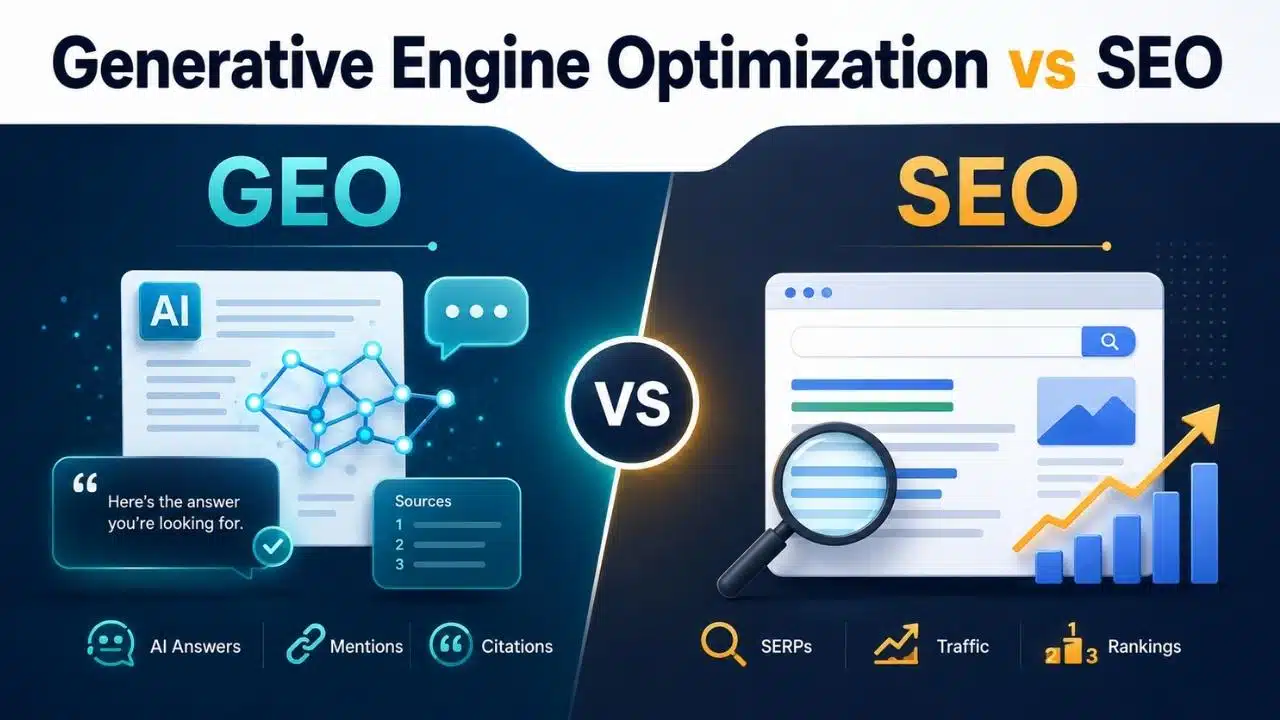
Generative Engine Optimization vs SEO isn’t a battle for dominance—it’s an evolution of how content gets found. While traditional SEO optimizes pages to rank among blue links, Generative Engine Optimization (GEO) ensures your content is retrieved, cited, and summarized inside AI-generated answers like Google AI Overviews, ChatGPT Search, and Perplexity.
GEO doesn’t replace SEO; it builds directly on top of it. Core foundations like clean crawlability, indexation, and topical authority remain essential. However, Answer Engine Optimization (AEO) and GEO shift the goalpost toward direct-answer delivery, semantic clarity, and verifiability. To capture modern search visibility, brands must structure high-density facts and authoritative data that both human readers and AI retrieval systems can immediately trust.
What Is Generative Engine Optimization?

The term Generative Engine Optimization was formalized in research by Pranjal Aggarwal and co-authors. Their work first appeared as a preprint in 2023 and was later published at KDD 2024.
The paper described generative engines as systems that retrieve information from different sources and synthesize it into a response. GEO was proposed as a way to study and improve how visible those sources become inside generated answers.
The researchers reported visibility gains of up to 40% under some experimental conditions. That number deserves context. It came from a controlled benchmark and specific experimental systems. It should not be interpreted as a promise that adding citations, statistics, or quotations to a live page will increase ChatGPT or Google AI visibility by 40%.
In practical marketing terms, GEO now covers work aimed at improving:
- citations in AI-generated answers;
- inclusion as a supporting source;
- brand mentions;
- retrieval for complex questions;
- referral traffic from AI search products;
- visibility inside Google’s generative Search features.
There is no universal GEO ranking score. Google, OpenAI, Perplexity, and other AI-search systems use different retrieval, ranking, and citation mechanisms.
Generative Engine Optimization vs SEO: What Actually Changes?
The biggest difference is the output being optimized.
| Area | SEO | GEO |
| Main visibility | Search results | Generated answers and supporting sources |
| Typical outcome | Ranking, impression, click | Citation, mention, retrieval, referral |
| Technical base | Crawlability, indexation, architecture | Mostly the same base, plus platform-specific crawler access |
| Content priority | Relevance, usefulness, authority | Relevance, evidence, specificity, source usefulness |
| Measurement | Mature search reporting | Still fragmented across AI platforms |
For Google, the distinction is especially narrow. Google’s current guidance describes GEO and AEO as industry terminology rather than separate optimization systems. Its AI Overviews and AI Mode still rely on Google’s core Search infrastructure and quality systems.
That is a useful reality check. AI search introduces new surfaces and new reporting questions, but it does not erase the value of conventional SEO.
AI Search Can Retrieve a Page for a Smaller Part of a Bigger Question
Generative search changes how people formulate searches.
A traditional query might be:
best CRM for small business
A user can now ask:
Which CRM works well for a 12-person consulting firm that needs email automation, simple deal tracking, QuickBooks integration, and predictable pricing without an enterprise implementation?
That is several information needs wrapped into one question.
Google says AI Overviews and AI Mode can use query fan-out, issuing related searches across different subtopics while developing a response.
This means one useful section of a page may be retrieved because it answers part of a larger question particularly well. The wrong response is publishing a separate article for every possible conversational variation.
The better response is covering the real decision properly: comparisons, constraints, exceptions, compatibility questions, costs where relevant, and the details a serious reader needs before choosing.
Google has specifically warned against scaling large numbers of pages around presumed query variations simply to manipulate Search or AI-generated responses.
Most GEO Foundations Are Already Strong SEO Foundations
A growing number of GEO tactics sound more complicated than they need to be. For most publishers, the first question is still basic: Can the relevant system access the page?
Google does not provide a separate indexing route for AI Overviews or AI Mode. Pages still need to meet normal Search technical requirements.
ChatGPT Search has its own crawler considerations. OpenAI currently uses OAI-SearchBot for search discovery and distinguishes it from GPTBot, which publishers can control separately when deciding whether pages may be used for potential model training.
Perplexity makes a similar distinction with PerplexityBot, which is documented for surfacing and linking web content in its search results.
For technical teams, that makes a blanket “block AI bots” rule too crude.
Review:
- robots.txt;
- CDN and WAF rules;
- authentication walls;
- accidental noindex directives;
- JavaScript accessibility;
- bot-blocking policies.
Decide separately what should be searchable and what should be available for model training.
Original Information Is Becoming More Valuable Than Another Rewrite
One of the clearest implications of AI search is that generic information is easier than ever to reproduce. If 20 websites explain the same topic from the same five public sources, another lightly rewritten article gives a retrieval system little reason to prefer it.
Google’s current AI-search guidance places particular emphasis on non-commodity content: material that contributes genuine experience, expertise, original reporting, research, or useful analysis instead of simply restating what already exists.
For a software publication, that might mean:
- actual benchmark results;
- verified feature comparisons;
- compatibility findings;
- screenshots from genuine testing;
- implementation failures;
- original datasets;
- interviews;
- consistent evaluation criteria.
A business publication might add proprietary survey data, document analysis, original reporting, or a comparison that reveals something existing coverage misses.
Not every publication has firsthand evidence for every article. That is fine.
Careful synthesis, stronger primary sourcing, useful historical context, and sharper analysis can still add real value. What matters is that the page contributes something beyond another rearrangement of widely available facts.
GEO Does Not Require Writing Like a Machine
Some GEO advice has produced articles that are technically tidy but exhausting to read: tiny sections, repetitive definitions, question-and-answer blocks under every heading, and sentences clearly written for extraction rather than comprehension.
There is no need for that.
Google explicitly says publishers do not need to divide content into artificial chunks or rewrite pages in a special “AI-friendly” style.
Clarity is still useful.
If a heading asks What is retrieval-augmented generation?, answer the question near the top of the section. Then add the limitations, example, or technical detail that makes the explanation worthwhile.
Use a table when comparison genuinely becomes easier in a table. Use numbered steps for an actual sequence. Keep names, dates, measurements, and technical terminology precise. Those are sound editorial practices whether a human reader or retrieval system reaches the page.
Evidence Matters More Than Decorative Citations
AI-generated answers often depend on factual support from several sources. That makes vague claims increasingly weak source material.
Compare:
Automation improves productivity.
with:
A documented experiment measured how a defined workflow changed processing time over a specified period. The second statement gives both the reader and a retrieval system something concrete to evaluate.
Good source material makes important evidence traceable:
- use primary research where possible;
- identify who collected a statistic;
- include dates when information can age;
- separate measured results from opinion;
- explain methodology for original research;
- use precise company and product names;
- remove statistics that can no longer be sourced confidently.
Do not add random quotations or numbers because an early GEO study found benefits from particular content interventions.
The evidence should serve the claim, not the tactic.
ChatGPT Search Optimization Starts With Access and Useful Information
There is no published formula that guarantees a citation in ChatGPT Search. OpenAI says its search ranking uses multiple factors intended to surface reliable and relevant information, and it does not guarantee top placement.
For publishers, ChatGPT search optimization therefore starts with fairly ordinary work:
- allow OAI-SearchBot on content intended for discovery;
- make sure the CDN or firewall is not rejecting it;
- avoid unnecessary login barriers on public information;
- keep factual material current;
- use descriptive page titles;
- maintain clear internal structure;
- publish information worth retrieving.
OpenAI currently adds utm_source=chatgpt.com to referral URLs from ChatGPT Search, giving publishers a practical way to identify at least some visits from the product.
A citation and a visit are not the same thing, though. A source can contribute to an answer without generating meaningful referral traffic. That is one reason GEO performance is harder to measure than ordinary search traffic.
Perplexity SEO Has Similar Limits
The phrase Perplexity SEO is useful shorthand, but it can imply more certainty than publishers actually have. Perplexity documents PerplexityBot and explains how publishers can allow the crawler so pages can be surfaced and linked in results.
There is no public formula that guarantees a citation position. The sensible optimization work remains familiar: publish current, relevant, specific, well-supported information and make sure the platform can access it.
Third-party GEO studies can identify patterns worth testing. They should not be presented as official Perplexity ranking factors. The same caution applies to commercial “AI authority” or “LLM visibility” scores. Such tools may be useful for monitoring. They do not have universal access to the internal ranking systems of every AI-search platform.
There Is No Special GEO Schema for Google
Structured data still matters where it accurately describes visible page content. Product, Article, Organization, LocalBusiness, Breadcrumb, and other supported schema types can continue to help Google interpret pages and qualify them for appropriate search features.
There is no separate GEO schema required for AI Overviews or AI Mode. Google also says it does not use llms.txt for Search. Adding the file does not improve or reduce Google Search or generative-search visibility. Other platforms may choose to use similar files in the future or for their own purposes, so having one is not inherently harmful.
It simply should not be sold as mandatory Google AI-search infrastructure.
GEO Measurement Is Improving, but It Is Still Fragmented
SEO teams are used to working with impressions, clicks, rankings, sessions, conversions, and revenue.
GEO adds less standardized measures.
Useful signals include:
- AI citations: Does the system link to the site?
- Brand mentions: Is the company named even when no link appears?
- Answer inclusion: Does information from the site become part of the generated response?
- Referral traffic: Are AI-search products sending visitors?
- Prompt coverage: Across a repeatable set of commercially important questions, how often does the brand or content appear?
Google has improved measurement on its own platform. In June 2026, it introduced dedicated Generative AI performance reporting in Search Console for visibility in AI Overviews, AI Mode, and related generative experiences.
Cross-platform reporting remains much less consistent. Generated answers can also vary between users, locations, repeated runs, and changing indexes. One screenshot of a brand appearing in an AI response is not a meaningful performance report. If GEO matters to the business, use a stable set of relevant prompts and observe them over time.
What Should SEO Teams Actually Change?
Most organizations do not need to create a completely separate GEO operation. They need to widen the existing SEO workflow.
Keep Technical SEO Healthy
Crawlability, indexation, canonicalization, internal linking, sensible architecture, HTML accessibility, JavaScript handling, and page performance still matter.
Audit AI Crawlers Deliberately
Understand how Googlebot, OAI-SearchBot, GPTBot, PerplexityBot, and other relevant crawlers are handled. Search discovery and model-training access should not automatically receive the same policy.
Find Commodity Content
Look for pages that contribute little beyond summarizing other search results. Some deserve better evidence or analysis. Others may not deserve rewriting at all.
Research Decisions, Not Only Keywords
Keyword research remains useful, but conversational AI queries contain more context. Research the comparison the reader is making, the constraints that change the answer, likely follow-up questions, and the evidence needed before acting.
Make Claims Verifiable
Use primary sources where possible. Date information that can expire. Mark genuine uncertainty. Keep editorial judgment separate from facts.
Add AI Visibility to Existing Reporting
Monitor citations, mentions, and AI referrals, but do not let them replace business outcomes. An impressive citation count means little if it never contributes to awareness, leads, subscriptions, sales, or another relevant objective.
GEO Advice That Deserves Skepticism
GEO is still young enough for speculative tactics to be packaged as established rules.
Be cautious when a provider promises:
- guaranteed ChatGPT citations;
- guaranteed Perplexity positions;
- one universal LLM authority score;
- mandatory llms.txt for Google;
- special GEO schema;
- fixed content chunk sizes;
- hundreds of pages targeting synthetic fan-out queries;
- fabricated brand mentions;
- traffic forecasts based directly on the GEO paper’s 40% experimental result.
Google itself currently recommends established SEO practices over unsupported GEO or AEO tricks.
GEO remains useful. It simply deserves the same discipline mature SEO eventually developed: distinguish documented behavior from correlation, experiments, commercial claims, and guesswork.
Final Thoughts
The practical difference in Generative Engine Optimization vs SEO is smaller than the terminology sometimes suggests. SEO remains the foundation. Search and AI systems still need to access, understand, and find value in a page before it has much chance of appearing in either conventional results or generated answers.
GEO broadens the outcome being measured. Rankings and clicks still matter, but marketers now also need to watch retrieval, citations, brand mentions, and AI referrals. That calls for some new monitoring and more deliberate crawler management. It does not require rewriting every article for an imagined LLM preference.
The stronger priority is harder to fake and more useful over time: publish information worth retrieving, support important claims properly, add something the rest of the web is not simply repeating, and keep the technical foundation clean. That is a sensible GEO strategy because it remains good search strategy even as the interface around search changes.