If you build apps, you have probably faced the classic debate of GraphQL Vs REST: When to Use Each. Your frontend team asks for one thing, your backend team builds something else, and suddenly everyone is frustrated. You are caught between REST APIs, making you fetch too much information, and GraphQL, sounding amazing but feeling complicated. This struggle happens to many developers, and it slows down your whole project.
Here is a fascinating detail from the 2025 Postman State of the API Report. They found that US developers still use REST for over 80% of their integrations, while GraphQL adoption has grown to 33% for specific, complex tasks. Choosing the right approach can cut development time by up to 40 percent.
That is not small. The right tool makes your team faster, your code cleaner, and your users happier. I am going to show you exactly when to pick each one, and even explain how to use them together.
Key Differences for GraphQL Vs REST: When To Use Each
GraphQL and REST take completely different approaches to moving data between clients and servers. Understanding what sets them apart helps you pick the right tool for your project.
Client-side data fetching
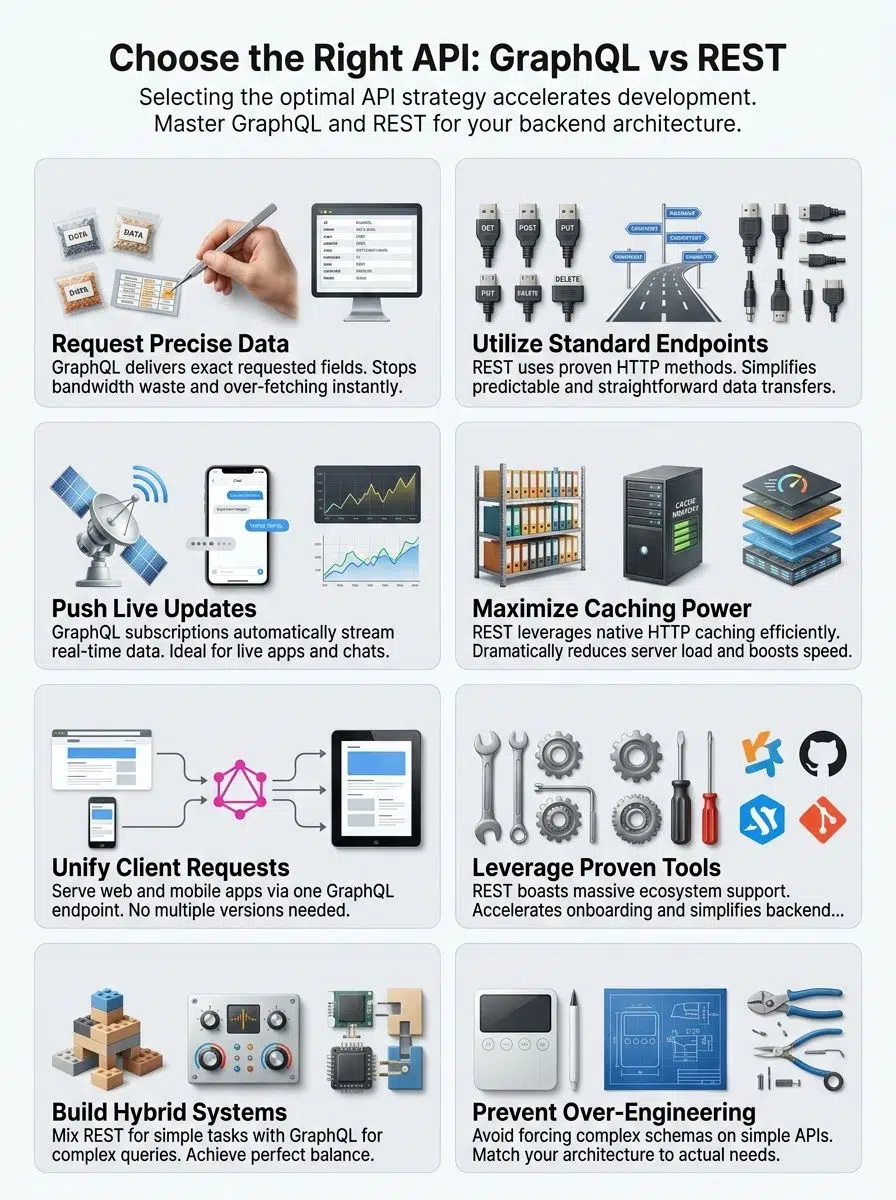
REST forces clients to hit multiple endpoints to grab all the data they need. Think about loading a simple profile page.
Here is how a standard REST architecture handles it:
- Call /users/123 to get basic profile information.
- Call /users/123/posts to fetch the recent articles.
- Call /users/123/friends to grab the connections list.
This approach creates extra network traffic and slows down your application. Each request travels back and forth, wasting time and bandwidth. The client-side data fetching process becomes tedious, repetitive, and inefficient.
GraphQL flips this on its head by letting clients request exactly what they need in a single query. Your frontend specifies the precise fields it wants, and the server returns only that information. No bloated responses filled with unnecessary data. No wasted bandwidth on fields your app never uses.
The client controls the shape and size of the data transfer, making the entire architecture more efficient. The differences in how these two approaches handle data retrieval set the stage for understanding server-side schema and structure.
Data returned to the client
REST APIs return fixed data structures to clients. The server decides what information travels back, and the client gets everything the server sends.
You might receive user details, product information, or order history all at once. The server bundles these items together, whether the client needs them or not.
Over-fetching happens constantly with REST. Your application downloads extra data it never uses, which slows things down and wastes bandwidth.
A 2026 technical analysis of systems like Shopify’s API found that switching to GraphQL reduced the payload size by up to 99% in total bytes, vastly improving load times for mobile users.
GraphQL flips this script entirely. Clients request exactly what they need, nothing more, nothing less. A mobile app might ask for just a user’s name and email, while a web dashboard requests the same user’s complete profile with transaction history. This precision in data transfer cuts bandwidth costs and improves performance significantly.
Each client shapes its own response, making the architecture far more adaptable than traditional REST endpoints.
Server-side schema and structure
How the server organizes data shapes everything about how clients pull information from it. REST APIs let servers define their own structure, and clients must adapt to whatever format the server sends back.
GraphQL puts the schema front and center, making it a formal contract between server and client. The server declares exactly what data types exist, what fields belong to each type, and how they connect to each other.
To enforce this contract seamlessly, many US development teams use tools like GraphQL Code Generator. This tool automatically creates TypeScript types from your schema, catching errors before you even run the code.
This architecture means developers know precisely what they can request before they write code. The schema acts like a detailed blueprint for your entire backend development.
REST APIs lack this formal structure natively, so developers often hunt through documentation to figure out what endpoints exist. With GraphQL, the schema itself becomes the documentation, always current and accurate.
Versioning and flexibility
REST APIs often struggle with versioning because they tie data structure to specific endpoints. You make a change to your data model, and suddenly, your old clients break.
Developers end up creating new versions like /v1/, /v2/, and /v3/ to keep old clients happy while supporting new features. This works, but it creates maintenance headaches.
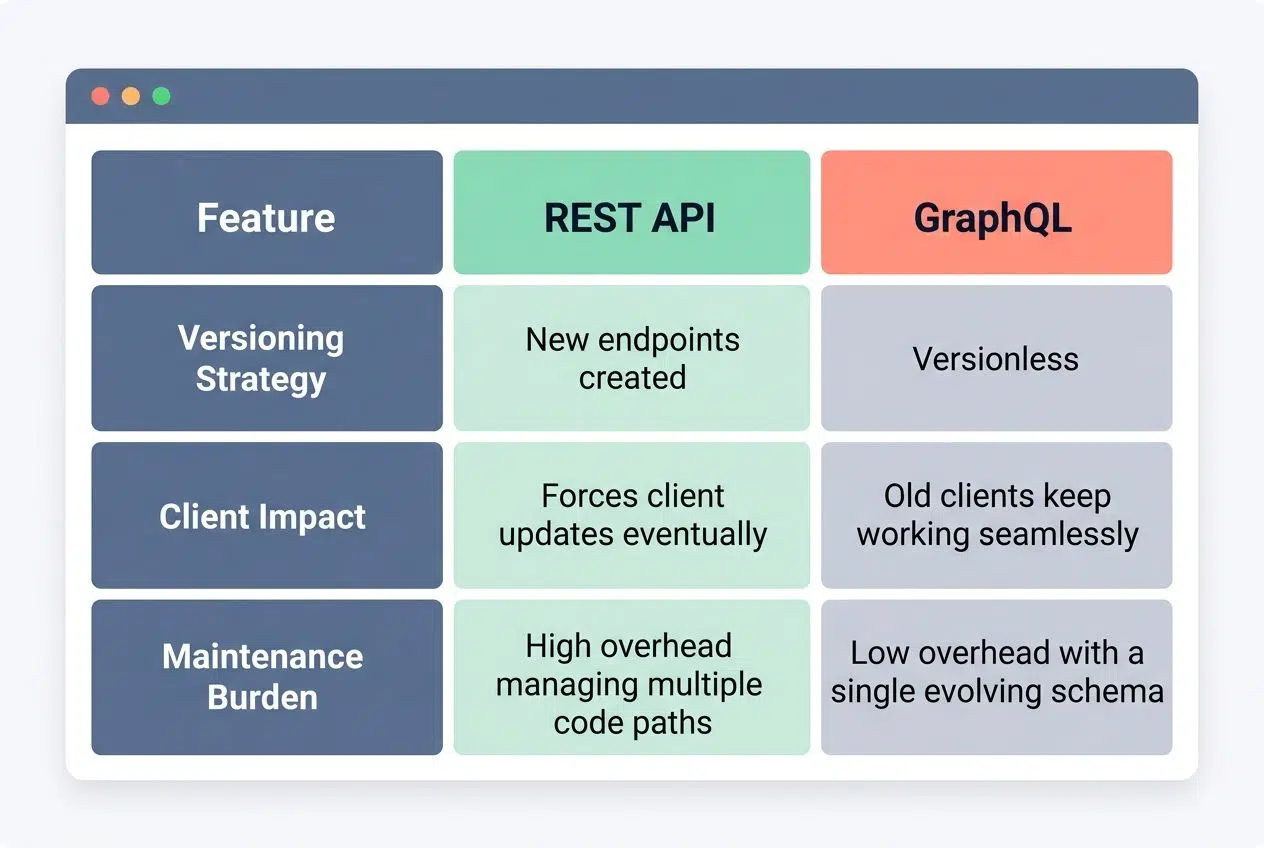
Here is a quick breakdown of how the two approaches compare on versioning:
| Feature | REST API | GraphQL |
|---|---|---|
| Versioning Strategy | New endpoints created (e.g., /v2/users) | Versionless (add new fields, deprecate old ones) |
| Client Impact | Forces client updates eventually | Old clients keep working seamlessly |
| Maintenance Burden | High overhead managing multiple code paths | Low overhead with a single evolving schema |
GraphQL flips this problem on its head through its flexible query language. Clients request exactly what they need, nothing more, nothing less.
You add new fields to your backend, and old clients keep working without any changes. GitHub famously transitioned to GraphQL precisely to stop maintaining dozens of legacy REST API versions.
Your backend evolves, your frontend stays stable, and everyone sleeps better at night. The query language adapts to your needs rather than forcing you into rigid endpoints.
Advantages of GraphQL
GraphQL lets you grab exactly the data you need, skip the rest, and watch your applications run faster than ever before. Stick around to see how this power can transform your projects.
Efficient and flexible data queries
You ask the server for exactly what you need, nothing more and nothing less. REST APIs often send back extra data you do not use, which wastes bandwidth and slows things down. With flexible data queries, you pick the specific fields you want from each resource. Your app downloads less information, loads faster, and uses less battery on mobile devices.
This precision in data transfer makes a real difference in the real world. In the US, the average 5G latency hovers around 30 to 50 milliseconds. Cutting out multiple API round-trips saves noticeable fractions of a second, making your app feel instant.
The architecture of flexible queries also lets multiple frontend clients get different data from the same endpoint. One mobile app might request just a user’s name and profile picture, while a web application asks for the full user profile.
You do not need separate API versions or multiple endpoints to satisfy different client needs. This flexibility means your backend development team spends less time building custom endpoints for each project.
Single endpoint for multiple resources
GraphQL takes this efficiency one step further by consolidating all your data requests into a single endpoint. Instead of hitting multiple REST endpoints scattered across your backend, you send one query to one location, usually /graphql.
Here are the immediate benefits of using a single endpoint architecture:
- Simpler routing logic on your application server.
- Easier configuration for firewalls and cross-origin resource sharing policies.
- One clear, centralized destination for all frontend data requests.
Your client receives exactly what they asked for, nothing more, nothing less. Managing multiple frontend clients becomes far easier with this approach. A mobile app, a web application, and a desktop client all talk to the same endpoint. Each one requests its specific data needs without forcing developers to create separate API versions.
Your backend stays cleaner, your data transfer stays lighter, and your team spends less time maintaining different code paths.
Real-time data updates
Real-time data updates matter when your app needs to show fresh information instantly. Think about a stock trading platform where prices shift every second, or a chat application where messages pop up as friends type.
REST APIs struggle here because they rely on clients asking for new data repeatedly. This back-and-forth takes time, and you often get stale information. The architecture forces you to build extra layers just to push updates to users.
Query language systems shine in this scenario through subscriptions. This feature uses WebSockets to let servers push data to clients automatically.
Your backend sends updates the moment something changes, without waiting for the client to ask. This real-time data transfer cuts delays dramatically and improves the user experience.
Developers building collaborative tools or instant notifications find this capability invaluable. The flexibility means your frontend clients get exactly what they need, exactly when they need it.
Advantages of REST
REST APIs follow a straightforward approach that developers understand immediately, making them easier to build and maintain across teams. These APIs also work beautifully with standard web caching.
Simplicity and standardization
REST APIs shine because they follow a straightforward approach. Developers build REST services using standard HTTP methods, like GET, POST, PUT, and DELETE.
This standardization means teams can work faster, since everyone understands the same rules. You do not need to learn complex query languages or special syntax.
A 2024 SmartBear State of Software Quality report noted that over 85% of API-first companies use the OpenAPI Specification (formerly Swagger) to document their REST services, providing a massive, standardized ecosystem.
The architecture stays predictable, making it easier for new developers to jump in and contribute. Companies have used REST for years, so plenty of documentation and examples exist online.
A JavaScript developer can talk to a REST API the same way a Python developer does. This maturity in the web services field means fewer surprises and more reliable performance.
The simplicity of REST endpoints keeps your backend development straightforward. Organizations that value predictability often choose REST because it delivers exactly what they expect.
Better caching mechanisms
REST APIs shine when you need to cache data efficiently. HTTP caching works naturally with REST because each endpoint returns fixed data structures.
Your infrastructure can store these responses easily to save massive amounts of server power. You can implement caching at several powerful levels:
- Browser Cache: Saves responses directly on the user’s device for repeat visits.
- CDN Cache: Uses services like Cloudflare or Fastly to serve data from edge servers globally.
- Gateway Cache: Stores data right before it hits your internal application logic.
A recent technical analysis of API caching found that proper HTTP caching with CDNs can handle over 90% of your read traffic. For example, Stripe caches their API documentation responses aggressively, reducing origin load by over 90% during traffic spikes.
GraphQL complicates caching. Every query is different, so standard HTTP caching struggles to work well. You must build custom caching solutions, which takes extra time and effort.
For projects where performance matters most, REST’s built-in caching advantages make it the smarter choice.
Wide adoption and tooling support
REST has been around for over two decades, and this longevity means developers have built massive ecosystems around it. Tools like Postman and Insomnia make testing REST APIs an absolute breeze.
Libraries exist in every programming language you can think of. Teams find it easy to hire developers who already know REST inside and out.
The standardization means less training time and faster project launches. Your team probably has REST experience already, so you skip the learning curve entirely.
Tooling support for REST translates directly into faster development cycles and lower costs. Documentation standards are well established, so onboarding new team members takes days instead of weeks.
Caching infrastructure works seamlessly with REST architecture. Companies have perfected REST patterns over years of production use, giving you confidence that your API will perform beautifully.
When to Use GraphQL
GraphQL shines when your app needs to pull different data shapes from multiple sources, all without creating new endpoints each time. Your frontend teams get exactly what they ask for, nothing more, nothing less.
For applications requiring dynamic and flexible data fetching
Your app needs to pull different data based on what users actually want. REST forces you to hit multiple endpoints and grab everything those endpoints offer, whether you need it or not.
GraphQL solves this beautifully. It is especially useful for these specific scenarios:
- E-commerce storefronts display varying levels of product details based on user interactions.
- Complex data dashboards with customizable widgets that users arrange themselves.
- Mobile apps that require minimal data payloads to save user bandwidth.
You write a query that specifies which fields matter for your use case. The server responds with only that information. This precision cuts down data transfer significantly.
Your app stays fast and responsive because it avoids the bloat of unnecessary information. Real-world applications rarely stay the same, and your requirements will shift.
Your mobile app needs different data than your web app. Each client constructs its own request based on its specific requirements, and the architecture scales with your product.
When supporting multiple frontend clients
Multiple frontend clients pull data in different ways. Some need lots of information, others need just a little. REST forces you to hit multiple endpoints to gather what each client requires.
GraphQL solves this problem by letting each client request exactly what it needs from a single endpoint. A mobile app might ask for user names and profile pictures, while a web application might ask for names, pictures, emails, and payment history.
Both clients talk to the same backend, but they each get precisely what they asked for, nothing more, nothing less. This flexibility makes development teams move faster. Frontend developers stop waiting around for backend teams to create new endpoints for each specific use case.
The query language lets them shape their own data transfer without constant back-and-forth conversations. Your architecture becomes cleaner because you eliminate the endpoint sprawl that plagues many REST services.
When real-time updates are essential
Real-time data fetching becomes critical when your application needs to push information to users instantly. Chat applications, live sports scores, stock market dashboards, and collaborative tools all demand immediate data transfer without delays.
GraphQL excels in these scenarios because it supports subscriptions, a feature that establishes persistent connections between clients and servers. Your backend development team can stream data updates the moment changes occur, rather than forcing users to refresh manually.
REST APIs struggle with real-time requirements because they rely on polling, a technique where clients repeatedly ask the server for new information at set intervals. This approach wastes bandwidth, drains device batteries, and creates unnecessary load on your infrastructure.
GraphQL’s subscription model eliminates this inefficiency by maintaining an open communication channel. Your application architecture becomes more responsive, your users experience smoother interactions, and your server resources get used intelligently.
When to Use REST
REST shines when you need straightforward APIs, strong caching power, and proven tools that your team already knows.
For simple and standardized APIs
Simple and standardized APIs work best with REST architecture. Your team builds endpoints that follow clear patterns, making the code easy to understand and maintain.
REST is the absolute ideal choice when your project matches these conditions:
- Your data structure is simple, flat, and rarely changes.
- Clients almost always need the entire resource object returned to them.
- You are building public APIs intended for third-party developers to consume easily.
REST uses HTTP methods like GET, POST, PUT, and DELETE, so developers already know how to work with them. This standardization means less training time and faster onboarding for new team members.
You avoid complex query languages and stick to straightforward data transfer methods. The predictability of REST shines through in projects where your data structure stays consistent. Small teams move faster with REST because it requires less setup and fewer specialized skills.
When caching and performance are priorities
REST shines when your project needs speed and efficiency. Caching mechanisms built into REST make it a powerhouse for performance-driven applications. HTTP caching headers like ETags and Cache-Control let servers store responses, so clients get data faster on repeat requests. Your infrastructure can cache responses at multiple levels: the browser, CDN, or server.
This layered approach cuts down on unnecessary data transfer and server load dramatically. REST’s predictability means you know exactly what data comes back every time, making caching strategies straightforward to implement.
Performance teams love REST because it follows standardized HTTP protocols that every caching system understands. You avoid over-fetching or under-fetching problems that plague other architecture choices.
Load balancers and reverse proxies work seamlessly with REST endpoints, adding another caching layer without extra effort. If your backend development team operates with limited resources, REST keeps things simple and proven.
For projects with limited development resources
Teams with tight budgets should pick REST for their web services. REST keeps things simple and straightforward, which means developers spend less time learning complex patterns.
The API architecture follows standard conventions, so your team can move fast without extensive training. You avoid the steep learning curve that GraphQL demands, and your backend development stays lean and efficient.
Because REST is the internet’s default language, you can often solve problems instantly by searching Stack Overflow or using pre-built integrations in tools like Zapier.
Most developers already know REST well, so hiring becomes easier and onboarding takes days instead of weeks. Building with REST also means you leverage existing tooling support that costs nothing.
Caching mechanisms work out of the box with standard HTTP practices, so performance stays solid without extra work. Your data transfer stays predictable and straightforward, making troubleshooting faster when problems pop up.
You skip the overhead of managing a GraphQL schema, which requires specialized knowledge and ongoing maintenance that strains limited budgets.
Can GraphQL and REST Be Used Together?
You do not have to pick one or the other. Many teams mix GraphQL and REST to get the best from both approaches.
Hybrid API architecture scenarios
Many teams find that mixing GraphQL and REST creates the perfect balance for their backend development needs.
Your microservices can use REST for straightforward operations, like fetching user profiles or product lists, while GraphQL handles complex data fetching that requires flexibility. This hybrid approach lets you pick the right tool for each job.
Here is how a modern team might divide the responsibilities successfully:
- REST handles: File uploads, secure authentication flows, and simple read-only data dumps.
- GraphQL handles: Complex user interface rendering, deeply nested data structures, and real-time social feeds.
Your mobile app pulls specific fields, while your web version pulls others, all through one GraphQL endpoint. Building a hybrid system takes planning, but the payoff matters.
Your team avoids over-engineering simple operations with GraphQL, yet gains its precision for complicated scenarios. Start with REST, add GraphQL later for specific use cases, and keep both running side by side without conflict.
Leveraging the strengths of both approaches
This hybrid approach works best when you combine REST and GraphQL in your architecture. You pick REST for straightforward, cacheable operations that do not change much.
You deploy GraphQL for complex queries where clients need flexibility and precision in data transfer. This strategy lets your backend development team avoid over-engineering while still meeting diverse client needs.
Your microservices can talk to each other through REST endpoints, keeping things simple and fast. Your frontend clients connect through GraphQL for the intricate data fetching they require.
The result is that you get the performance benefits of REST with the flexibility that GraphQL offers. Some teams run GraphQL as a layer on top of existing REST APIs, which saves time and money.
Others maintain separate endpoints for different use cases, letting each architecture shine where it matters most. This client-server architecture gives you predictability from REST and adaptability from GraphQL.
Avoiding Common Pitfalls
Developers often over-engineer GraphQL solutions when simple REST calls would work better. Teams can waste time building complex query systems for straightforward data needs, so pick the right tool for your actual problem.
Avoid Over-engineering with GraphQL
GraphQL offers tremendous power, but that power can tempt you into building something far too complex. Many teams start with GraphQL and immediately create elaborate schema structures, nested queries, and intricate data fetching logic.
This approach backfires fast. Your codebase becomes harder to maintain, your API slows down, and your team spends more time debugging than shipping features.
A massive pitfall in GraphQL is the N+1 Problem. If poorly configured, a single query asking for a list of 100 users and their posts could trigger 101 separate database calls, completely crashing your server. You must implement tools like DataLoader to batch these requests safely.
Start simple. Build only the data transfer capabilities your application actually needs right now. You can expand your architecture later if your use cases demand it.
Over-engineering happens when developers treat GraphQL as a magic fix for all backend development challenges. You do not need a massive query language if you are just fetching a simple list of users.
REST might handle those endpoints better, faster, and with less overhead. Ask yourself what your clients truly need, then build exactly that, nothing more.
Avoid Misusing REST for Complex Data Structures
REST architecture works best for straightforward data transfers and simple endpoints. Developers often make the mistake of forcing REST to handle intricate, nested data structures that demand multiple requests.
This approach creates a massive performance issue where clients receive too much irrelevant data or must make several trips to the server. REST’s rigid endpoint structure struggles with complex client-server architecture needs.
The API returns fixed data sets regardless of what the client actually needs. Projects that push REST beyond its limits face slower performance and frustrated teams.
Microservices built on REST can multiply these problems when they need to share interconnected information. Teams waste time creating custom solutions and workarounds instead of selecting the right tool from the start.
REST excels at serving simple, standardized operations with excellent caching mechanisms and widespread tooling support. Complex data structures belong in systems designed to handle them.
Wrapping Up
Choosing between GraphQL and REST comes down to your project’s specific needs, team expertise, and long-term goals. GraphQL shines for applications that demand flexibility, real-time data transfer, and support for multiple frontend clients.
REST remains the solid choice for straightforward web services, projects where caching matters most, and teams working with limited development resources.
Your architecture decision shapes how your backend development evolves. Take time to assess what your microservices and client-server setup truly require. The smartest move often involves using both approaches together in a hybrid API architecture.
You might deploy REST for simple, predictable endpoints while leveraging GraphQL’s query language for complex data fetching scenarios. This blended strategy lets you harness the maturity and standardization of REST alongside the precision and flexibility that GraphQL offers.
Frequently Asked Questions (FAQs) on GraphQL Vs REST
1. What is the main difference between GraphQL and REST?
GraphQL lets you ask for exactly what you need in one request, while REST gives you fixed packages of data that might include stuff you don’t want. Facebook built GraphQL in 2012 and shared it with everyone in 2015. Both get your app talking to servers, just in different ways.
2. When should I use GraphQL instead of REST?
Use GraphQL when you need to grab specific bits of data from multiple places at once. It’s perfect for mobile apps or complex systems, and companies like Shopify use it to keep their APIs fast and flexible.
3. Is REST better for simple projects?
Yes, REST is great for simpler projects with stable, predictable needs. Roy Fielding introduced it back in 2000, and it’s still super popular because it’s straightforward and reliable.
4. Can I switch between GraphQL and REST later on?
You can switch if you need to, and some companies like GitHub run both APIs at the same time during transitions. Think about which one fits your needs from the start so you avoid extra work later.