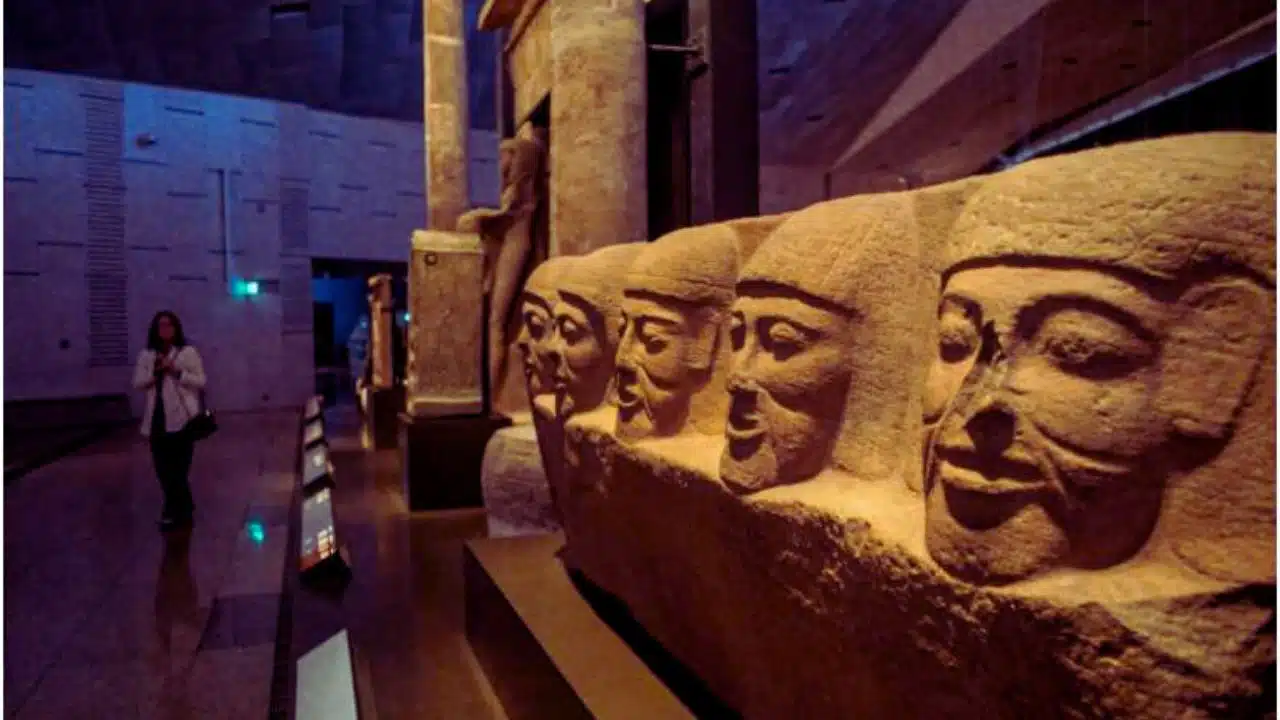
The Grand Egyptian Museum has officially opened on November 2, 2025, marking the culmination of more than 20 years of construction challenges, political upheaval, and regional tensions. This $1 billion facility near the Giza Pyramids represents the world’s largest museum dedicated to a single civilization, housing over 50,000 artifacts spanning 7,000 years of human civilization in Egypt, from prehistory to the end of the Greek and Roman eras around 400 A.D.
Origins and Design Competition
In January 2002, the Egyptian Ministry of Culture announced an international architectural competition to design a new museum complex capable of housing, displaying, and preserving some of the world’s greatest ancient treasures. This competition, supervised by the International Union of Architects and conducted under UNESCO’s patronage, attracted 1,557 entries from 82 countries, making it the second-largest architectural competition in history.
In February 2002, even before a winner was announced, then-President Hosni Mubarak unveiled the foundation stone for the museum at a site located just two kilometers from the Pyramids of Giza. This strategic location was carefully chosen to allow visitors to experience both the pyramids and the museum in a single trip to the Giza Plateau, eliminating the need to navigate Cairo’s congested traffic to reach the older Egyptian Museum in Tahrir Square.
The competition results were announced in June 2003, with Dublin-based Heneghan Peng Architects securing first prize. The final design was a collaborative effort involving 14 different companies across six countries—Egypt, Ireland, England, Canada, the Netherlands, and Austria—with 300 individual experts contributing to perfect the architectural vision.
Construction Phases and Timeline
Construction began in earnest in 2005, with the project divided into three main phases. The first phase focused on the museum’s enabling works, the second phase included the Conservation Centre, energy centre, and fire station, while the third phase encompassed bulk excavation, the main building construction, and the master plan completion.
However, the ambitious project soon encountered significant setbacks of environmental, financial, and political natures that caused monumental delays. Construction was halted for three years following the 2011 Arab Spring uprising, which resulted in President Mubarak’s ousting and subsequent political instability. Tourism to Egypt dwindled during these years, severely reducing government revenue and jeopardizing the museum’s future.
With considerable financial and technical assistance from Japan and other international partners, the project resumed in 2014. The initial cost estimate of $500 million eventually ballooned to over $1 billion, funded through Egyptian resources and international cooperation. The COVID-19 pandemic in 2020 caused another interruption, further extending the timeline. The most recent delay occurred when the planned July 2025 opening was postponed due to escalating regional tensions between Iran and Israel.
Architectural Features and Design
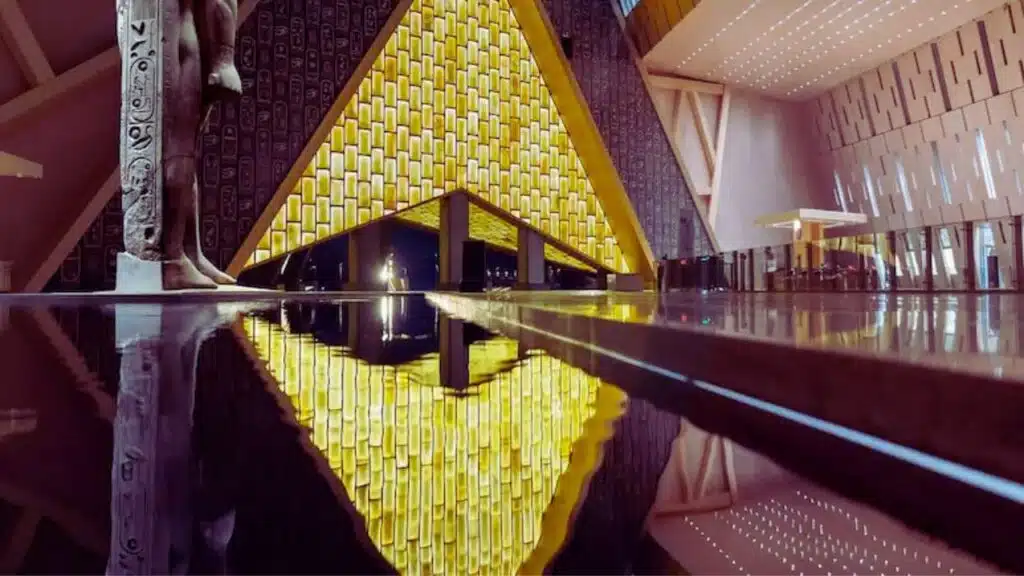
The Grand Egyptian Museum covers an area of 500,000 square meters (5,381,955 square feet), equivalent to approximately 70 soccer fields, with nearly 872,000 square feet of exhibition space. The building’s scale, the triangular patterns on its facade, and the sloping ceilings of the interior echo the nearby Pyramids of Giza, located 1.2 miles (2 kilometers) to the southeast.
Guests pass through a spectacular entrance covered with translucent alabaster panels and framed by hieroglyphs to reach the shaded atrium. The facade is decorated with different sizes and colors of triangles, serving as an ode to Ancient Egypt. Even the stones over which water trickles in the shallow rectangular pools decorating the vast esplanade between the ticket office and the main building are pyramidal in shape.
In front of the main entrance stands the imposing 53-foot-high Hanging Obelisk, the only such structure in the world. This 3,500-year-old obelisk sits suspended overhead on a modern structure with a glass floor, allowing visitors to peer up and view its ancient inscriptions from an angle never before possible.
Upon entering, visitors are greeted by a 3,200-year-old colossal statue of Ramses II, standing 36 feet tall and weighing 82 tons. This magnificent statue arrived at the museum six years before it could finally welcome visitors into the vast atrium. From there, guests can ascend the Grand Staircase, featuring 108 steps that bring visitors up the equivalent of six floors to the main galleries, with colossal statues of deities and royalty flanking the pathway.
The building’s design includes a unique feature where the top lies level with the Giza Plateau and descends to the Nile Valley where the principal entrance for visitors is located. Tall glass windows at the southeast end of the building offer unobstructed views of the pyramids, creating a stunning connection between ancient and modern.
Exhibition Galleries and Collections
The museum houses over 50,000 artifacts displayed in 16 main galleries, with exhibits divided by historical period and organized around themes such as religion, rulers, and society. The crown jewel of the collection is the complete Tutankhamun collection of 5,600 objects, which will be displayed together for the first time in history. These treasures span artifacts from the young pharaoh’s tomb discovered in 1922 by Howard Carter.
Another significant highlight is King Khufu’s 4,600-year-old solar boat, which was carefully transported from its original location at Giza in 2021. The museum also features extensive collections representing thousands of years of Egyptian civilization, providing visitors with a comprehensive journey through one of humanity’s most influential cultures.
The displays showcase artifacts from multiple dynasties, offering insights into ancient Egyptian daily life, religious practices, burial customs, artistic achievements, and technological innovations. The sheer volume and quality of artifacts make the Grand Egyptian Museum an unparalleled resource for understanding ancient Egyptian civilization.
Trial Opening Phase
Before the grand opening, the museum conducted a successful trial phase starting in October 2024, when some galleries opened for public admission. During this 10-month period, approximately 1.5 million visitors explored the partially opened museum, with an average of 4,000 daily visitors. Private tours were first offered in 2022, allowing select groups to preview the extraordinary collection before wider public access became available.
The GEM complex operates daily from 8:30 AM to 6:00 PM, with galleries opening at 9:00 AM and closing at 5:00 PM. This extended trial period allowed museum staff to refine operations, test visitor flow management systems, and ensure all facilities were functioning optimally before the official inauguration.
Official Opening and Inauguration Ceremony
Egyptian President Abdel Fattah el-Sisi set the official opening date for November 1, 2025, with world leaders and dignitaries attending a grand inauguration ceremony on Saturday, November 2. Egypt’s government hosted dozens of foreign leaders and dignitaries for this momentous cultural event, celebrating what many consider one of the most significant museum openings of the century.
The museum was temporarily closed from October 15 to November 3, 2025, for final preparations and ceremonial arrangements before resuming regular public access on November 4, which coincidentally marks the 103rd anniversary of the discovery of Tutankhamun’s tomb by Howard Carter.
Additional Facilities and Amenities
The nearly $1 billion complex extends far beyond exhibition galleries, incorporating comprehensive visitor amenities and professional facilities. The museum includes eight restaurants, a food court offering diverse dining options, restoration and conservation laboratories where visitors can observe artifact preservation work, outdoor gardens providing scenic areas for reflection, a 3D movie theatre presenting immersive historical experiences, a conference centre for academic gatherings and special events, and commercial spaces for gift shops and cultural merchandise.
These extensive facilities position the Grand Egyptian Museum not merely as a display venue but as a complete cultural destination capable of accommodating visitors for extended periods while providing educational, entertainment, and dining experiences that complement the artifact collections.
Economic Impact and Tourism Projections
Egyptian authorities anticipate the museum will attract between 5 and 7 million annual visitors, positioning it as a centerpiece of Egypt’s tourism industry. This massive influx of international tourists is expected to serve as a vital source of foreign currency for Egypt’s economically challenged nation. The museum’s opening comes at a crucial time when Egypt seeks to revitalize its tourism sector and strengthen its economy.
The facility’s proximity to the Pyramids of Giza creates a powerful dual attraction that tourism officials believe will significantly extend visitor stays in Egypt and increase overall tourism revenue. By consolidating tens of thousands of artifacts in a single, world-class facility with modern amenities and presentation technologies, Egypt has created a compelling destination capable of competing with the world’s premier museums while celebrating its unique cultural heritage.
Historical Comparison and Significance
The development timeline of the Grand Egyptian Museum has exceeded even the construction of ancient monuments, with the project spanning 23 years from the 2002 foundation stone laying to the 2025 opening. For perspective, the Great Pyramid of Giza is estimated to have taken between 15 and 30 years to construct using ancient technologies.
The museum represents a monumental achievement in preserving and presenting ancient Egyptian heritage for contemporary and future generations. It addresses long-standing concerns about the overcrowded conditions at the older Egyptian Museum in Tahrir Square, which opened in 1902 and became so filled with artifacts that it resembled a storage facility more than a modern exhibition space. The Grand Egyptian Museum provides the space, technology, and infrastructure necessary to properly display, preserve, and contextualize Egypt’s extraordinary archaeological treasures.
After three decades of planning, construction challenges, political upheavals, pandemic disruptions, and repeated delays, the Grand Egyptian Museum finally stands as a testament to Egypt’s commitment to protecting and sharing its incomparable cultural legacy with the world.