Google’s latest AI model, Gemini 2.0 Flash, has come under intense scrutiny as users on social media have discovered its ability to remove watermarks from images. This includes images published by well-known stock media companies such as Getty Images, raising legal and ethical concerns over copyright infringement and intellectual property rights.
Gemini 2.0 Flash: Advanced AI Image Editing Capabilities
Last week, Google expanded access to the Gemini 2.0 Flash model, introducing its powerful image generation and editing feature. This tool allows users to create and modify images seamlessly. However, it appears that the model lacks strict guardrails to prevent misuse.
Watermark Removal Discovery
Several users on platforms like X (formerly Twitter) and Reddit have demonstrated that Gemini 2.0 Flash can remove watermarks from existing images. More alarmingly, the AI does not simply erase the watermark but also attempts to reconstruct the missing portions of the image, making it appear as if the watermark was never there.
While AI tools with similar functionalities already exist, Gemini 2.0 Flash stands out for its precision and efficiency. However, it does face challenges with semi-transparent watermarks and those covering large portions of images.
Legal Ramifications of Watermark Removal
U.S. Copyright Law and the Digital Millennium Copyright Act (DMCA)
Removing a watermark from an image without the original owner’s consent is generally considered illegal under U.S. copyright law. Specifically, the Digital Millennium Copyright Act (DMCA) prohibits the intentional removal or alteration of copyright management information, including watermarks. Violators can face severe penalties, including:
- Fines up to $25,000 per violation
- Potential civil lawsuits from copyright holders
- Criminal charges leading to imprisonment in severe cases
Additionally, courts have ruled in favor of copyright holders in previous legal battles where unauthorized removal of watermarks was proven. For instance, Getty Images has aggressively pursued legal action against individuals and companies that misuse its images without proper licensing.
Ethical Implications: The AI Dilemma
The Role of Watermarks in Protecting Intellectual Property
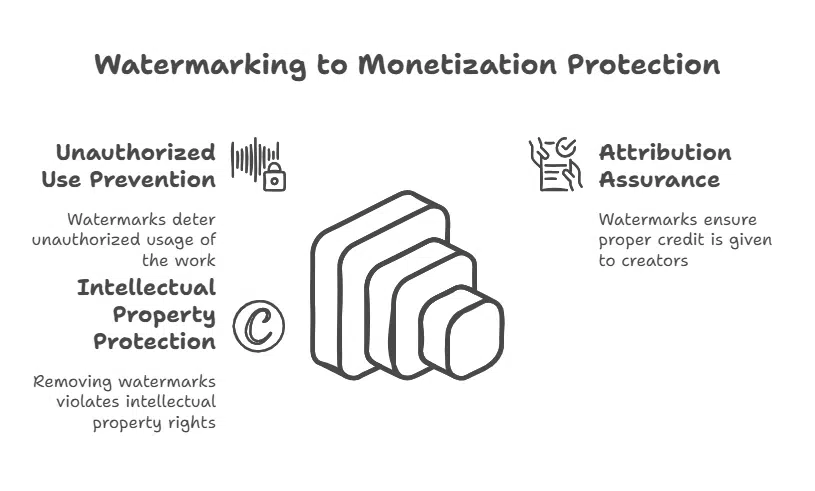
Watermarks serve as a critical mechanism for artists, photographers, and stock media agencies to claim ownership over their work. By embedding a watermark, creators prevent unauthorized usage of their images and ensure proper attribution. Removing these watermarks not only undermines their intellectual property rights but also threatens their ability to monetize their work.
AI Companies Implementing Guardrails
Unlike Google’s Gemini 2.0 Flash, several AI models, such as OpenAI’s GPT-4 and Anthropic’s Claude 3.7 Sonnet, have strict measures in place to prevent users from using their tools for unethical purposes, including watermark removal.
- OpenAI’s GPT-4o explicitly refuses to remove watermarks, recognizing it as unethical and potentially illegal.
- Claude 3.7 Sonnet from Anthropic blocks requests for watermark removal, acknowledging its implications for copyright infringement.
Google’s Response and Current Status
Experimental Feature with No Clear Restrictions
Currently, Google has labeled Gemini 2.0 Flash’s image generation feature as “experimental” and “not for production use.” The tool is only accessible through Google’s developer-focused platform, AI Studio.
Despite the controversy, Google has yet to provide an official response regarding the watermark removal issue. The lack of immediate corrective action raises concerns about whether Google will impose stricter limitations on Gemini 2.0 Flash in the future.
Potential Consequences for the Creative Industry
How This Affects Content Creators and Photographers
If AI-powered watermark removal becomes widely accessible, the creative industry may suffer serious consequences:
- Loss of revenue for photographers and artists: Many professionals rely on licensing their work through platforms like Getty Images. Unauthorized watermark removal could lead to financial losses.
- Increased risk of image theft: With easy access to tools that can remove watermarks, bad actors could steal copyrighted images and use them for commercial purposes without proper attribution.
- Weakening of intellectual property rights: The prevalence of AI-generated content combined with watermark removal capabilities could make it harder for content creators to protect their work.
Global Legal Responses to AI and Copyright Protection
Governments worldwide are exploring regulatory measures to address the potential misuse of AI in copyright-related matters.
- The European Union’s AI Act is considering requiring AI developers to disclose the sources of training data and impose stricter penalties for copyright infringement.
- The UK is reviewing AI transparency regulations to protect artists from unauthorized use of their work in AI models.
- The U.S. Copyright Office is conducting studies on the implications of AI in copyright law, including unauthorized image modifications.
The Need for Responsible AI Development
Google’s Gemini 2.0 Flash highlights both the incredible advancements in AI technology and the ethical challenges that come with it. While AI can enhance creativity and streamline workflows, unchecked capabilities such as watermark removal threaten the integrity of intellectual property rights.
To balance innovation with ethical responsibility, companies like Google must:
- Implement strict guardrails to prevent unethical use cases.
- Collaborate with copyright holders to ensure fair compensation for artists.
- Comply with global regulations to prevent AI misuse in copyright violations.
As AI technology continues to evolve, the industry must address these concerns proactively to protect content creators while fostering responsible AI innovation.