Waiting days for important test results can be incredibly frustrating. Delays and confusing medical forms often leave patients feeling overwhelmed and exhausted. A powerful solution is already transforming this experience. Generative AI in healthcare is rapidly changing how doctors diagnose and treat patients.
This guide explores the exact steps used to make medical processes faster, more accurate, and more efficient. Get ready to discover how smarter technology is reshaping modern healthcare.
What is Generative AI in Healthcare?
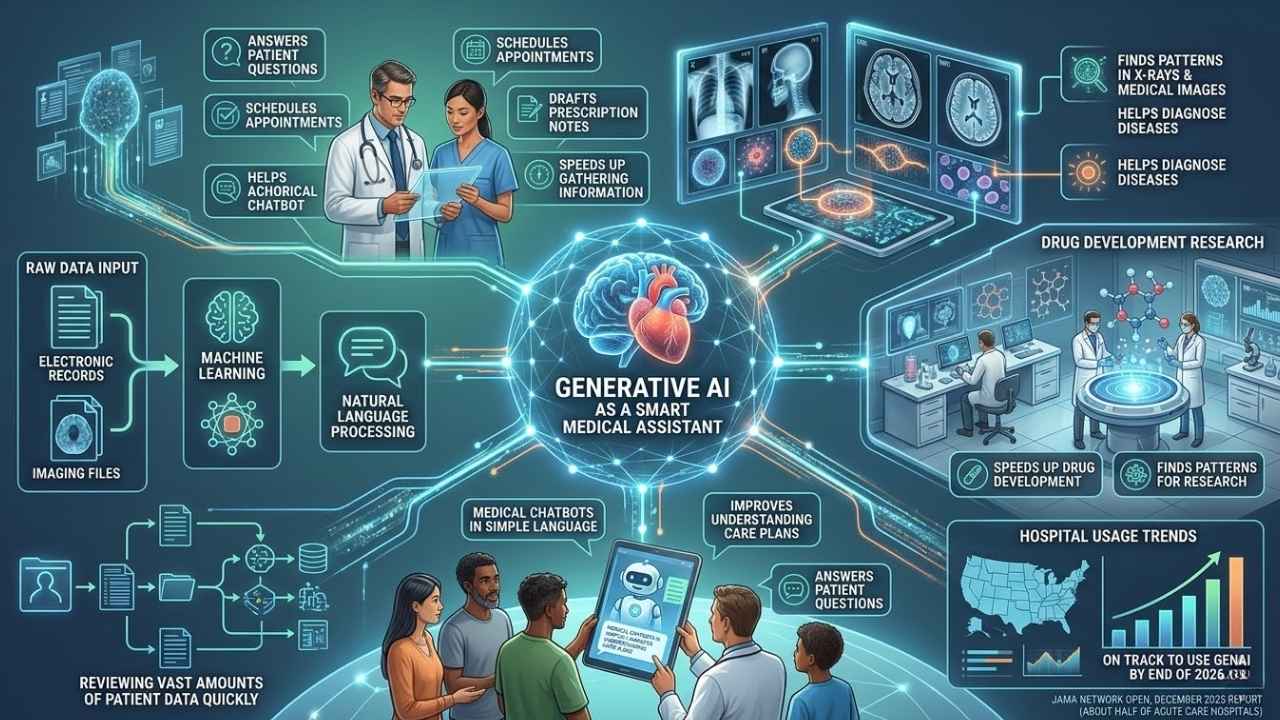
Generative AI in healthcare uses smart computer programs to help doctors, nurses, and patients. It acts like a highly trained medical assistant. The software can answer patient questions, schedule appointments, and draft prescription notes.
Hospitals use Machine Learning and Natural Language Processing to review vast amounts of patient data quickly. Medical chatbots speak in simple language, so people easily understand their care plans.
A December 2025 report in JAMA Network Open found that about half of all acute care hospitals in the US are on track to use generative AI by the end of 2026.
This technology handles tough jobs like checking symptoms or finding patterns in X-rays. Doctors already use these tools to diagnose diseases and speed up drug development. Healthcare providers turn to these programs because they make gathering information incredibly fast.
Real Use Cases of Generative AI in Healthcare
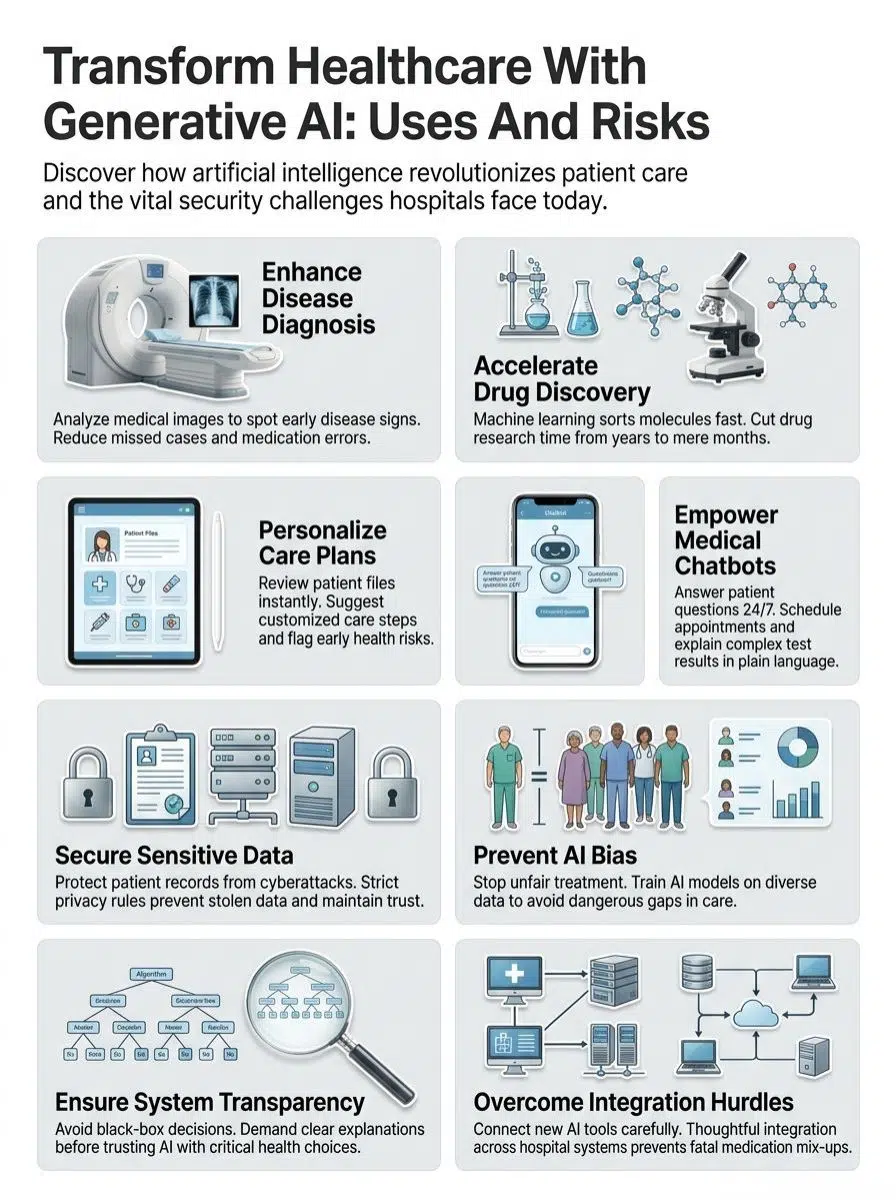
Doctors and nurses see real change in their daily work. Some tools offer surprising benefits for patients and hospitals.
Enhancing Disease Diagnosis
Generative AI analyzes patient data to spot diseases faster and with high accuracy. Machine learning tools sift through thousands of test results and medical images in the blink of an eye.
AI models work right alongside physicians to flag early signs of cancer or rare disorders. These signs sometimes slip past tired human eyes.
- Google’s Med-PaLM 2: This specialized medical AI achieved an 86.5 percent accuracy rate on US Medical Licensing Examination style questions in 2025.
- Superior Clinical Reasoning: A recent landmark study showed Google’s AMIE system outperformed human primary care physicians on 30 out of 32 clinical axes.
- Safer Care: These predictive analytics suggest possible diagnoses to reduce missed cases and medication errors.
Patients get quicker answers about their health concerns. Medical teams gain clearer insights before deciding on treatments.
Accelerating Drug Discovery and Development
AI tools cut drug research time from years to months. Machine learning helps scientists sort through millions of molecules to pick the ones with the best shot at becoming new medicine.
A great example is Insilico Medicine. Their AI-designed drug for lung fibrosis, rentosertib, showed positive Phase IIa clinical trial results published in Nature Medicine in mid-2025.
In January 2026, the US Food and Drug Administration issued new guidelines to formally regulate these AI practices. Less guesswork means faster cures and fewer dead ends. This saves money and speeds up the path from idea to pharmacy shelf.
Personalizing Patient Care Plans
Generative AI works like a helpful nurse who never sleeps. It sorts through patient files and lab results in seconds to suggest care steps built just for each person.
Machine learning spots early signs of diabetes from blood tests. It also tracks asthma attacks using data from wearable technology like smartwatches.
Healthcare professionals use these AI systems to adjust medications quickly. Patients get clear charts and reminders that make complex care plans feel simple and easy to follow. AI tools listen to real-time feedback from patients to keep treatments moving in the right direction.
Transforming Medical Imaging
AI plays a massive role in medical imaging right now. Doctors use AI models to scan X-rays, MRIs, and CT scans.
These tools spot tiny signs of lung infections much faster than the human eye alone. To put this in perspective, let us look at the numbers.
| Imaging Task | Traditional Method | AI-Assisted Method |
|---|---|---|
| Mammography Reading Time | Standard manual review | Up to 90 percent faster with AI |
| Cancer Detection Rate | Baseline detection | 17.6 percent higher detection |
| FDA Authorized Devices | None in the past | Over 1,300 tools by late 2025 |
Hospitals sort images sooner to speed up patient care. Doctors always double-check every suggestion from the machine before making life-changing decisions.
Empowering Medical Chatbots for Patient Support
Medical chatbots use generative AI to answer patient questions day or night. A worried parent can type a message about a fever at midnight and get helpful advice in plain language.
Epic Systems recently debuted Emmie, an AI chatbot integrated directly into the MyChart patient portal. It answers specific questions about lab results and suggests upcoming screenings.
These tools help schedule doctor appointments and remind patients to take their medicine. Hospitals respond to common concerns quicker, which frees nurses for urgent tasks.
Improving Clinical Decision-Making
Generative AI supports doctors by sorting through massive amounts of patient data. It spots patterns in medical records that might slip past busy eyes.
Doctors use these insights to catch medication errors. Predictive analytics can warn a doctor if a patient faces a high risk of a stroke.
At Kaiser Permanente, a predictive early-warning system called Advance Alert Monitor prevents approximately 500 deaths per year. The system also cuts readmissions by 10 percent. AI generates synthetic patient data so researchers can safely study rare diseases.
Supporting Medical Training and Simulations
AI-powered simulations bring real-life medical cases into the classroom without risking patient safety. Medical students use virtual patients to practice diagnosing diseases.
These digital training aids help young doctors learn fast and sharpen their decision-making skills. Hospitals use AI-based simulators for hands-on surgical practice.
- Osso VR Platform: This virtual reality system provides highly realistic surgical training.
- Performance Boost: A study from UCLA’s David Geffen School of Medicine showed surgical performance improved by 230 percent for VR users.
- Speed Increases: The same study found trainees completed procedures 20 percent faster.
Future healthcare professionals gain immense confidence before treating real people.
Benefits of Generative AI in Healthcare
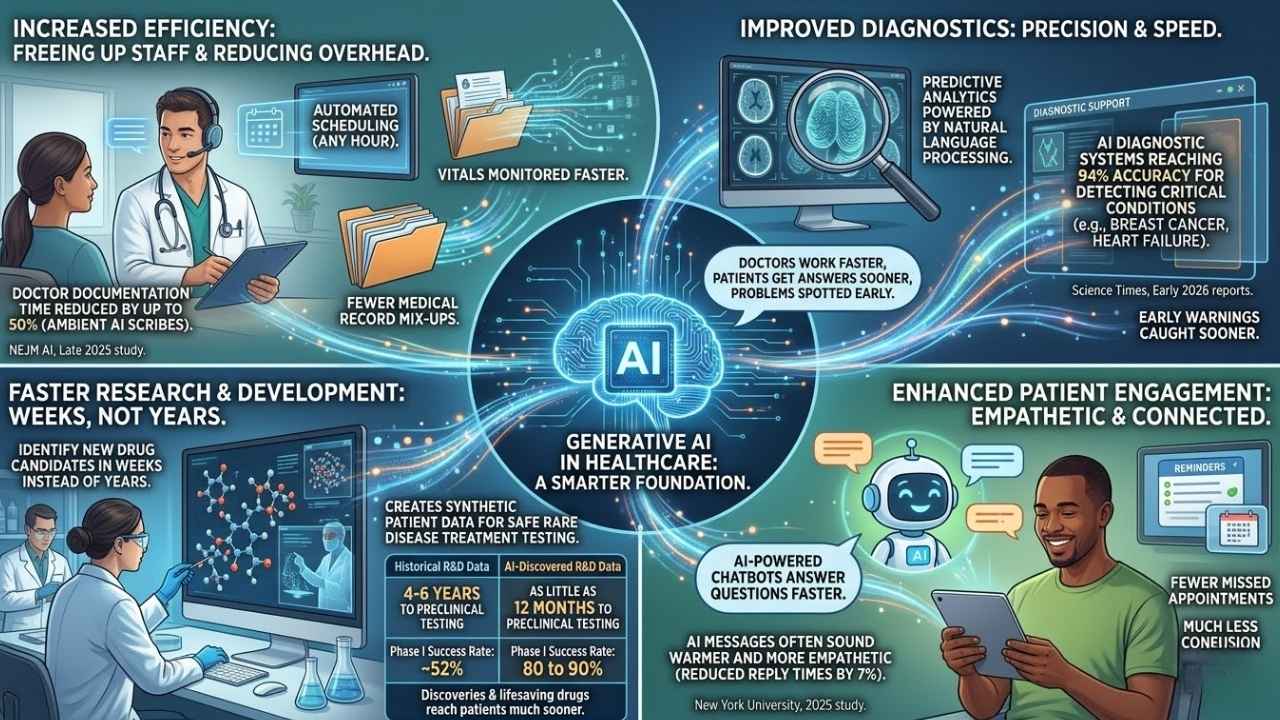
Doctors work faster, and patients get answers in much less time. Smart tools spot problems early to make care safer for everyone.
Increased Efficiency in Healthcare Operations
Generative AI shakes up healthcare like a strong shot of espresso. Computers handle clerical jobs, freeing up staff for hands-on care.
A late 2025 study published in NEJM AI found that ambient AI scribes reduce a doctor’s documentation time by up to 50 percent. AI sorts medical records and schedules visits at any hour.
This means fewer mix-ups with files. Hospital staff monitor patient vitals faster than ever before. These changes save money and make care smoother for patients and clinics alike.
Improved Accuracy in Diagnostics
AI sorts through mountains of patient data incredibly fast. Doctors use machine learning tools to spot rare diseases.
Medical technology companies deploy predictive analytics powered by natural language processing to flag unusual symptoms with sharp precision. Early 2026 reports from Science Times show AI diagnostic systems reaching 94 percent accuracy for detecting critical conditions like breast cancer and heart failure.
Clinical decision support systems give doctors a reliable second set of eyes. This catches warning signs early so patients receive care before problems grow worse.
Faster Research and Development Processes
Generative AI speeds up research by sifting through vast pools of medical data. Scientists use machine learning to identify new drug candidates in weeks instead of years.
This technology creates synthetic patient data. Experts test treatments for rare diseases safely without waiting for enough real-world cases.
| Drug Development Phase | Historical Success Rate | AI-Discovered Success Rate |
|---|---|---|
| Phase I Clinical Trials | Approximately 52 percent | 80 to 90 percent |
| Time to Preclinical Testing | 4 to 6 years | As little as 12 months |
Clinical trials move forward at lightning speed. Doctors and researchers make discoveries and bring lifesaving drugs to patients much sooner.
Enhanced Patient Engagement
AI-powered chatbots answer patient questions faster than most humans can. AI systems handle the scheduling and remind you to check on your symptoms.
A recent 2025 study from New York University found that using AI to draft responses to patient messages reduced reply times by 7 percent. The study also noted the AI messages often sounded warmer and more empathetic.
Medical technology uses natural language processing to talk just like people do. Strong patient engagement means fewer missed appointments and much less confusion.
Risks and Challenges of Generative AI in Healthcare
Every shiny tool casts a shadow. Using smart software in clinics brings big questions about safety and fairness.
Data Privacy and Security Concerns
Healthcare runs entirely on sensitive patient data. Tools use this data every day to analyze and improve care, but each step brings security concerns.
A 2025 report by IBM found that the average healthcare data breach costs 7.42 million dollars, making it the most expensive industry for breaches 14 years in a row.
Hackers actively target medical technology. The massive Change Healthcare cyberattack exposed records for over 190 million individuals. Healthcare providers must follow strict privacy rules to avoid catastrophic fines and loss of reputation.
Bias and Fairness Issues in AI Models
Generative AI models reflect unfairness that already exists in historical data. If a system learns mostly from information about one group, it makes serious mistakes with others.
An AI-powered dermatology tool might misread skin conditions on darker skin because many training photos come from lighter-skinned patients. Historically, algorithms have used healthcare costs as a proxy for health needs.
This flaw falsely concluded that Black patients were healthier than equally sick white patients because less money was historically spent on their care. Patient trust depends on equal, unbiased treatment across every group.
Lack of Transparency and Explainability
Doctors and patients often feel confused by how machine learning models reach decisions. Many AI tools act like black boxes where the internal process is completely hidden from view.
If an AI suggests a new medication for a patient, it might not explain its reasoning in plain language. This lack of clarity makes people worry about mistakes slipping through unnoticed.
- Automation Bias: Clinicians might lower their guard and blindly trust the machine.
- Top Safety Threat: The ECRI institute ranked the AI diagnostic dilemma as the top patient safety concern for 2026.
- Informed Consent: Patients need clear information before trusting technology with their lives.
Scalability and Integration Challenges
Bringing generative AI into healthcare systems is rarely a walk in the park. Hospitals use very different electronic health record platforms and medical devices.
A late 2025 industry analysis revealed that while 85 percent of healthcare organizations explored AI, only 18 percent were actually ready to deploy it in care delivery. Each system uses its own file types, making it incredibly hard to connect new tools across clinics.
As more patients chat with bots, computer servers work harder to keep up. If systems lag during peak hours, care quality takes a direct hit and staff lose faith in the technology.
Final Thoughts
Generative AI in healthcare is making medicine smarter, quicker, and deeply personal. Doctors use it right now for faster diagnoses, safer drug discovery, and friendlier chatbots that answer your urgent health questions. With predictive analytics, tasks that once took hours now finish in minutes.
We still must watch for data privacy slips and build systems that play fair with all patients. Change feels incredibly fast, but every smart step leads directly to better care. Maybe one day soon you will see your doctor’s virtual assistant crack a joke while catching a mistake no human ever could!