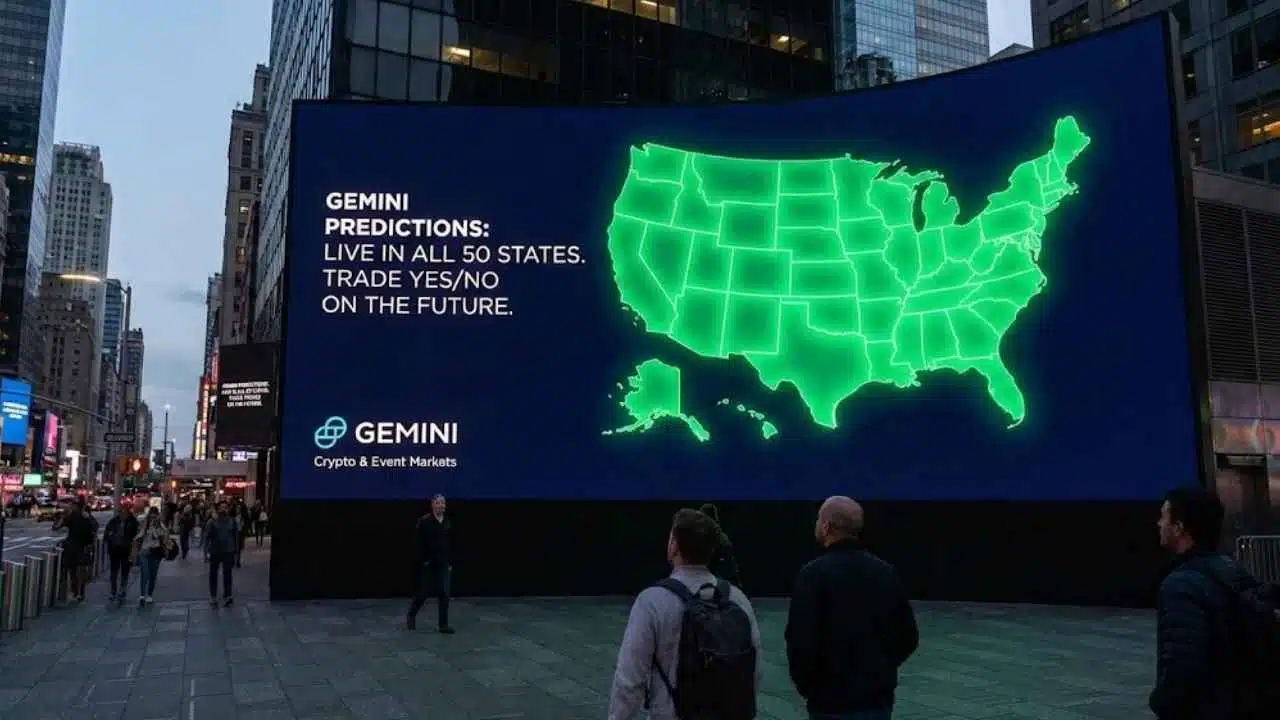
Gemini prediction markets are now available in all 50 U.S. states, letting users trade simple yes-or-no event contracts in USD via Gemini’s app and web platforms after its affiliate secured federal derivatives approval.
What launched, and what users can trade
Gemini, the crypto exchange founded by Tyler and Cameron Winklevoss, has rolled out Gemini Predictions, a regulated “event contracts” product that allows customers to take positions on clearly defined outcomes that settle as Yes/No. At launch, examples include contracts tied to crypto price thresholds (such as whether Bitcoin finishes above a specific level by year-end) and certain policy or enforcement outcomes, depending on what contracts Gemini lists.
Gemini says customers can trade these contracts using U.S. dollars held on the platform, and that access spans all 50 states through its consumer interfaces. Gemini has also promoted zero trading fees for a limited time as part of the launch push.
Sports contracts: not part of Gemini’s first wave
While sports-related event contracts have become a flashpoint across the broader sector, Gemini’s initial release is positioned around non-sports events. That choice matters because sports event contracts have drawn intense scrutiny and legal fights in multiple states over whether these products resemble sports wagering.
The regulatory trigger: a federally licensed derivatives venue
The nationwide launch follows federal approval for Gemini’s derivatives affiliate, Gemini Titan, LLC, which received a Designated Contract Market (DCM) license from the U.S. Commodity Futures Trading Commission (CFTC). Gemini has said it originally applied on March 10, 2020, making the approval the endpoint of a multi-year licensing effort.
A DCM is the core federal registration for operating a U.S. exchange for certain derivatives products. For event contracts, this framework is central to the argument that a platform can offer contracts nationwide under federal supervision—an argument that has become central to current state-versus-federal disputes.
Why prediction markets are booming right now
Event-contract trading has expanded quickly from niche users into mainstream retail finance apps, helped by:
- Simpler formats (Yes/No contracts are easier to understand than many derivatives).
- Always-on trading behavior similar to crypto markets.
- Broader use cases beyond politics and sports, including macro and regulatory risk.
- Media integrations that normalize “market-implied probabilities” as a way to discuss uncertainty.
One large U.S. bank’s analysts recently projected the sector could grow to more than $10 billion in annual revenue by 2030, implying multiple-fold expansion from current levels.
Competitive landscape: Gemini joins a crowded field
Gemini is entering a market that already has major incumbents and fast-moving challengers:
- Kalshi has built a leading position in regulated U.S. event-contract trading and has been expanding its partnerships and distribution.
- Coinbase has announced a plan to bring prediction markets to its user base via a partnership approach, signaling that the largest U.S. crypto platforms see event contracts as a core product line—not an experiment.
- Robinhood has repeatedly highlighted prediction markets as a breakout line of business, pointing to rapid scaling in activity and revenue run-rate metrics.
- Fanatics has launched a prediction-market app and outlined a phased rollout and category expansion plan.
How major platforms are positioning
| Platform | Positioning theme | Distribution edge | Notable focus (recent) |
| Gemini | Regulated event contracts inside a crypto exchange | Existing Gemini retail users | Nationwide “Gemini Predictions” rollout + promo pricing. |
| Kalshi | Regulated U.S. event markets | Partnerships + category breadth | Industry coalition + media integrations. |
| Coinbase | “Everything exchange” expansion | Large U.S. crypto user base | Prediction markets sourced via partnership model. |
| Robinhood | New “asset class” pitch | Mass-market brokerage app | Rapid growth claims and expanding sports-related formats. |
| Fanatics | Sports/finance/culture blend | Fanatics ecosystem reach | Phased rollout across states and categories. |
Regulatory tensions: state pushback and the federal preemption fight
As platforms scale, regulators and stakeholders are increasingly focused on a key question: are some event contracts functionally equivalent to gambling—especially sports betting—or are they federally regulated derivatives?
Several states and tribal gaming interests have challenged or criticized sports-related event contracts, and multiple companies have faced lawsuits or enforcement actions tied to jurisdictional authority and product classification.
In that environment, major operators have banded together through a newly announced industry group, the Coalition for Prediction Markets, which argues for consistent, federally supervised rules and clearer guardrails (including consumer protection and market integrity).
Washington backdrop: CFTC leadership remains in flux
The product launch also lands during a transition moment for U.S. derivatives regulation leadership. The White House withdrew the earlier CFTC chair nomination of Brian Quintenz, and later nominated Michael (Mike) Selig for the role; the CFTC has been led by an acting chair during the interim period.
That matters for prediction markets because the CFTC’s leadership will influence how aggressively the agency clarifies event-contract standards, handles surveillance and enforcement, and navigates conflicts with state regulators.
Timeline table: key milestones in Gemini’s path to launch
| Date | Milestone | Why it matters |
| March 10, 2020 | Gemini says it applied for a DCM license | Starts the regulatory clock for operating a U.S. derivatives venue. |
| Dec. 10, 2025 | Gemini Titan receives DCM license | Enables federally regulated listing of eligible contracts. |
| Mid-Dec. 2025 | Gemini Predictions launches nationwide | Brings event-contract trading to Gemini’s U.S. user base across all states. |
What this means for users and the industry
For users, Gemini’s rollout is another step toward making event contracts a mainstream retail product—available alongside crypto, and potentially alongside more traditional markets over time.
For the industry, Gemini’s entry increases pressure on every platform to differentiate on:
- Contract quality (clear definitions, predictable settlement rules)
- Liquidity and pricing (tight spreads, reliable fills)
- Trust and compliance (surveillance, anti-manipulation controls, KYC/AML)
- Category breadth (macro, policy, finance, culture—while managing the sports controversy)
And for regulators, wider distribution raises the stakes around consistent standards—especially as platforms compete for share and expand the range of tradable outcomes.
Gemini’s nationwide debut of Gemini prediction markets signals that event-contract trading is moving from a niche corner of fintech into a high-visibility battleground spanning crypto exchanges, brokerage apps, and sports-adjacent brands. The next phase will likely be defined by two forces: rapid product expansion—and an equally fast-moving fight over where the regulatory lines should be drawn.