The era of “AI tourism” is officially over. For the past three years, boards have tolerated high-burn experiments and vague promises of future transformation. But as we settle into 2026, the mandate from the C-suite has shifted with brutal clarity: prove the value, or kill the pilot. This is no longer about who has the flashiest chatbot; it is about “Intelligence Orchestration”—the messy, unglamorous, and critical work of rewiring business processes to turn silicon into solvent, auditable returns.
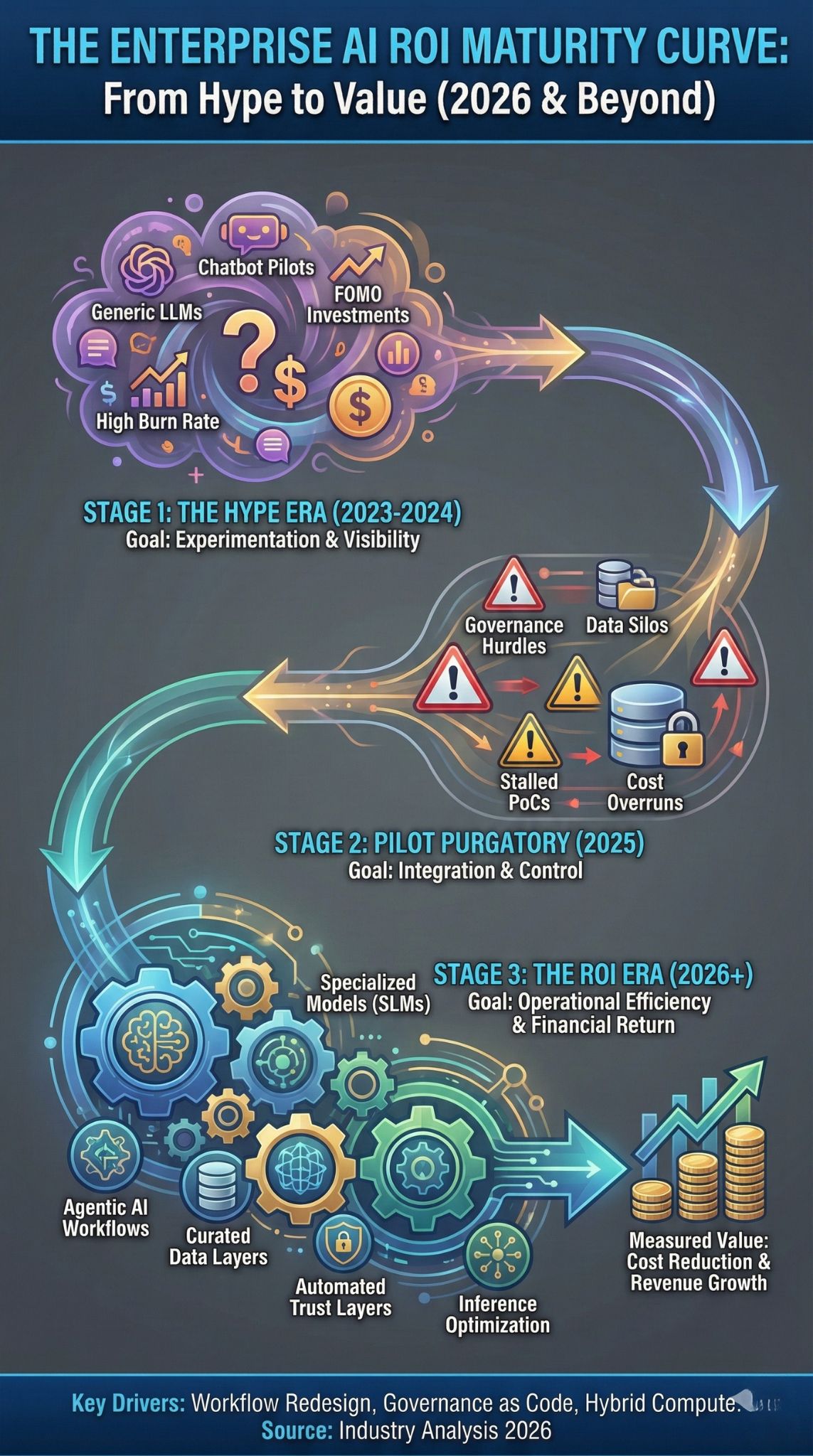
The trajectory that brought us to this moment was defined by a classic Gartner hype cycle, but with a velocity never before seen in tech history. In 2023, the world woke up to Generative AI, sparking a gold rush of curiosity. By 2024 and 2025, enterprises entered what analysts now call “Pilot Purgatory”—a period characterized by thousands of proofs of concept (PoCs) that dazzled in isolation but failed to scale safely or affordably. Companies spent millions on compute and cloud credits, often with little to show on the EBIT (Earnings Before Interest and Taxes) line.
Now, in early 2026, the bill has come due. The novelty of “conversing” with data has worn off. The focus has pivoted entirely to Agentic AI—systems that don’t just talk, but act—and Inference Economics, the discipline of managing the cost of running these models at scale. We are witnessing a bifurcation in the market: the “AI Natives” who redesigned their workflows around autonomous agents, and the laggards who merely paved cow paths with expensive GPUs. This year is the reckoning point where infrastructure, governance, and workforce strategy finally converge to answer the investors’ loudest question: “Show me the money.”
The Great Shift from “Chat” to “Action” (Agentic AI)
The most significant trend defining 2026 is the death of the passive chatbot and the rise of the AI Agent. For years, employees treated AI as a smart encyclopedia—a tool to query for summaries or code snippets. Today, AI is transitioning into a digital colleague capable of executing multi-step workflows without constant human hand-holding.
This shift is driven by the maturation of “planning” capabilities in models. In 2026, an enterprise AI system doesn’t just draft an email; it analyzes the CRM, identifies a churn risk, drafts the email, schedules a meeting based on calendar availability, and updates the sales forecast—all autonomously, only flagging a human for final approval.
However, this introduces a new layer of complexity: reliability. A chatbot that hallucinates a fact is annoying; an agent that hallucinates a bank transfer is catastrophic. Consequently, 2026 is seeing massive investment in “Evaluation Harnesses”—automated systems that test AI agents thousands of times before they are allowed to touch production data. The companies winning this year are those that have moved beyond “prompt engineering” to “flow engineering,” designing rigid guardrails within which these agents can operate autonomously.
The Economics of Inference (Stopping the Cloud Bleed)
During the hype phase, cost was a secondary concern. In 2026, CFOs have taken the reins. The cost of training models has become a niche concern for the hyperscalers (Google, Microsoft, OpenAI); for the average enterprise, the silent killer is inference costs—the price paid every time a user queries the model.
We are seeing a massive “repatriation” of data and compute. Enterprises are realizing that routing every single query to a massive, general-purpose LLM (Large Language Model) is like using a Ferrari to deliver a pizza. It is overkill and economically unsustainable.
This year, the “Small Language Model” (SLM) revolution has taken hold. Companies are deploying highly specialized, smaller models (7B to 13B parameters) that run cheaper and faster on specific tasks (e.g., a model trained only on Java code migration or only on reading medical claims). Furthermore, hybrid compute strategies are dominating, where sensitive or high-volume inference happens on-premise or at the edge, while the cloud is reserved for burst capacity. The winners of 2026 are mastering “Model Routing”—using a gateway AI to decide whether a user’s request needs the expensive “smart” model or the cheap “fast” model.
Governance as a Velocity Enabler
Historically, compliance was seen as a brake on innovation. In 2026, it is the engine. With the EU AI Act fully operational and similar frameworks tightening in California and Asia, “Shadow AI” (employees using unapproved tools) has become a massive liability.
Successful enterprises have realized that you cannot scale what you cannot trust. They are implementing “trust layers”—middleware that sits between the employee and the model. This layer handles PII (Personally Identifiable Information) redaction, bias detection, and copyright filtering in real-time. By automating governance, companies are actually moving faster, because they no longer need a manual legal review for every new use case. Governance has evolved from a checklist to a technological primitive, embedded directly into the IT stack.
Workflow Redesign and the “Human-in-the-Loop” Paradox
The most painful realization of 2026 is that dropping AI into a broken process just creates a faster broken process. The companies seeing genuine ROI are those that engaged in “Business Process Re-engineering 2.0.”
They aren’t just automating tasks; they are deleting them. For example, in insurance, the goal isn’t to use AI to help a human read a claim faster; the goal is to have the AI adjudicate the claim instantly, with the human only reviewing the exceptions. This requires a fundamental change in workforce structure. We are seeing the emergence of “AI Orchestrators”—employees whose job is not to do the work, but to manage the fleet of agents doing the work. This creates a paradox: as AI does more “work,” the value of deep human expertise increases, because only an expert can validly judge if the AI’s output is correct.
The “Data Memory” Evolution
Data in 2023 was “oil”—a resource to be extracted. In 2026, data is “memory.” The focus has shifted from having massive data lakes to having curated semantic layers.
The buzzword of 2026 is “Contextual Intelligence.” Generic models are commodities; the competitive moat is a company’s proprietary data graph. Enterprises are spending their budget on cleaning and structuring their unstructured data (PDFs, emails, Slack logs) so that AI agents can retrieve it accurately. This utilizes RAG (Retrieval-Augmented Generation) patterns that are far more sophisticated than the simple vector searches of 2024. Now, systems can “reason” across documents, understanding that a contract update in 2025 overrides a clause from 2022.
Comparative Analysis: The Maturation of Enterprise AI
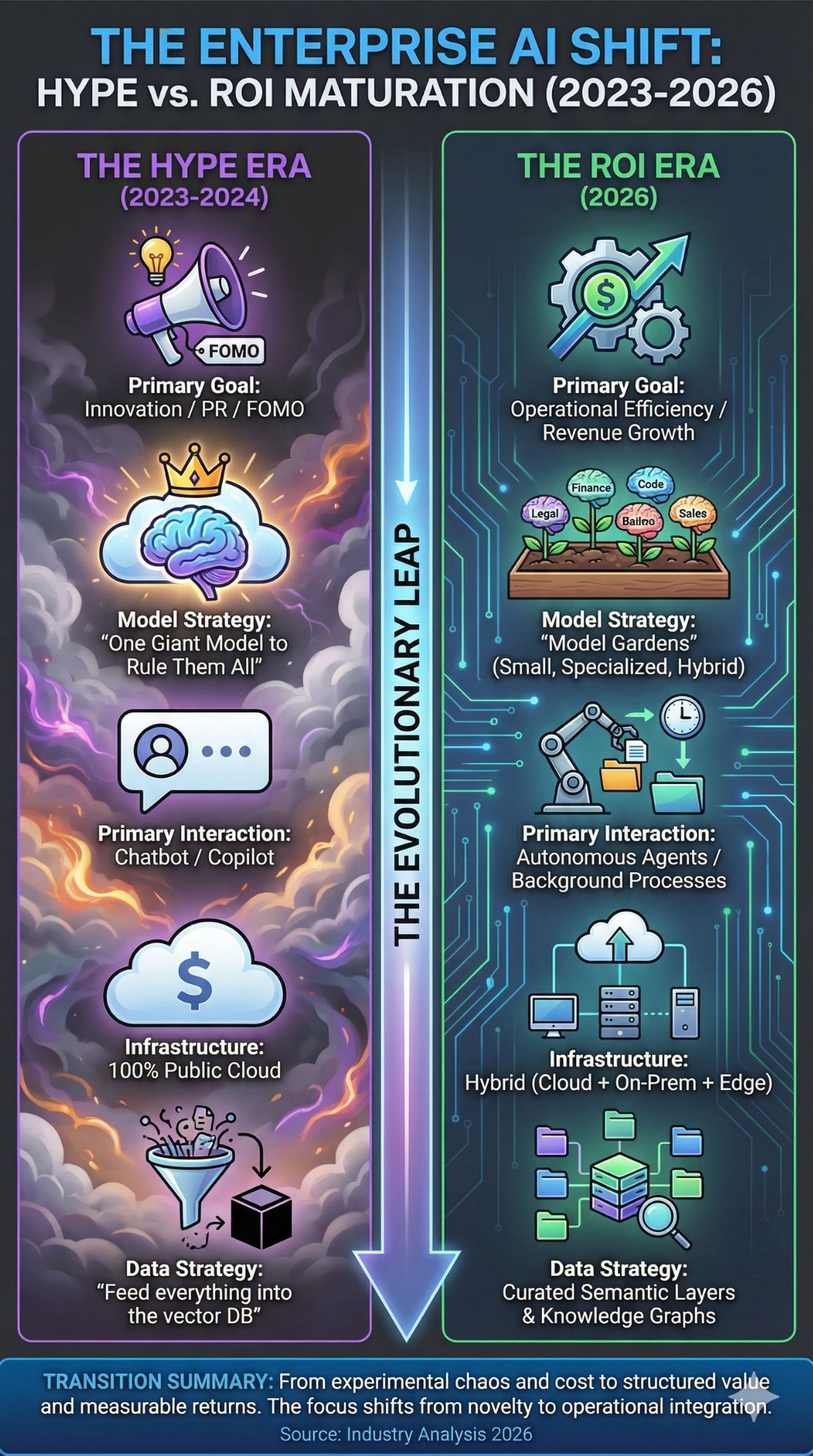
To understand the magnitude of the shift, we must look at the operational differences between the “Hype Era” and the current “ROI Era.”
The Evolution of Enterprise AI (2023 vs. 2026)
| Feature | The Hype Era (2023-2024) | The ROI Era (2026) |
| Primary Goal | Innovation / PR / FOMO | Operational Efficiency / Revenue Growth |
| Metric of Success | Number of Pilots / Users | Cost Savings / Time-to-Value / EBIT |
| Model Strategy | “One Giant Model to Rule Them All” | “Model Gardens” (Small, Specialized, Hybrid) |
| Primary Interaction | Chatbot / Copilot | Autonomous Agents / Background Processes |
| Infrastructure | 100% Public Cloud | Hybrid (Cloud + On-Prem + Edge) |
| Data Strategy | “Feed everything into the vector DB” | Curated Semantic Layers & Knowledge Graphs |
| Governance | Policies in a PDF | Automated Trust Layers & Real-time Redaction |
Key Statistics for 2026 (Projected/Current State)
- Production Deployment: Gartner data suggests over 80% of enterprises now have GenAI in production, a staggering rise from <5% in 2023.
- Inference Dominance: Deloitte analysis indicates that inference (running models) now accounts for nearly 66% of all AI compute load, surpassing training costs.
- Spend Deferral: Forrester warned that up to 25% of planned AI spend is being deferred to 2027 in organizations that failed to demonstrate ROI in Q1/Q2.
- Workflow Impact: McKinsey reports that workflow redesign is the #1 correlate for AI value capture, with high performers 3x more likely to have rebuilt processes from scratch.
Expert Perspectives
The industry consensus is shifting from excitement to pragmatism.
“The data foundation is becoming the intelligence layer.” — Abhas Ricky, Chief Strategy Officer, Cloudera
Ricky argues that the winners in 2026 aren’t those with the most GPUs, but those who treat data as an active “organizational memory.” If your AI cannot recall the context of a decision made six months ago, it is a toy, not a tool.
“Financial scrutiny will redefine AI investments.” — Forrester Research
Analysts note that the “blank check” era is over. CIOs are now competing for budget against other capital projects, and if an AI initiative cannot show a clear path to reducing OpEx or increasing CapEx efficiency within 12 months, it is being cut.
“The era of the ‘Generic Model’ is fading.” — Gartner
The prediction that Domain-Specific Language Models (DSLMs) would overtake generic LLMs for enterprise tasks is proving true. Companies prefer a model that knows everything about supply chain logistics and nothing about poetry.
Future Outlook: The Autonomous Enterprise (2027-2030)
As we look beyond 2026, the current friction of “integrating” AI will disappear. AI will cease to be a separate “thing” and will simply be the substrate of enterprise software.
- The “Neocloud” Consolidation: We expect a shakeout among the specialized GPU cloud providers (“Neoclouds”) as the hyperscalers aggressively price-match and acquire the most promising niche players.
- Standardized Agent Protocols: Just as TCP/IP standardized the internet, 2027 will likely see the universal adoption of protocols (like the Model Context Protocol) that allow an Agent from Salesforce to seamlessly hand off a task to an Agent in SAP without custom code.
- The Talent Crisis Shift: The concern will move from “Will AI replace us?” to “Who can manage the AI?” The shortage of “AI Architects” and “Model Ops” specialists will drive a massive wage premium for those who can bridge the gap between business logic and stochastic algorithms.
2026 is the crucible. It is the year the enterprise market decides which AI technologies are enduring infrastructure and which were merely a passing fever dream. For leaders, the message is simple: Stop playing with the tech, and start re-engineering the business.