When business leaders look for the absolute best way to build a happy and deeply engaged workforce, they almost always turn their eyes toward Scandinavia. Denmark consistently dominates global rankings for employee satisfaction, hourly productivity, and overall workplace wellbeing. Many casual observers point to cultural concepts like hygge or the national love for cycling as the reason for this happiness.
While those cultural elements definitely matter to the daily mood of the population, the real engine driving their booming economy is an entirely unique economic design. This framework protects the human beings doing the work rather than protecting specific, outdated jobs. Most global markets force a harsh and unforgiving compromise on their citizens. You either build a hyper-flexible system that leaves workers vulnerable to instant ruin, or you build a rigid, heavily regulated system that makes companies terrified to hire new staff. The Danes simply refused to make that compromise.
Instead, they built the Denmark flexicurity model. This exact framework perfectly balances the aggressive, fast-paced needs of modern businesses with the very real, biological needs of the human workforce. By actively combining high job mobility with an incredibly generous social safety net, the government built an environment where people actually want to show up and contribute their best ideas. The system removes the deep existential dread that haunts corporate workers in other nations. When you take away the fear of losing basic survival needs, you unlock a level of creativity and dedication that money simply cannot buy. Let us break down exactly how this model operates on a daily basis and look at the highly surprising facts that make it so effective for both the CEO and the junior employee.
Understanding the Core of the Denmark Flexicurity Model
Labor markets usually operate on a spectrum of financial risk and burden. In highly capitalist structures, the financial risk falls entirely on the individual worker, meaning a sudden layoff can result in instant poverty or homelessness. In heavily regulated socialist structures, the financial risk falls heavily on the employer, forcing them to keep underperforming staff on the payroll forever.
The Denmark flexicurity model shifts this risk completely away from both the worker and the employer, placing the burden of economic transition squarely on the state. This creates a deeply dynamic corporate environment where businesses can pivot quickly without destroying the lives of their former employees. It is a highly engineered, deeply thoughtful ecosystem built on three distinct pillars.
The Golden Triangle Explained
You absolutely cannot understand the Danish economy without understanding the concept of the golden triangle. This is the structural foundation of the entire system, and all three pieces must work together to prevent collapse. First, the system features a highly flexible labor market where companies face very few legal hurdles when they need to hire or let people go.
Second, the system provides a massive social safety net so that losing a job never means losing your home or your ability to feed your family. Third, the government maintains a highly active labor market policy that forces state intervention. The state does not just write welfare checks and walk away; they actively pay for education, mandatory retraining, and personalized career counseling to push the unemployed back into the active labor force as fast as humanly possible.
One of the absolute biggest bottlenecks for business growth globally is the sheer terror of making a bad hire. When labor laws make it incredibly difficult, expensive, and legally dangerous to fire an underperforming employee, companies completely freeze up. They leave vital positions open for months, demand wildly unrealistic qualifications for entry-level jobs, and hesitate to take a chance on young, unproven talent.
Denmark removes this friction entirely by allowing companies to scale up and scale down with the natural, unpredictable rhythm of the global market. This constant, fluid movement actually benefits the workers just as much as the executives because it prevents the job market from stagnating.
1: Easy to Hire, Easy to Fire
In many countries around the globe, getting laid off is treated as a catastrophic life event that brings immense shame and financial ruin. In Denmark, it is simply treated as a very normal career transition that happens to almost everyone at some point. Because organizations can let people go without facing massive legal battles or paying ruinous severance packages, they are highly aggressive and open in their hiring practices. They are incredibly willing to hire unproven talent, give chances to recent graduates, or train people shifting into entirely new industries.
You might logically assume that making it exceptionally easy to fire someone would create a highly stressed, anxious workforce constantly looking over their shoulders. The reality on the ground is the exact opposite. Because workers see that companies are constantly hiring and expanding without fear, they feel entirely confident they can find a new role quickly if their current job falls through. This creates a fluid labor market where people are never truly trapped.
| Hiring Dynamics | Traditional Corporate Markets | Danish Flexicurity Market |
| Speed to Hire | Very slow, plagued by hesitation | Fast, driven by low risk |
| Severance Costs | Massively high, legally complex | Very low, handled by the state |
| Talent Risk | Low risk tolerance for unproven staff | High willingness to train raw talent |
| Market Stagnation | High, people stay in jobs they hate | Low, high mobility and movement |
2: High Unemployment Benefits Keep Panic Away

The extreme, ruthless flexibility of the corporate side only functions properly because of the extreme, comforting security on the human side. In Denmark, workers actively pay a small monthly fee into unemployment insurance funds called A-kasses, which are heavily subsidized by the government. If you are laid off or the company goes bankrupt, this insurance system kicks in almost immediately to catch you. You can receive up to 90 percent of your previous salary for up to two full years, though the actual payout is capped at a specific monthly limit to prevent abuse by ultra-high earners.
Because their rent, groceries, heating bills, and basic necessities are fully covered, Danish professionals simply do not make career decisions out of sheer, blinding panic. They have the financial breathing room to carefully look for a job that actually matches their skills and long-term goals. They never have to accept a miserable, underpaying role just to survive the harsh winter, which keeps overall wage standards high.
| Benefit Features | A-kasse Unemployment System Details |
| Income Replacement | Up to 90 percent of previous working salary |
| Duration of Payout | Guaranteed for up to 24 months |
| Funding Source | Mix of worker contributions and state taxes |
| Mental Impact | Removes survival panic and desperation |
Investing Heavily in Human Capital and Skill Development
Technology moves so much faster today than ever before in human history. Skills that were highly valuable and well-paid just five years ago are rapidly becoming obsolete, especially in fast-moving sectors like software development, digital marketing, AI, and advanced manufacturing. Most nations completely wash their hands of this problem, leaving it entirely up to the individual to pay for their own retraining and driving them into massive personal debt.
The Denmark flexicurity model takes an entirely different and highly pragmatic approach. The national government acts as a massive human resources department for the entire country, viewing an unemployed person not as a lazy burden, but as a highly valuable asset that simply needs a software update to become profitable again.
3: Massive Investment in Upskilling
The active labor market policy is the absolute beating heart that keeps the Danish economy moving forward despite global turbulence. The government willingly allocates a massive portion of its total GDP to adult education, vocational training, and high-level retraining programs. If a traditional manufacturing factory permanently closes down, the state immediately steps in to offer those displaced workers completely free courses in IT networking, green energy infrastructure, or specialized healthcare.
The state desperately wants the workforce to remain highly skilled, globally competitive, and adaptable to whatever the future holds. For the individual worker, this means they never have to feel completely left behind by the relentless march of technological progress. They stay deeply engaged with the broader economy because they are given the exact educational tools they need to evolve without going bankrupt.
| Upskilling Focus | State Intervention Strategy |
| Financial Cost | 100 percent free to the unemployed worker |
| Industry Targeting | Focuses strictly on high-demand future skills |
| Accessibility | Available across all age groups and demographics |
| Economic Outcome | Prevents long-term structural unemployment |
4: Almost Zero Fear of Losing a Job
Psychological safety is the absolute core driver of any deeply engaged, high-performing corporate team. Because the social safety net is so incredibly robust and reliable, Danish professionals simply do not operate under the constant, gnawing threat of financial ruin. This fundamental lack of deep-seated fear changes absolutely everything about how they behave in the physical office space.
They are perfectly comfortable speaking up loudly in executive board meetings, pointing out critical flaws in a major project, and pushing back aggressively against poor management decisions. When people can bring their authentic, honest selves to work without the dark fear of starvation hanging over their heads, their daily engagement naturally skyrockets. They stop acting like compliant robots trying to survive and start acting like genuine partners trying to improve the business.
| Psychological Element | High-Fear Workplace | Low-Fear Flexicurity Workplace |
| Meeting Behavior | Silent, agreeable, afraid to object | Vocal, challenging, deeply constructive |
| Mistake Handling | Hide errors to avoid immediate firing | Share errors openly to fix systems |
| Innovation Rate | Very low, playing it safe | Exceptionally high, willing to test ideas |
| Stress Levels | Chronically high, leading to burnout | Low and entirely manageable |
Workplace Culture, Equality, and Structural Trust
If you walk into a traditional corporate office in Copenhagen, you will instantly notice something massive is missing from the environment. The thick, invisible, suffocating walls of rigid hierarchy simply do not exist in their business culture. You will rarely find massive corner offices reserved exclusively for executives while junior staff sit crammed together in noisy, poorly lit cubicles. The physical layout of the building strongly reflects the social layout of the national mindset.
The Denmark flexicurity model thrives so beautifully because the national culture demands absolute equality among human beings. Managers are viewed strictly as helpful facilitators rather than untouchable dictators. This deeply rooted sense of equality completely changes how employees view their daily tasks and their long-term loyalty to the overarching mission of the company.
5: Flat Hierarchies Lead to Higher Ownership
Danish work culture relies entirely on a flat, decentralized organizational structure that strips away useless middle management. The CEO often sits at the exact same style of desk, in the exact same open-plan room, as the newest marketing intern who just graduated from university. Because everyone is treated as a highly capable intellectual equal from day one, employees naturally develop a much deeper sense of personal ownership over their specific projects.
They absolutely do not sit around waiting to be told exactly what to do step by step by a micromanager. They are given a clear, measurable goal and completely trusted to figure out the absolute best way to achieve it using their own brains. This high-autonomy, high-respect environment is the ultimate cure for widespread workplace disengagement and corporate boredom.
| Hierarchy Feature | Traditional Top-Down Culture | Danish Flat Culture |
| Office Layout | Segregated by rank and title | Open, mixed, entirely egalitarian |
| Task Management | Heavy micromanagement and tracking | High autonomy and self-direction |
| Information Flow | Filtered slowly down the chain | Transparent and widely shared |
| Employee Mindset | Wait for exact daily orders | Actively find and solve problems |
6: Trade Unions Play a Massive Role
It genuinely surprises many foreign business owners to learn that Denmark does not actually have a statutory minimum wage set by the national government. The state completely stays out of the messy business of setting baseline salaries across different industries. Instead, starting salaries, mandatory working hours, and physical working conditions are negotiated directly between highly organized trade unions and powerful employer associations.
A massive percentage of the entire Danish workforce proudly belongs to a labor union, and it carries zero social stigma. Because workers have a massive, unified, and legally protected collective voice, they naturally feel deeply respected by the corporate class. This collaborative, highly pragmatic collective bargaining approach completely stops the toxic, combative relationship between labor and management that actively destroys daily productivity in other western nations.
| Labor Element | Government Mandated Approach | Danish Union Negotiation Approach |
| Minimum Wage | Set by politicians, often outdated | Set by industry experts, highly fluid |
| Contract Rules | Blanket rules for all businesses | Specific rules tailored to each sector |
| Conflict Resolution | Settled via long court battles | Settled via rapid union mediation |
| Worker Representation | Very low, highly individualized | Massively high, collective power |
Life Beyond the Office and Taxation Realities
You fundamentally cannot maintain a highly engaged, wildly innovative workforce if your people are chronically exhausted, sleep-deprived, and depressed. Burnout absolutely destroys creative thinking, massively lowers daily physical output, and drastically increases employee turnover costs. The Danish economic system explicitly recognizes that human beings are flesh and blood, not industrial machines designed to run indefinitely.
They need substantial, uninterrupted time away from their glowing screens to properly rest, raise their children, and participate in local society. The flexicurity system actively and aggressively defends the firm boundary between paid work and personal life. Of course, maintaining this highly civilized, incredibly comfortable system requires massive funding. The Danes pay a hefty premium for their society, but they logically view it as the absolute best financial investment they could possibly make for their families.
7: Work-Life Balance is a Right, Not a Perk
Danes fundamentally work hard so they can afford to live a deeply satisfying life; they absolutely do not live simply to work until they die. The standard, legally recognized work week across the country is strictly 37 hours, and overtime is highly frowned upon by management. It is completely normal and expected for busy corporate offices to literally empty out by 4 PM as professionals leave to pick up their children from state-subsidized daycare centers.
Furthermore, every single full-time worker is legally entitled to five full weeks of paid vacation every single year. When employees have actual, guaranteed time to rest their minds, aggressively pursue their own personal hobbies, and build incredibly strong family units, they return to the office completely refreshed. They are highly productive and intensely focused during their actual working hours specifically because they are never running on empty.
| Work-Life Metric | Danish Standard |
| Weekly Hours | Strictly capped around 37 hours |
| Daily Schedule | Highly flexible, often ends by 4 PM |
| Annual Leave | Minimum 5 weeks of paid time off |
| Parental Support | Heavily subsidized, highly accessible childcare |
8: The Trust Factor Between Employers and Employees
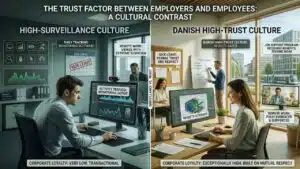
Deep, unwavering trust is the ultimate, highly invisible currency that holds the entire Danish economy tightly together. Employers genuinely trust their hired staff to complete their complex tasks without secretly installing keystroke monitoring software or demanding completely useless daily status reports. Workers, in turn, deeply trust that their executive leaders will treat them fairly during hard times, pay them a highly decent wage, and never steal their earned credit.
The federal government implicitly trusts unemployed citizens to actively seek new opportunities while sitting at home receiving their generous benefit checks. This incredibly high-trust cultural environment completely eliminates the exhausting, soul-crushing office politics and deep surveillance tactics that completely destroy worker morale in other competitive corporate cultures.
| Trust Dynamics | High-Surveillance Culture | Danish High-Trust Culture |
| Daily Tracking | Software monitors mouse movements | Results are measured, not screen time |
| Sick Leave | Requires immediate doctor notes | Handled via verbal trust and respect |
| Remote Work | Viewed with extreme suspicion | Fully embraced and widely supported |
| Corporate Loyalty | Very low, highly transactional | Exceptionally high, built on mutual respect |
9: High Taxation Pays for High Psychological Safety
You completely cannot discuss the incredible, undeniable success of Denmark without honestly addressing their national taxes. The individual income tax rates are undeniably steep, often taking close to half of a highly skilled professional’s monthly paycheck. Yet, you will almost never find a native Danish citizen loudly complaining about this reality in the streets. They absolutely do not view their massive taxes as a cruel punishment from a greedy government.
They highly logical view them as a standard, required subscription fee for living in an exceptionally excellent, incredibly safe modern society. They fully know their collected tax money directly funds their world-class hospitals, their completely free universities, and the vital A-kasse safety net that protects them. They happily and willingly trade personal, hoarded wealth for the absolute, ironclad peace of mind that neither they nor their direct neighbors will ever fall into crushing poverty.
| Taxation Element | Danish Public Perception |
| Income Tax Rate | Accepted as necessary for social stability |
| Healthcare Access | Viewed as a totally free, right-of-birth service |
| University Costs | Completely free, students receive living stipends |
| Welfare Status | Seen as an insurance policy, not a handout |
Economic Impact and Global Competitiveness
Loud critics of strong, European welfare states often loudly argue that giving average people far too much financial security will instantly make them lazy and useless. They heavily assume that without the dark, looming threat of absolute poverty, people will simply sit on the couch and stop working hard entirely. The hard, undeniable economic data coming out of Denmark proves this cynical theory completely wrong every single day of the year.
Denmark currently serves as home to some of the most highly competitive, aggressively innovative, and massively profitable corporate entities in the entire world, particularly in global shipping, advanced pharmaceuticals, and green renewable energy. The social safety net absolutely does not act as a comfortable hammock where lazy people go to sleep and hide from the world. It directly acts as a highly tensioned trampoline that allows brave people to bounce back from failure and jump significantly higher on their next attempt.
10: It Fuels Innovation Rather Than Stifling It
True corporate innovation deeply requires a massive appetite for personal risk. If failing at a new, exciting venture guarantees that you will completely lose your house, your car, and your ability to buy basic groceries, you are absolutely not going to take that bold risk. Because the Denmark flexicurity model entirely removes the catastrophic, life-ending consequences of business failure, the general population is incredibly entrepreneurial.
If you bravely quit your safe corporate job to build a wild software startup and it completely goes bankrupt in six months, you will be totally fine. If you passionately pitch a radical new marketing strategy to your boss and it fails miserably, you will simply pivot and try a different angle without being fired. This ultimate, unshakeable safety net breeds a national culture of incredibly bold, highly aggressive innovation that pushes the entire country forward.
| Innovation Driver | Impact of the Flexicurity System |
| Startup Creation | Massively encouraged due to zero survival risk |
| Corporate R&D | Highly funded, companies adapt rapidly |
| Failure Perception | Viewed as a required learning step, not a disaster |
| Global Ranking | Consistently places Denmark in top innovation tiers |
How Other Countries Can Learn from Denmark?
It is a deeply established, highly acknowledged fact that you cannot simply copy the entire Danish economic model and aggressively paste it into a massive, highly populated nation like the United States, China, or India and expect instant, perfect results. Denmark is a relatively small, highly connected country with a deep, centuries-old history of incredibly high social trust among its citizens. However, global businesses and agile tech companies can absolutely adapt the core, underlying principles to improve their own terrible retention rates.
Modern SaaS organizations can willingly choose to offer much better, softer severance packages and invest heavily in continuous employee training budgets. Local governments can deeply explore new policies that actively decouple basic human healthcare from rigid employment status. Moving drastically away from fear-based, dictatorial management toward highly trust-based collaboration absolutely works in any geographic location if the leadership is brave enough to try it.
Final Thoughts
The incredibly successful Denmark flexicurity model actively proves that a modern society absolutely does not have to brutally sacrifice human wellbeing just to build a highly competitive, massive global economy. By making it incredibly simple for large companies to rapidly adapt to shifting global markets while simultaneously providing an absolutely unbreakable financial safety net for the actual humans doing the labor, Denmark has brilliantly engineered a modern workforce that is entirely fearless, highly adaptable, and deeply, passionately engaged.
Workers existing within this unique system are consistently treated as highly valuable, appreciating intellectual assets that deeply deserve respect, adequate physical rest, and continuous education. As the chaotic global corporate landscape aggressively shifts toward artificial intelligence, heavy automation, and rapid market changes, the rest of the civilized world has a massive amount to learn from the highly compassionate Danish approach to human capital.
Frequently Asked Questions (FAQs) About Denmark Flexicurity Model
1. How does the Denmark flexicurity model treat gig workers and freelancers?
Traditionally, the entire structural system was originally built specifically for standard, full-time corporate employees. However, Denmark has been highly proactive and actively updating its rigid A-kasse unemployment insurance rules to significantly better accommodate modern freelancers, independent contractors, and digital platform workers. They now allow these non-traditional workers to carefully calculate their unemployment benefits based on their highly variable, month-to-month incomes over a longer historical period.
2. Do expats and foreign workers actually benefit from the flexicurity system?
Yes, absolutely. Foreign professionals and skilled expats working entirely legally within the borders of Denmark can easily join an A-kasse and a relevant trade union. After consistently contributing their required monthly fees for a specific qualifying period, which is usually exactly one full year of employment, they are completely entitled to the exact same high-level unemployment benefits and free retraining programs as native-born Danish citizens.
3. Can small bootstrapped startups survive the high salaries and taxes in Denmark?
Yes, they thrive incredibly well. While baseline salaries are undeniably high, small startups actively benefit massively from the highly flexible labor laws. They can rapidly hire new talent to aggressively test a wild idea and effortlessly scale down quickly if their venture funding suddenly dries up. They can do this without ever facing the crippling, deeply expensive legal severance battles found in other strict European countries like France or Germany.
4. What practically stops lazy people from abusing the high unemployment benefits?
The entire system is strictly and aggressively monitored through the active labor market policy branch of the government. To legally keep receiving your massive 90 percent salary benefit check, you must constantly prove you are actively applying for specific, relevant jobs every single week. You are also entirely mandated to attend regular career coaching meetings and fully participate in state-mandated upskilling courses. You absolutely cannot simply sit quietly at home and collect free money forever.
5. How do Danish companies actually retain staff if everyone can switch jobs so easily?
Companies aggressively retain their best staff by simply creating absolutely excellent, highly desirable work environments. Because managers absolutely cannot trap their employees with the dark threat of sudden unemployment, the businesses must actively compete based on maintaining a deeply healthy culture. They win loyalty through incredibly flat hierarchies, deep personal respect, excellent physical office conditions, and strict, unwavering adherence to the 37-hour work week.