

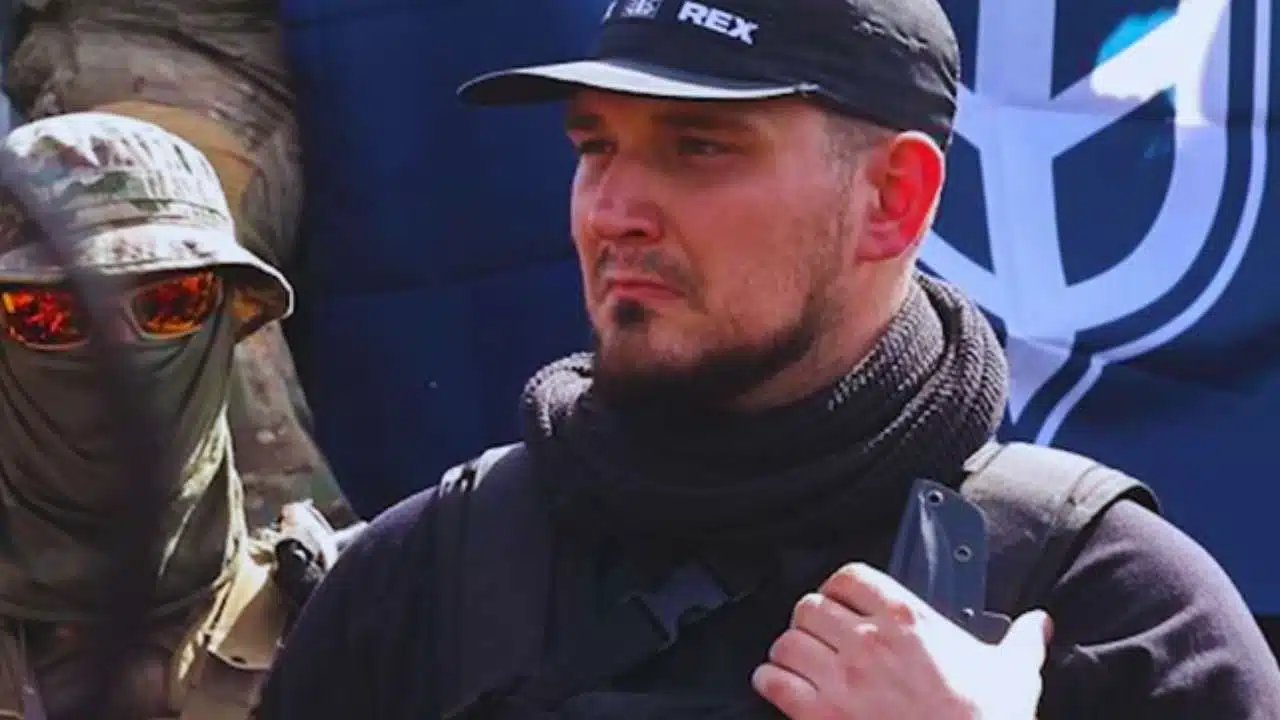
Denis Kapustin, the Russian Volunteer Corps founder known as “White Rex,” was killed by an FPV drone strike during a combat mission in Ukraine’s Zaporizhzhia region on Dec. 27, according to the group. He was 41 and fought on Ukraine’s side against Russia’s invasion.
What happened on Dec. 27 in Zaporizhzhia
The Russian Volunteer Corps (often abbreviated as RVC or RDK) said Kapustin was killed overnight during a mission on the southern front in Zaporizhzhia Oblast. In its initial statement, the unit cited preliminary information indicating a first-person-view (FPV) drone strike and said it would publish more detail after reviewing the circumstances.
The group’s announcement was followed by tributes from allied Ukrainian-linked formations and pro-Ukraine Russian volunteer circles online. Publicly available information immediately after the claim did not include independent battlefield verification, and there was no rapid confirmation from official Ukrainian channels. In the fog of war, such gaps are common, especially for special operations and volunteer units operating near the front.
Still, multiple outlets and open-source profiles reported the same basic timeline: Kapustin was killed on Dec. 27 in Zaporizhzhia Oblast during a combat operation, with the RVC attributing the death to an FPV drone strike.
Who was Denis Kapustin
Kapustin was a Russian national born in Moscow in 1984. He was widely known by the nickname “White Rex” and was also reported under the surname “Nikitin” in various legal and media contexts. Over the years, he became a controversial figure because of his past involvement in far-right activism and networks in Europe.
According to multiple profiles, Kapustin moved to Germany in the early 2000s and became associated with football hooligan circles and far-right activism. He later faced bans and restrictions in Europe connected to extremist activity allegations and was reported to have relocated to Ukraine before Russia’s full-scale invasion.
Kapustin acknowledged holding right-wing views in past interviews, while disputing labels that he was formally aligned with neo-Nazism. Those denials have not prevented critics and researchers from documenting his links to far-right scenes, including combat-sport subcultures that overlap with extremist organizing.
From activist networks to a battlefield commander
After Russia launched its full-scale invasion of Ukraine in February 2022, pro-Ukraine Russian volunteer formations became more visible. Some operated as part of Ukraine’s broader security ecosystem, while presenting themselves as Russian opposition-in-arms.
Kapustin’s name became tied to these circles early in the war. Later in 2022, he founded the Russian Volunteer Corps, a unit made up of Russian citizens who said they were fighting to topple Vladimir Putin’s government and end the invasion.
The RVC positioned itself as both a fighting unit and a political symbol: Russians taking up arms against the Kremlin. That combination—military activity paired with an explicitly regime-change narrative—made the group especially high-profile and especially polarizing.
Russian Volunteer Corps: what the group says it is
The RVC describes itself as a formation of Russian volunteers fighting alongside Ukraine against Russian forces. Its public messaging has emphasized:
- opposition to Putin’s government
- support for Ukraine’s defense
- cross-border pressure on Russian regions near Ukraine
Unlike conventional Ukrainian brigades, the RVC has operated with a mix of battlefield roles and media messaging—releasing videos, statements, and claims of operations designed to demonstrate vulnerability along Russia’s border and encourage dissent.
Key events linked to Kapustin and the RVC
| Date | Event | Why it mattered |
| Aug. 2022 | RVC founded | Established a distinct anti-Kremlin Russian unit fighting from Ukraine |
| Mar. 2, 2023 | Bryansk raid claimed by RVC | Drew international attention; Russia framed it as “terrorism,” RVC framed it as anti-regime action |
| May–Jun. 2023 | Belgorod-border operations | Added pressure on Russia’s border defenses; boosted the visibility of Russian volunteer units |
| Nov. 2023 | Russian court sentencing in absentia | Russia escalated legal designation and punishment; reinforced “terrorist/extremist” framing |
| Mar. 2024 | New cross-border incursions reported | Demonstrated continued capability and coordination by pro-Ukraine Russian fighters |
| Dec. 27, 2025 | Kapustin killed in Zaporizhzhia | Removes the unit’s best-known public leader; raises questions about succession and cohesion |
Cross-border raids into Russia: what is known
The RVC’s global profile grew sharply after incursions into Russian territory.
Bryansk, March 2023
A cross-border incident in Bryansk Oblast in March 2023 became one of the most widely reported episodes. Russian authorities said attackers crossed from Ukraine and fired on civilians. The RVC claimed responsibility but denied targeting civilians, framing the operation as an anti-Kremlin action meant to expose weak border defenses and inspire resistance.
Belgorod and Kursk operations
Subsequent operations in Russia’s Belgorod and Kursk regions—often described as raids—were claimed by different pro-Ukraine Russian groups at different times, including the RVC and other formations. These events tended to follow a pattern: rapid border assaults, heavy information warfare, Russian claims of repulsion, and competing narratives about objectives and impact.
Ukrainian officials have historically walked a careful line on such actions, often describing Russian volunteer formations as operating within Ukraine’s broader defense structure while emphasizing that cross-border raids were not necessarily conducted under Kyiv’s direct orders.
How Russia treated Kapustin and the RVC
Russia classified the RVC as a terrorist organization and pursued Kapustin legally. In late 2023, a Russian military court sentenced him in absentia to life imprisonment in a “special-regime” penal colony, one of the country’s harshest incarceration categories. The charges related to cross-border attacks and were framed by Russia as terrorism and treason-related crimes.
Those legal steps fit Russia’s broader approach to armed anti-Kremlin actors: criminalization, terrorist designation, and expanded domestic security messaging. For Moscow, the narrative value is significant—linking Ukraine and its partners to “terrorism.” For Ukraine and its supporters, the counter-narrative emphasizes that these are Russians fighting Russia’s leadership, not Ukrainians targeting civilians.
Why an FPV drone strike matters
FPV drones have become one of the defining weapons of the war, especially from 2023 onward. They are relatively cheap compared with missiles, can be guided precisely at close range, and are used to strike vehicles, trenches, and positions near the front line.
If the RVC’s preliminary account is accurate, Kapustin was killed in a manner increasingly common for frontline commanders: targeted or opportunistic drone engagement during movement or command activity. FPV threats have forced units across the war to change routines—more dispersed command posts, less predictable travel, stricter electronic discipline, and more layered counter-drone measures.
What Kapustin’s death could change for the RVC
Kapustin was not just a commander; he was the RVC’s public face. That can create both strength and vulnerability:
- Strength: a recognizable leader helps recruitment, fundraising, messaging discipline, and morale.
- Vulnerability: a charismatic figure can centralize decision-making and make succession harder.
The RVC said it would provide more details after investigating the circumstances. The next major questions include:
- Who takes operational command?
- Does the group’s media strategy change?
- Does it continue cross-border raids at the same tempo?
- How does Ukraine’s security ecosystem manage coordination with a unit undergoing leadership transition?
Historically, armed volunteer formations can either fragment after a high-profile loss or consolidate under new leadership, depending on structure, external support, and battlefield pressure.
What comes next
Kapustin’s reported death on Dec. 27 is a significant moment for pro-Ukraine Russian volunteer forces because it removes one of the most recognizable—and controversial—leaders in that space. Even if the RVC continues operating, it may do so with less centralized public messaging, at least in the short term.
More clarity will likely depend on what the unit releases after its internal review, whether Ukrainian officials provide any confirmation, and whether independent open-source indicators (geolocation, battlefield imagery, unit communications) substantiate the circumstances described.






















