Do you remember the first time a manga chapter made you jump out of your seat? Maybe it was Goku turning Super Saiyan or Luffy landing that first punch on a Warlord. We all have that moment. But lately, you might have noticed the landscape looks a little different. New hits rise and fall in the blink of an eye, and the magazines we used to stack in our closets are getting harder to find. If you’re wondering why your favorite series seems to move faster or why everyone is reading on their phones, you aren’t the only one. The industry is shifting under our feet.
For decades, the “Shonen Jump Model” was the king of comics, selling millions of paper copies every week. But with 2025 circulation numbers dropping to nearly 1 million, a far cry from the 6.53 million peak of the 90s, things have officially changed. I’m going to walk you through exactly what is happening to our beloved medium.
We will look at the real numbers, the new digital contenders, and what this all means for the stories we love in 2026. Grab a coffee and let’s get into it; the future of manga is already here.
The Rise of the Shonen Jump Model
Shonen Jump didn’t just sell comics; it defined a culture. By focusing on three simple words, “Friendship, Effort, and Victory,” it created a formula that hooked young readers and never let go. The magazines were thick, printed on cheap recycled paper, and absolutely packed with the most exciting art in Japan.
Origins and Early Success (1960s-1970s)
Weekly Shonen Jump launched in 1968, and it shook up the status quo immediately. Before this, manga was often seen as disposable entertainment for small children, but Jump aimed slightly higher, targeting teens with grittier action and louder comedy. Early hits like “Harenchi Gakuen” pushed boundaries, while police comedies like “Kochikame” became staples that would run for decades.
The editors used a ruthless survey system to pick winners. Every week, readers voted for their favorite chapters. If a series stayed at the bottom of the rankings for too long, it was cut. This “survival of the fittest” approach meant only the most engaging stories survived, driving sales past one million copies a week by the early 1970s.
The Golden Age of Shonen Jump (1980s-1990s)
If you ask any long-time fan about the “Golden Age,” they will point to the mid-90s. This was the era of titans. You had Dragon Ball redefining action, Slam Dunk making an entire nation fall in love with basketball, and Yu Yu Hakusho bringing supernatural style to the masses.
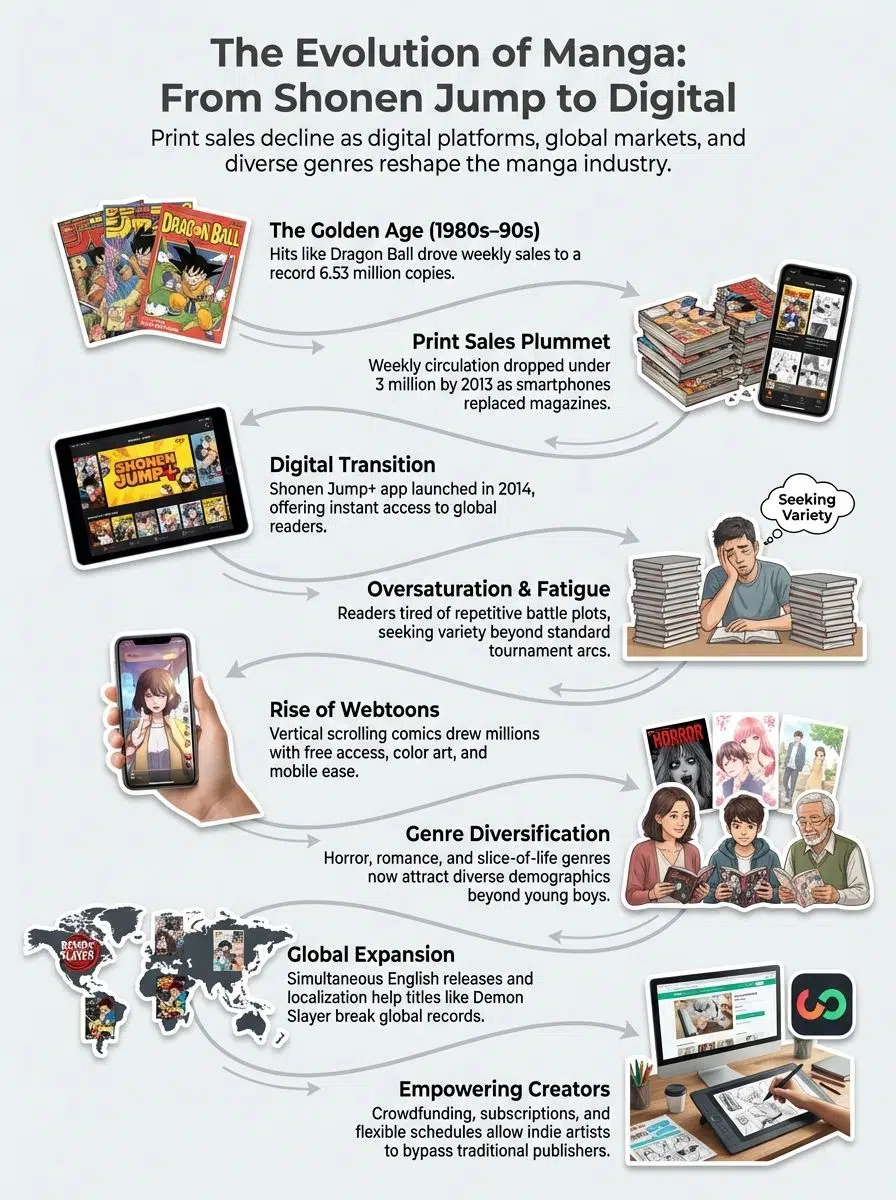
The numbers from this era are staggering. In 1995, Weekly Shonen Jump achieved a circulation record of 6.53 million copies per week. To put that in perspective, that is more than the population of many countries, all buying the same magazine on the same day.
“Walking into a convenience store on a Monday in 1995 was an event. The stacks of Jump magazines were taller than the kids buying them.”
Iconic Series and the Big Three: One Piece, Naruto, and Bleach
As the 90s ended, a new trinity emerged to carry the torch into the 2000s. We call them “The Big Three,” and they were responsible for exploding manga popularity overseas, especially here in the US.
- One Piece (1997): Eiichiro Oda’s pirate epic became the best-selling manga in history, proving that a single story could sustain readership for over 25 years.
- Naruto (1999): This ninja saga bridged the gap between Eastern and Western audiences, becoming a massive gateway series for American fans on Cartoon Network.
- Bleach (2001): With its stylish character designs and sword battles, it captured the “cool” factor of the early 2000s perfectly.
These three didn’t just sell books; they built empires of merchandise, anime, and video games. They set a standard for long-running serialization that defined the industry for fifteen years.
Declining Circulation and Changing Trends
But nothing stays on top forever. While the stories remained exciting, the way people consumed them started to fracture. The physical phone book-sized magazine began to lose its appeal as screens took over.

Decline in Print Sales (2000-2013)
The drop-off was steep. After the high of 1995, print circulation began a steady slide. By 2013, Weekly Shonen Jump had dropped below three million copies a week. The reality was simple: kids were spending more time on flip phones and early smartphones than they were in bookstores.
It wasn’t just a distraction; it was a convenience. Why carry a heavy, ink-smudging book when you could play a game or text your friends? Even massive hits like Naruto couldn’t reverse the trend. Publishers were terrified. Ad revenue was shrinking, and the old model of “print cheap, sell millions” was starting to crumble.
Transition to Digital Platforms (2013-Present)
Shueisha, the publisher of Jump, didn’t go down with the ship. They built a new one. In 2014, they launched Shonen Jump+, a digital app that changed the rules. Instead of just digitizing the magazine, they started creating original content specifically for mobile readers.
This was a gamble that paid off. By 2024, the platform had produced massive hits like Spy x Family and Kaiju No. 8, series that found millions of readers online before a single paper volume was printed. The app currently boasts over 4.6 million weekly active users, proving that the audience didn’t leave; they just moved.
Impact of Globalization on Manga Consumption
The digital shift cracked the global market wide open. In the past, American fans had to wait months (or years) for official translations. Piracy was rampant because it was the only way to keep up.
Today, apps like Manga Plus allow a kid in Ohio to read the new One Piece chapter at the exact same moment as a kid in Tokyo. This simultaneous release strategy has exploded the market. In 2024, the US manga market was valued at an estimated $1.06 billion. Titles now trend globally on social media minutes after release, creating a worldwide conversation that simply wasn’t possible ten years ago.
Challenges Facing the Shonen Jump Model
Even with digital success, the traditional “Jump” formula faces serious questions. Readers are smarter, faster, and have more options than ever before.
Oversaturation of Battle Shonen Series
For a long time, if you wanted a hit, you wrote a “Battle Shonen.” You gave a teenage boy a special power, a rival, and a tournament to win. But in 2026, readers are showing signs of fatigue. We have seen the “underdog wants to be king” story a hundred times.
When every new series tries to be the next Naruto, they all start to blur together. Critics and fans alike have noted that recent cancellations in the magazine often stem from series playing it too safe. Without a unique hook, like the horror elements of Chainsaw Man or the historical setting of The Elusive Samurai, standard battle comics struggle to survive past their first year.
Shifting Demographics and Reader Preferences
The “Shonen” label literally means “boy,” but the readership has moved on from gender labels. Recent data suggests that nearly 40% of Shonen Jump’s readership is female. This shift is changing the stories themselves.
We are seeing massive success with titles that blend genres. Blue Box, a series currently running in Jump, mixes sports with genuine romance, and it’s consistently topping popularity polls. The modern reader wants emotional depth and complex relationships alongside their action scenes. The old rule of “aim for 12-year-old boys” is a fast track to irrelevance.
Competition from Webtoons and Independent Creators
The biggest threat to traditional manga isn’t other manga, it’s Webtoons. Korean platforms like LINE Webtoon have popularized the “vertical scroll” format, which is native to smartphones. You don’t need to zoom or pan; you just swipe up.
Webtoons like Solo Leveling proved that a vertical comic could become a global blockbuster, generating over 14 billion views worldwide. These platforms offer color artwork and faster pacing, which appeals heavily to the TikTok generation. Shonen Jump’s black-and-white, page-flip format feels “retro” to a teenager who grew up with an iPhone in their hand.
Emerging Alternatives to the Shonen Jump Model
Creativity hates a vacuum. As the main magazine squeezes tighter, creators are finding wild new ways to get their work seen.
Rise of Digital Manga Platforms
The barrier to entry has vanished. Platforms like Manga Plus have hit over 30 million downloads as of mid-2024, giving creators a direct line to a global audience. This isn’t just a backup plan; it’s becoming the main stage.
Digital-first launches allow for more experimental art and riskier storytelling because there are no printing costs to worry about. If a series doesn’t find an audience, it can be ended without pulping thousands of unsold books. This efficiency is why digital sales in the US grew by double digits last year while print remained steady.
Growth of Indie Manga
You don’t need a corporate editor to be a mangaka anymore. Sites like Pixiv and Twitter (X) allow artists to build massive followings independently. The series One Room Angel started as a small project and gained critical acclaim purely through online word-of-mouth.
In fact, indie manga sales have seen a sharp rise, with reports showing a 60% increase in the indie sector between 2017 and 2022. Readers are actively hunting for raw, unfiltered voices that the big publishers might consider “too weird” for print.
Popularity of Webtoons and Vertical Scrolling Formats
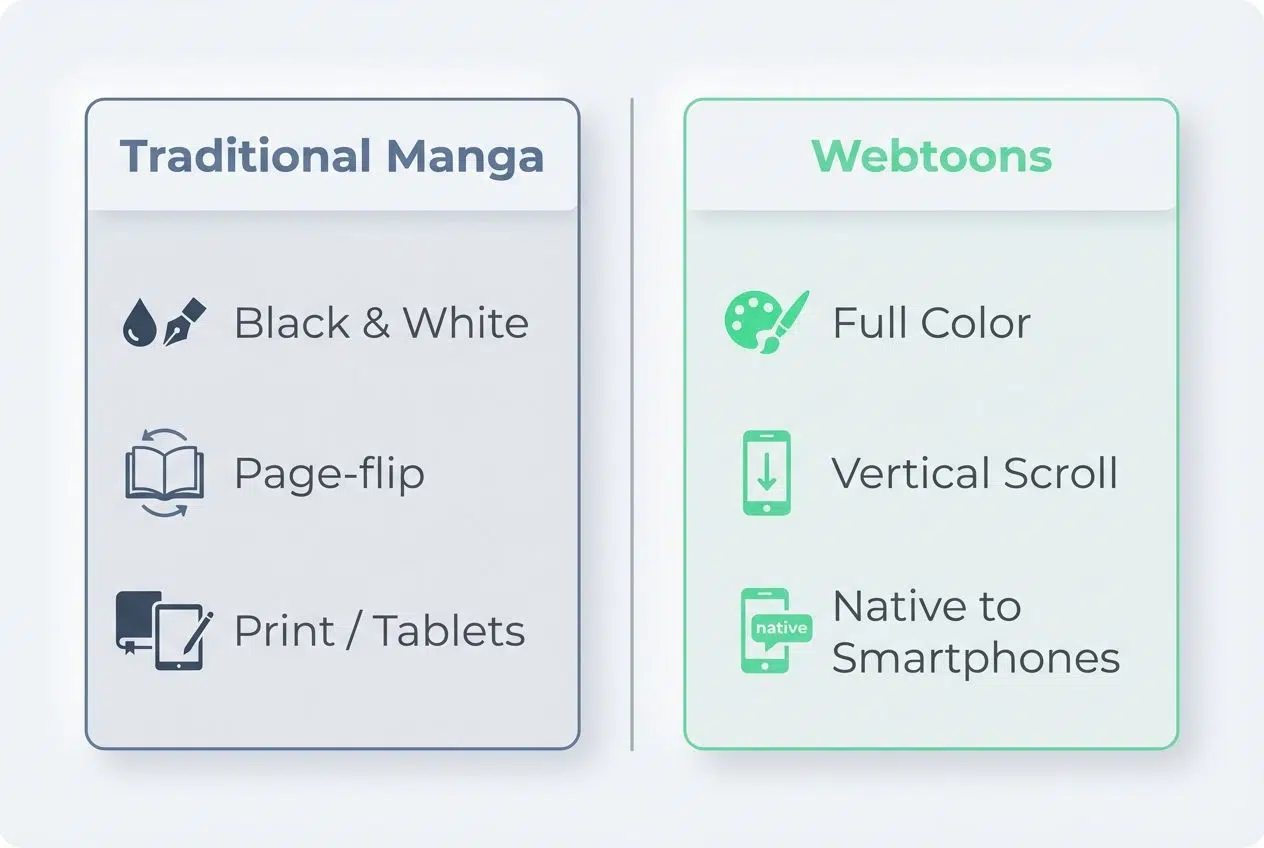
Let’s compare the traditional manga model with the rising Webtoon model. The differences show exactly why the competition is so fierce.
| Feature | Traditional Manga (Shonen Jump) | Webtoons (LINE/Tapas) |
|---|---|---|
| Format | Black & White, Page-flip (Right to Left) | Full Color, Vertical Scroll |
| Reading Device | Optimized for Print / Tablets | Native to Smartphones |
| Updates | Strict Weekly Schedule | Weekly (often with “Fast Pass” options) |
The vertical format is winning the battle for casual readers on the subway. It is simply easier to consume one-handed. This pressure is forcing traditional Japanese publishers to experiment with their own “webtoon-style” verticals, something that would have been unthinkable ten years ago.
Innovations in Manga Storytelling and Distribution
To survive, the industry is getting creative. We are seeing a renaissance of genre-bending and tech-savvy storytelling.
Genre Diversification and Experimental Narratives
The “Battle Shonen” isn’t dead, but it’s evolving. Spy x Family is a perfect example; it’s technically an action series, but it’s built on a foundation of family comedy and slice-of-life heartwarming moments. It appeals to parents, kids, and action fans all at once.
We are also seeing horror make a massive comeback. Chainsaw Man brought gore and surrealism into the mainstream, showing that Jump readers can handle, and actually crave, darker, more mature themes. The magazine is no longer just for “kids.”
Integration of Augmented Reality and Interactive Manga
Why just read a fight scene when you can see it? Publishers are testing Augmented Reality (AR) features where scanning a page with your phone triggers a 3D animation. Shueisha has experimented with AR character pop-ups for One Piece celebrations, turning a flat page into an interactive toy.
While still in the early stages, interactive apps where readers vote on the outcome of a story arc are being tested. It gamifies the reading experience, keeping younger fans engaged in a way static paper never could.
Expansion into Global Markets with Localized Content
Localization used to be an afterthought. Now, it’s the strategy. The success of Kagurabachi in late 2023 and 2024 proved this. The series became a meme-fueled global hit before the first volume even hit shelves in Japan, largely because Western fans could read it legally on day one.
Publishers are now hiring localizers who understand internet culture, ensuring jokes land and dialogue feels natural. This respect for the international audience is a key reason why manga sales in Europe and the US have remained resilient even as other book sales fluctuate.
Crowdfunding for Manga Projects
If the publisher says no, the fans might say yes. Kickstarter had a record-breaking year for comics in 2024, with over $706 million pledged across the platform’s creative categories. Manga-style projects are a huge part of this.
Creators are using crowdfunding to print deluxe editions or fund niche genres that publishers ignore. It turns the “customer” into an “investor,” creating a fiercely loyal community that supports a project from the first sketch to the final book.
Subscription-Based Models
The days of buying individual magazines are fading. For $2.99 a month, apps like the Shonen Jump membership give you access to a vault of 15,000+ chapters. This “Netflix for Manga” model lowers the risk for new readers.
You don’t have to commit $10 to a book you might not like. You just click, read, and decide. This ease of access is crucial for hooking the next generation of fans who are used to all-you-can-eat content buffets.
What’s Next for Manga?
So, where are we heading? The crystal ball shows a world that is smaller, faster, and more diverse.

Global Collaborations
Expect to see more international talent in the pages of Jump. The French manga Radiant by Tony Valente was a pioneer, getting a Japanese release and an anime adaptation. Japanese publishers are actively scouting talent in Korea, China, and the US.
We might soon see a major Shonen Jump hit created by an artist in Brazil or a writer in California. The “manga style” is now a global language, not just a Japanese export.
Exploring Diverse Genres
The future is niche. Instead of one giant hit like Dragon Ball that everyone reads, we will see dozens of smaller hits that dominate specific subcultures. You’ll have the massive “cozy fantasy” hit, the “cyberpunk horror” hit, and the “LGBTQ+ romance” hit all running side-by-side.
Series like Akane-banashi, which is about the traditional art of Rakugo storytelling, are finding surprising success. It proves that if the writing is good, the subject matter doesn’t have to be ninja battles to sell copies.
Flexible Release Schedules
The weekly grind is a health hazard. Fans are becoming more understanding of creator health, and the industry is adapting. Ruri Dragon is a recent example of a series that moved to a digital-only, flexible schedule to accommodate the author’s health, and fans stayed loyal.
We will likely see more “bi-weekly” or “monthly” serialization models becoming the norm for high-quality art. A rested artist draws better pages, and in the long run, that creates a better product.
The Influence of Fans on Manga Evolution
You have more power than you think. In the digital age, reader feedback is instant and loud.
Support for Manga on Platforms like Patreon
Direct support is changing careers. Platforms like Patreon and Fanbox allow artists to make a living with just a few thousand dedicated fans. They don’t need to sell a million copies to survive anymore.
This financial independence allows for riskier, more personal stories. It acts as a farm system for the big publishers, who watch these platforms to see what themes are resonating with paying readers.
Online Community Impact on Manga Success
Viral trends make or break series. When Kagurabachi launched, it was the “memes” on Twitter (X) that drove its initial readership numbers through the roof. The community decided it was going to be a hit, and so it was.
Publishers monitor Reddit threads and Discord servers. They see what characters you love and which plot twists you hate. The gap between creator and consumer has never been smaller, and that feedback loop is shaping the endings of your favorite stories in real-time.
The Future of the “Shonen Jump” Model
Can the old giant learn new tricks? The answer seems to be a resounding yes.
Can It Adapt to Modern Trends?
Shonen Jump is surviving by becoming a hybrid. It is no longer just a magazine; it is a brand that lives on your phone, your bookshelf, and your TV screen. By embracing digital apps and simultaneous global releases, they have stopped the bleeding.
The circulation numbers of the physical magazine will likely never return to 1995 levels, and that is okay. The readership is higher than ever; it’s just spread across apps, websites, and collected volumes rather than a disposable phone book.
Potential for Hybrid Formats
We are moving toward a world where “Print” is a luxury item for collectors, while “Digital” is for consumption. You read the weekly chapter on your phone for convenience, but you buy the high-quality paperback volume for your shelf because you love the cover art.
This separation allows publishers to sell the same content twice: once as a service (ad-supported reading) and once as a product (collectible book). It is a smarter, more sustainable business model for 2026.
Expanding Beyond Traditional Demographics
The “Shonen” wall has fallen. The most successful recent series, like Spy x Family and Frieren: Beyond Journey’s End (though from a rival magazine, the trend is industry-wide), appeal to everyone from 10 to 60.
Future hits will be universal. They will tackle themes of mental health, societal pressure, and identity, topics that resonate with a global, modern audience. The era of writing specifically for “Japanese teenage boys” is over; the new era is writing for the world.
Final Thoughts
Manga hasn’t died; it has just molted. The decline of the physical Shonen Jump magazine is not an ending, but a necessary evolution into something bigger and more accessible.
Today, we have more variety, easier access, and a more direct connection to creators than at any point in history. Whether you are reading on a crispy new iPad or flipping through a yellowed paperback from a used bookstore, the magic of the story remains the same.
So, if you haven’t checked out the new wave of hits on Manga Plus or Webtoon, go take a look. Your next obsession is waiting for you, and this time, you won’t have to wait months to read it.