
Most software companies lose more revenue to customers quietly walking away than to competitors beating them in a head-to-head deal. Nobody sends a complaint. Nobody asks for a discount. The account just goes cold, and the renewal date does the rest.
That is the case for customer success, and it is why the function keeps getting funded in years when almost everything else gets cut. I am chief technical advisor at imaginelab.art and rankpilot.ai, and what follows is not a textbook definition.
It is what customer success for SaaS companies looks like from inside two products still finding their footing, including the two customers we nearly lost last month, the signals we watch, and a fairly expensive mistake I made about what our users were really asking for.
The Two Customers Who Almost Left
Last month we took imaginelab.art global. Within a week, two customers told us they were done. Neither one had a billing problem or a bug to report. They wanted advanced capability we had not built, and they had decided we were never going to build it.
We got both of them on a one-on-one call. Not a survey. Not a win-back discount.
Those two calls changed our roadmap. We found out what they were actually trying to do inside the platform, and a lot of it needed a conversational layer instead of more buttons. That is where Imagine Chat came from. Both customers stayed.
That is customer success in one story. It is the work of finding out why someone is about to stop paying you, early enough to do something about it. I have watched this function decide more of our revenue than any campaign we have run.
What Customer Success Actually Means
Support answers a question someone asked. Account management owns the contract and the upsell. Customer success owns something narrower and harder: whether the customer gets the result they bought the product for.
The difference shows up in who starts the conversation. A support team waits for a ticket. A customer success team goes looking for the customer who has stopped showing up.
Think about a user on ImagineLab Art who logs in every week and exports nothing. They have not complained. They have not asked for help. Support will never hear from that person. They will just be gone at renewal. Finding that user before the renewal date is the entire job.
Why Customer Success for SaaS Companies is a Different Job
In a one-time sale, the money arrives and the relationship becomes optional. Subscription software works the opposite way. The customer re-decides every month or every year, and the cost of leaving is low. In our category it is very low. Someone can move from one AI creative platform to another in an afternoon.
So the sale never really closes. It just repeats. That is why teams building software fund a function whose only output is a customer who stays and grows.
There is a second reason, and it is specific to early-stage products. Our users are the roadmap. We did not decide to build Imagine Chat in a planning meeting. We built it because two people about to leave told us what was missing. At our stage we depend heavily on user preference, and we treat that input as the most valuable thing we own.
The Money Argument Every Founder Eventually Hears
Net revenue retention is the number boards look at. It measures what happens to your existing customer revenue over a year after upgrades, downgrades, and cancellations.
The benchmarks have been drifting down. Median net revenue retention across private B2B SaaS slipped from roughly 105 percent in 2021 to about 101 percent in 2024, based on Benchmarkit and Maxio survey data. The blended median hides a lot, though. Enterprise accounts sit near 118 percent, mid-market around 108 percent, and SMB-focused products closer to 97 percent. SaaS Capital’s 2026 figures put bootstrapped companies between $3M and $20M in ARR at a median of 103 percent.
Here is why that gap matters to valuation. McKinsey’s analysis found top-quartile B2B SaaS companies running about 113 percent NRR traded near 24 times revenue, while bottom-quartile peers at 98 percent traded around 5 times. Fifteen points of retention lined up with a fivefold difference in multiple.
The cost side is manageable. Gainsight and ChurnZero benchmark data puts a healthy customer success cost at 6 to 10 percent of ARR, with a 2026 median of roughly $1.6M in ARR covered per customer success manager. You are not funding a cost center. You are funding the part of the business that keeps last year’s revenue from leaking out.
What the Work Looks Like Week to Week
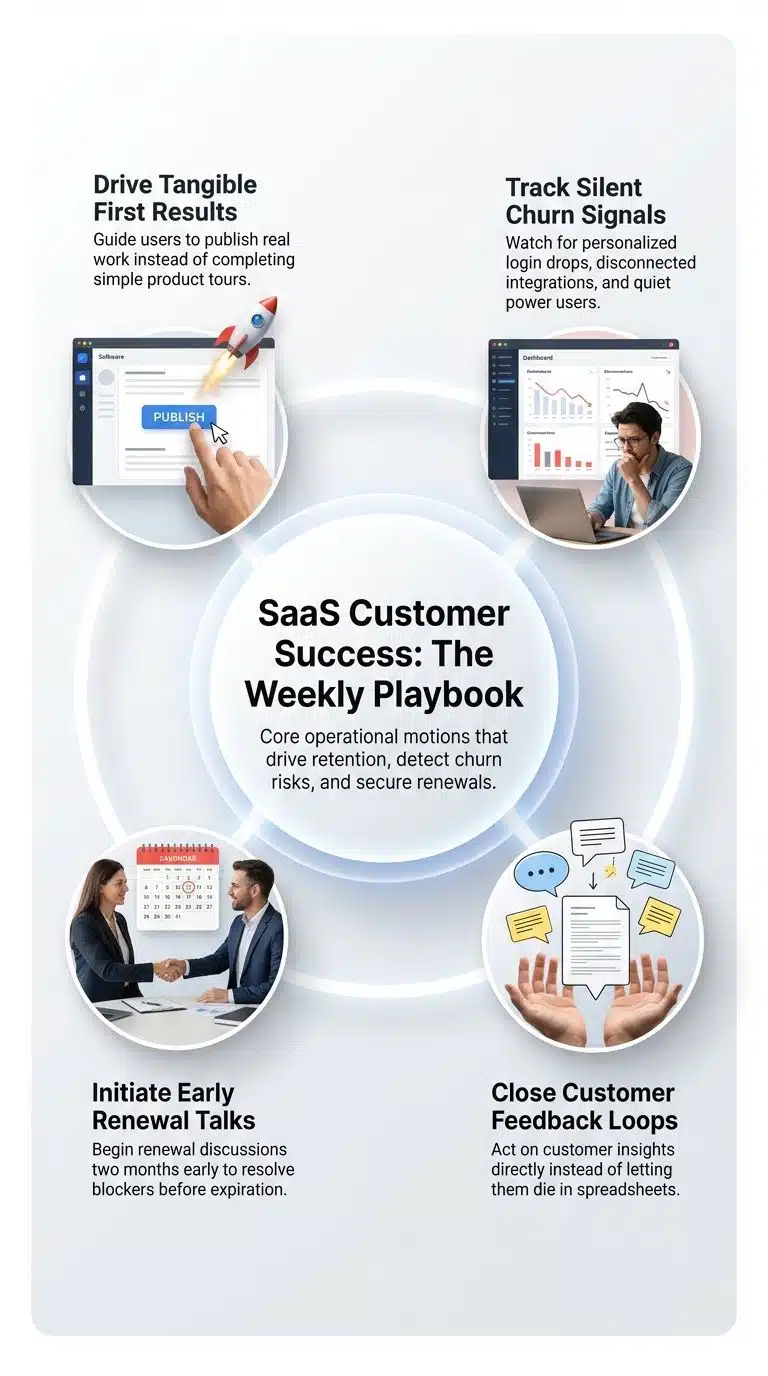
Most of it is unglamorous.
Onboarding to a real result: Not a product tour. The first thing that matters is the moment a user produces something they would actually publish. For us that might be a finished ad creative or a music video, not a completed signup form. Everything before that first real output is at risk.
Watching for silence: We track three signals. Login gaps against a user’s own normal pattern, not a global average. A dropped integration, which usually means the workflow moved somewhere else. And a power user going quiet, which is the one I take most seriously, because the person who championed you internally leaving is often the first move in a churn that takes four more months to become official.
Closing the loop on what people tell you: Feedback that goes into a spreadsheet and dies is worse than no feedback, because you have now taught the customer that talking to you is pointless. If you are setting this up, customer feedback tools built for SaaS are worth more than another dashboard.
The renewal conversation, held early: Not two weeks out. Two months out, when there is still time to fix whatever is wrong. The teams that do this well have written it down as a repeatable motion, and there are customer success strategies for SaaS teams that map the whole sequence.
The Mistake We Made
We tried to put advanced SEO features into imaginelab.art.
It seemed obvious. Users were making content. Content needs to rank. Same customer, same platform, more value.
It was wrong, and it took us a while to see why. Creative content and SEO content are different jobs with different inputs, different success criteria, and different users inside the same company. The person making a music video and the person building a keyword cluster are not thinking the same way, even when they sit two desks apart. Bolting one workflow onto the other made both of them worse.
That realization is why RankPilot AI is a separate product, built entirely around search: AEO and GEO research, full SEO audits, keyword research, AI SERP placement analysis, and SEO content writing.
The lesson applies directly to customer success. Listening to feature requests is not the same as understanding the job someone hired your product to do. Our users were asking for SEO features. What they were telling us was that they had a second job we were not equipped to handle. Answering the request would have damaged the product. Answering the job produced a second one.
Where AI Helps and Where It Stops
The AI story in customer success is real but narrower than the marketing suggests.
G2’s 2026 survey on AI in churn reduction found platforms reporting churn drops of up to 25 percent when predictive signals were built directly into customer success workflows. ChurnZero expects the average CSM to gain 25 to 50 percent more capacity by the end of 2026, mostly by handing off manual reporting and data gathering.
Both of those are about the who. AI is good at telling you which fifteen accounts look wrong this week. It is much weaker at the “why,” and the “why” is the part that saves the account. Gainsight’s benchmarks show only 18 percent of B2B SaaS companies were hitting their digital-touch retention goals, and the top performers treated automated engagement as a way to listen at scale rather than a cheaper way to broadcast.
Our two near-churns proved this to me. Every automated signal we had would have flagged those accounts eventually. Neither signal would have told us to build a chat layer. That came out of a human conversation, and it took about forty minutes.
If Nobody on Your Team Has “Customer Success” in Their Title
At both of our companies, the marketing team owns this. There is no dedicated department, and at our size there does not need to be.
What matters is that somebody is accountable for it by name. Three things make that workable without headcount. Define what a healthy customer looks like in your product, in plain terms, so anyone can spot an unhealthy one. Pick two or three churn signals you will actually check, and check them weekly. And talk to five customers a month who have not complained about anything.
That last one is the highest-return activity I know of, and almost nobody does it. Complaints find you. Quiet dissatisfaction never will. When you outgrow this informal version, structured customer success programs are the natural next step.
Frequently Asked Questions (FAQs)
1. Is customer success just a new name for customer support?
No. Support responds to problems customers report. Customer success works on outcomes customers may not have told you about yet. They need different metrics and usually different people, though at small companies one team covers both.
2. When should a SaaS company hire its first customer success manager?
There is no clean ARR threshold. The better trigger is when the person currently doing the work informally starts missing signals because they have another full-time job. Account complexity matters more than account size.
3. Does customer success make sense for a self-serve product?
Yes, but it looks different. Instead of named managers, you invest in onboarding that reaches a real result fast, usage signals that surface at-risk accounts, and a small number of human conversations with the users who matter most.
4. What one metric should a small team track?
Net revenue retention, if you can calculate it. If you cannot yet, track the share of new signups who produce their first real output in week one. It moves earlier and you can act on it.
The Bottom Line
Customer success for SaaS companies is not a platform you buy or a department you announce. It is the habit of finding out why people leave before they leave and then doing something about it while the account is still yours.
The economics back this up. Retention now drives valuation more than growth rate does, and the cost of the function sits in single digits as a share of revenue. But the numbers were never what convinced me. Two calls did.
So if you are building software and have no customer success function, do not start by buying a tool. Start by calling three customers who have gone quiet this month. Ask what they were trying to do and where it broke. Our best product decision this year came out of exactly that, and it cost nothing except the willingness to hear that the thing we built was not the thing they needed.
If you have run this play at your own company, I would like to know what your earliest churn signal turned out to be. Ours surprised us.