
Are you tired of call flows that trap customers in menus and still send them to the wrong queue? If you are shopping for an ai voicebot solution in 2026, that frustration is exactly why the market has changed so fast. The strongest platforms now answer in natural speech, pull customer data in real time, and pass clean context to a human agent instead of forcing people to start over.
I put this guide together to help you compare the vendors that matter, what they do well, where they fall short, and what to test before you sign a contract. Below, I walk you through the best options for a modern call center, plus the questions I would ask before any rollout.
What Is a Custom Ai Voicebot Solution?
A custom AI voicebot solution is a phone-based assistant built to handle real conversations for your business. It listens, understands intent, asks follow-up questions, completes tasks, and hands the call to a human agent when the issue needs judgment or empathy.
What makes it custom is the business logic behind it. Instead of reading generic scripts, it connects to your CRM, order system, scheduling tools, knowledge base, and telephony stack so it can answer with the right context for your customers.
That matters in a call center because the goal is not just to automate calls. The goal is to resolve more calls well, lower avoidable workload, and improve customer satisfaction at the same time.
Custom Ai Voicebot Solution vs Traditional Voicebots and IVR
I have watched voice systems move from rigid menu trees to real back-and-forth conversation. That shift is the biggest reason many teams are replacing old IVR flows instead of patching them again.
Traditional IVR still works for very simple routing. Once callers need context, interruptions, account lookups, or multilingual support, a Custom Ai Voicebot Solution usually gives a much better experience.
| Feature | Traditional Voicebots and IVR | Custom Ai Voicebot Solution Providerss |
| Interaction style | Menu driven, scripted prompts, one-step commands. | Natural language, intent recognition, freeform speech accepted. |
| Conversation capability | Single turn exchanges, frequent repeats, poor resolution rates. | Multi-turn dialogs, context carryover, better containment and smoother resolution. |
| Task execution | Limited, often requires human fallback for bookings or status checks. | Can book appointments, check orders, verify information, and complete transactions end-to-end. |
| Handoff quality | Rigid transfers, little context, agents often need to restart discovery. | Context-rich handoffs with summaries, caller intent, and captured data. |
| Technology stack | Separate ASR, rule engines, and reporting tools. | Unified stacks with speech recognition, NLU, analytics, guardrails, and workflow orchestration. |
| Reporting and insights | Fragmented logs and manual analysis. | Conversation analytics, trend spotting, QA workflows, and intent reporting in one place. |
| Multilingual support | Patchwork language support and high maintenance. | Better language coverage, stronger accent handling, and easier global deployment. |
| Noise and interruptions | Often struggles with barge-in, mobile calls, and background noise. | Handles interruptions better and recovers more gracefully in messy real calls. |
| Best fit | Simple routing or fixed scripts. | Customer support, self-service, appointment flows, and higher-volume automation. |
The biggest upgrade is not the voice itself. It is the ability to keep context, finish tasks, and hand off cleanly when automation should stop.
Common Business Uses for AI Voicebots
I see the best results when teams start with high-volume calls that already follow a pattern. That gives the voice bot enough repetition to automate profitably without taking on the riskiest conversations first.
A 2026 enterprise CX report from NiCE points to a useful benchmark here: early agentic AI deployments are already showing double-digit reductions in cost per contact, containment above 80% in some programs, and customer satisfaction gains of up to 20%. That is why the right first use case matters so much.
- Ecommerce order support: check order status, shipping, returns, exchanges, and basic product questions without tying up live agents.
- Healthcare patient services: schedule appointments, confirm visits, share office instructions, and route callers to the right care team with privacy controls in place.
- Insurance claims intake: capture first notice of loss details, confirm policy information, and route urgent cases faster.
- Recruiting and HR screening: screen applicants, confirm availability, and book interviews with consistent qualification questions.
- Membership and retention: renew plans, answer coverage or billing questions, and trigger save offers when callers show cancellation intent.
- Sales qualification: identify high-intent callers, gather lead details, and transfer warm opportunities to a closer with full context.
- Multilingual support: serve callers in multiple languages without building separate IVR trees for each market.
For most teams, the easiest wins come from tasks that are repetitive, rules-based, and time-sensitive. Think address changes, payment reminders, appointment booking, or order lookups.
10 Best Custom AI Voicebot Solution Providers in 2026
These are the providers I would keep on a serious shortlist if you need a custom ai voicebot for customer support, inbound automation, or a modern contact center stack. I am looking at conversation quality, deployment speed, integration depth, pricing clarity, and how well each product handles real voice interactions.
No single vendor wins every use case. Some are stronger for developer control, some for enterprise governance, and some for quick launch inside an existing cloud ecosystem.
1. BlueTweak: Editor’s Choice for Unified AI Customer Support
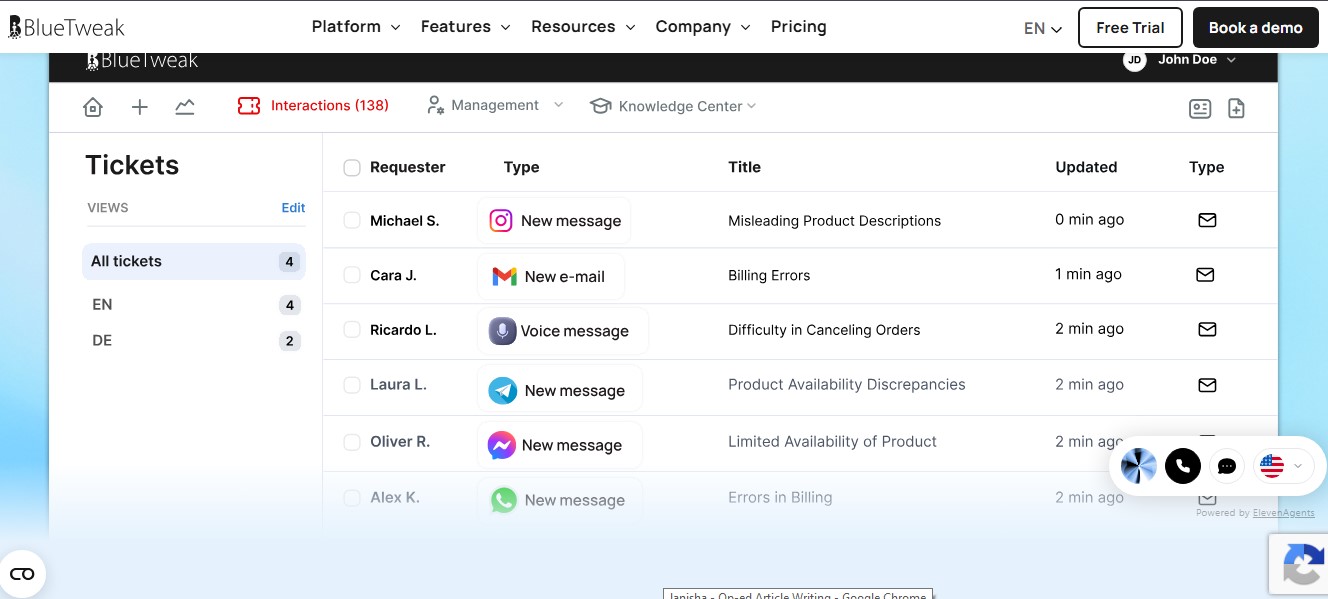
BlueTweak stands out to me because it approaches voice automation as part of a broader customer support system, not as an isolated bot layer. That matters if your team wants voice, chat, email, ticketing, translation, analytics, and knowledge management in one place.
The platform combines conversational voice, AI ticketing, workflow automation, transcription, translation, canned responses, and a smart knowledge base. For support leaders, that reduces the usual problem of stitching together separate vendors just to make one voice flow useful.
Its listed price of $65 per agent per month is also easier to model than usage-heavy enterprise quotes. For mid-sized teams, predictable pricing can matter as much as raw features because it keeps pilot math honest.
- Best for: teams that want one workspace for voice and support operations
- Key strength: unified support stack with QA, WFM, analytics, and automation
- Watch out for: a newer brand may need a deeper proof-of-value pilot than older enterprise names
2. Retell AI: Best for Production-Ready Phone Automation
Retell AI is one of the most compelling picks if you want fast, programmable phone automation and you care about conversation speed. Its pricing page currently shows voice AI usage starting around $0.07 per minute, with higher rates depending on model choice and setup, which gives builders a clearer starting point than many enterprise vendors.
What I like most is its production posture. You get telephony support, built-in fallback features, safety guardrails, PII redaction options, and HIPAA-related enterprise options for teams that need stricter controls.
Retell is a strong fit when your engineers want to control prompt logic, call flows, model selection, and integrations directly. It is less ideal if you want a fully managed enterprise contact center suite out of the box.
| Why teams pick it | What to verify in a pilot |
| Fast conversational feel, flexible telephony, API-first build path | Carrier quality, barge-in behavior, fallback logic, and total minute cost at your real volume |
| Clearer usage-based pricing than many enterprise platforms | How quickly costs rise when you add premium models, QA, SMS, and concurrency |
3. PolyAI: Best for Enterprise-Scale Natural Conversations
PolyAI is built for large enterprises that want customer-led conversations instead of tightly scripted prompts. Its platform documentation says most agents run on its Raven model with sub-300 millisecond latency across more than 24 languages, which is a strong signal for teams that care about natural pacing.
Another detail I like is implementation clarity. PolyAI says a customer-led voice assistant typically takes about six weeks to build, integrate, and deploy. That is useful because enterprise buyers often get vague timelines during sales calls.
PolyAI also leans hard into multilingual voice. The company says it offers 45 languages as standard and supports handoff with captured context, which is exactly what global contact center teams need if they want to reduce repeat questioning.
- Best for: large enterprises with complex inbound voice use cases
- Key strength: natural conversation design and multilingual coverage
- Watch out for: pricing is quote-based, so you need tight scope control before procurement
4. Google Conversational Agents and Dialogflow CX: Best for Google Cloud Teams
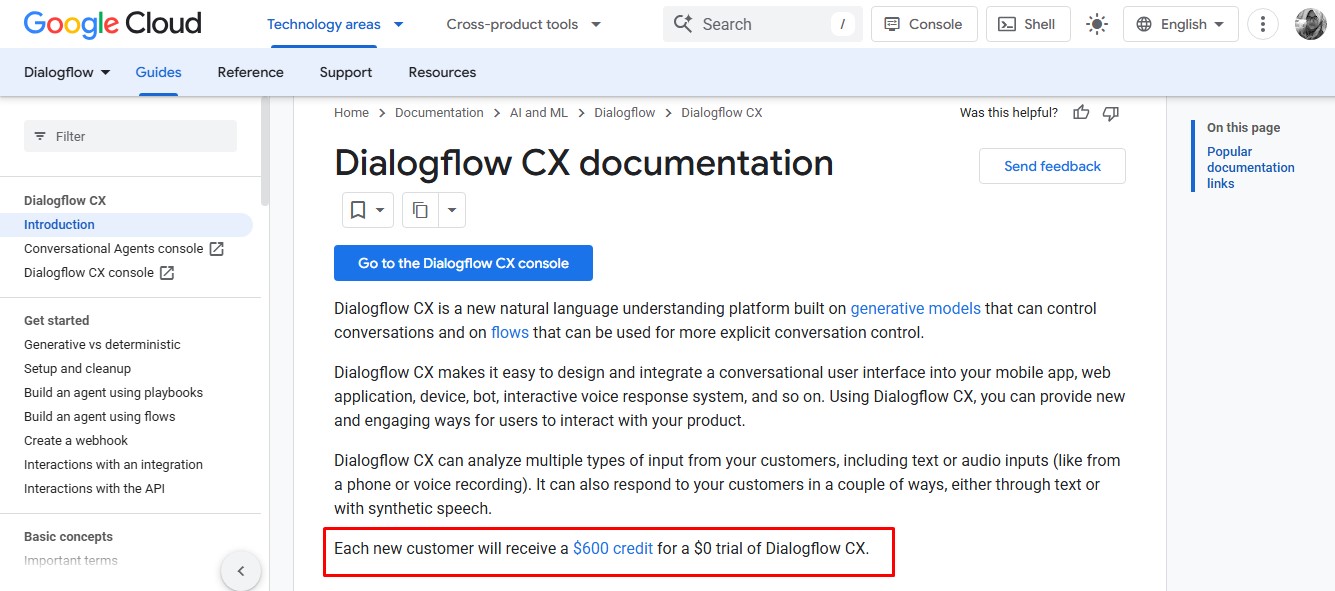
If your team already runs heavily on Google Cloud, Dialogflow CX and Google Conversational Agents can be a very practical choice. The product gives you visual flow design, NLU, voice support, and an easier path into the broader Google ecosystem.
Google’s official pricing page is refreshingly direct. Flows are listed at $0.007 per request for chat and $0.001 per second for voice, with higher rates for playbook-style generative agents. That makes it easier to estimate whether simple automation or more advanced orchestration fits your budget.
I usually recommend this option for teams that already have cloud engineering talent. The platform is powerful, but it rewards clean architecture and careful testing more than it rewards speed for non-technical teams.
Dialogflow CX can look inexpensive in a demo. At scale, request volume, voice seconds, speech services, and external integrations are what change the real bill.
5. Amazon Lex with Amazon Connect: Best for AWS-Based Contact Centers
Amazon Lex still makes sense when your call center already lives in AWS and you want to keep as much of the stack as possible under one roof. It pairs naturally with Amazon Connect and gives builders a familiar low-code environment for bot design.
AWS currently lists Lex pricing at $0.004 per speech request and $0.00075 per text request. New AWS customers can also receive Free Tier credits, which helps for a small proof of concept but should not drive the long-term decision.
The upside is tight AWS alignment. The tradeoff is that real-world voice quality depends a lot on configuration, prompts, speech tuning, and line quality, so I would never judge Lex from a clean demo alone.
- Best for: AWS-native teams and Amazon Connect users
- Key strength: cloud ecosystem fit and pay-as-you-go entry point
- Watch out for: accent handling, interruption recovery, and cross-platform flexibility
6. Genesys Cloud Voicebots: Best for Existing Genesys Contact Centers
Genesys Cloud Voicebots are the obvious shortlist option if you already run Genesys Cloud CX. The benefit is less about novelty and more about stack fit, because routing, reporting, workforce tools, and voice automation can live in the same environment.
As of 2026, Genesys publicly lists Cloud CX 1 at $75 per user per month and Cloud CX 2 at $115 per user per month when billed annually, with higher tiers and usage-based options available as well. That pricing matters because many teams underestimate how quickly bot costs stack on top of a full contact center platform.
Genesys also includes features that contact centers care about beyond the bot itself, such as speech-enabled IVR, analytics, outbound campaigns, native bots, predictive routing, and AI copilots. If you already use Genesys, the integration advantage is real.
For smaller teams, though, this can be more platform than you need.
| Good fit | Less ideal fit |
| Enterprise contact centers that already use Genesys Cloud CX | Smaller teams that only need a lightweight voice bot solution |
| Programs needing QA, WFM, routing, and orchestration in one suite | Buyers who want low setup complexity or fast DIY launches |
7. NiCE Cognigy Voice AI Agents: Best for Low-Code Enterprise Automation
NiCE Cognigy is a strong choice for enterprises that want low-code design without giving up serious automation depth. Cognigy documentation says its NLU supports more than 100 languages, which is a major plus for organizations serving varied caller bases.
The platform is also moving deeper into enterprise contact center workflows. Recent NiCE materials emphasize AI agents across voice and digital channels, plus stronger integration with enterprise CX operations.
From a buying perspective, this is a platform for organizations with scale, process maturity, and budget. AWS Marketplace examples show enterprise-style contract values, and that lines up with how I think about it: powerful, flexible, and rarely a cheap buy.
- Best for: large teams that need low-code control and broad language support
- Key strength: enterprise automation depth across voice and digital
- Watch out for: longer implementation cycles and higher contract complexity
8. Kore.ai SmartAssist: Best for Complex Enterprise Self-Service
Kore.ai SmartAssist is a solid option for companies that need complex self-service journeys, regulated workflow support, and flexible deployment models. In practice, I put it in the bucket of platforms that shine when the business process matters as much as the voice layer.
Kore.ai has long leaned into no-code and enterprise orchestration. Recent product materials highlight omnichannel support, multilingual deployment, agent assist, and workflow control for service operations, which makes it appealing for banking, healthcare, telecom, and large support teams.
The downside is the same one I see with several enterprise-first vendors: you need good internal ownership. Without that, the platform can feel heavy for teams that mainly want a quick voice automation win.
Kore.ai is strongest when your voice bot needs to complete business processes, not just answer questions.
9. Talkdesk AI Agents for Voice: Best for Contact Center Automation
Talkdesk has become more interesting in 2026 because it is pushing beyond basic virtual agents into a broader agentic AI model. Its pricing and product pages describe Talkdesk Autopilot as a voice or digital assistant that can resolve issues, complete tasks, and trigger workflows across the customer journey.
That is important because many buyers no longer want a voice bot that only deflects calls. They want one that can verify information, update records, route intelligently, and finish the job.
Talkdesk is especially worth a look if you want strong contact center framing around the AI layer, including routing, analytics, identity tools, and backend workflow automation. Public pricing for the AI layers is still quote-led, so I would push hard for scenario-based pricing during evaluation.
- Best for: organizations modernizing a full contact center operation
- Key strength: voice automation tied to workflow execution
- Watch out for: custom pricing and the need to map add-ons carefully
10. Yellow.ai VoiceX: Best for Multilingual Global Deployment
Yellow.ai VoiceX is easy to notice if multilingual rollout is high on your list. The company’s current pricing page positions VoiceX as its natural voice AI layer and highlights enterprise plans with 35-plus supported channels, more than 150 integrations, and role-based access with SOC 2, GDPR, and ISO-oriented compliance controls.
I like Yellow.ai for teams that need one system across regions, channels, and campaign types. It is also useful when operations teams want no-code tools instead of a pure engineering workflow.
The tradeoff is pricing transparency. Yellow.ai now shows a free entry tier for limited usage, but serious voice deployments still move into enterprise quoting, so you need a pilot with real call volume before you can trust the economics.
If your support org serves many languages and customer touchpoints, this is one of the more practical vendors to compare side by side with PolyAI and Cognigy.
How to Choose the Right Custom Ai Voicebot Solution
Choosing the right ai voicebot is less about who has the flashiest demo and more about who can resolve your real calls without blowing up your costs, compliance posture, or agent workflow. I always start with the job the agent must do, then work backward into integrations, testing, and commercial terms.
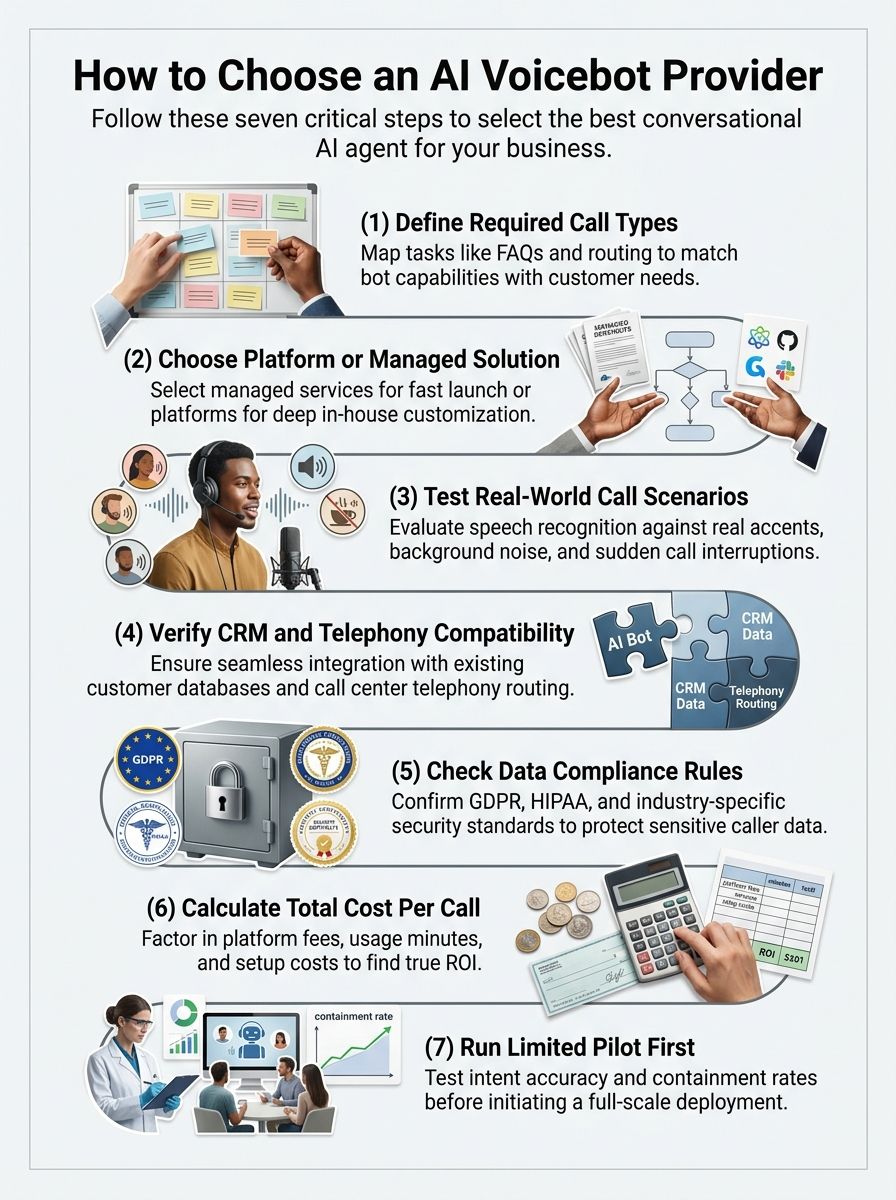
If you skip that order, it is very easy to buy a clever demo and a painful rollout.
Define the Calls the Agent Must Handle
I always start by listing call types, not features. That keeps the project tied to business value instead of generic AI language.
Good starting flows usually include order status, appointment scheduling, payment reminders, account verification, store hours, shipping questions, and first-level triage. These are repetitive enough to automate and valuable enough to matter.
Then I split calls into three buckets:
- Automate fully: simple, repeatable tasks with clear system actions
- Assist and hand off: calls where the bot should gather details before a live agent joins
- Keep human-led: complaints, emotionally sensitive issues, fraud concerns, and exceptions
That one exercise prevents a common mistake. Teams often expect a voice bot to do too much too soon, then blame the platform when the real issue was poor use case selection.
Choose Between a Platform and a Managed Solution
A managed solution is usually the better fit if you want speed, packaged best practices, and less engineering overhead. This route works well for support teams that care more about launch speed, governance, and predictable onboarding than about building every workflow from scratch.
A platform approach makes more sense when your team wants deep control over telephony, prompts, APIs, data routing, and orchestration. Retell AI, Dialogflow CX, Amazon Lex, and Cognigy all lean more in that direction, though each sits at a different point on the technical spectrum.
I use a simple rule here:
| If you need this | Lean toward this |
| Fast rollout, guided migration, one main vendor | Managed solution |
| Custom logic, internal developers, deep workflow control | Platform |
| Full CCaaS replacement or expansion | Enterprise suite |
The mistake I see most often is paying enterprise platform prices without having the internal team to use that flexibility well.
Test Real Calls, Accents, Noise, and Interruptions
This is where weak voice products get exposed fast. A demo in a quiet room tells you almost nothing about performance on mobile networks, speakerphones, noisy kitchens, or overlapping speech.
I test with accented speakers, barge-in, incomplete answers, bad line quality, and callers who change their minds halfway through a sentence. A good ai voicebot platform should recover gracefully, not freeze or restart the whole flow.
Build your pilot scorecard around metrics that actually reveal voice quality:
- Re-prompt rate
- Handoff rate
- Intent recognition accuracy
- Average turn latency
- Containment rate
- First-call resolution for automated interactions
If a vendor talks a lot about natural voice but avoids these numbers, I take that as a warning sign.
Verify CRM and Telephony Compatibility
A voice bot becomes much more useful when it can pull customer context instantly and write back cleanly after the call. That means your evaluation should include real CRM lookups, real record updates, and real phone routing, not just a mocked screen.
Genesys, Amazon Connect, Talkdesk, and other major platforms all have their own ecosystem advantages here. PolyAI says calls can route through SIP or PSTN integrations into your CCaaS platform or telephony provider, and other systems can be connected through APIs, which is the kind of flexibility I want to see in a serious enterprise tool.
During a pilot, I would test at least these integration points:
- Caller identification: can the bot find the customer quickly?
- Data retrieval: can it pull order, billing, or appointment data in real time?
- Write-back: can it log outcomes correctly in the CRM?
- Handover: does the human agent receive a usable summary?
If any of those fail, the bot may still sound good but it will not reduce operational drag.
Examine Data Storage and Compliance Requirements
I treat compliance as an early filter, not a late checklist. In healthcare, finance, insurance, and any environment with sensitive data, you need clear answers on storage, access, redaction, retention, and model governance before the pilot gets too far.
Some vendors make this easier than others. Retell lists options such as PII redaction, custom data retention, SSO, and HIPAA-related enterprise support. Yellow.ai highlights role-based controls and compliance frameworks on its pricing page. LivePerson’s trust center also lists certifications and reports tied to security and regulated use cases.
My checklist here is simple:
- where recordings and transcripts are stored
- who can access them
- whether sensitive data can be redacted automatically
- how long data is retained
- whether the vendor will sign the agreements your industry requires
If a provider gives fuzzy answers on any of those points, I would slow the deal down.
Calculate the Complete Cost per Resolved Call
Sticker price is not enough. For voice AI, the real number that matters is cost per resolved call.
To calculate it, I add platform fees, voice usage, telephony charges, implementation costs, maintenance, QA time, and any live-agent time left in the flow. Then I divide that monthly total by the number of calls the system actually resolves without creating rework.
Here is a simple model I use:
| Cost item | Monthly amount |
| Platform seats or subscription | $2,600 |
| Telephony usage | $1,200 |
| Integration and hosting allocation | $1,500 |
| Total | $5,300 |
If that setup resolves 8,000 calls in a month, cost per resolved call is about $0.66. That is the kind of math that helps you compare a cheaper-looking tool against one that resolves more issues cleanly.
This is also where public pricing helps. Genesys publishes user tiers, Google publishes request and voice-second pricing, Amazon Lex publishes request pricing, and Retell shows minute-based estimates. Quote-only vendors can still be excellent, but you need tighter pilot data to judge them fairly.
Run a Limited Pilot Before Full Deployment
I never recommend a full rollout first. A limited pilot gives you proof on performance, customer response, integration quality, and economics before you commit the whole call center.
Keep the pilot narrow enough to measure clearly. One queue, one language, and a small set of use cases is usually enough to tell you whether the platform deserves a wider launch.
My baseline pilot scorecard looks like this:
- Intent accuracy: aim for at least 80% on the chosen flow set
- Containment: how many calls end successfully without a live agent?
- Latency: does the conversation feel natural, or awkwardly delayed?
- Fallback quality: does handover preserve context?
- Customer sentiment: are callers calmer, faster, and less likely to repeat themselves?
According to Google’s pricing model, voice agents are charged by the second, and according to Retell’s current model, minute cost varies by configuration. That makes pilot measurement even more important, because poor flow design increases both customer friction and your bill.
If the pilot hits your service goals and cost target, expand. If it does not, fix the flow first instead of assuming the technology is the problem.
Wrapping Up
The best ai voicebot for your team is the one that resolves real calls cleanly, fits your stack, and keeps costs predictable as call volume grows.
I would start by matching vendors to your environment: BlueTweak for unified support operations, Retell AI for programmable phone automation, PolyAI for large enterprise conversation design, Dialogflow CX for Google Cloud teams, Amazon Lex for AWS shops, Genesys for existing Genesys contact centers, NiCE Cognigy and Kore.ai for enterprise automation, Talkdesk for workflow-driven contact center automation, and Yellow.ai for multilingual global rollout.
Keep the pilot tight, test messy real calls, and calculate cost per resolved call before you commit. That is how you choose the right ai voicebot with confidence, and how you turn voice automation into a better customer experience instead of one more support headache.
Frequently Asked Questions on AI Voicebot Solution
1. What is this list and when was it updated?
This is a list of the 10 best custom AI voicebot solution providers to watch in 2026. Updated 2026-01-01T00:00:00.000+00:00.
2. Why should I watch these vendors?
They build voice assistants that cut costs, speed service, and lift customer satisfaction. Big players, like Genesys (company), show how the tech scales.
3. What tech features should I look for?
Look for Orchestration (computing), clear speech models, and good analytics, these tie systems and teams together. Pick tools that let you change flows fast, without a lot of code.
4. How do I pick the right vendor?
Start with a small pilot, test voice quality, data rules, and system fit. Check integration, security, and support, then scale what works.