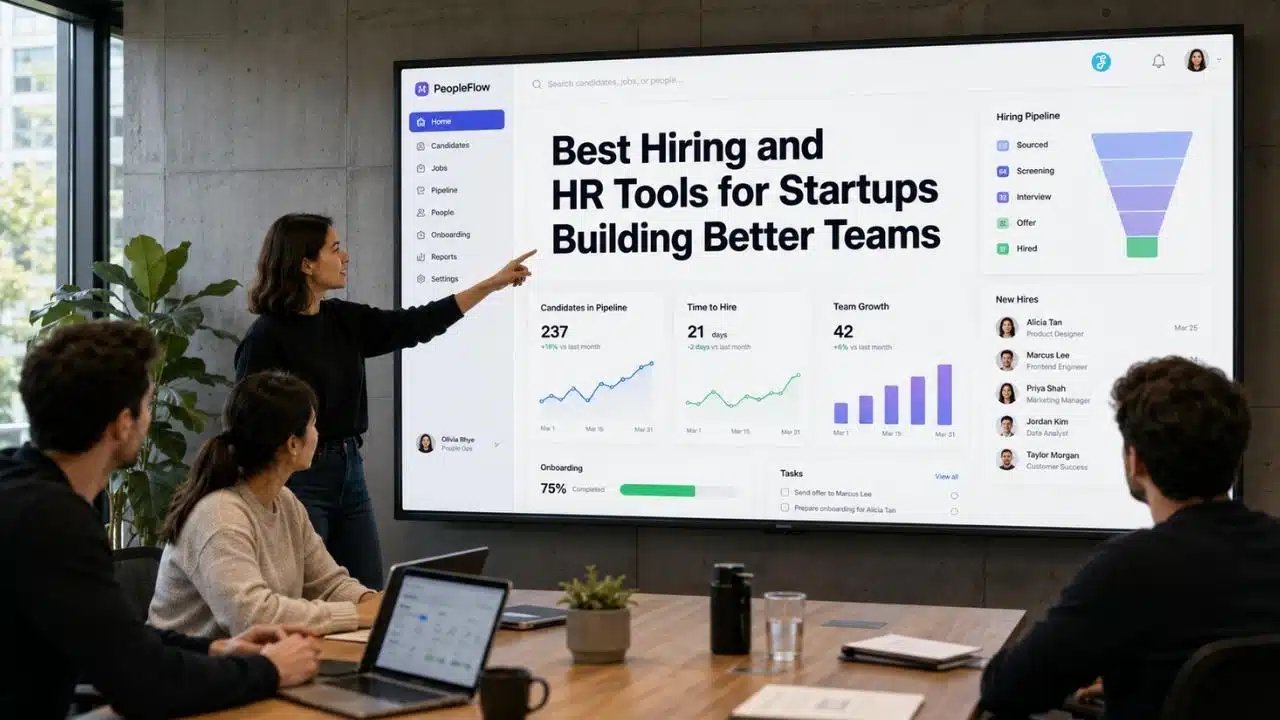
Hiring is exciting until the admin work starts eating the company alive. One founder is reviewing resumes in Gmail, another is tracking candidates in a spreadsheet, payroll is handled separately, onboarding lives in scattered docs, and nobody has a clean view of who is joining, who is paid, and what still needs approval. That is exactly why choosing the Best Hiring and HR Tools for Startups matters earlier than many founders expect. The right Best Hiring and HR Tools for Startups can save time and streamline processes.
A good HR tool does not just help you hire people. It helps you manage candidate pipelines, employee records, onboarding, payroll, compliance tasks, time off, performance, and people data before small mistakes become expensive problems.
To successfully navigate the hiring landscape, it is essential to leverage the Best Hiring and HR Tools for Startups that cater specifically to your needs.
This guide compares 10 hiring and HR platforms based on startup fit, ease of setup, pricing flexibility, applicant tracking, HR depth, payroll support, integrations, and long-term scalability.
Selection Criteria for the Best Hiring and HR Tools for Startups
Understanding the Best Hiring and HR Tools for Startups will empower your startup to grow efficiently and attract the right talent.
Hiring tools and HR platforms are not all built for the same stage. Some are applicant tracking startups can use to organize candidates. Others are broader startup HR software platforms built for payroll, compliance, onboarding, and employee management.
Here are the filters used to compare the options:
| Criteria | Why It Matters for Startups |
| Startup suitability | The tool should work for lean teams, founder-led hiring, and growing startups. |
| Pricing flexibility | Startups need clear entry points, free trials, free plans, or scalable quotes. |
| Ease of setup | HR tools should not require a full operations team to launch. |
| Hiring workflow | The platform should help with job posts, candidate tracking, interviews, feedback, and offers. |
| HR management | Employee records, onboarding, time off, documents, and policies should be easier to manage. |
| Payroll and compliance | Startups need fewer mistakes around pay, contractors, taxes, benefits, and local rules. |
| Integrations | The tool should connect with email, calendar, Slack, payroll, accounting, CRM, and other startup SaaS tools. |
| Reporting and analytics | Founders need visibility into hiring pipelines, headcount, costs, and people operations. |
| Scalability | The tool should support growth without forcing a painful migration too early. |
| Overall value | The software should reduce founder workload, not create more admin layers. |
Who This Guide Is For
This article is for startup founders, operators, people managers, hiring leads, SaaS teams, and small businesses choosing hiring tools for the first time. It is especially useful if your team has outgrown spreadsheets but is not ready for a heavy enterprise HR system.
10 Best Hiring and HR Tools for Startups to Compare
These Best Hiring and HR Tools for Startups are designed to address unique challenges and support your team’s growth at various stages.
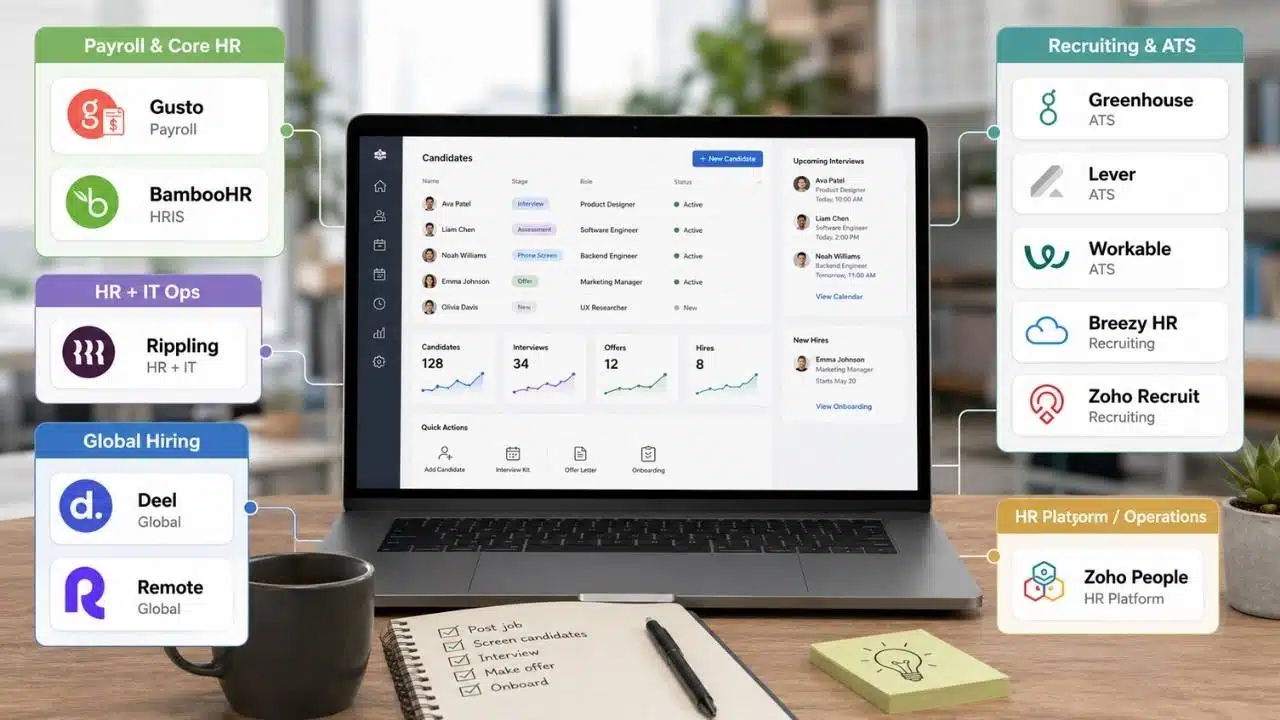
The tools below cover different startup needs. Some are stronger for payroll and HR operations. Some are built for recruiting and applicant tracking. Others are useful for global hiring, contractor management, or structured hiring at scale.
Do not choose based only on brand recognition. Choose based on your current hiring stage, team size, countries of operation, budget, and whether you need HR management, recruiting, payroll, or all three.
1. Gusto
Gusto is a strong HR and payroll platform for US-based startups that need payroll, benefits, onboarding, contractor payments, and basic HR support in one place. It is especially useful for founders hiring their first employees because payroll mistakes can become expensive fast. Gusto’s official pricing page lists plans for payroll, benefits, HR, contractor-only businesses, and scaling companies, with the Premium plan including dedicated support, access to certified HR experts, performance and compensation management, custom reports, and payroll migration support.
Best Feature/For:
- Best for US startups that need payroll and HR basics together.
- Strong fit for founders hiring employees or managing contractors.
Key features:
- Payroll, benefits administration, onboarding, contractor payments, time tools, HR support, reports, and compliance-related workflows.
Why We Chose It:
- Gusto helps founders handle payroll and HR without building a full people-ops function.
- It is approachable for early teams that need practical HR support.
- It supports both employee and contractor workflows.
- It fits well into a founder tool stack where finance, payroll, and people operations need to stay clean.
Things to consider:
- It is strongest for US payroll and HR use cases.
- Startups with complex global hiring needs may need Deel, Remote, or another global employment platform.
Best startup fit:
- US-based startups, founder-led teams, small businesses, and early companies hiring their first employees.
2. BambooHR
Utilizing the Best Hiring and HR Tools for Startups can enhance your recruiting efforts and improve employee retention.
BambooHR is a well-known HR software platform for small and mid-sized businesses that need employee records, onboarding, performance, reporting, payroll add-ons, and applicant tracking. It is useful for startups that want a clean HR system of record before people data spreads across spreadsheets, inboxes, and payroll tools. BambooHR’s pricing page says pricing is quote-based and adjusts as companies scale, while its applicant tracking page positions BambooHR ATS around finding, evaluating, hiring, and onboarding talent in one place.
Best Feature/For:
- Best for startups that want a simple HRIS with hiring and onboarding support.
- Strong fit for growing teams that need people data organized.
Key features:
- Employee records, onboarding, applicant tracking, performance tools, time-off tracking, reporting, payroll options, and employee self-service.
Why We Chose It:
- BambooHR is easier to understand than many enterprise HR platforms.
- It gives startups a central place for employee data.
- Its ATS and onboarding tools help connect hiring with employee management.
- It works well for teams that want HR structure without overbuilding.
Things to consider:
- Pricing is not fully public, so startups need to request a quote.
- Teams that only need recruiting may prefer a dedicated ATS.
Best startup fit:
- Growing startups, people-ops teams, small businesses, and companies moving from spreadsheets to formal HR software.
3. Rippling
Startups often underestimate the impact of choosing the right Best Hiring and HR Tools for Startups on their long-term success.
Rippling is a workforce management platform that connects HR, IT, finance, payroll, benefits, device management, apps, and spend management. For startups, its real value is centralization: when someone joins, changes roles, or leaves, the same system can help manage employee data, payroll, apps, devices, and permissions. Rippling’s pricing page says HR, finance, and IT products can be purchased separately alongside the required core platform, and most products are billed on a per-employee, per-month basis.
Best Feature/For:
- Best for startups that want HR, IT, payroll, and app access connected.
- Strong fit for technical or remote teams managing devices and software permissions.
Key features:
- HRIS, payroll, benefits, identity and access management, device management, finance tools, app provisioning, and workflow automation.
Why We Chose It:
- Rippling is powerful when HR and IT workflows overlap.
- It helps startups reduce manual work when onboarding or offboarding employees.
- It can connect people data with apps, devices, and permissions.
- It scales well for startups that expect more operational complexity.
Things to consider:
- It may be too much for very small teams that only need basic hiring tools.
- Pricing depends on the platform and selected modules, so teams should get a clear quote.
Best startup fit:
- Remote startups, technical teams, security-conscious startups, and growing companies that need HR plus IT operations.
4. Deel
Deel is a global HR, payroll, contractor, and compliance platform for startups hiring across countries. It is especially useful when a company wants to hire international employees or contractors without managing every local payroll and employment requirement manually. Deel’s pricing page lists products for recruiting and development, full HR, payroll, contractor management, and employer-of-record workflows, with the Full HR Solution positioned as an end-to-end suite for larger teams.
Best Feature/For:
- Best for startups hiring globally.
- Strong fit for remote teams managing international employees and contractors.
Key features:
- Global payroll, contractor management, employer-of-record support, HRIS features, compliance workflows, onboarding, compensation tools, and workforce reporting.
Why We Chose It:
- Deel is useful when hiring crosses borders.
- It reduces the need to manage separate local employment systems manually.
- It supports contractor and employee workflows in multiple countries.
- It fits startups that want to hire talent based on skill, not geography.
Things to consider:
- It can be more platform than a local-only startup needs.
- Global payroll, EOR, and contractor features should be priced carefully before committing.
Best startup fit:
- Remote-first startups, global SaaS teams, contractor-heavy companies, and startups hiring across multiple countries.
5. Greenhouse
Greenhouse is a hiring platform and applicant tracking system built for structured recruiting, interview planning, sourcing, onboarding, reporting, and hiring team collaboration. It is a strong option for startups that are no longer hiring casually and need a repeatable process for evaluating candidates fairly and consistently. Greenhouse’s official pricing page says pricing is customized based on hiring needs and plan level, while its platform page highlights AI recruiting, talent sourcing, candidate experience, scalable workflows, onboarding, reporting, and 500+ integrations.
Best Feature/For:
-
- Best for startups building a structured hiring process.
By implementing the Best Hiring and HR Tools for Startups, companies can streamline operations and focus on core business objectives.
- Strong fit for teams that need interview scorecards, hiring workflows, and candidate pipeline visibility.
Key features:
- Applicant tracking, structured hiring, interview planning, candidate experience tools, onboarding, reporting, AI recruiting tools, and integrations.
Why We Chose It:
- Greenhouse helps startups make hiring more consistent.
- It is strong for teams involving multiple interviewers and hiring managers.
- Its reporting helps founders see where hiring bottlenecks happen.
- It is useful when hiring quality matters more than simply filling roles quickly.
Things to consider:
- Pricing is custom, so very early startups should compare cost carefully.
- It may be too advanced for teams hiring only one or two roles per year.
Best startup fit:
- Scaling startups, VC-backed teams, structured hiring teams, and companies with multiple open roles.
6. Lever
Lever combines applicant tracking and candidate relationship management, which makes it useful for startups that want to build hiring pipelines rather than only process inbound applications. It works well for teams that care about sourcing, nurturing candidates, interview workflows, analytics, and collaboration. Lever’s pricing page says pricing is customized based on team size and hiring needs, with ATS, CRM, analytics, AI, and integrations included in scalable plans.
Best Feature/For:
- Best for startups that want ATS plus candidate relationship management.
- Strong fit for companies building long-term talent pipelines.
Key features:
- Applicant tracking, candidate CRM, sourcing workflows, interview management, analytics, integrations, and AI-supported recruiting features.
Why We Chose It:
- Lever is helpful when recruiting is relationship-driven.
- It supports both active candidates and future talent pools.
- It gives hiring teams a more strategic view of candidates.
- It is useful for startups competing for specialized talent.
Things to consider:
- Pricing is custom and may not suit very early teams.
- Startups with simple hiring needs may prefer Breezy HR, Workable, or Zoho Recruit.
Best startup fit:
- Growth-stage startups, talent-driven companies, technical hiring teams, and startups with recurring hiring needs.
7. Workable
Workable is an all-in-one hiring and HR platform that helps teams post jobs, manage applicants, collaborate on hiring, run interviews, and manage people workflows. It is a strong option for startups that want a dedicated recruiting system with enough HR capability to support growth. Workable’s pricing page says every plan includes 1,000 free agent credits, offers a 15-day free trial with no credit card required, and positions the platform around recruiting, HR, and AI agent plans.
Best Feature/For:
- Best for startups that want recruiting software with broader HR direction.
- Strong fit for teams hiring regularly but not ready for enterprise ATS complexity.
Key features:
-
- Job posting, applicant tracking, candidate sourcing, interview workflows, hiring collaboration, onboarding, HR records, performance tools, and AI-supported workflows depending on plan.
With the right Best Hiring and HR Tools for Startups, your organization can foster a culture of efficiency and responsiveness.
Why We Chose It:
- Workable is practical for teams that need hiring workflows quickly.
- It supports collaborative hiring without feeling overly technical.
- The free trial makes it easier for startups to test the platform.
- It can grow from recruiting into broader HR workflows.
Things to consider:
- It may be more expensive than lightweight ATS tools for occasional hiring.
- Startups should check which HR features are included in the plan they choose.
Best startup fit:
- Startups hiring multiple roles, small HR teams, founder-led recruiting teams, and companies that want applicant tracking startups can scale.
8. Breezy HR
Breezy HR is an applicant tracking system focused on visual hiring pipelines, candidate management, job posting, automation, interview scheduling, and offer workflows. It is especially useful for startups that want to move away from spreadsheet recruiting but do not need a heavy enterprise ATS. Breezy’s pricing page mentions Bootstrap plans and unlimited candidate access, with features such as offer approvals, offer management, and optional add-ons like Breezy Intelligence.
Best Feature/For:
- Best for startups that want a simple visual ATS.
- Strong fit for small teams managing active roles and candidate pipelines.
Key features:
- Candidate pipelines, job posting, team collaboration, interview scheduling, automation, offer approvals, offer management, and optional AI-related add-ons.
Why We Chose It:
- Breezy HR is easier to adopt than many larger recruiting platforms.
- Its visual pipeline helps founders see candidate progress quickly.
- It works well for early hiring teams that need structure without enterprise overhead.
- It can support simple approval and offer workflows as hiring becomes more formal.
Things to consider:
-
- Advanced features and add-ons can affect total cost.
Investing in the Best Hiring and HR Tools for Startups ensures that your team is prepared for scaling challenges ahead.
- Larger or more complex hiring teams may eventually need Greenhouse, Lever, or Workable.
Best startup fit:
- Small startups, founder-led hiring teams, bootstrapped companies, and teams hiring a few roles at a time.
9. Zoho People and Zoho Recruit
Zoho is useful for startups that want affordable HR and recruiting tools inside a broader business software ecosystem. Zoho People supports HR processes such as employee data, leave, attendance, onboarding, performance, and HR workflows, while Zoho Recruit focuses on applicant tracking and recruitment. Zoho People’s pricing page includes a 30-day free trial that moves accounts to the Free plan after trial expiry, and Zoho Recruit’s pricing page says its 15-day trial moves users to the Free Plan after the trial ends.
Best Feature/For:
- Best for budget-conscious startups that want HR and recruiting tools under one ecosystem.
- Strong fit for companies already using Zoho CRM, Zoho Books, or Zoho Projects.
Key features:
- HR records, onboarding, attendance, leave, performance, applicant tracking, candidate management, job posting workflows, reporting, and Zoho integrations.
Why We Chose It:
- Zoho offers strong value for startups watching software costs.
- It can connect HR, recruiting, CRM, finance, and operations through the Zoho ecosystem.
- The free trial and free plan structure make it approachable for small teams.
- It works well when founders want essential startup software without buying many separate tools.
Things to consider:
-
- The ecosystem can feel broad, so setup should stay simple.
- Teams should decide whether they need Zoho People, Zoho Recruit, or both.
As your startup evolves, the Best Hiring and HR Tools for Startups will adapt to meet your changing needs.
Best startup fit:
- Bootstrapped startups, Zoho users, small businesses, and founder-led teams needing affordable HR and hiring tools.
10. Remote
Remote is a global employment, payroll, contractor management, and HR platform for companies hiring across borders. It is especially relevant for startups that want to employ people internationally, pay contractors, or manage global payroll without opening local entities too early. Remote’s pricing page lists Employer of Record, Payroll, contractor management, and HR-related products, with Payroll shown at $29 per employee per month and EOR pricing shown per employee per month.
Best Feature/For:
- Best for startups hiring international employees or contractors.
- Strong fit for remote-first companies that need payroll and compliance support.
Key features:
- Employer of Record, global payroll, contractor management, HR tools, benefits support, onboarding, compliance workflows, and international employment infrastructure.
Why We Chose It:
- Remote helps startups hire beyond one country.
- It reduces friction around payroll, compliance, and employment logistics.
- It is useful when a startup wants global talent without creating local entities immediately.
- It can support global teams as hiring expands.
Things to consider:
-
- EOR and global payroll costs can be significant for early startups.
- Local-only startups may not need this level of global employment infrastructure.
The selection of the Best Hiring and HR Tools for Startups is crucial for building a robust foundation for your workforce.
Best startup fit:
- Remote-first startups, global SaaS teams, international contractor teams, and companies hiring across countries.
An Overview of the Best Hiring and HR Tools for Startups
The best tool depends on whether your startup needs recruiting, payroll, HR records, global hiring, or all of them. A three-person startup hiring one contractor does not need the same system as a 40-person SaaS company hiring engineers in three countries.
Overview Comparison Table
Use this snapshot to narrow your shortlist before testing or booking demos. Pricing notes are careful because HR software pricing often changes by employee count, country, selected modules, and contract terms.
Finding the right Best Hiring and HR Tools for Startups can enhance productivity and ensure compliance with regulations.Using the Best Hiring and HR Tools for Startups effectively can lead to improved hiring outcomes and stronger company culture.The integration of the Best Hiring and HR Tools for Startups allows for seamless communication across departments.
| Tool | Best For | Main Strength | Startup Fit | Pricing Note | Ease of Use |
| Gusto | US payroll and HR | Payroll, benefits, and HR basics | US startups and small teams | Public plan pricing available | Easy |
| BambooHR | HRIS and onboarding | Employee records and people operations | Growing startups | Quote-based pricing | Easy to medium |
| Rippling | HR plus IT operations | HR, payroll, apps, devices, and access | Remote and technical startups | Modular pricing with required platform | Medium |
| Deel | Global hiring | International payroll and contractors | Global startups | Public pricing for several products | Medium |
| Greenhouse | Structured hiring | ATS, interviews, reporting, onboarding | Scaling hiring teams | Custom pricing | Medium |
| Lever | Talent pipeline building | ATS plus candidate CRM | Growth-stage startups | Custom pricing | Medium |
| Workable | Recruiting and HR | Job posting, ATS, hiring workflows | Startups hiring regularly | Free trial available | Easy to medium |
| Breezy HR | Lightweight ATS | Visual candidate pipeline | Small teams | Free/paid plan structure available | Easy |
| Zoho People/Recruit | Affordable HR and ATS | HR plus recruiting inside Zoho ecosystem | Bootstrapped startups | Free trials and free plans available | Medium |
| Remote | International employment | EOR, payroll, contractors | Remote-first global teams | Public pricing for key products | Medium |
Our Top 3 Picks and Why
The Best Hiring and HR Tools for Startups are essential for establishing a strategic approach to talent management.
This category benefits from a top three because hiring and HR needs vary sharply by stage.
- Gusto: Best for US startups that need payroll, basic HR, benefits, and contractor support in one practical system.
- BambooHR: Best for growing teams that need an easy HRIS, employee records, onboarding, and people management.
- Greenhouse: Best for startups that are hiring seriously and need structured applicant tracking, interviews, reporting, and scalable recruiting workflows.
How to Choose the Right Hiring and HR Tool for Your Startup

Choosing HR software is not only about features. It is about what kind of people problem your startup is solving first. Are you trying to pay employees correctly, hire faster, manage international contractors, track candidates, onboard new hires, or organize people data?
The Selection Framework
- Start with the core problem: If payroll is the issue, look at Gusto, Rippling, Deel, Remote, or Zoho. If recruiting is the issue, look at Greenhouse, Lever, Workable, Breezy HR, or Zoho Recruit.
- Match the tool to hiring volume: Occasional hiring needs a lighter ATS. Continuous hiring needs structured workflows, reporting, scorecards, and pipeline visibility.
- Check country and compliance needs: A local team and a global team have very different HR software needs.
- Watch long-term cost: Employee count, contractors, EOR fees, recruiter seats, add-ons, implementation, and premium support can change the real price.
The Final Checklist
Before choosing startup HR software, ask these five questions:
- Does the tool solve the most urgent hiring or HR problem today?
- Can the team use it without a dedicated HR operations manager?
- Does it connect with payroll, accounting, calendar, email, Slack, CRM, or other startup SaaS tools?
- Will pricing still make sense when headcount doubles?
- Can your team export data if the tool stops fitting later?
Common Mistakes to Avoid When Choosing Hiring Tools
Choosing the Best Hiring and HR Tools for Startups is vital for creating a cohesive and effective hiring strategy.
The first mistake is buying a heavy HR system before the startup has a clear people process. Software cannot fix vague job roles, weak interview questions, unclear compensation, or poor onboarding.
Another mistake is treating recruiting and HR as separate worlds. A candidate becomes an employee. The handoff from application to offer to onboarding to payroll should feel clean. If your ATS and HRIS do not connect, your team may end up copying the same data across tools.
Startups also forget candidate experience. Slow feedback, messy scheduling, repeated questions, and unclear next steps hurt your employer brand. Good hiring tools should make your process easier for candidates, not just recruiters.
Finally, founders often ignore integration with the broader founder tool stack. Hiring and HR touch payroll, accounting, project management, communication tools, CRM, and support workflows. Just like your guide on Best CRM Tools for Startups helps founders organize customer relationships, this article should help them organize people operations before growth turns messy.
Which Hiring and HR Tool Should Your Startup Choose?
Different startup types need different systems. Use this as a practical shortcut before building your shortlist.
| Startup Type | Best Match | Why |
| US founder hiring first employees | Gusto | Payroll, HR basics, benefits, and contractor support. |
| Growing startup needing HR records | BambooHR | Clean HRIS, onboarding, employee data, and people workflows. |
| Technical remote startup | Rippling | Strong HR, IT, app access, and device management connection. |
| Global startup | Deel or Remote | Better fit for contractors, EOR, payroll, and international hiring. |
| Structured hiring team | Greenhouse | Strong ATS, interview process, reporting, and hiring workflows. |
| Talent pipeline-focused startup | Lever | ATS plus candidate relationship management. |
| Startup hiring regularly | Workable | Practical recruiting system with broader HR direction. |
| Small team hiring occasionally | Breezy HR | Lightweight, visual applicant tracking. |
| Budget-conscious startup | Zoho People and Zoho Recruit | Affordable HR and recruiting inside one ecosystem. |
How This Fits Into Your Startup SaaS Stack
Hiring and HR software should not sit alone. It connects with payroll, accounting, project management, communication, CRM, onboarding, finance, and security tools. A new hire may start as a candidate in an ATS, become an employee in an HRIS, receive payroll setup, get added to Slack and project management tools, and later appear in headcount planning.
Broader guide on SaaS tools every startup needs and naturally link to your CRM guide using the anchor Best CRM Tools for Startups. A CRM helps startups manage customer relationships, while hiring and HR tools help them manage team growth. Both matter because startups scale through people and customers at the same time.
A smart startup SaaS stack should feel connected. Your HR software, CRM, accounting tool, project management system, customer support platform, and analytics stack should reduce manual work instead of creating new silos.
The Best HR Tool Is the One That Prevents Founder Chaos
The uncomfortable truth is that many founders wait too long to organize hiring and HR. They assume people operations can stay informal until the company is bigger. Then the startup suddenly has unclear job records, inconsistent onboarding, missed candidate follow-ups, messy contractor data, and payroll questions nobody wants to handle.
The future of the Best Hiring and HR Tools for Startups will likely include more AI sourcing, automated onboarding, compensation planning, headcount forecasting, global payroll automation, and deeper integrations across the startup SaaS stack. That will help small teams move faster, but it also raises the bar for process discipline. Bad hiring decisions will not become good ones because software made them faster.
Start simple if you are early. Choose a focused ATS if hiring is the bottleneck. Choose payroll and HR software if compliance and employee management are the problem. Choose global employment tools if talent is spread across countries. The right tool should make growth cleaner, not just make your HR stack look more mature than it really is.
Frequently Asked Questions (FAQs) About Best Hiring and HR Tools for Startups
In conclusion, the Best Hiring and HR Tools for Startups are indispensable for fostering growth, improving hiring processes, and ensuring compliance.
What are the Best Hiring and HR Tools for Startups?
Some of the best options include Gusto, BambooHR, Rippling, Deel, Greenhouse, Lever, Workable, Breezy HR, Zoho People/Recruit, and Remote. The right choice depends on whether your startup needs payroll, applicant tracking, HR records, onboarding, or global hiring support. The Best Hiring and HR Tools for Startups can make a significant difference in your growth journey.
Should startups use separate hiring and HR tools?
Very early startups can use separate tools if the workflow is simple. As the team grows, it becomes more important to connect applicant tracking, onboarding, payroll, employee records, and people data.
What is the best startup HR software for a small team?
Gusto, BambooHR, Zoho People, and Rippling are strong options depending on location and needs. Gusto is useful for US payroll, BambooHR is strong for HR records, Zoho is budget-friendly, and Rippling is better when HR and IT need to connect.
Which hiring tools are best for applicant tracking startups can use?
Greenhouse, Lever, Workable, Breezy HR, and Zoho Recruit are strong applicant tracking options. Breezy HR and Zoho Recruit are better for lighter needs, while Greenhouse and Lever fit more structured or scaling hiring teams.
How do HR tools fit into a startup SaaS stack?
HR tools connect people operations with payroll, finance, project management, communication, CRM, and security workflows. They help startups manage hiring, onboarding, employee data, and compliance as part of a broader founder tool stack.