Hey there, are you curious about how tech can solve real-world problems, but find all the buzz around blockchain technology a bit confusing? You’re not alone, my friend; tons of folks feel lost in this digital maze, wondering how it actually works in everyday life.
Here’s a cool tidbit to chew on: Berlin, often called the “Bitcoin Capital of Europe,” is home to nearly half of Germany’s blockchain startups. That’s a big deal! In this blog, we’re breaking down five awesome ways blockchain is being tested right now in Berlin, from secure digital identity to speedy cross-border payments.
We’ll keep it simple, like chatting over coffee, so you can see how these decentralized applications, or dapps, are changing the game. Stick around, it’s gonna be neat!
Key Takeaways
- Berlin hosts 194 blockchain startups, nearly half of Germany’s total, making it a key hub for blockchain tech.
- KILT Protocol in Berlin uses blockchain for secure digital IDs, letting users control their data with smart contracts.
- Centrifuge, started in 2017, tokenizes real-world assets like art or property, unlocking fast cash without selling.
- SatoshiPay, founded in 2014, simplifies cross-border payments with instant, low-cost transactions, raising $911K.
- Chainflip, launched in 2020, enables smooth cross-chain crypto swaps, connecting different blockchain networks easily.
Decentralized Identity Verification

Hey there, want to know how Berlin is changing the game with personal data security? Let’s chat about a cool project in the city that’s making digital IDs safe and private, using blockchain tech!
KILT Protocol: Secure and private identity solutions
KILT Protocol is making waves in Berlin’s buzzing blockchain scene. Imagine a world where your personal data stays yours, no matter who needs to verify it. That’s what KILT offers with its decentralized identity solutions.
It’s a game-changer for keeping your info safe and private. Built on blockchain technologies, KILT lets you control your digital signatures without handing over sensitive details.
Plus, with nearly 50% of German blockchain startups based in Berlin, it’s no surprise that this city is a hotbed for such cool ideas.
Now, let’s chat about why this matters to you. Berlin hosts 194 blockchain startups, and KILT stands out in this busy decentralized ecosystem. They use smart contracts to create a secure way to prove who you are online.
Think of it as a digital ID card, only you hold the key. This fits right into the web 3.0 vibe, focusing on user-friendly and private solutions. Stick around to see how such blockchain networks are shaping our future!
Real-World Asset Tokenization
Hey, did you catch how Centrifuge is turning real stuff, like property or art, into digital tokens on the blockchain? Keep reading to see how this cool trick frees up cash fast!
Centrifuge: Unlocking liquidity for tangible assets
Centrifuge is making waves in Berlin’s blockchain scene, folks. Started in 2017, this innovative project turns real-world assets into digital tokens. Think of houses, cars, or even art becoming tradable on a blockchain.
They unlock liquidity, letting owners access cash fast without selling their stuff. How cool is that?
Imagine you’ve got a valuable painting just sitting there. Centrifuge helps you tokenize it, so you can borrow against its worth using smart contracts. This fintech company is building a fresh way to handle finance, connecting tangible items to the crypto asset world.
It’s like giving your old treasures a new digital life!
Cross-Border Payments and Finance
Hey, want to send money across borders without the usual hassle? Check out how blockchain is making international payments faster and cheaper, right here in Berlin!
SatoshiPay: Simplifying instant international payments
SatoshiPay introduces an innovative approach to manage cross-border payments. Established in 2014, this clever blockchain startup simplifies sending money abroad. Envision transferring cash to a friend in another country without the typical obstacles.
Using their smart contracts, transactions occur instantly, eliminating sluggish bank delays. This Berlin-based standout has already secured $911K to support its vision. Consider it a fast connection across the financial divide.
Now, imagine sending funds without high fees draining your resources. SatoshiPay leverages cryptocurrencies to maintain low costs and high speed. Their role in the blockchain network ensures secure, interoperable transfers.
It’s akin to having a reliable partner for global transactions. Moreover, their decentralized applications, or dapps, ensure every payment is seamless. Stay with this team, and international money transfers become effortless.
Chainflip: Native cross-chain swapping for seamless transactions
Hey there, readers, let’s talk about Chainflip, an impressive player in the blockchain space. Founded in 2020, this platform focuses on cross-chain cryptocurrency exchanges. Think of trading coins across different blockchains as effortlessly as swapping snacks with a friend.
Chainflip ensures these swaps are smooth and quick, eliminating the need for intermediaries. It’s all about connecting separate blockchain ecosystems for seamless transactions.
Now, imagine you’ve got assets on one public blockchain, but you want to use them on another. Chainflip acts like a reliable bridge, managing native cross-chain swapping without any issues.
Using smart contracts, it keeps your trades secure and fast. Plus, it enhances interoperability between blockchains, making the entire process feel incredibly easy for entrepreneurs and users alike.
Decentralized Autonomous Organizations (DAOs)
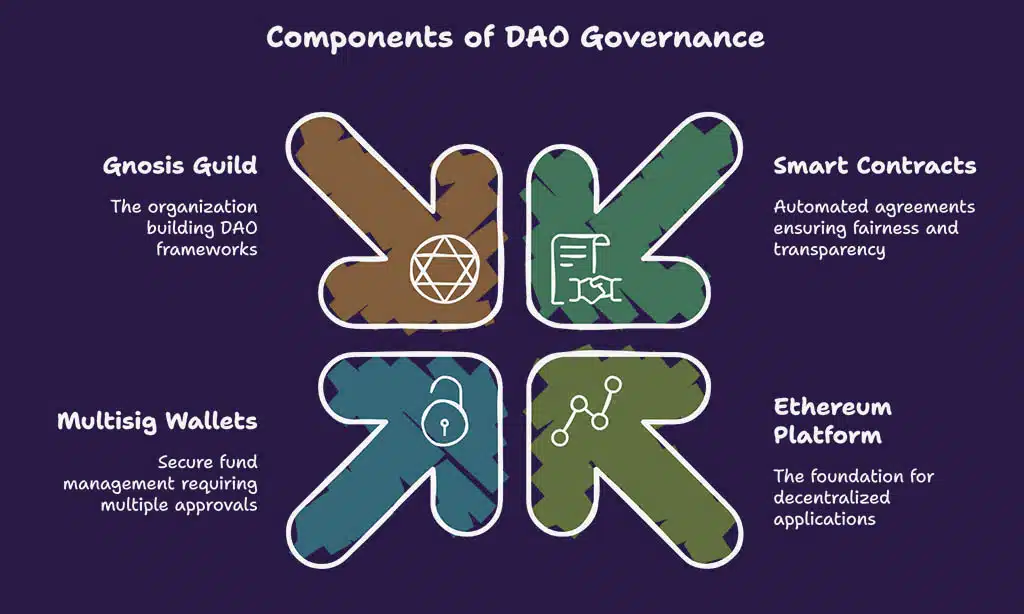
Hey, have you ever wondered how groups can make decisions without a big boss calling the shots? Explore the fascinating sphere of DAOs, like Gnosis Guild, where smart contracts take charge and ensure everything remains fair, transparent, and seamless!
Gnosis Guild: Building frameworks for DAO governance
Gnosis Guild, based in Berlin, is making waves in the blockchain ecosystem. They’re hard at work crafting solid frameworks for Decentralized Autonomous Organizations, also called DAOs.
Imagine a club where everyone votes on rules using smart contracts, no boss needed. Gnosis, built on the Ethereum platform, started as a prediction market tool but now helps groups run smoothly without a central leader.
Isn’t that a neat trick?
Their focus is on creating systems for fair and clear governance in distributed autonomous organizations. Think of it as setting up a digital democracy, where every voice counts. With tools like multisig wallets, they help DAOs manage funds safely.
It’s like having a shared piggy bank that only opens with everyone’s key. Stick around to see how this shapes the future of teamwork online!
Sustainable Energy Management
Hey, wanna know how blockchain is making energy greener in Berlin? Check out Blok-Z, a cool startup using smart contracts to track carbon-free energy and even deal with carbon credits to offset emissions!
Blok-Z: Blockchain for carbon-free energy tracking
Let’s talk about an exciting development in Berlin with Blok-Z. They’re using blockchain, a kind of digital ledger, to monitor carbon-free energy. Envision a vast notebook that everyone can view, yet no one can tamper with.
Blok-Z records the amount of clean energy produced and consumed. This assures people that their power originates from sustainable sources. It’s akin to receiving a confirmation for purchasing environmentally friendly products, but with top-notch security.
Now, imagine this system connected to the Energy Web Foundation, also located in Berlin. Their collaboration drives the mission for a more sustainable world, with blockchain startups at the forefront.
Blok-Z employs smart contracts to streamline energy monitoring. No intermediary is needed, just direct data on a database. Consider it a reliable partner ensuring that carbon credits to balance emissions are authentic.
Stay tuned to witness the evolution of this technology!
Takeaways
Hey folks, Berlin’s blockchain scene is buzzing with fresh ideas! From tracking green energy to swapping assets across chains, this city is a real hotbed for tech magic. Isn’t it wild how these projects could shake up old systems like banks? Drop a thought below about which use case excites you most, I’d love to chat!
FAQs
1. What’s the buzz about blockchain startups in Berlin right now?
Hey, let me tell you, Berlin is popping with blockchain startups testing wild ideas. These innovators are diving into decentralized applications, or dapps, to shake up how we handle tech. It’s like watching a tech revolution unfold on the streets!
2. How are smart contracts being piloted in Berlin’s blockchain ecosystem?
Well, smart contracts are getting a real workout in Berlin. Companies are using them to automate deals with ironclad trust, no middleman needed. It’s like having a digital handshake that nobody can break, especially in industries craving regulatory compliance.
3. Are blockchain companies in Berlin messing with non-fungible tokens?
Oh yeah, non-fungible token projects, or NFTs, are totally a thing here. Some clever folks are crafting digital art and collectibles, making waves with ERC20 standards.
4. What’s the deal with Hyperledger or sidechain tech in Berlin’s trials?
Listen up, Hyperledger and sidechain experiments are cooking in Berlin’s blockchain scene. They’re tweaking these tools to boost data bases for businesses, making transactions faster than a rabbit on the run. It’s all about scaling up without tripping over bottlenecks.
5. How does Berlin’s blockchain vibe tie into augmented reality or cloud tech?
Picture this, augmented reality paired with blockchain is no sci-fi dream in Berlin. Startups are blending these with cloud systems for jaw-dropping apps on iOS and Android, think immersive games with gamification to incentivize users. It’s like stepping into a new world, powered by the Ethereum Foundation’s influence.
6. Is Berlin’s blockchain push touching hiring processes or NGOs?
You bet, blockchain is sneaking into the hiring process and NGO work in Berlin. Recruitment gets a trust boost with transparent records, while non-profits use issuance of tokens via platforms like Coinbase or WeChat to fund causes. It’s like giving charity a high-tech makeover, straight from Satoshi Nakamoto’s vision of fairness!