


No matter whether we like it or not, AI is already here and it’s sufficiently changing the whole landscape of modern education. ChatGPT and other tools based on AI are already widely used by students and also by teachers as an instrument that helps to write, edit, research, and so on.
So the question is no longer: ‘Should students be using AI?’ because it will not go anywhere. The actual question is: how do we help students use AI tools ethically, responsibly, and in a way that supports their learning?
This is an article about balancing AI help and academic integrity. Let’s dig deeper into this topic.
AI Is a Supporting Tool, Not a Replacement of Students
Everybody knows writing isn’t easy, especially for students. The process takes time, focus, and mental energy. Students who have different additional responsibilities like part-time jobs, exams, and others often fail to successfully manage all their roles.
Hence, when an instrument like AI exists, it’s very hard not to ask it to write a paper for you in several minutes. Of course, there is a temptation to copy-paste and submit it as a paper written by you when you’re exhausted, overloaded, and anxious.
But the main thing is: if you use AI as a replacement for an author, the whole point of education is missed. Because academic writing has a simple purpose not just to compile a text, but first to think about the topic, to research it, to gain insights, to come up with ideas, and to form your opinion on a certain case. If you outsource everything that relates to this process, you miss the opportunity to learn. AI is a tool and the key is how to use it properly.
Different Approaches to Using AI for Academic Writing
There are many differences in how students use AI, and the approach can change everything. Here are several ideas on how modern students apply AI instruments for academic writing:
- Suggest synonyms and improve your grammar;
- Explain a concept you don’t understand or didn’t clarify in class;
- Generate an outline and structure your paper based on your own inputs and ideas;
- Write the whole essay and then change just a few words in it.
If you compare these different ways of using AI, you can see that some of them are just needed to support your own writing process to help you think and brainstorm. For example, an essay writer on WriteMyEssay.ai can assist with an outline or full essay (up to 10 pages) while still keeping you involved. But others seem to replace your thinking totally, and this is when things start to get risky, because you are violating academic integrity and not improving your skills in this case.
The fact is that even the most polished AI-written paper can be detected because it doesn’t sound like you. It doesn’t have anything to do with your ideas, your own tone of voice, and so on. Moreover, it doesn’t reflect the way you think and the way you find connections between different situations and events. If your teacher knows how you write, they will find out that something’s not right and they will know you used AI.
How to Use AI Tools Ethically?
Here is a small list of the important intentions one must have in mind when using AI:
- Transparency. Being clear and straightforward when it comes to your processes. Admit that you use AI in a certain way and follow the rules set by your educational establishment for these instruments. Such an approach will eliminate any confusions and help you maintain a good reputation.
- Intention. Clear goals and vision on the tasks you delegate to the machine is a way to prevent any confusions. When you use AI to boost your knowledge and better your understanding of a topic, or to improve your writing it’s appropriate for most institutes and schools.
- Ownership. It’s crucial to be responsible about what results of work are completed by yourself. All the original ideas, final thoughts, structure, and tone of voice must truly be yours to call the use of AI ecological and ethical.
If you find yourself answering positively in all these three situations, it means that you are doing well. Of course, to be sure, you must reflect on the process and be honest with yourself. And finally, you must resist the temptation to just copy and paste the generated text.
If you’re a teacher, it also means that you probably already understand that you cannot just forbid students to use AI because it will not solve anything. You need to start teaching students how to use AI correctly, ecologically, and meaningfully.
Tips for Teachers to Balance the New Reality
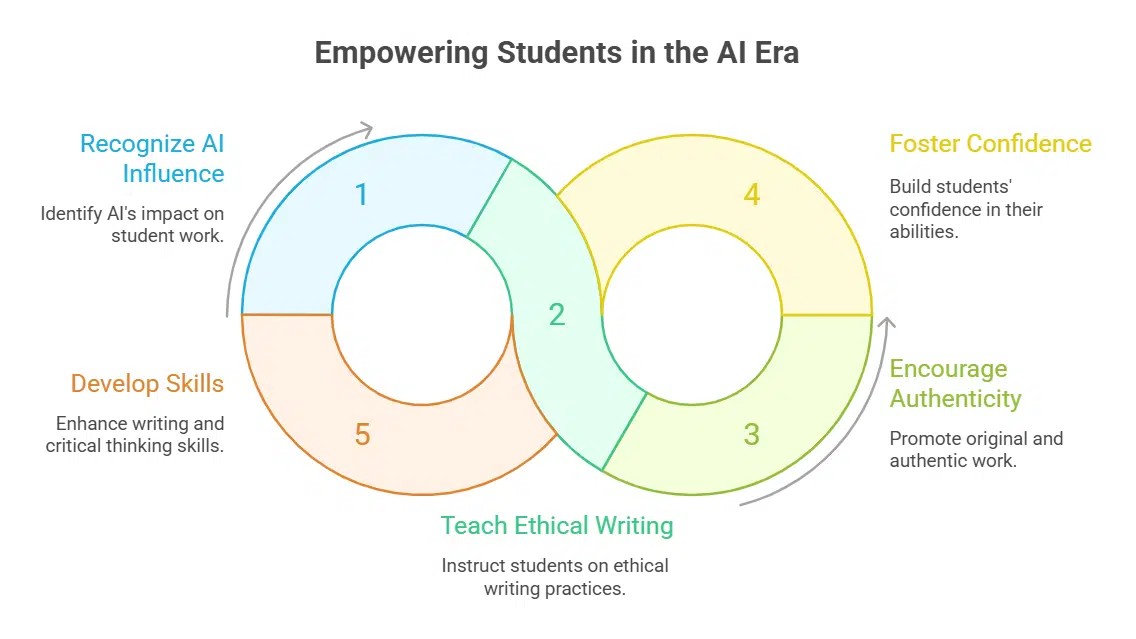
If you are a teacher, you spectate a lot of changes happening in the industry. If your students often submit works that are written in a style that’s too good to be true, you have already started to figure out what to do with this.
At this moment, you need to see the perspective and teach students what to do in this new reality, which is probably changing more and more with AI. You need to show them the correct approach to writing, talk about tone of voice, process, research, authenticity, ownership, transparency, and other important things. You need to explain to your students what it means to create something that’s truly theirs even if it’s messy and imperfect.
The fact is that when students feel that they truly impacted their work, then even if it starts with a prompt to ChatGPT they will gain confidence and skills, because they will understand what the process of writing takes.
What Do Students Think?
Modern students are very knowledgeable and thoughtful. They realize a lot about AI already. Some of them ask ChatGPT to generate counter-arguments to test their thesis. Some of them use it to brainstorm and then rewrite everything in their own words or to summarize long articles and save time. Some ask AI to rephrase something they’ve already written to make it sound more concise.
If you talk to students about using AI, most of them realize how to use it with integrity and want to be better writers. They want to learn and the AI tool offers them the support they need. We don’t have to forbid students to use AI, but we need to teach them how to use it well.
Conclusion
So, it’s clear that there is no black and white in this situation. Balancing AI help and academic integrity is a chaotic process that still has a lot of unresolved issues. Some students for sure can be tempted and use AI inappropriately, and some already are doing it. But other students can do better. They try to maintain the balance and most of them already know how to do it.
Forbid students to use AI, and you will reach no goals because they will do it anyway. Give students the permission to use AI tools and the guidance on how to do it, and it could be a great shift that will help them to balance the new reality of education that is already here. Because writing is about thinking and any tool, even the best AI, can do that part for you.
























