Amazon Web Services has taken a major step forward in enterprise artificial intelligence by introducing a new generation of “frontier agents” capable of performing long, complex tasks with minimal human involvement. The announcement came during AWS re:Invent 2025 in Las Vegas, where AWS executives described autonomous AI as the next major wave of productivity for global businesses.
The move signals a shift from today’s AI assistants — which rely on continuous user prompts — toward fully autonomous digital workers that can plan, execute, and iterate for hours or even days at a time. AWS leaders framed this advancement as a decisive turning point for software development and operations, positioning the company at the forefront of AI-driven enterprise automation.
AWS CEO Matt Garman emphasized that enterprises will unlock most of their future AI value through agents that operate like independent team members, not merely suggestion engines. According to him, as much as 80 to 90 percent of enterprise AI benefits will come from agentic systems capable of handling complex workflows end-to-end. By putting autonomy at the center, AWS aims to redefine how organizations build, manage, and secure software at scale.
A New Class of AI: How Frontier Agents Differ From Traditional Coding Tools
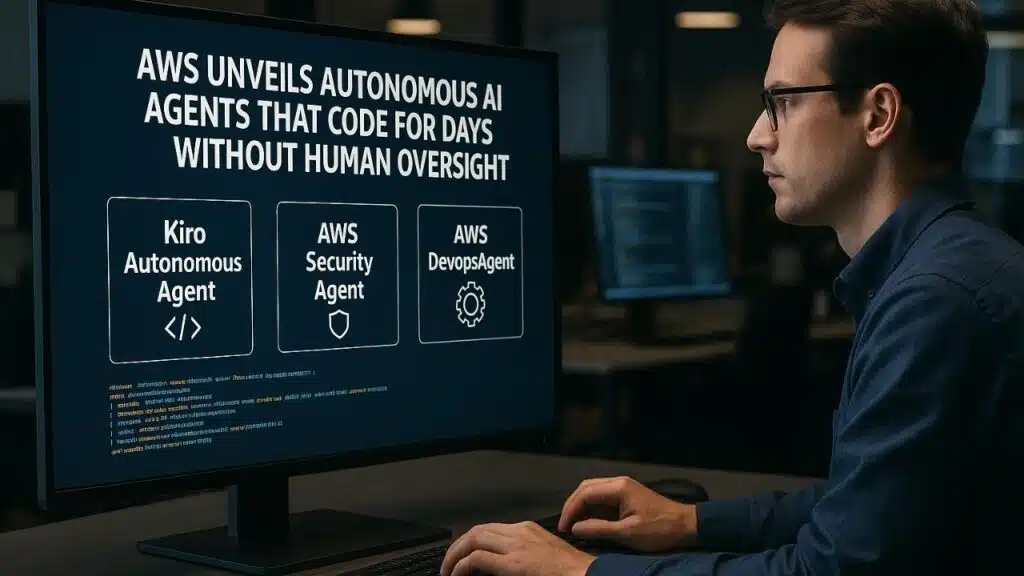
AWS introduced three flagship frontier agents — each specializing in a critical part of the software lifecycle:
- Kiro Autonomous Agent for coding.
- AWS Security Agent for application protection.
- AWS DevOps Agent for infrastructure and operations.
What makes these agents fundamentally different from existing tools is their ability to function with long-term memory, sustained reasoning, and independent execution. Traditional AI coding assistants require constant prompting, often returning a single code snippet or suggestion. Frontier agents instead behave like autonomous contributors who understand project context, track ongoing tasks, break work into subtasks, and create parallel instances of themselves to accelerate progress.
Developers can connect these agents to real-world tools such as GitHub, Jira, and Slack, enabling them to operate within an organization’s actual workflows. Instead of taking over production systems directly, they generate proposals — code changes, design updates, or diagnostic findings — that human engineers review and approve. This maintains safety while allowing the agents to function as highly capable collaborators.
The Kiro agent in particular represents a major leap. It continuously learns from a team’s coding style, historical pull requests, and review patterns. Over time, it becomes more aligned with each company’s engineering culture, reduces repetitive work, and supports large-scale code modernization across multiple repositories. For developers, this means routine tasks like bug triage, dependency updates, or cross-application refactoring can run in the background while they focus on more strategic work.
Under the hood, these agents rely on persistent context windows that allow them to understand prior sessions, remember decisions, and track project history for days at a time. This persistent memory, combined with autonomous task orchestration, enables them to handle real-world engineering problems that require continuous reasoning rather than short prompt-response cycles.
Early Testing Shows Dramatic Time Savings Across Development, DevOps, and Security
Several early adopters have reported significant productivity gains after testing AWS’s new agents. Their experiences showcase how autonomous AI might transform complex engineering environments that traditionally depend on manual investigation and skilled oversight.
One of the most striking examples came from the Commonwealth Bank of Australia, which manages more than a thousand cloud accounts. In a real-world trial, the bank used the AWS DevOps Agent to diagnose a complicated networking and identity-management issue. What normally consumes hours of senior engineering time was resolved in under 15 minutes. The agent rapidly traced dependencies, analyzed configuration behaviors, and identified the root cause with a level of speed and precision that surprised even experienced DevOps teams.
According to the bank’s leadership, the DevOps Agent behaved like a seasoned engineer capable of understanding system dependencies and constraints while suggesting remediation steps. For organizations operating large, distributed cloud environments, such capabilities could drastically reduce downtime, accelerate incident response, and prevent cascading failures.
The AWS Security Agent also demonstrated powerful capabilities during early evaluations. Security assessments that once took days — such as penetration testing, logic-flow evaluation, or misconfiguration scanning — were completed in hours. One company reported that the Security Agent discovered a business-logic flaw that existing security scanners failed to detect. These types of logic errors often require deep contextual understanding and manual analysis, making them difficult for automated tools. The ability of the agent to uncover such issues highlights its potential to raise overall security posture for organizations of all sizes.
In software development trials, the Kiro Autonomous Agent streamlined project backlogs, automated code maintenance, and orchestrated multi-service updates without getting overwhelmed by complexity. Teams described the experience as working alongside an intelligent partner that handles tedious or time-intensive work with steady, uninterrupted focus.
Competition and Industry Impact: How AWS Positions Itself Against Rivals
By bringing autonomous agents into mainstream enterprise products, AWS is placing direct competitive pressure on Microsoft, Google, IBM, and others developing generative AI platforms. While many companies have released AI copilots or productivity assistants, few have unveiled agents designed to operate autonomously for extended periods. AWS’s decision to make DevOps and Security agents publicly available — with Kiro’s autonomous features set to follow — signals a push to lead in real deployment of agentic AI rather than theoretical concepts.
Across the tech industry, autonomous agents are widely expected to reshape software engineering roles, security operations, and IT workflows. Instead of replacing engineers, AWS positions its agents as force multipliers that help teams work faster, improve code quality, and create safer applications. Human oversight remains a central principle: the agents cannot deploy code to production, enforce system changes, or override human decisions. Instead, they amplify engineering capacity by performing tasks that are repetitive, time-consuming, or require constant attention.
Analysts expect that as these agents mature, enterprises will increasingly treat them as digital employees capable of owning functional responsibilities — such as monitoring cloud infrastructure or managing routine security checks. This could reduce operational bottlenecks and improve resilience across industries ranging from finance and healthcare to e-commerce and logistics.
AWS’s announcement also demonstrates a broader industry shift toward “agentic automation ecosystems,” where organizations deploy fleets of AI workers that collaborate, communicate, and learn continuously.
What Comes Next: The Future of Autonomous AI in the Enterprise
With the release of its frontier agents, AWS enters a new era of AI-powered enterprise automation. As more organizations experiment with autonomous systems, software development lifecycles may change dramatically. Instead of waiting for engineers to triage issues or maintain large codebases manually, AI agents could handle routine upkeep, accelerate feature development, and reduce human error across critical systems.
The long-term implications are profound. Engineering teams may begin designing workflows where agents take the lead on long-running tasks — from dependency updates to security audits — while humans guide direction, provide oversight, and make final approvals. For complex infrastructures, agents that operate continuously could maintain a level of vigilance and consistency that even highly skilled teams struggle to match.
At the same time, this shift raises important questions around governance, transparency, model safety, and accountability. As AWS rolls out these agents more broadly, enterprises will need clear policies for auditing agent actions, ensuring alignment with human goals, and protecting sensitive data. The emphasis on human sign-off remains essential for preserving trust and preventing unintended system behavior.
Overall, AWS’s frontier agents mark a major technological milestone. They represent not just an evolution in AI assistance, but a redefinition of what digital tools can accomplish within modern engineering environments. If widely adopted, they may become foundational elements of how organizations build, secure, and operate software in the coming decade — ushering in a new phase of scalable, autonomous, AI-driven productivity.