Apple has officially confirmed a delay in the rollout of its highly anticipated iOS 18 Siri features. Originally set to be a major step forward for Apple’s virtual assistant, these enhancements—including personal context awareness, on-screen recognition, and in-app actions—will now be introduced “in the coming year.” This announcement confirms previous rumors about potential delays and raises concerns about Apple’s ability to keep pace with the rapid advancements in AI-driven voice assistants.
The company did not provide a detailed explanation for the delay but acknowledged that the development process is taking longer than expected. However, insights from industry experts and reports from Bloomberg’s Mark Gurman suggest that a combination of technical limitations, internal development challenges, and possible leadership concerns have contributed to this setback.
Siri’s Underlying Issues: Why the Delay?
One of the primary reasons behind the delay is Siri’s fragmented backend infrastructure. Unlike competing AI voice assistants that operate on a unified system, Siri currently runs on two separate frameworks:
- Legacy System – Handles traditional commands such as setting timers, making phone calls, and performing basic voice-activated tasks.
- Advanced AI System – Processes more complex commands that require contextual understanding and real-time adjustments.
Because these two systems operate independently, integrating them into a seamless experience has proven difficult. Apple reportedly planned to merge these systems into a single, more sophisticated AI-driven backend. However, due to time constraints, the company was unable to complete this integration for iOS 18.
According to Bloomberg, Apple now intends to launch the unified Siri backend with iOS 19. This means that instead of releasing half-baked features that rely on two different infrastructures, Apple might be choosing to wait until the next major iOS update before rolling out the promised improvements.
Internal Development Struggles: A Race Against Time
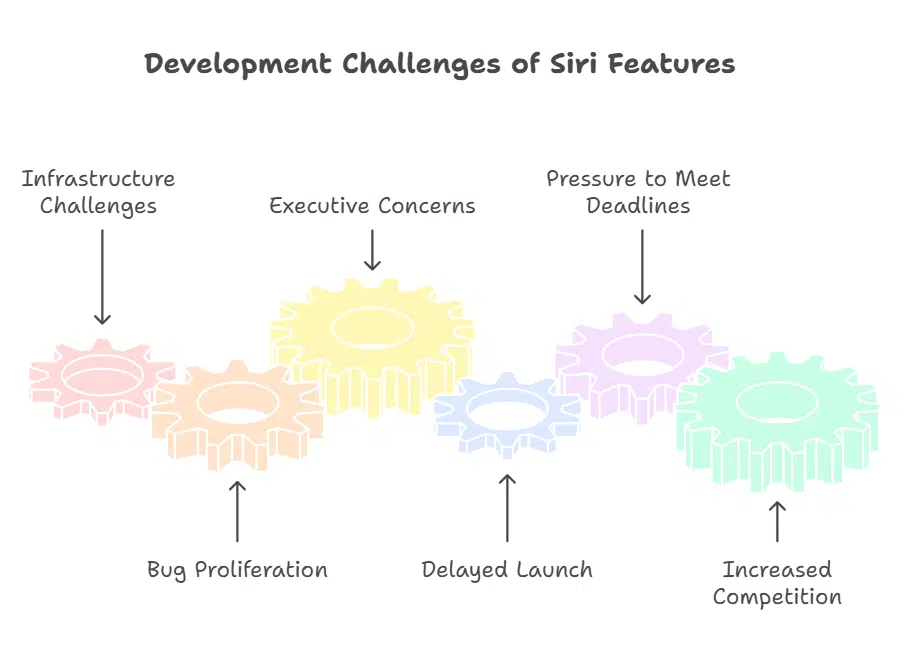
Aside from infrastructure challenges, Apple engineers have reportedly faced significant difficulties in making these new Siri features work as expected. Sources suggest that development has been plagued by a “rash of bugs” that have proven difficult to resolve. These issues have led to major delays, pushing the expected launch date further back.
Even Apple’s top executives, including software chief Craig Federighi, have expressed concerns about the current state of these features. Reports indicate that Federighi and other senior executives found that the features were not performing as advertised in their internal testing. The results reportedly did not align with Apple’s high standards or the way the company had initially marketed the features to work.
The struggle to refine these features before release has also led to speculation that Apple engineers are under immense pressure to meet deadlines. Given the growing competition in AI-driven voice assistants, particularly from Google, Microsoft, and OpenAI, Apple may have rushed the development process, leading to more problems instead of solutions.
Leadership Challenges: Is Apple Falling Behind in AI?
Another major factor fueling the delay is growing concerns about Apple’s leadership in AI development. Multiple reports indicate that some Apple employees are questioning whether the company’s AI division requires new leadership. They worry that without significant changes, Apple will continue to lag behind competitors in the AI space.
This concern stems from Apple’s historically cautious approach to AI. While companies like Google and OpenAI have aggressively pushed forward with AI-powered tools, Apple has been slower to adopt similar technologies. The company has also faced criticism for failing to make significant improvements to Siri over the years, despite advancements in AI capabilities.
Apple CEO Tim Cook and the company’s board are reportedly being urged to evaluate whether leadership changes within the AI team are necessary to prevent future delays and ensure that Apple remains competitive in the AI-driven era.
The Broader Impact of the Delay
The delay in Siri’s new features has broader implications beyond just iOS 18. Apple’s long-term plans for integrating AI into its ecosystem could be significantly affected. Here are some potential consequences:
- Impact on Apple Intelligence: The delay may affect Apple’s broader AI strategy, known as “Apple Intelligence.” If Siri remains less capable than its competitors, Apple’s AI-driven products and services could suffer from weaker adoption rates.
- Setback for Apple’s Smart Home Ambitions: Apple was reportedly working on a new smart home hub that would heavily rely on Siri’s advanced capabilities. With these features delayed, the launch of such a device may also be pushed back.
- Competitive Disadvantage: Google Assistant, Amazon Alexa, and Microsoft Copilot continue to evolve rapidly, leaving Apple at risk of losing its foothold in the voice assistant market. The longer Apple takes to enhance Siri, the harder it may become to catch up.
- User Frustration: Apple users who were expecting significant improvements to Siri may be disappointed by this delay. This could lead to frustration and potential shifts toward alternative AI assistants.
What’s Next for Siri?
Although Apple has not provided an exact timeline for the release of these delayed features, the phrase “in the coming year” suggests that users may have to wait until late 2025 or even iOS 19.3 before seeing these improvements in action.
Apple’s long-term vision for Siri appears to be focused on creating a more intelligent and context-aware AI assistant. However, the road to achieving that vision has proven to be more challenging than expected. In the meantime, users will have to rely on Siri’s existing capabilities until Apple resolves the technical and leadership hurdles delaying its evolution.
As Apple continues working on refining its AI strategy, all eyes will be on whether the company can successfully overcome these setbacks and deliver an AI assistant that truly meets the expectations of modern users.