Digital publishers and content marketing teams built their playbooks around a straightforward mechanism: publish keyword-targeted content, capture high organic rankings on traditional search engine results pages, and drive traffic directly to owned websites. However, the rapid adoption of large language models and conversational engines has permanently altered this dynamic.
Understanding how AI search is changing content distribution requires moving past basic blue-link indexing. Generative engines summarize complex topics, answer user prompts inline, and pull real-time sources across multi-step query pathways. To maintain visibility and brand authority, organizations must adapt their distribution models. Here are nine pivotal ways AI search is transforming how content reaches modern audiences.
Fundamental Shifts in Visibility and Discovery
The transition from keyword-matching search engines to conversational AI models fundamentally alters how audiences encounter digital content.
1. Shift from Click-Through Traffic to Citation-First Visibility
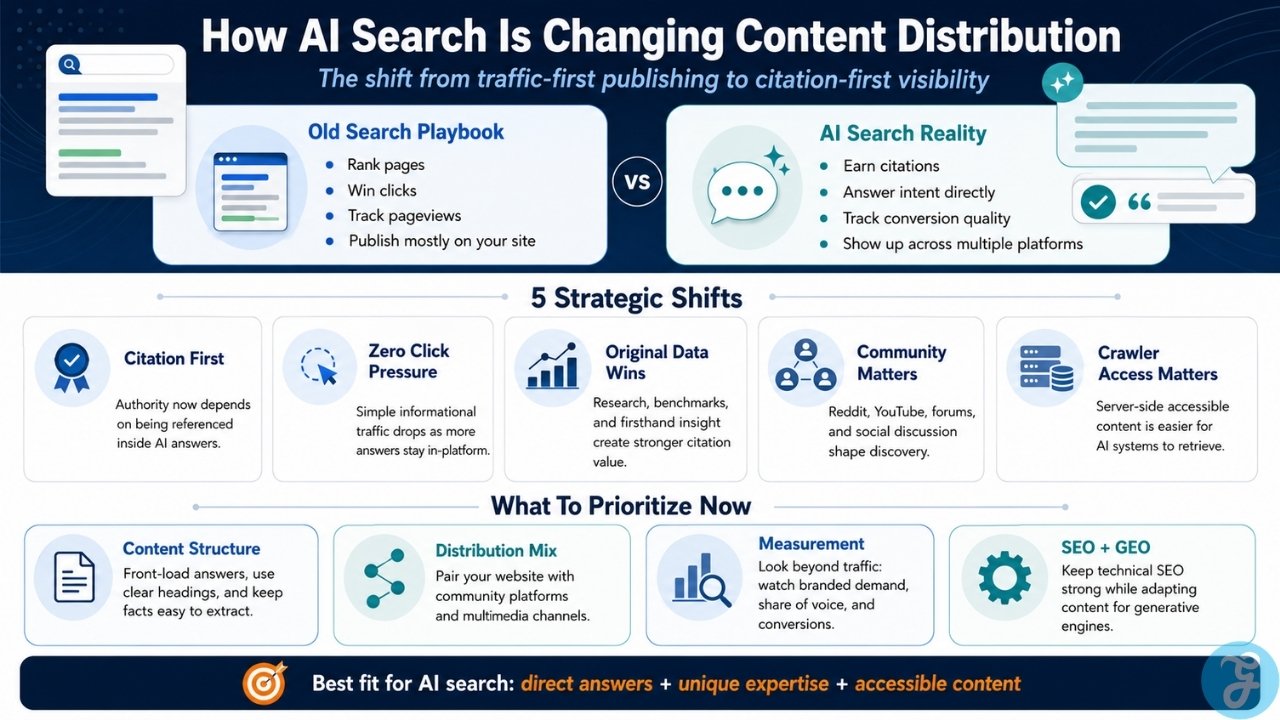
For over two decades, successful content distribution focused primarily on securing top SERP rankings to maximize click-through rates. In an AI-mediated search environment, primary visibility centers on citation. Large language models synthesize information from multiple web sources, presenting users with comprehensive answers directly inside the interface. Instead of measuring success strictly by direct website visits, brands must evaluate how frequently their content is cited as an authoritative reference within generative responses. Appearing as a cited source builds top-of-mind awareness and category authority, even when a user does not click through immediately.
2. Expansion of Zero-Click Search Experiences
AI Overviews and conversational search interfaces resolve informational queries directly on the search page. By analyzing and summarizing web content in real time, AI engines fulfill user intent without forcing visitors to navigate away. Consequently, top-of-funnel informational content experiences significant drops in traditional organic traffic. Content distribution must pivot toward capturing mid-to-bottom-funnel intent, where users require detailed comparisons, nuanced decision making, or specialized assets that require direct engagement.
3. Emergence of Generative Engine Optimization (GEO)
Traditional Search Engine Optimization (SEO) focuses on matching static search queries with keyword-optimized web pages. In contrast, Generative Engine Optimization (GEO) optimizes content to be retrieved, understood, and recommended by AI assistants like ChatGPT, Perplexity, and Gemini. GEO tactics require publishers to organize information into machine-readable structures, maintain high factual density, and maintain clear entity relationships across digital assets. GEO builds upon foundational technical SEO rather than replacing it entirely.
Content Structural and Formatting Evolution
How articles are written and formatted directly dictates whether AI models can extract and cite the underlying information.
4. Demand for Direct, Front-Loaded Content Structures
Generative search algorithms extract and synthesize text using automated parsing models that prioritize immediate relevance. Articles built with long, narrative introductions or delayed answers perform poorly in AI extraction routines. Modern distribution strategies dictate a bottom-line-up-front approach. Defining key concepts, placing concise answers in the initial paragraph of each section, and using logical heading hierarchies make content significantly easier for AI models to parse and cite accurately.
5. Increased Value of Original Research and Proprietary Data
Because generative models can instantly synthesize freely available public facts, commodity content has lost its distribution leverage. AI engines heavily favor unique, primary data sources that cannot be replicated elsewhere. Publishing proprietary industry surveys, original benchmark studies, expert commentary, and firsthand case studies creates citable data anchors. AI models frequently pull these verified statistics directly into synthesized summaries, driving both AI visibility and high-authority editorial backlinks.
6. Adaptation to Multi-Query Fan-Out Discovery
When a user submits a prompt to an AI search engine, the system rarely runs a single keyword query. Instead, the AI employs query fan-out techniques, executing multiple sub-queries simultaneously to gather context from various angles before generating a unified response. Content distribution must therefore account for broad topical coverage. Comprehensive, long-form guides that address related sub-topics, underlying cause-and-effect relationships, and practical edge cases stand a higher chance of ranking across these underlying sub-queries.
Channels, Measurement, and Infrastructure
Distribution strategies are expanding beyond static websites to encompass dynamic technical setups and multi-platform footprints.
7. Amplified Influence of User-Generated and Community Platforms
AI search engines place significant trust weight on real-world discussions and community feedback. Platforms like Reddit, YouTube, specialized forums, and social channels serve as primary retrieval sources for conversational engines seeking authentic human perspectives. As a result, content distribution can no longer rely solely on publishing articles on a central blog. Brands must actively syndicate insight, participate in discussions, and maintain an active presence on community platforms where AI models crawl for genuine user sentiment.
8. Pivot from Volume Metrics to High-Intent Conversion KPIs
Traditional content distribution relied on tracking pageviews, unique visitors, and session duration. In an environment dominated by zero-click AI responses, evaluating performance strictly through raw traffic figures provides an incomplete picture. Instead, organizations are shifting KPIs toward brand share of voice inside LLM outputs, branded search volume, and downstream pipeline impact. Although AI search sends fewer total visitors, users who do click through from AI citations demonstrate higher intent and convert at elevated rates.
9. Technical Requirement of Server-Side Accessibility for AI Crawlers
Content distribution fails if AI search bots cannot access your raw text. Unlike human web browsers, many AI web crawlers cannot render complex client-side JavaScript or bypass aggressive bot-blocking security rules. Organizations must ensure that critical content is rendered server-side and properly configured in server logs and robots.txt files. Blocking AI user-agents or concealing text behind complex interactive scripts makes content completely invisible to generative discovery systems.
Strategic Limitations and Trade-Offs (What to Avoid)
While adapting to AI search creates new growth avenues, content creators must avoid several strategic pitfalls.
Over-Optimizing for AI Engines at the Expense of Human Readers
Writing strictly for machine extraction risks creating cold, formulaic text that lacks tone, emotional resonance, and unique perspective. If a user visits your site after reading an AI citation, mechanical content will fail to convert them. Maintain a clear human editorial voice while applying clean structural formatting.
Blind Reliance on AI Content Generation Loops
Using automated AI tools to churn out mass volumes of generic content to target AI search creates a destructive feedback loop. Generative engines penalize repetitive, low-value information. Focus distribution efforts on high-quality, experience-based insights that demonstrate real expertise.
Neglecting Core Technical SEO Foundations
GEO does not replace fundamental SEO infrastructure. AI retrieval models heavily draw from websites that already possess strong domain authority, clean site architecture, fast loading speeds, and robust backlink profiles. Abandoning core SEO mechanics in favor of experimental AI tactics leads to reduced overall web visibility.
The Verdict
The way AI search is changing content distribution demands a complete modernization of digital publishing strategies. By shifting from traffic-first metrics to citation-first authority, structuring articles for direct extraction, and maintaining technical accessibility for AI crawlers, brands can thrive in the generative search era. Focus on delivering unique, high-quality information that both AI models and human audiences can trust.
Frequently Asked Questions(FAQs) on How AI Search is Changing Content Distribution
How does Generative Engine Optimization (GEO) differ from traditional SEO?
Traditional SEO optimizes web pages to rank at the top of search engine results pages to capture clicks. GEO focuses on structuring content and entity signals so that AI models cite, summarize, and recommend your brand within synthesized responses.
Will AI search destroy organic website traffic?
AI search reduces top-of-funnel organic traffic for simple informational queries due to zero-click answers. However, traffic originating from AI citations often carries much higher intent, resulting in better conversion rates for detailed, high-value content.
What type of content performs best in AI search results?
Original research, proprietary statistics, direct answer guides, structured comparisons, and authoritative expert commentary perform best because AI engines prioritize verified, non-commodity information.