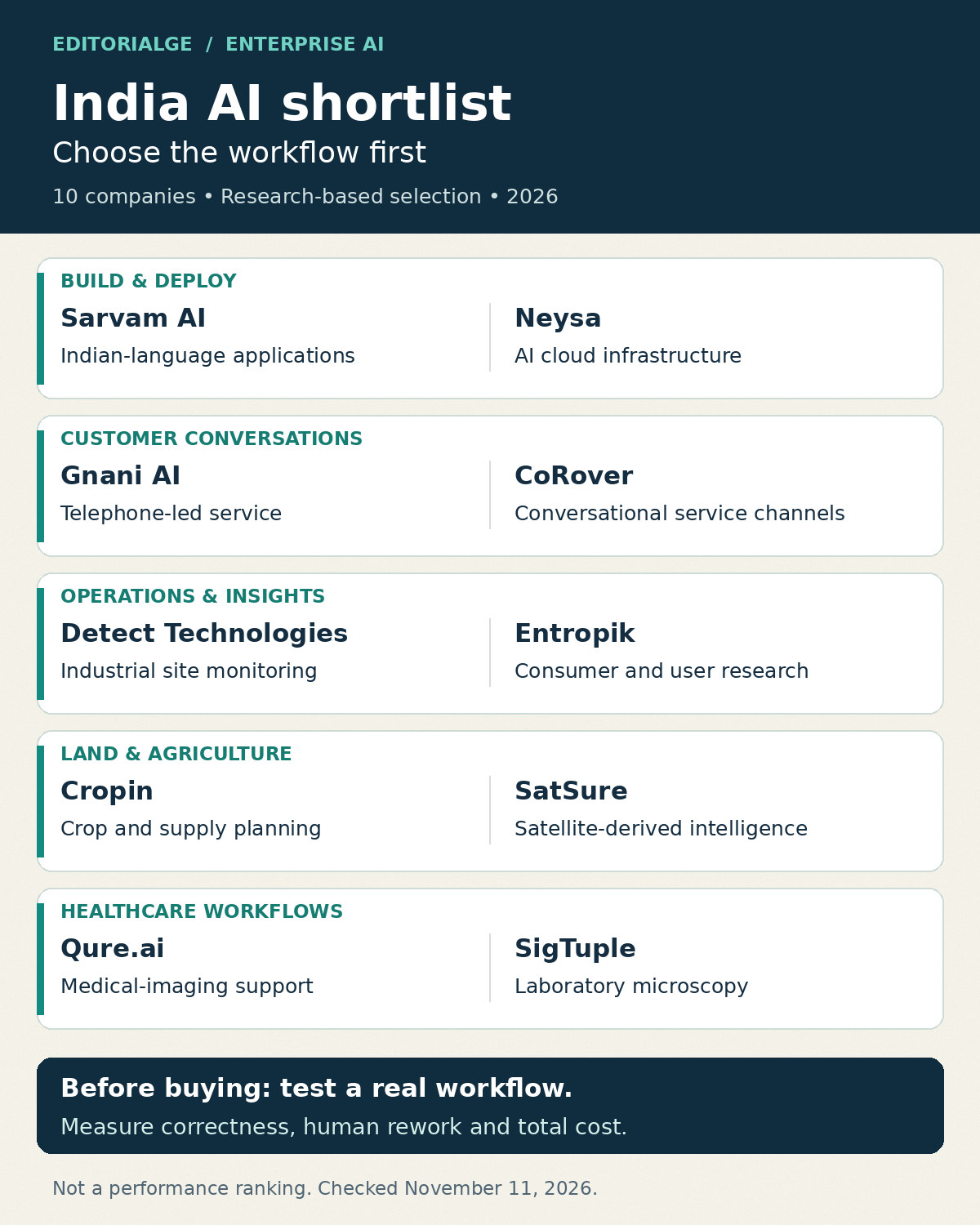
The Best AI Startups in India for an enterprise shortlist depend on the work you need to improve. Sarvam AI is worth examining for Indian-language applications, Neysa for AI infrastructure, and Gnani AI for voice-led customer operations. Other specialists address factory safety, research, agriculture and diagnostics. These ten companies show where Indian enterprise AI is becoming useful—and what buyers should test before committing.
A convincing demonstration is only the beginning. An enterprise needs software that fits its data, connects to existing systems and gives someone responsibility when an answer or alert is wrong. This guide focuses on those buying decisions rather than funding headlines.
How We Selected the Best AI Startups in India
This research-based shortlist was checked on November 11, 2026. Selection considered an identifiable Indian operating base, a current enterprise offering, a clear AI capability and a distinct business use case. “Startups” includes established private scaleups; it does not imply that every company is newly founded, independently controlled or eligible for a particular government startup classification. “In India” refers to the Indian base described below, not exclusively Indian ownership or headquarters.
The numbering groups useful options; it is not a performance ranking. We reviewed company materials and relevant external reporting but did not conduct hands-on product tests. Best-fit recommendations are editorial judgments, while documented capabilities are attributed to the companies. We have not independently verified their advertised accuracy, revenue impact or customer counts.
Quick Comparison: Match the Company to the Job
Start with the workflow column. A hospital imaging platform, a GPU cloud and a voice agent are different purchases, even though all involve AI.
| Company | Indian connection | Best-fit workflow | Key evaluation question |
|---|---|---|---|
| Sarvam AI | Bengaluru base; India-developed AI platform | Indian-language speech and enterprise applications | Does it handle your actual language mix and terminology? |
| Neysa | Indian AI cloud business | GPU infrastructure and managed AI deployment | What capacity, support and total operating cost are contracted? |
| Gnani AI | Bengaluru operations; global business | Contact-center voice automation | Can callers complete tasks and reach a human when needed? |
| CoRover | Bengaluru registered office | Multilingual conversational service channels | Can the assistant complete an authorized transaction safely? |
| Detect Technologies | Chennai operating base | Industrial video intelligence and safety workflows | Do useful alerts reach the responsible supervisor? |
| Entropik | Bengaluru headquarters | Consumer and user research through Decode | Can researchers trace an insight to actual participant evidence? |
| Cropin | Bengaluru base | Agricultural planning and supply intelligence | Are models suitable for your crops, regions and field data? |
| SatSure | Bengaluru company address | Satellite-based land and asset intelligence | Are coverage and observation frequency adequate? |
| Qure.ai | Mumbai base | Medical-imaging support for healthcare organizations | Is the specific product appropriate for the intended clinical use? |
| SigTuple | Bengaluru company address | Digital microscopy and laboratory review | Does the instrument fit the laboratory’s sample workflow? |
1. Sarvam AI: Indian-Language AI Applications
Best for: Product and technology teams building services for users who speak Indian languages or switch between languages during a conversation.
Sarvam develops an AI platform in India, with offerings spanning speech, document processing and enterprise agents. Its founders, Vivek Raghavan and Pratyush Kumar, established the company in August 2023. The practical appeal is access to language technology alongside application components, rather than having to assemble every layer separately.
Why choose it: Consider an illustrative insurance-service workflow: a customer explains a request in Hindi mixed with English policy terms, and the system must retrieve the correct information before responding. Speech recognition, language understanding and the business knowledge source all matter. Sarvam is a relevant candidate when local-language interaction is central to the product rather than an optional translation feature.
What to consider: Evaluate complete tasks, including names, addresses, interruptions and unfamiliar terminology. A readable transcript does not prove that the underlying request was handled correctly. Its India-focused positioning also does not establish the processing location of every proposed integration. Confirm the architecture and data handling for the specific service being purchased.
2. Neysa: Infrastructure for Enterprise AI Workloads
Best for: Engineering teams that need compute and deployment infrastructure for AI applications they build or operate.
Neysa’s Velocis platform brings together GPU infrastructure, orchestration, monitoring and managed AI services. Its published offerings include GPU-as-a-service and managed inference. That places Neysa underneath an application: it supplies infrastructure on which models and services run, rather than replacing a customer-support or analytics product by itself.
Why choose it: A team moving from a small prototype to a sustained inference workload may need more control over compute, deployment and operations. Neysa is relevant when those requirements justify a dedicated infrastructure evaluation. A simple application with modest usage may be easier to operate through an existing managed model API.
Ownership also deserves context. Mint reported in October 2026 that Blackstone had become Neysa’s majority shareholder. Inclusion here therefore does not imply founder control.
What to consider: Compare the total bill for your workload, including storage, network traffic, support, idle capacity and commitments. Test end-to-end response time under expected concurrency. A lower headline GPU price can be outweighed by capacity that sits unused or engineering work that remains with your team.
3. Gnani AI: Voice-Led Customer Operations
Best for: Contact centers and service teams whose workload involves substantial telephone conversations.
Gnani’s enterprise products cover voice agents, speech analytics, agent assistance and voice biometrics. The company documents proprietary speech and language models and offers multiple deployment arrangements, including private-cloud and on-premises options. Its Indian operations include Bengaluru; this guide does not characterize its global business as exclusively headquartered in India.
Why choose it: Telephone audio brings a different set of problems from a neatly typed chat. Background noise, accents and changes of language can affect whether a customer completes a task. Gnani is a logical candidate when the buying team wants voice automation and tools for human agents within the same broader supplier relationship.
An illustrative pilot could compare an automated appointment-confirmation call with the existing human-assisted process. Measure correct confirmations, misunderstood requests and successful handoffs—not just how natural the voice sounds.
What to consider: Keep identity verification and permission to change an account separate from conversational fluency. Test failures in the connected business system as well as failures in speech recognition. Buyers needing a straightforward website knowledge assistant should compare that narrower requirement with CoRover before commissioning a telephone-focused deployment.
4. CoRover: Conversational Access to Enterprise Services
Best for: Organizations bringing multilingual assistance to customer or public-service channels.
CoRover, whose registered office is in Bengaluru, offers conversational AI across chat, voice and other interfaces. Its portfolio includes BharatGPT and options involving custom models and integrated language models. The relevant enterprise question is how users reach information and services through conversation, rather than which standalone chatbot produces the most impressive answer.
Why choose it: An organization with a large service catalog can use a conversational interface to help users find the right process. In an illustrative travel-service deployment, answering a baggage question and changing a booking are different tasks. The first needs reliable information; the second requires an authenticated connection, permissions and a confirmed transaction.
CoRover is worth considering when several languages or interaction channels belong to the same service experience. Compared with building directly on a model API, the attraction is the surrounding conversational platform.
What to consider: Ask the supplier to demonstrate your own knowledge sources and an approved backend action. Confirm how stale information is replaced, how uncertainty triggers escalation and how a failed transaction is communicated. A multilingual interface is useful only if important service details remain correct in each supported language.
5. Detect Technologies: Industrial Safety and Site Intelligence
Best for: Industrial operators evaluating AI analysis of camera feeds and site data.
Detect Technologies’ T-Pulse platform targets industrial safety, security and operational monitoring. The company describes applications such as identifying personal protective equipment gaps and restricted-zone events using existing cameras. Its Chennai base connects it to India’s industrial technology ecosystem.
Why choose it: A useful industrial AI system must connect an observation to a response. For example, an illustrative restricted-zone alert should identify the location, reach the right supervisor and leave a record of the action taken. That workflow is more valuable than another screen showing camera feeds.
A technology validation report hosted by IIT Madras Research Park examines Detect’s industrial-risk technology and deployment cases. It provides useful background, although a high-level assessment does not establish performance at a new buyer’s site.
What to consider: Trial the system under actual lighting, camera angles and work patterns. Count missed events and unnecessary alerts, then check whether staff can respond promptly. AI monitoring should support established safety responsibilities; neither vendor claims nor a successful demonstration justify assuming every hazard will be detected.
6. Entropik: AI-Assisted Consumer and User Research
Best for: Research, product and marketing teams trying to organize participant evidence and interpret studies.
Bengaluru-headquartered Entropik develops Decode, a platform for consumer and user research. Its materials describe research workflows and analysis involving behavioral and emotional signals, alongside AI-assisted insights. The business value lies in helping teams work with research evidence across studies rather than producing another general-purpose content draft.
Why choose it: Imagine a product team investigating why customers abandon an onboarding step. Interviews can explain confusion, while usability sessions reveal where people hesitate. A shared research environment can help the team connect those observations and discuss which change to test next. This is a better fit than treating a general chatbot’s suggestion as evidence of customer preference.
What to consider: Treat inferred emotion or attention as a measurement to scrutinize, not direct access to a participant’s thoughts. Check consent, sampling and whether a generated finding can be traced to the original session. Keep simulated or predictive outputs distinguishable from observations involving real participants. Researchers still need to judge whether the study supports the proposed product decision.
7. Cropin: Agricultural Intelligence for Business Planning
Best for: Agribusinesses and food-supply teams combining field information with broader crop and climate signals.
Cropin has a Bengaluru base and describes an AI platform that brings together field data, satellite imagery, weather information and domain models. Its current platform includes applications, data infrastructure and OrbitAI agents. This is enterprise technology for organizations managing agricultural operations or sourcing—not simply an app offering individual farming tips.
Why choose it: A food processor may need to anticipate supply changes across several growing regions. In an illustrative workflow, field observations and weather signals help identify areas that procurement staff should investigate before adjusting a sourcing plan. Cropin’s appeal is the connection between agricultural data and an operating decision.
It is the more natural starting point here when the problem begins with crops, field teams and the food value chain. SatSure offers a related but different entry point when satellite-derived land or asset intelligence is the central requirement.
What to consider: Model relevance depends on the crop, geography, season and available ground data. Evaluate forecasts against historical outcomes and a baseline your team already uses. Ask how incomplete field records are handled, and keep the forecast’s uncertainty visible to the people making purchasing decisions.
8. SatSure: Satellite Intelligence for Land and Assets
Best for: Organizations whose decisions depend on observing large areas, dispersed infrastructure or agricultural land.
SatSure operates from Bengaluru and turns Earth-observation and other data into decision-support products. Its published applications span agriculture, banking, insurance, infrastructure and natural-resource management. The company describes crop monitoring, asset tracking and vegetation monitoring among its use cases.
Why choose it: An infrastructure operator cannot physically inspect every part of a long corridor every day. In an illustrative workflow, observed changes help the team prioritize where to send field inspectors. The value comes from narrowing the search area and bringing relevant evidence into an existing operational process.
For buyers comparing SatSure with Cropin, begin with the decision rather than the shared use of satellite imagery. Crop and supply planning points toward an agribusiness platform; broad land or infrastructure observation calls for a closer look at geospatial coverage and analytics.
What to consider: Check spatial resolution, observation frequency and the age of the data behind each output. Request validation for your terrain and target objects. A satellite-derived signal should be combined with appropriate ground checks before a consequential asset, insurance or lending decision.
9. Qure.ai: Medical-Imaging Workflow Support
Best for: Hospitals, diagnostic networks and healthcare programs evaluating AI assistance within medical-imaging workflows.
Mumbai-based Qure.ai develops healthcare AI, including chest-imaging applications. Its qXR offering is associated with chest X-ray analysis, and the company publishes an evidence collection for its work. This is a specialized clinical technology purchase with requirements that differ substantially from buying an office assistant.
Why choose it: The useful enterprise question is where assistance changes the imaging pathway. An illustrative evaluation could examine how flagged studies enter a clinician’s review queue, whether relevant information remains available and what happens after an abnormality requires follow-up. A model output alone does not complete that process.
Qure.ai is a more relevant candidate for radiology-related workflows than SigTuple, which addresses laboratory microscopy. They should not be compared as interchangeable diagnostic tools.
What to consider: Have qualified clinical and procurement teams review the exact product, intended use, applicable authorization and evidence for the local population. Confirm compatibility with the organization’s imaging systems and escalation procedures. Do not generalize one study or regulatory clearance to every product, country or clinical task, and do not treat AI output as an independent diagnosis.
10. SigTuple: AI-Assisted Digital Microscopy
Best for: Diagnostic laboratories considering automation of slide imaging and expert review.
Bengaluru-based SigTuple combines microscopy, automation and AI in laboratory instruments. Its current product descriptions distinguish AS76, intended for peripheral blood smear review, from AI100, which supports peripheral blood smear and urine-sediment workflows. The company describes on-device AI processing for AS76 and remote-review capabilities within its wider portfolio.
Why choose it: A laboratory’s bottleneck may be preparing, imaging and routing slides for review rather than generating prose from existing records. SigTuple addresses that physical workflow. An illustrative pilot should follow a sample from preparation through scanning to the qualified reviewer’s decision, including cases that need rescanning or manual handling.
This makes it a different purchase from imaging software that processes X-rays: instrument selection, sample compatibility and service arrangements become central.
What to consider: Confirm the supported specimen types and capabilities of the exact instrument being quoted. Evaluate slide quality requirements, maintenance, review access and downtime procedures with laboratory staff. Published automation claims are not a substitute for local validation, and a pathologist’s responsibility should remain explicit in the operating procedure.
Turn the Shortlist Into an Enterprise Pilot
Choose one workflow with a named owner before inviting demonstrations. If the underlying problem is moving information between systems or routing approvals, first assess whether conventional business process automation software can handle it. Add AI where interpreting language, images or uncertain patterns is actually necessary.
The following is a proposed evaluation method, not a report of tests performed for this article:
- Define a completed task. For a voice agent, that might mean a correct appointment change confirmed in the business system. For an inspection tool, it might mean a relevant alert reaching the responsible person.
- Build a representative evaluation set. Include normal cases, uncommon terminology, missing information and failure conditions. Use synthetic or appropriately approved data before exposing confidential records.
- Compare against the existing process. Record correctness, completion time, human rework and failure handling. Choose acceptance thresholds before looking at the results.
- Calculate cost per accepted outcome. Include usage charges, infrastructure, integration work, staff review and ongoing maintenance. For language-model applications, our guide to open-source AI token optimization tools explains why reducing tokens is not automatically the same as reducing total cost.
- Agree on the operating boundary. Document data access, retention, approved actions, escalation ownership and an exit plan. Obtain the deployment and support commitments in the contract.
For an Indian deployment, include the languages actually used by staff and customers, the invoice currency and applicable taxes, local support coverage, and the location of processing and backups. An Indian office does not by itself prove that all data stays in India.
Which Company Should You Evaluate First?
The Best AI Startups in India are best approached as a set of specialists. Start with Sarvam for local-language applications, Neysa for infrastructure, and Gnani or CoRover for conversational workflows. Examine Detect Technologies for industrial monitoring, Entropik for research, and Cropin or SatSure for agricultural and geospatial decisions. Healthcare organizations should evaluate Qure.ai and SigTuple through their clinical and laboratory teams.
Bring a real workflow, a baseline and a clear definition of success to the first meeting. The strongest supplier for your enterprise is the one that can demonstrate a useful, supportable improvement under those conditions.