
Build a vendor security review process for legal technology around a documented decision: which service may handle which information, under what conditions, and who accepts the remaining risk. Start before staff upload client files or connect firm accounts. Collect evidence that matches the proposed use, check contractual protections, and verify the configuration before granting production access.
A research subscription used with public queries and a document platform holding confidential case files need different reviews. Even within one product, approval for a limited pilot should not automatically authorize access to the entire matter repository.
This guide provides an operational framework for law firms and legal departments. Its tiers, approval rules, and examples are suggested internal practices. Applicable professional rules, privacy requirements, court orders, and client agreements need separate jurisdiction-specific assessment.
Define the proposed use before reviewing the vendor
Ask the requester to complete a short intake record. “Contract review software” is too broad to assess. A useful request explains whether the tool will summarize public templates, process signed client agreements, or search the firm’s complete document collection.
Record the product and subscription tier, intended users, business owner, data categories, integrations, and expected dependency. Include browser extensions, plug-ins, free trials, and AI features added to existing subscriptions. A familiar supplier can introduce a new processing arrangement through an optional feature.
Map the information from upload to disposal. Identify storage locations, support access, subprocessors, logs, backups, exports, and any external model providers. Ask the vendor to correct the map rather than accepting “hosted in a secure cloud” as an explanation.
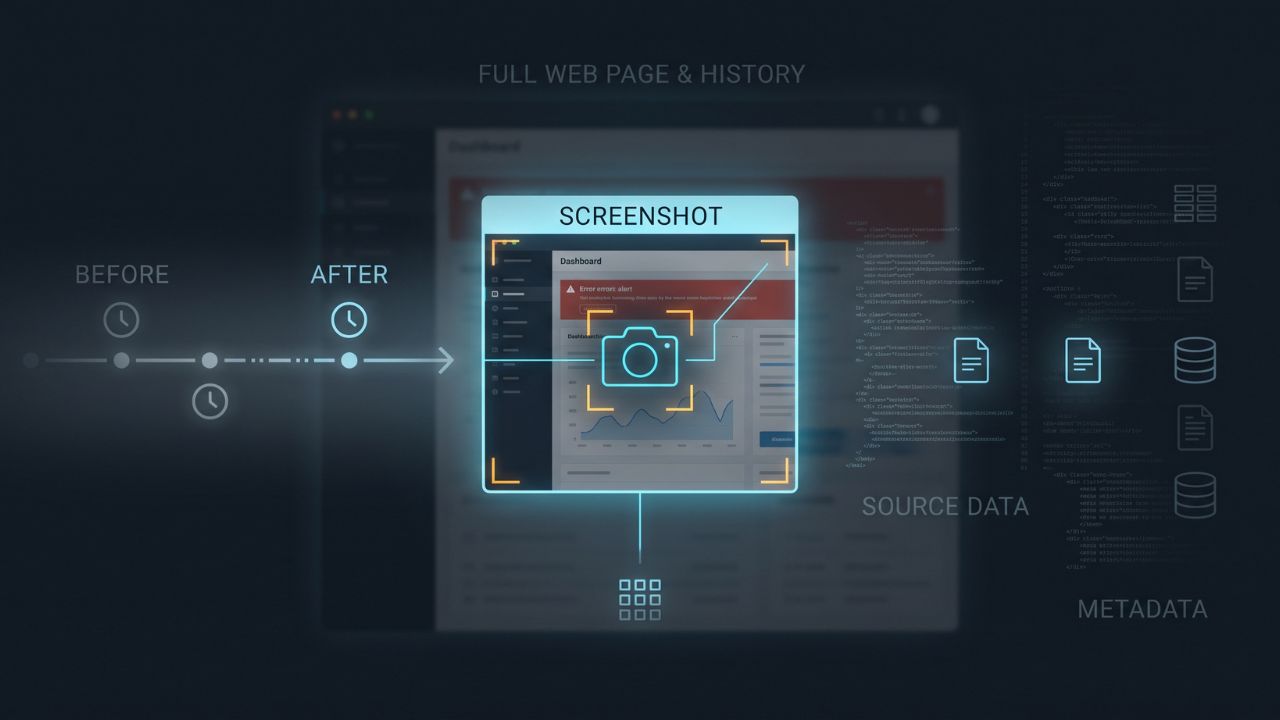
For evidence-related services, the workflow also needs to preserve the connection between original material and later versions. Editorialge’s guide to legal technologies for managing digital evidence explains why source files, metadata, and export checks matter.
Assign responsibilities at intake. A practice owner explains the use and client restrictions; IT or a security specialist evaluates controls; counsel reviews legal and contractual issues. An authorized partner or department leader accepts residual business risk. Small firms can combine roles, but the approval record should still identify who made each decision.
Set the review depth by exposure and dependency
NIST’s cybersecurity supply chain guide recommends prioritizing suppliers using factors including business importance, information sensitivity, and system access. Apply that principle through a simple internal tiering model:
| Suggested tier | Example exposure | Review approach |
|---|---|---|
| Limited | Public information; no firm integrations or confidential inputs | Check terms, access arrangements, and permitted use; record restrictions |
| Elevated | Client-related personal information or access to selected internal files | Review security evidence, data handling, contract terms, and configured permissions |
| Critical | Broad matter access, highly sensitive records, privileged administration, or a service essential to deadlines | Require deeper specialist review, demonstrated controls, recovery planning, and senior approval |
These tiers are a working template, not a NIST classification. Assess consequences as well as data volume. A narrow deadline-management service may deserve critical treatment because an outage could disrupt filings. A low-cost AI extension may deserve the same attention because it requests broad document access.
Define stop conditions before reviewing individual products. For example, a firm might prohibit confidential uploads when the provider cannot explain secondary data use, or block production access until a required matter-access restriction works. Choose conditions that match the firm’s obligations and risk appetite.
Ask questions that lead to evidence
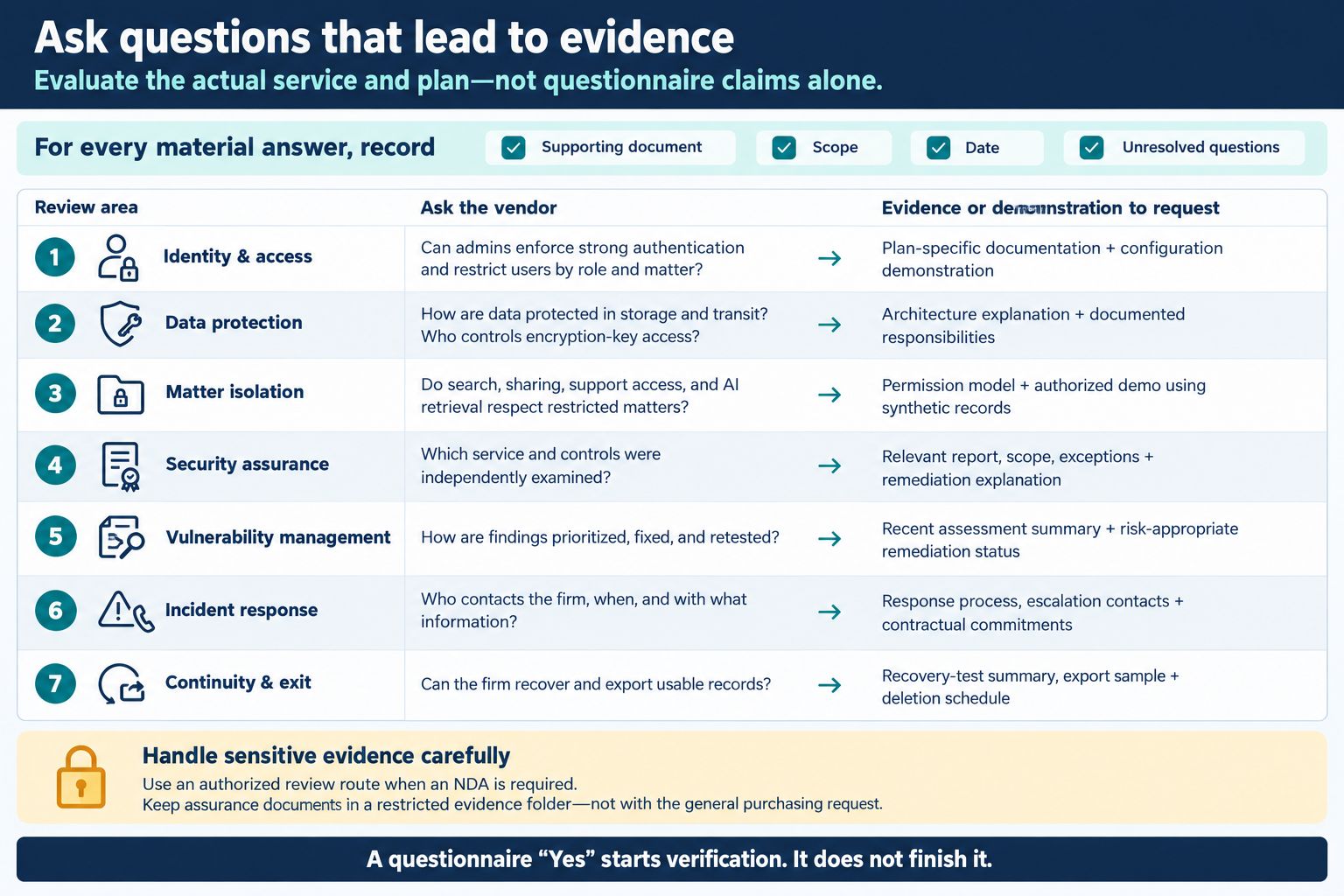
Send a focused request covering the actual service and plan. For every material answer, record its supporting document, scope, date, and unresolved questions. “Yes” in a questionnaire is a starting point for verification.
| Review area | Ask the vendor | Evidence or demonstration to request |
|---|---|---|
| Identity and access | Can administrators enforce strong authentication and restrict users by role and matter? | Plan-specific documentation and a configuration demonstration |
| Data protection | How are stored and transmitted data protected, and who manages access to encryption keys? | Architecture explanation and documented responsibilities |
| Matter isolation | Can search, sharing, support access, and AI retrieval respect restricted matters? | Permission model and an authorized demonstration with synthetic records |
| Security assurance | What service and controls were independently examined? | Relevant assurance report, scope, exceptions, and remediation explanation |
| Vulnerability management | How are findings prioritized, fixed, and retested? | Recent assessment summary and remediation status appropriate to the risk |
| Incident response | Who contacts the firm, when, and with what information? | Response process, escalation contacts, and contractual commitments |
| Continuity and exit | Can the firm recover and export usable records? | Recovery-test summary, export sample, and deletion schedule |
Where sensitive assurance documents require a nondisclosure agreement, use an authorized review route. Keep those documents in a restricted evidence folder rather than circulating them with a general purchasing request.
Read the assurance report behind the badge
AICPA describes SOC 2 reports as information that helps customers assess outsourced-service risks and controls; public SOC 3 reports contain less detail. Obtain the relevant report when available instead of relying on a logo.
Check which product, legal entity, locations, and reporting period it covers. Read the auditor’s opinion, exceptions, excluded services, and controls the customer is expected to operate. Ask how the vendor addresses changes since the report period. A report covering the core platform may leave a newly introduced AI integration outside its scope.
If a smaller provider lacks the requested report, document the evidence gap and assess suitable alternatives. A control demonstration or independent assessment may help, but it should not be relabeled as equivalent assurance. The permitted use may need to remain narrower.
Review AI processing as a separate data path
For a generative AI feature, establish what happens to prompts, uploaded files, responses, embeddings, and diagnostic logs. An embedding is a numerical representation used for tasks such as retrieval; include it in retention and access questions rather than assuming only original documents matter.
Ask whether information is used for model training or other improvement, whether humans can review it, which providers receive it, and how long each category is retained. Obtain answers for the purchased plan and configuration. “Not used for training” does not answer questions about logging, support access, or downstream retention.
ABA Formal Opinion 512 calls for a fact-specific assessment before representation-related information enters a generative AI tool. It discusses exposure both outside the firm and across internal matters. For the self-learning tools and disclosure risks addressed in the opinion, informed client consent is required; boilerplate authorization is insufficient. The opinion interprets ABA Model Rules, so counsel must assess the rules and guidance applicable to the practice.
Keep output quality review separate from security approval. A tool may have acceptable data-handling arrangements while still requiring careful verification of generated legal work. Approval should state who checks consequential outputs against their sources.
Make the contract match the reviewed service
Translate important answers into enforceable commitments where appropriate. Counsel should reconcile the order form, service terms, security schedule, data-processing terms, and AI addendum, including which document controls if they conflict.
Address permitted data use, confidentiality, personnel access, subprocessor changes, incident cooperation, audit evidence, export assistance, retention, and termination. Specify the incident-notification trigger and timetable through legal review; there is no single contractual deadline suitable for every service and jurisdiction.
Have counsel identify the parties’ data-protection roles and the rules governing the proposed processing. Do not assume that every provider acts only on the firm’s instructions, or that signing a generic data-processing addendum resolves international transfers and all other privacy requirements.
Discuss deletion precisely. Ask when active copies, backups, logs, and derived data are removed or placed beyond use, and how legally required retention is handled. Coordinate disposal with preservation obligations. A request to delete everything immediately may conflict with a matter’s requirements or the provider’s documented backup cycle.
Pilot the configuration before allowing live matter data
Use synthetic or otherwise authorized sample material for an approved pilot. Write the expected result before each check and retain the actual result, date, configuration, and reviewer. This article proposes checks; it does not report a completed product test.
Create two mock matters with separate user permissions. Verify that an authorized user can retrieve the intended records and a restricted user cannot find them through search, direct links, exports, or AI retrieval. Follow the approved test scope; do not probe another customer’s environment.
Also check user removal, external sharing, administrative logging, and the completeness of an export. Open exported files outside the platform. Confirm that needed attachments and metadata remain usable. For a critical service, review recovery evidence and document how staff would continue urgent work during an outage.
Treat an unresolved failure of a required control as a blocker for the affected use. A promised fix can support a later retest, but it does not establish that the control works today.
Record an approval staff can follow
Use clear outcomes: approved, approved with conditions, on hold, or rejected. Keep evidence collection separate from approval so that receipt of a questionnaire cannot accidentally become permission to upload files.
The decision record should identify:
- The exact service, plan, approved use, and permitted information.
- Required settings, integrations, and matter restrictions.
- Evidence reviewed and remaining gaps.
- Conditions, remediation owners, and deadlines.
- The approver, decision date, next review, and change triggers.
For example, an illustrative approval could allow a contract-summary pilot with synthetic documents while prohibiting client uploads until retention terms and access controls are resolved. Staff should be able to read that boundary without interpreting the underlying security report.
Any exception needs an authorized owner, a compensating measure where appropriate, and an expiry or review date. Internal acceptance of risk cannot override a legal prohibition or a binding client restriction.
Keep the decision current through renewal and exit
Choose review intervals according to exposure, dependency, evidence age, and contractual requirements. Reopen the assessment when the vendor changes material processing terms, introduces a model provider, expands integration permissions, reports a relevant incident, or begins handling more sensitive matters. An existing approval applies to its recorded scope.
Maintain an accessible vendor register with links to restricted supporting evidence. Useful management measures include the share of active critical services with current approval, overdue conditions, and review time by tier. Define review time consistently—for example, from completed intake to documented decision—so delays can be investigated meaningfully.
At exit, export and validate required records, address preservation duties, revoke users and integration credentials, and track agreed deletion actions. Close the vendor record only after those tasks have owners and documented outcomes. The final evidence of a workable review process is an approval the firm can explain, enforce, and withdraw when circumstances change.
Final Words
Building a vendor security review process for legal technology is about more than collecting security questionnaires or checking compliance certificates. It requires a documented assessment of how each service handles information, who can access it, what protections apply, and who is responsible for accepting any remaining risk. Law firms and legal departments should begin with the proposed use, classify vendors according to their exposure and business importance, and request evidence that matches the specific product and subscription plan.
Contractual protections, AI data-processing practices, access restrictions, and security configurations should all be verified before confidential matter information enters a system. The process should not end when a vendor receives approval. Regular reviews, configuration checks, incident monitoring, and documented exit procedures help ensure that the original approval remains appropriate as services and business requirements change. Ultimately, an effective vendor security review process gives legal teams a practical way to adopt technology without losing control of confidential information, client obligations, or professional responsibilities. Every approval should have clear boundaries, accountable owners, and a defined process for reassessment.
Frequently Asked Questions (FAQs)
1. What is a vendor security review process in legal technology?
A vendor security review process is a structured assessment used by law firms and legal departments to determine whether a technology provider can safely handle their information. It examines security controls, data processing, access permissions, contractual protections, compliance obligations, and potential business risks before approving a service.
2. Why do law firms need to assess legal technology vendors?
Legal technology vendors may process confidential client information, privileged communications, financial records, contracts, and sensitive case documents. A security review helps identify potential data exposure, unauthorized access, inadequate retention practices, and contractual weaknesses before they affect clients or the firm.
3. What is the difference between SOC 2 and SOC 3 reports?
SOC 2 reports provide detailed information about a service organization’s controls and are generally intended for customers and other authorized stakeholders. SOC 3 reports provide a less detailed, publicly distributable overview. Legal technology buyers should examine the relevant report’s scope, reporting period, exceptions, and excluded services rather than relying solely on a vendor’s certification claims.
4. Who should approve a legal technology vendor?
Approval should involve the relevant practice or department owner, IT or security personnel, and legal counsel. An authorized partner or senior department leader should accept the remaining business risk. Smaller firms may combine these responsibilities, but the decision record should clearly identify the people responsible for each assessment and approval.
5. What happens if a technology vendor fails a security review?
The firm should place the vendor on hold, reject the proposed use, or approve it with clearly defined restrictions, depending on the nature of the failure. An unresolved weakness in a required security control should prevent the affected use until remediation is completed and verified. A promised fix should not be treated as evidence that the control is already working.