

Confusion here is not the buyer’s fault, and I think the explainers that blame careless shoppers have the story backwards. Most Asian consumer laws never define the two words separately, so “guarantee” and a “warranty” can mean exactly the same thing on one product and completely different things on the next. India’s Consumer Protection Act, 2019, defines “warranty” but never defines “guarantee.” Neither term appears in Bangladesh’s consumer statute at all. Japan has stopped using the warranty concept altogether.
That is the honest answer, and I would state it plainly because the internet is full of confident explainers that are simply wrong. I spent a week reading the five statutes that decide these disputes across Asia, and the pattern was not a neat dictionary distinction. It is a legal vacuum that retailers fill with whatever wording sells best. Reading them side by side, the confusion buyers carry into the shop turned out to be the rational response to the law.
What each word means, and why the dictionary does not settle it
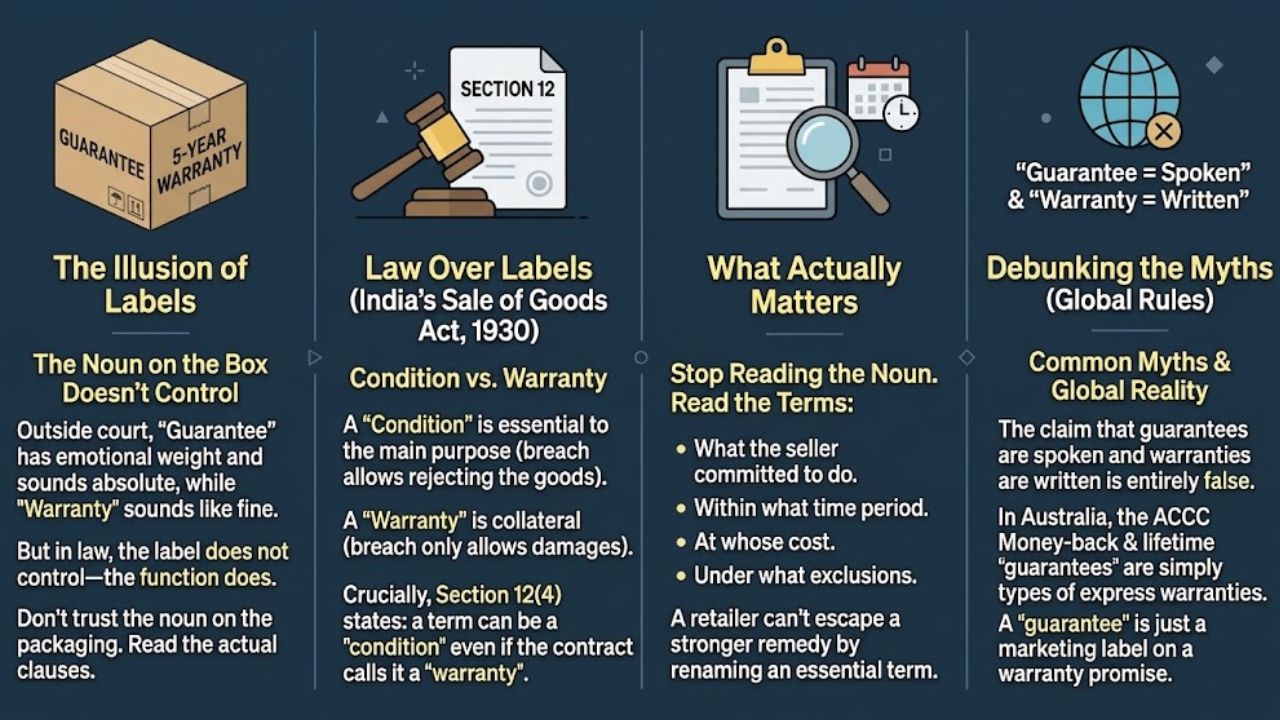
Outside a courtroom, “guarantee” carries emotional weight. It sounds absolute, as though someone is staking their reputation on an outcome. That is why an advertisement prefers “guaranteed to last” over “warranted to last” — the first sells, the second sounds like fine print. I do not read the first word as having more legal force than the second, and the guarantee vs warranty question resolves the same way once you stop treating either word as decisive.
In contract law, the same two words reverse their hierarchy depending on where you are. Under India’s Sale of Goods Act, 1930, section 12, the law distinguishes a condition from a warranty. A condition is a stipulation essential to the main purpose of the contract, and breaching it lets the buyer reject the goods outright. A warranty is collateral to the main purpose, and breaching it only entitles the buyer to damages, not rejection.
Then section 12(4) does something that should end every argument on the internet. It states that whether a stipulation is a condition or a warranty depends on how the contract is construed — and that a stipulation may be a condition even though the contract calls it a warranty. The label does not control. The function does. I keep coming back to that sub-section because a 1930 statute already told buyers not to trust the noun on the box.
So when a gadget box says “5-year warranty,” the word is not doing the legal work. The clause behind it is. A retailer who labels a minor term a “guarantee” gains nothing in court, and a manufacturer who calls an essential term a “warranty” cannot escape the stronger remedy by naming it differently. Stop reading the noun on the packaging. Read what the seller has committed to do, within what period, at whose cost, and under what exclusions.
Two of the highest-ranking pages on this topic get the rule backwards. They claim a guarantee is spoken and a warranty is written. No statute in any of the four countries below supports that distinction, and a written “money-back guarantee” is exactly the kind of promise regulators have penalised.
Australia’s competition regulator goes further and settles the matter outright. The Australian Competition and Consumer Commission states that money-back guarantees and lifetime guarantees are both types of express warranty. The word “guarantee,” in other words, is not a separate legal instrument at all. It is a label that businesses put on a warranty promise, and the regulator files it accordingly.
India defines warranty and leaves guarantee undefined
India’s Consumer Protection Act, 2019 is the clearest example of the two words being treated as one idea. Section 2(20) defines an express warranty. Section 2 of the Act contains no definition of “guarantee” at all. I checked that twice, because it is the kind of absence that explainer articles usually paper over, and I wanted to be sure the gap was real and not my own search failure.
Where the word does appear, it appears fused to warranty. Section 2(47), which defines an unfair trade practice, lists at clause (g) the practice of giving the public “any warranty or guarantee of the performance, efficacy or length of life of a product” that is not based on an adequate or proper test. Clause (h) covers a representation that purports to be “a warranty or guarantee of a product” or a promise to replace, maintain or repair an article — when that purported warranty, guarantee or promise is materially misleading. The statutory language runs the two terms together in a single breath. That is not sloppy drafting. It reflects how Indian consumer law actually treats them: as interchangeable promises whose content matters and whose name does not.
The teeth sit in two places. Section 2(34) defines product liability as the responsibility of a manufacturer or seller to compensate a consumer for harm from a defective product or a deficiency in service. Section 84(2) states that a product manufacturer is liable in a product liability action even if he proves he was not negligent or fraudulent in making the express warranty of a product. Negligence is not the defence. That is the provision I would hand to any buyer who has been told the company “made an honest mistake.”
Buyers who believe a seller has misrepresented a guarantee have a cheap first step. The National Consumer Helpline, run by the Department of Consumer Affairs, takes grievances on the toll-free number 1915, in 17 languages, and its own dashboard reported 1,092,264 grievances registered between 1 January and 5 September 2025, of which 983,708 were resolved or disposed. A separate government release of 4 July 2025 recorded ₹7.14 crore refunded through the helpline in two months, with e-commerce generating the highest volume of claims at 8,919 grievances.
I find those numbers more persuasive than any clause summary, because they show the system works before litigation. A warranty dispute over a ₹30,000 phone rarely justifies a consumer commission filing. A helpline complaint often does the job.
What happens when a guarantee claim is actually tested
India’s enforcement record answers the question the statute leaves open, because the Central Consumer Protection Authority has already acted against companies over guarantee and warranty wording. Two orders show how the words get policed in practice.
The Eureka Forbes order, dated 5 August 2026, is the clearest case. The authority took suo motu cognizance of grievances registered on the National Consumer Helpline and examined 5,008 complaints against the water-purifier maker. Of those, 2,161 concerned delays in providing service, 1,742 concerned after-sales service not being provided, and 349 concerned charges for repairs despite warranty coverage. The authority found the company’s “30 days money-back guarantee” paired with a “no-questions-asked” return policy to be misleading, because the actual terms imposed restrictions that could make a product ineligible for return. It also held that advertising “lifetime free re-installation and uninstallation,” described as a ₹1,400 benefit offered free, created an impression the benefit would last through ownership while material limitations went undisclosed. The penalty was ₹5 lakh.
That order matters for a simple reason. The word penalised was not “warranty.” It was “guarantee,” used in exactly the strong, absolute sense that makes buyers trust it. A written guarantee did not protect the seller; it became the evidence against them.
A second order shows what happens when the promise and the cover do not match. The authority opened a preliminary inquiry into Jaquar over LED bulbs marketed with a “Rated Life 50,000 Hrs” claim — roughly 22 years at six hours a day — while the products carried only a one or two-year warranty, and in some instances none at all. The authority examined whether the claim fell under the misleading advertisement definition in section 2(28) and the unfair trade practice definition in section 2(47).
The lesson generalises beyond water purifiers and light bulbs. When a headline number and the actual warranty period point in different directions, the mismatch itself becomes the complaint. Under section 21 of the Act, the authority can order an advertisement discontinued or modified and impose a penalty up to ₹10 lakh, rising to ₹50 lakh for a repeat contravention.
I would treat the Jaquar inquiry as the more useful of the two for an ordinary buyer. It shows that the gap between what a claim implies and what the warranty actually covers is itself actionable, even when no one has been hurt yet.
The commercial incentive behind that wording is worth naming. The India extended warranty market was estimated at USD 4.40 billion in 2025 by the research firm IMARC Group, which projects it reaching USD 10.04 billion by 2034. Sellers do not push “guarantee” language because it is legally precise. They push it because it sells.
Singapore runs the lemon law beside your warranty
Singapore took a different route and made the separation explicit. The Consumer Protection (Fair Trading) Act creates additional consumer rights in respect of non-conforming goods, in Part III, sections 12A to 12F. This is what everyone calls the lemon law, and I found the drafting tighter than the other three statutes.
The trigger is not a broken promise of quality. It is non-conformity. Under section 12B, goods are defective if they do not correspond with their description, are not of satisfactory quality, or are unfit for a purpose the buyer made known to the seller before purchase. The consumer can require repair, replacement, or a refund. I would describe that as the better model, because it tests the product against the contract rather than against a marketing word.
The six-month rule is where buyers win silently. If a defect appears within six months of delivery, the law presumes it existed at the time of delivery, and the seller must prove otherwise. After six months, the burden flips. The buyer has to prove the defect was there from the start, which is why almost every successful lemon-law claim in Singapore is filed early. I would treat that six-month line as the deadline that matters most.
Now the part most guides miss. Singapore’s Ministry of Trade and Industry, in its own advisory on the amendments, stated that the new remedies would not replace existing protections such as guarantees and warranties, retailers’ own return policies, or remedies already available under the Sale of Goods Act and the common law.
So a Singapore buyer with a faulty appliance may hold two independent claims at once. The statutory non-conformity right comes from the Act. Any additional manufacturer warranty sits on top and is enforced by its own terms. A seller who says “you only have your warranty” is describing half the picture, and I would push back on that in the shop rather than afterwards.
The Philippines uses warranty and guarantee interchangeably
The Philippines Consumer Act, Republic Act No. 7394, governs warranties through Articles 67 to 69, with penalties in Article 73. Article 67 defers to the Civil Code on conditions and warranties in contracts of sale. Article 68 then adds detailed consumer protections. Of the four jurisdictions I read, this is the one that drafts around the confusion most cleanly.
What stands out is the drafting. Article 68 treats the two words as synonyms throughout. The provision on express warranty requires written warranties or guarantees issued by a manufacturer, producer or importer to be operative from the moment of sale. The provision on enforcement is titled enforcement of warranty or guarantee, and it says warranty rights can be enforced by presentment of a claim — the buyer needs only the warranty card or equivalent.
Article 73 makes the point unmistakable by penalising refusal, without valid legal cause, to honour a warranty or guarantee issued, and unreasonable delay in honouring one, and any false representation in an advertisement as to the existence of a warranty or guarantee. The statute does not care which word the advertisement used. I would like to see India adopt that clause directly, because it closes the exact gap a misleading guarantee card exploits.
Philippine law also sets a floor that buyers elsewhere would envy. Under Article 68, where an implied warranty of merchantability accompanies an express warranty, both last equally long. Any other implied warranty endures for not less than sixty days and not more than one year following the sale of new consumer products. India has no equivalent floor, and I would argue that is the single biggest gap in its regime. If I were drafting for Indian buyers, that minimum would be my first addition.
Japan stopped calling it a warranty at all
Japan’s reform is the most instructive of the four, because it shows a legal system deliberately retiring the language that confuses buyers. No other jurisdiction in this comparison has gone that far, and I think Japan is right to have done it.
Until 2020, Japanese law worked through a defect warranty concept. The Civil Code reform that took effect on 1 April 2020 replaced it with a lack-of-conformity framework. The seller is now strictly liable when delivered goods do not conform to the contract in type, quality or quantity. The buyer does not have to prove the seller’s negligence or intent, and the remedies are repair, replacement, delivery of the shortfall, or a reduction in price, alongside cancellation and damages. I keep pointing importers to that shift, because it moves the argument from “is this defect covered” to “does this match what was sold.”
The government’s own English translation of the amended Consumer Contract Act shows the same vocabulary shift. Article 8, which voids clauses that unfairly exempt a business operator from liability, now speaks of the subject matter not conforming to the contents of the contract with respect to type or quality — replacing the older framing built on latent defects. The Act was last amended on 25 May 2022, and Article 8 now also voids clauses that let the business operator decide for itself whether it bears liability, not merely clauses that exclude liability outright. I read that amendment as the clearest signal of where consumer law in the region is heading: away from the word on the box and toward what was actually promised.
For a Japanese buyer, the word on the box carries even less weight than in India, because the governing concept is conformity to what was contracted. For an exporter selling into Japan, that is the compliance point: your standard warranty document is not the controlling instrument, and a clause disclaiming liability may simply be void. If I were advising an importer, I would have counsel read those terms before the first shipment, not after the first complaint.
Guarantee vs warranty across four Asian jurisdictions
Here is how the four rule sets actually compare, and I have put burden of proof in its own column because it decides more disputes than the remedy list does.
| Jurisdiction | Governing law | Does it define “guarantee” separately? | Buyer’s core remedy | Burden of proof |
| India | Sale of Goods Act, 1930, s.12; Consumer Protection Act, 2019, ss.2(20), 2(47), 84(2) | No. Statutory language treats warranty and guarantee together | Condition breach allows rejection; warranty breach gives damages. Product liability does not require proving negligence | On the consumer, except the seller must prove any defence that a warranty or guarantee rests on adequate testing |
| Singapore | Consumer Protection (Fair Trading) Act, Part III, ss.12A–12F | No. The Act regulates non-conformity, not the two words | Repair, replacement or refund for non-conforming goods | On the seller for the first six months after delivery; on the buyer after that |
| Philippines | Republic Act No. 7394, Arts. 67, 68, 69, 73 | No. Expressly uses “warranty or guarantee” as one term | Repair or refund of purchase price; implied warranty floor of 60 days to one year for new goods | On the consumer to raise the claim; refusal to honour a warranty or guarantee is separately penalised |
| Japan | Civil Code, Arts. 562–563 (2020 reform); Consumer Contract Act, Art. 8 (amended 25 May 2022) | The defect-warranty concept was replaced by lack of conformity | Repair, replacement, price reduction or cancellation | On the seller, as strict liability for non-conformity; exemption clauses are void |
One gadget usually carries six separate promises
The confusion compounds because a single purchase can sit under half a dozen different protections at once, and they do not expire together or answer to the same party. Buyers who treat them as one thing are surprised at the worst moment.
| Protection | The question it answers | Who owes it |
| Retailer return policy | Can I bring the gadget back, and by when? | The shop |
| Manufacturer’s warranty | What does the maker promise if a covered fault develops? | The manufacturer |
| Money-back guarantee | What conditions must I meet for a refund? | Whoever issued it |
| Extended warranty or service contract | What am I buying on top of what I already have? | The plan provider |
| Accidental damage plan | Are drops, spills and cracked screens covered? | The plan provider |
| Statutory consumer rights | What does the law give me regardless of all the above? | The state |
The last row is the one buyers forget, and it is the one that does not depend on anyone’s goodwill. Australia’s competition regulator states plainly that consumer guarantee rights under the Australian Consumer Law can last longer than any warranty a business offers, and that a manufacturer’s warranty applies in addition to those guarantee rights rather than replacing them. I would put that row first in any buying decision, because it is the only one nobody can talk you out of.
What “covered” means when something actually breaks
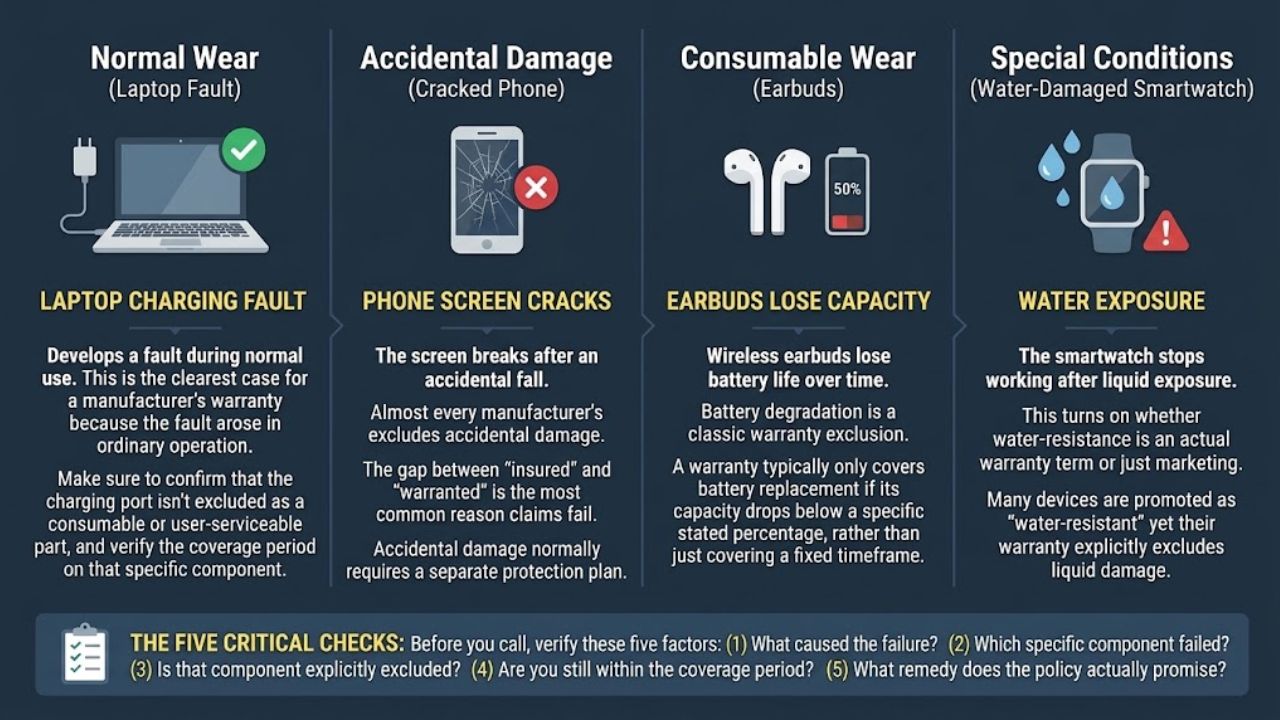
Coverage language is tested at the moment of failure, and the same word produces different answers depending on the cause. Four everyday failures show why.
A laptop develops a charging fault during normal use. This is the clearest case for a manufacturer’s warranty, because the fault arose in ordinary operation. Check whether the charging port is a covered component or listed as consumable or user-serviceable, and confirm the coverage period on that specific part.
A phone screen cracks after a fall. Almost every manufacturer warranty excludes accidental damage, so this claim normally fails unless the buyer holds an accidental damage plan. The gap between “my phone is insured” and “my phone is warranted” is where most rejections originate, and I would treat that gap as the single most expensive misunderstanding in this whole subject.
Wireless earbuds lose battery capacity over time. Battery degradation is the classic exclusion, and it is usually defined by a capacity threshold rather than a fixed date. A warranty may cover the battery only if it drops below a stated percentage within the period, which is far narrower than buyers assume.
A smartwatch stops working after water exposure. The outcome turns on whether the model carries a water-resistance rating and whether that rating is a warranty term or only a marketing specification. Many devices are described as water-resistant while the warranty expressly excludes liquid damage.
For each of these, the same five checks settle the question: what caused the fault, which component failed, whether that component is excluded, where you are in the coverage period, and what remedy the policy promises. I would run those five before making the call, because the answer changes on each one.
The fine print that changes the whole experience
Two warranties of identical length can be worth very different amounts, and the difference lives in clauses that are never on the shelf label. The ACCC adds a point that catches buyers out: an express warranty promise must be honoured whether it was made verbally or in writing, so a salesperson’s verbal assurance is not the throwaway it sounds like. I now treat a verbal promise as something worth writing down at the counter.
Whether the promise offers repair, replacement, refund, or a sequence of remedies matters more than the period. A policy that promises replacement only after two failed repairs is a different product from one that refunds on first failure.
Batteries and accessories frequently carry separate, shorter terms than the main device. Who pays shipping, inspection, labour or a deductible is the other half of the value — a repair covered in full can still cost the buyer a courier charge each way.
Ask whether replacement parts may be refurbished, because many policies permit it and buyers discover this only at the counter. Regional restrictions matter acutely for imported gadgets: coverage is often void outside the country of sale, and some manufacturers refuse to service grey-market units at any price. Proof-of-purchase requirements and transferability decide what happens if you sell the device or receive it as a gift, and a policy is silent on coverage after a completed repair more often than buyers expect.
Six questions to ask before buying your next gadget
These take two minutes at the counter and settle most of what the warranty document will later argue about. Read the promised coverage period together with them, because a three-year warranty on a laptop frequently means three years on the motherboard and one year on the battery — the part that usually fails.
- What faults and components are covered?
- What is excluded?
- Who actually handles the claim, and where?
- Could I have to pay anything — shipping, labour, a deductible?
- What remedies are available, and who chooses between them?
- Can I read and save the full terms before paying?
If the salesperson cannot answer all six from the document rather than from memory, I would treat that as information about the seller rather than a reason to guess.
The exclusions matter most in practice. The clause that catches Indian buyers most often is the authorised-repair condition — getting a phone screen replaced at a local shop can void the entire warranty on the handset, including on the parts the shop never touched. I have watched that clause cost people a repair they had already paid for once.
Keep the paperwork as if it were part of the product. In the Philippines, Article 68 makes enforcement turn on presentment of a claim using the warranty card or its equivalent. In India, the helpline route runs faster when the invoice, the warranty card and the complaint reference numbers are all in hand.
Then match the tool to the size of the loss. A ₹2,000 accessory with a failed warranty is a complaint to the seller and nothing more. A ₹80,000 laptop that dies in month five is a consumer commission matter, and the jurisdiction you bought in decides what you can demand and who has to prove what. If I had to compress this whole article into one habit, it would be that one.
Choosing an extended warranty, and what to do when a claim is rejected
On extended warranties, the foreign guidance is unusually blunt and it applies anywhere. The United States Federal Trade Commission advises that an extended warranty or service contract “is not a good value if it doesn’t offer more coverage than the warranty that came with the product,” and it recommends checking how the coverage period overlaps with the manufacturer’s warranty to avoid paying for protection you already hold. The plan’s provider matters as much as its terms, since an extended warranty is often serviced by a company the buyer has never heard of, and its value is only as good as that company’s willingness to pay.
For an Indian buyer, the local version of that check is the statutory floor. In Singapore, the six-month non-conformity right applies whether or not an extended plan is purchased. In the Philippines, the implied warranty runs up to a year on new goods. An extended plan pays only for the period beyond that floor.
When a claim comes back rejected, the useful response is procedural rather than emotional. Ask for the rejection reason and the exact policy clause relied on, in writing rather than by phone. Gather the receipt, the warranty document, the original product listing and any service history. Establish which party is actually responsible for the claim, because “take it to the service centre” often means the retailer has handed off a duty they still hold. Then request a review through the seller’s or manufacturer’s own escalation process before considering a regulator. In India, that regulator route starts with the National Consumer Helpline on 1915 — and a written rejection reason is the document that makes the complaint stick. I have found that the written-reason request alone resolves a fair share of rejected claims, because a vague refusal is much harder to defend once it is on paper.
FAQs
Is a guarantee legally stronger than a warranty?
Not by name. India’s Sale of Goods Act, 1930, section 12(4), says a stipulation may be a condition even though the contract calls it a warranty. The content of the promise decides its strength, not the word chosen.
Why do companies use both words on the same product page?
Because the words are marketing instruments, not legal ones. An advertisement can say “guaranteed” for emphasis while the accompanying document is headed “warranty” — and the two words land in the same unfair trade practice clause.
Does a manufacturer’s warranty replace my rights against the retailer?
No. Singapore’s Ministry of Trade and Industry advisory is explicit that the lemon-law remedies do not replace guarantees, warranties, retailers’ own return policies, or rights under the Sale of Goods Act. I would treat the two as separate claims to be raised independently.
How long must a seller honour an implied warranty in the Philippines?
Under Republic Act No. 7394, Article 68, any implied warranty other than merchantability endures not less than sixty days and not more than one year following the sale of new consumer products, and an implied warranty of merchantability matched to an express warranty lasts as long as the express one.
What if the seller’s clause says it accepts no liability at all?
In Japan that clause is likely void. Article 8 of the Consumer Contract Act voids clauses that totally exempt a business operator from liability, and since the 25 May 2022 amendment, clauses that let the operator decide its own liability are void too. I would have that clause tested rather than accepted.
What happens if a company advertises a guarantee it does not honour?
In India, the Central Consumer Protection Authority can act on its own. It penalised Eureka Forbes ₹5 lakh in an order dated 5 August 2026, holding a “30 days money-back guarantee” with a “no-questions-asked” return policy misleading because the actual terms could make a product ineligible for return. Section 21 allows a penalty up to ₹10 lakh, or ₹50 lakh for a repeat contravention.