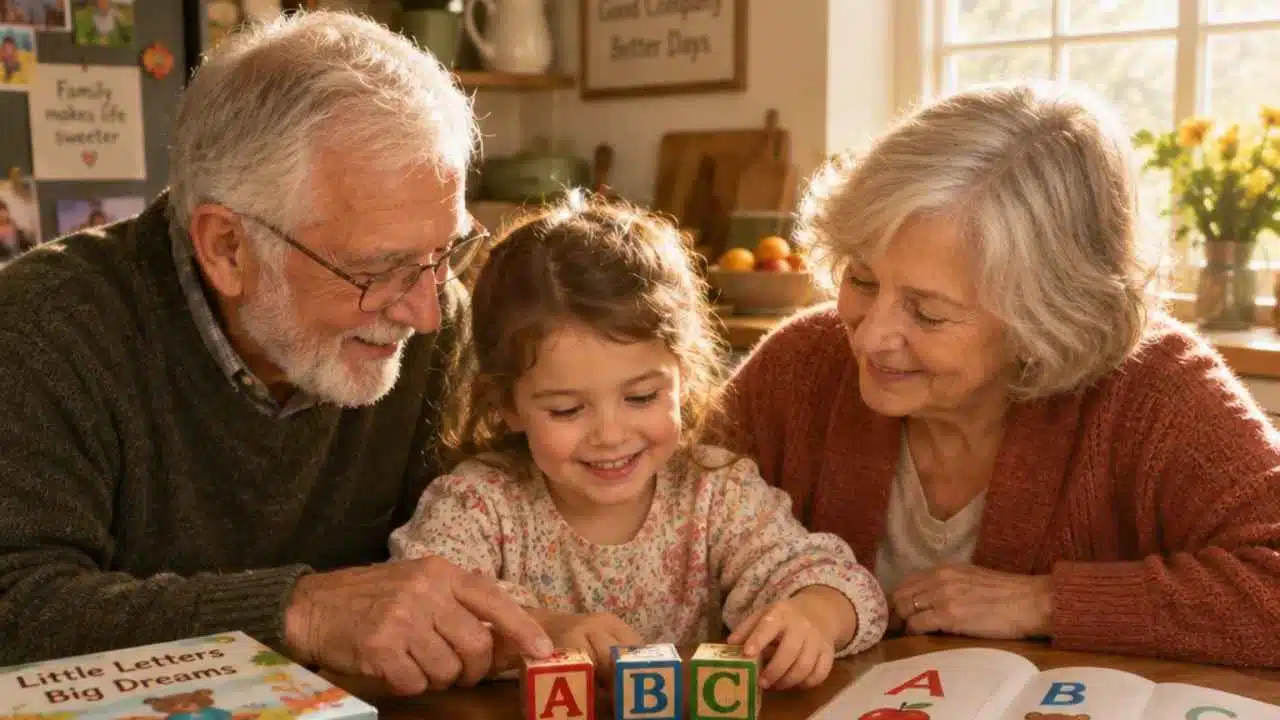
My mom sits with Zayan most days, an old picture book open between them. She is his grandmother, and she teaches letters the way she taught us: point at the letter, say it, and say it again. Some days he follows along. Other days he pushes the book away. If you want to know how grandparents can help with letter learning without it turning into a struggle, the answer is simpler than most guides make it.
Grandparents help most when they do three things: share rhymes and songs, keep practice short and playful, and repeat the same letters patiently. They don’t need to copy a classroom. The nine ways below come from watching my mom with my five-year-old nephew and from my work as chief technical advisor on Alphabet Magic: Trace & Phonics, a letter tracing app for young kids.
1. How Grandparents Can Help With Letter Learning Through Nursery Rhymes
Zayan learned Baa Baa Black Sheep, Pussycat Pussycat, and Twinkle Twinkle Little Star from my mom. Not from me, and not from a screen.
I used to treat those songs as just songs. They do more work than that. A study of pre-kindergarten children by Laurie Harper found that kids who got nursery rhyme instruction scored much better on rhyme awareness than kids who didn’t. Hearing the sounds inside words comes before matching those sounds to letters.
So after the song, pause on one word. “Twinkle. What sound does it start with? T.” Then show the letter T on paper. One letter per song is plenty.
2. How Grandparents Can Help With Letter Learning From Old Picture Books
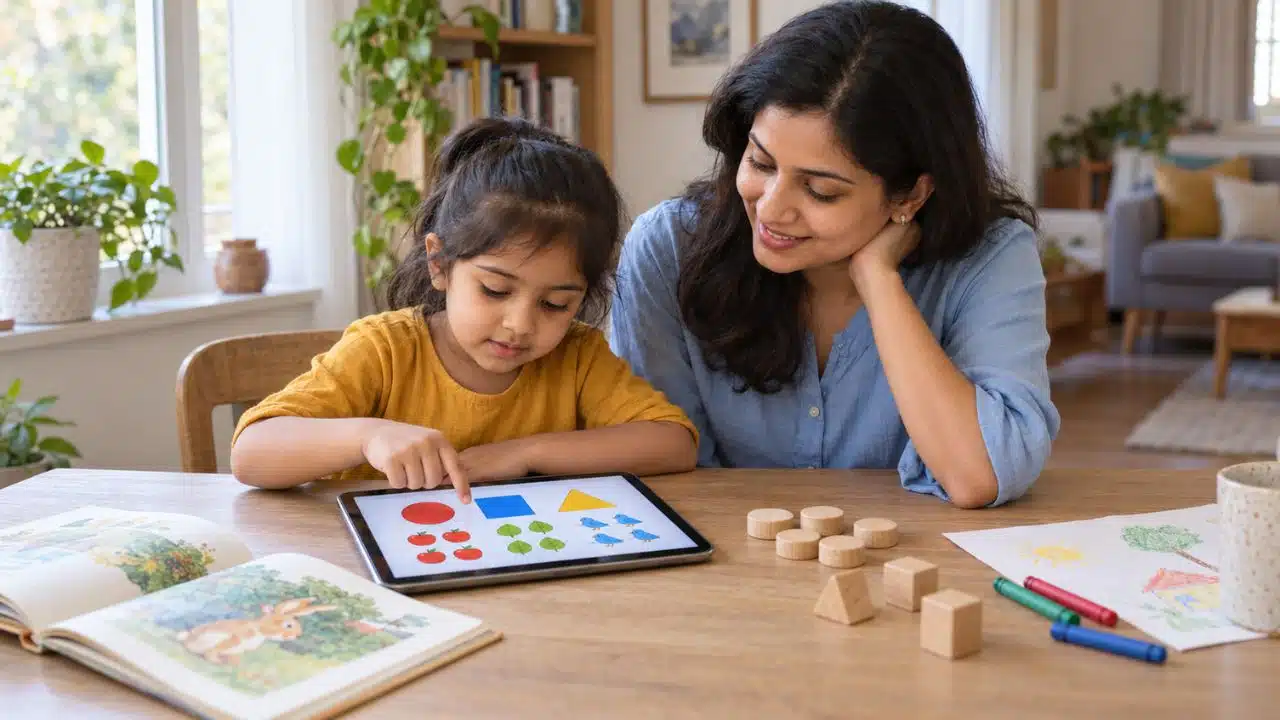
My mom’s method is the traditional one: a book, a finger under the letter, and lots of repeating. Nothing is wrong with it. The problem is that it asks a five-year-old to sit still and follow someone else’s plan, and that’s exactly when Zayan says no.
A few small changes keep the old way but cut down the refusals:
- Let the child pick the book, even if it’s the same one for the tenth time.
- Hunt for just one letter per page. Start with the first letter of the child’s name.
- Ask “Can you find it?” instead of “What letter is this?” Finding feels like a game. Naming feels like a test.
- Close the book while the child still wants more.
3. How Grandparents Can Help With Letter Learning With Offline Games
Here is the part that never changes. Zayan may refuse the book, but he always enjoys my mom’s games.
That tells you where to put the effort. What worked best for him was matching letters to real things and going on letter hunts. A grandparent can run games like these with no prep:
- Letter hide-and-seek. Write three or four letters on cards and hide them around the room. For each card he finds, he says the sound.
- Find-it walk. “Find me something that starts with B.” Ball, bag, bed, banana.
- Sound toss. Toss a soft ball back and forth. Whoever catches it says a word that starts with the letter you called.
On good-weather days, take these outside. These outdoor alphabet games for letter practice add running and chalk to the mix, which helps active kids.
4. How Grandparents Can Help With Letter Learning in Short Sessions
Zayan’s focus lasts about ten minutes. After that, any lesson turns into a bargain.
Grandparents often have more time and patience than busy parents. That’s a strength, but it can also lead to long sittings. Two or three ten-minute rounds in a day work better than one long one.
When he refuses, I don’t count it as failure. Most of the time he is tired, hungry, or bored with the format. Switch to a game, or stop and try again after a meal. Forcing it only teaches a child that letters mean trouble.
5. How Grandparents Can Help With Letter Learning at Mealtimes
Grandparents are often there for lunch, snacks, and dinner. Those are easy letter moments that don’t feel like school. Point to the big letter on a cereal box. Shape a letter with peas or rice. Ask what sound “milk” starts with.
You can find more ideas in this guide to practicing letters at the dinner table. Keep it to one or two letters per meal so food stays fun.
6. How Grandparents Can Help With Letter Learning by Repeating the Same Letters
Grandparents are good at this. They don’t get bored saying the same thing again.
Zayan mixed up b, d, p, and q for a long time. These four letters are the same shape turned around, so kids need many rounds before they stick. One trick that helps with b: “first the bat, then the ball.” Draw the line first, then the circle.
The key is the same letter in different activities. Trace it in a book on Monday, find it in the house on Tuesday, and sing a song with it on Wednesday. There’s a fuller look at why this works in this piece on repetition in alphabet learning.
7. How Grandparents Can Help With Letter Learning Through the Child’s Interests
Zayan wants to be a footballer like Cristiano Ronaldo. He copies the goal celebrations of Ronaldo, Messi, Mbappé, and Neymar. He is good at drawing, but he mostly draws flags of big football nations.
So we use that. R for Ronaldo. M for Messi. B for Brazil, written under the flag he just drew. A child pays more attention to a letter that belongs to something he loves.
Your grandchild might love trucks, cats, or cartoons instead. The method is the same. Find the thing, then find its first letter.
8. How Grandparents Can Help With Letter Learning Alongside a Tracing App
Not every grandparent is comfortable with phones or tablets, and that’s fine. A good split is this: the grandparent keeps the books, rhymes, and games, and a parent or uncle sets up any app.
I’m chief technical advisor on Alphabet Magic: Trace & Phonics, so I’ll be careful here. An app should be one small part of letter learning, not the teacher. Our app offers guided tracing for uppercase and lowercase letters, phonics activities, and mini-games like Star Match and Ocean Adventure. It is ad-free, so no random ads pop up while a grandparent is helping. The Android version also works offline, which matters in homes with weak Wi-Fi.
Screen time still needs limits. The American Academy of Pediatrics updated its advice in February 2026. For ages 2 to 5, it suggests about one hour a day of high-quality content, with an adult watching and talking along.
Here’s an order that works well:
- Read a book page with the letter in it.
- Trace the same letter in the app for five minutes, with Grandma saying the sound.
- Write it once with a pencil on paper.
That last step matters. Tracing with a finger on glass is not the same as holding a pencil, and kids need both.
9. How Grandparents Can Help With Letter Learning by Celebrating Small Wins
For a long time, Zayan didn’t want to learn or go to school. What changed things was small. A few months ago, I brought him alphabet picture books, a school bag, and pencils with erasers. Now he gets up early in the morning to practice letters and numbers.
The lesson for grandparents: let the child own his learning tools. His own book. His own pencil. And praise the effort in plain words. “You wrote the Z all by yourself” means more than “good job.”
Try not to compare. Lines like “your cousin knew all the letters at four” make kids quit. Every child learns letters at a different pace.
Final Thoughts
If you’re still wondering how grandparents can help with letter learning, start with what they already do well: rhymes, stories, games, and patience. My mom didn’t need new skills to teach Zayan. She needed shorter sessions, more games, and a bit less pressure on the days he says no.
Pick one rhyme and one letter this week. Sing the rhyme, find the letter in a book, then hunt for it around the house. That’s enough to start.