Learning how to teach simple addition with objects can begin with something as ordinary as a handful of crayons. Place two on the table, add one more, and ask your child how many there are now. They can move the crayons, count them, and see how the total changes. A question like “What is two plus one?” now has something concrete behind it.
Blocks, toy cars, and other easy-to-handle items work well for these small lessons. You might combine two groups of toy animals during play or count how many crayons you have after choosing another colour. There’s no need to turn every activity into a maths lesson; a few questions at a natural moment give children a chance to practise.
Start with small totals and let your child do the moving and counting. Ask them to show you how they found the answer, and leave room for another try if they lose track. This guide explains how to use familiar objects to introduce addition, keep practice manageable, and connect hands-on counting to written number sentences.
Start with Real Objects
Kids learn addition best when they touch and move real objects around. Toys, fruits, blocks, and other familiar items make math concrete and fun for young learners.
This isn’t just a nice idea. According to the Common Core State Standards for Mathematics (Kindergarten, Operations and Algebraic Thinking), kindergartners are expected to “represent addition and subtraction with objects, fingers, mental images, drawings, sounds, acting out situations, verbal explanations, expressions, or equations.” The same standards set a clear fluency goal: adding and subtracting within 5. That target lines up perfectly with starting small, which is exactly what you should do.
Use Toys, Fruits, or Other Familiar Items
Grab some blocks from the toy box, pull out apples from the kitchen, or round up stuffed animals from the bedroom. These countable items are your best tools for introducing addition.
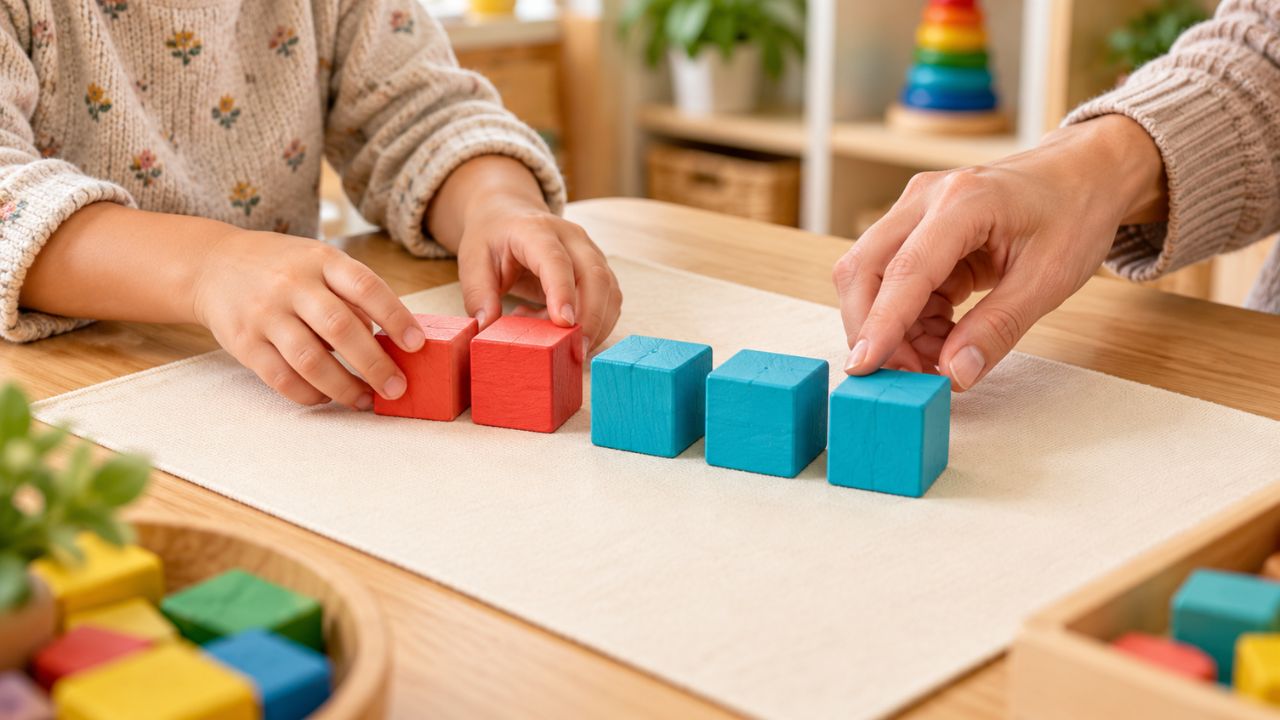
The most basic addition strategy is counting all the objects together. Place three toys on a table, then add two more next to them. Have your child count all five out loud.
This simple move builds real number sense. It shows kids that combining groups creates a bigger group, which is the whole idea behind addition.
One parent placed three foam blocks on the floor, then added two more in front of her four-year-old daughter. They counted the blocks together several times. After just three guided repetitions, the child counted combined groups correctly eight out of ten times during a brief twelve-minute session, and by the next attempt, she could find the total on her own with new block combinations.
That kind of quick progress happens because familiar objects help kids grasp addition through short, focused, repeated practice, not long drills.
Physical objects beat numbers on a page, especially early on. Your child’s brain locks in the concept faster because they touch, move, and see the items change.
- Use square blocks for doubles like 1+1 or 2+2. They stack neatly and create a visual pattern.
- Try fruit for two-group addition: bananas on one plate, apples on another, then combine them.
- Start with sums within 5 before moving higher.
- Let your child touch and move every object, not just look at it.
Children should always work with concrete objects before moving to more abstract math. This progression, from hands-on play to visual worksheets, builds a math foundation that sticks for years.
Encourage Counting Physical Objects Together
Counting physical objects together is the foundation of early math. Grab some blocks, buttons, or crackers from the kitchen. Point to each one slowly and say the number together.
This hands-on habit makes addition concrete instead of abstract. Your child sees that two apples plus one apple equals three apples. They touch the objects, move them around, and count again to check the answer. That tactile step sticks in a young brain far better than numbers on paper ever will.
Start small, with numbers one through five. Your child’s brain won’t feel overwhelmed, and easy wins build confidence before you introduce bigger addends.
Here’s a simple routine that works well:
- Grab a handful of toys or snacks and count them out loud together.
- Ask your child to add one more object to the pile.
- Count the new total together.
- Repeat with a different small number.
Keep it playful, and celebrate every counting win. Your child will start noticing patterns in numbers on their own. Soon, they’ll hold the bigger number in their head and count up from there using the smaller one, which sharpens their number sense fast.
Use Everyday Scenarios
Kids learn addition faster when it’s tied to their daily life. Mealtime, playtime, and even chores can become counting opportunities that stick with them.
Combine Items During Meals
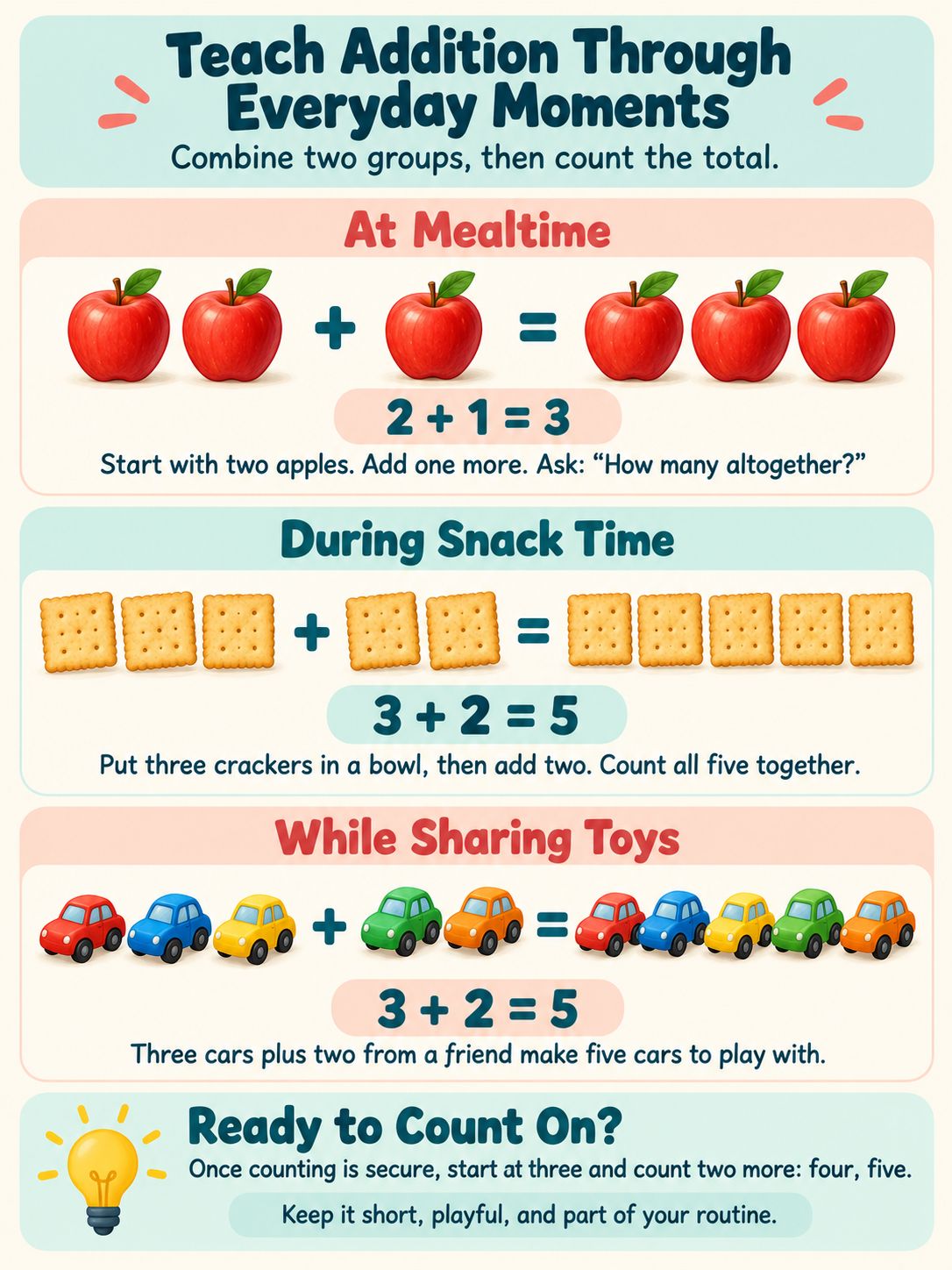
Mealtime is a perfect stage for teaching addition with real objects. Place two apples on your child’s plate, then add one more. Have your child count everything together to find the total.
This concrete approach makes addition real and touchable, not just numbers on paper. Fruits, crackers, or vegetables all work well here. Your child sees the problem, touches the items, and solves it with their own hands. The lesson sticks because they lived it.
That kind of natural repeat practice, done during a normal routine moment, helps kids speed up and feel good about getting the answer right. No drills or worksheets needed.
Try this: pour three crackers into a bowl, then add two more, and ask your child to count everything together. It’s a small moment that builds real number skills, and your child learns that addition just means putting groups together. That’s the most basic strategy there is, and it’s the one they’ll lean on for years.
Relate Addition to Common Activities Like Sharing Toys
Sharing toys with friends gives kids another concrete way to see addition in action. If your child has three toy cars and a friend brings two more, your child can count all five cars together.
This kind of hands-on moment makes addition facts stick because kids see the numbers actually happening. They touch the toys, count out loud, and watch the total grow right in front of them.
As your child gets more confident, they’ll start locking the bigger number in their head and counting on from there using the smaller one. Playing with blocks or candies during snack time turns this into a game instead of a task. Kids remember math better when they’re playing with objects instead of staring at a page, and these small, playful moments build number skills that last well beyond kindergarten.
Incorporate Playful Activities
Kids learn addition faster when they play games with blocks, dice, or candies. These hands-on activities turn math into fun, so your child stays engaged instead of tuning out.
Play Counting Games with Blocks or Candies
Grab a handful of blocks, and have your child grab another. Now count them all together, combining the two piles into one big group.
This kind of play makes addition concrete and real. Your child sees the numbers, touches them, and counts every object. Blocks work great because they stack and stay put. Candies work too, though your child might eat a few before you finish counting.
The most basic addition strategy, counting all the objects together, happens naturally through games like this. Your child learns without feeling like they’re doing homework.
Dice games are another great option. Roll two dice and have your child count all the dots. Start with doubles, like rolling two threes or two fives. Doubles give your child a strong foundation for later addition facts, and square objects work especially well for showing this pattern visually.
Keep rolling. Each roll becomes a fresh counting adventure, and your child builds number skills through play instead of pressure.
Use Interactive Tools Like Flashcards or Dice
Flashcards and dice turn addition practice into a game your child actually wants to play. Write simple problems on flashcards, like 2+1 or 3+2, and have your child solve them quickly. Or roll a pair of dice and add up the numbers that land face up.
Try this simple dice game:
- Roll two dice and have your child count the dots on each one separately.
- Help them combine the counts using their fingers to find the total.
- Record each sum with a sticker on a chart.
- Repeat for several rounds, tracking progress on the chart.
Transition to Visual Representations
Once kids count objects with their hands, they’re ready to draw what they see. Pictures and drawings help children move from real toys to paper-and-pencil math.
Teach Drawing Objects to Represent Numbers
Drawing helps children move from touching objects to picturing them. Your child can sketch apples, blocks, or dots to show what a number means. Start by having them draw simple pictures right next to the physical objects.
They might draw three circles to match three toy blocks sitting in front of them. This bridges the gap between real items and written math. Kids start to understand that a drawing can stand in for an actual object, and that numbers represent quantities, not just things they can touch.
Show your child how to draw two apples, then three more apples, and count all six together. Illustrated worksheets work well at this stage since your child draws the starting amount, then adds more drawings to show the second number.
Drawing also gives kids control. They move at their own pace and can erase mistakes without getting frustrated, which matters more than it sounds for a kid who’s still building confidence.
Use Illustrated Worksheets for Practice
Illustrated worksheets give kids a hands-on way to practice addition after they’ve mastered real objects. These worksheets show pictures of apples, blocks, or stars that children count together, which helps bridge the gap between physical objects and abstract numbers on a page.
The parent noticed the child needed the physical toys first before the pictures made real sense. That’s not a fluke. The Florida Center for Instructional Technology at the University of South Florida advises that as kids move through this kind of learning sequence, the numbers and symbols should be used alongside the objects and drawings, not swapped in cold. Try writing “2 + 3 = 5” right next to the blocks and the picture your child drew. That small link helps the symbol click.
Start worksheets with simple problems showing just two or three objects per group. Your child counts the first group, counts the second, then counts everything together to find the sum. From there, you can slowly raise the difficulty:
- Add more objects to each group.
- Introduce doubles, like 2 plus 2 or 3 plus 3.
- Mix in different objects (stars, apples, blocks) so your child generalizes the skill.
- Pair each worksheet answer with the written equation.
The pictures on these worksheets act as a bridge, carrying your child from touching real objects toward abstract thinking on paper.
Final Thoughts
Teaching simple addition with objects starts with helping children understand what happens when they put groups together. When your child gathers two blocks and three more, then counts five altogether, they can see what the addition means. Give them time to move the pieces, check their counting, and explain the answer in their own words.
Keep practice short enough to hold their interest. You could add toy passengers to a bus or bring two groups of crayons together before drawing. If your child skips an item or counts one twice, encourage them to move each object aside as they count. Stay with small totals until they can work through them comfortably.
As their understanding grows, write a matching number sentence beside the objects: 2 + 3 = 5. Show how each number relates to what they have just counted, without rushing to put the objects away. When you teach simple addition with objects, these everyday moments give children time to make sense of the maths, one small sum at a time.
FAQs about How To Teach Simple Addition With Objects
1. Why should I use objects to teach addition?
Kids need to see and touch math to understand it. Using physical objects follows what educators call the concrete-to-representational-to-abstract approach, which helps children grasp number concepts before moving to pencil and paper.
2. What objects work best for teaching addition?
Small items you already have at home work great. Try buttons, coins, cereal pieces, or Unifix Cubes, which are the snap-together blocks used in most US kindergarten classrooms.
3. How do I start an addition lesson with objects?
Start small by placing two groups on the table, like 2 beans and 1 bean. Ask your child to push them together and count the total out loud.
4. At what age can kids learn addition this way?
Most children are ready for concrete addition around age 5 or 6, which is when they typically start kindergarten in the US. Some younger kids pick it up sooner with patient practice. Go at your child’s own pace and adjust the difficulty as their counting skills grow.