A small company can pay for an SEO audit, agree with every recommendation, and still make no changes to its site. The report may be sound. The team may simply lack a writer, developer, or decision-maker with time to act on it.
That is why the SEO agency vs in-house vs freelancer decision should begin with the work that keeps stalling. A freelancer can solve a defined problem. An agency can bring several skills to a coordinated project. An employee can make SEO part of regular marketing and site decisions. None of those advantages matters if you hire for the wrong gap.
Before comparing proposals, work out what needs to happen over the next six to twelve months—and who inside your business can help make it happen.
Find the bottleneck before choosing a hire
Look at the last few SEO tasks your team discussed. Perhaps important service pages have old information. Maybe a site redesign is approaching, or a developer has a list of indexing questions that nobody has investigated. Follow each task to the point where it stopped.
Usually, the constraint falls into one of three areas:
- Direction: The team does not know which pages or issues deserve attention first.
- Production: The priorities are clear, but nobody has time to write, edit, build, or publish the changes.
- Ownership: Work passes between people without anyone keeping decisions and deadlines moving.
These problems call for different help. A second audit will add little if the first audit is sitting in a folder. Hiring a writer will not resolve a question about how a planned site move should be handled. An experienced employee may struggle if the company gives them responsibility for SEO but no route to development time or content approval.
Prepare a short brief before you speak to candidates. Name the products or services that matter most, the pages that already bring useful traffic, known site problems, and any planned changes. Include who can edit the website and who approves claims about the business.
Google Search Console can show which pages and queries receive visibility and clicks from Google Search. Pair that with your own lead or sales information. A busy page is not necessarily a valuable one, and Search Console alone cannot tell you what a visitor bought or whether an enquiry was qualified.
SEO agency vs in-house vs freelancer: the practical differences
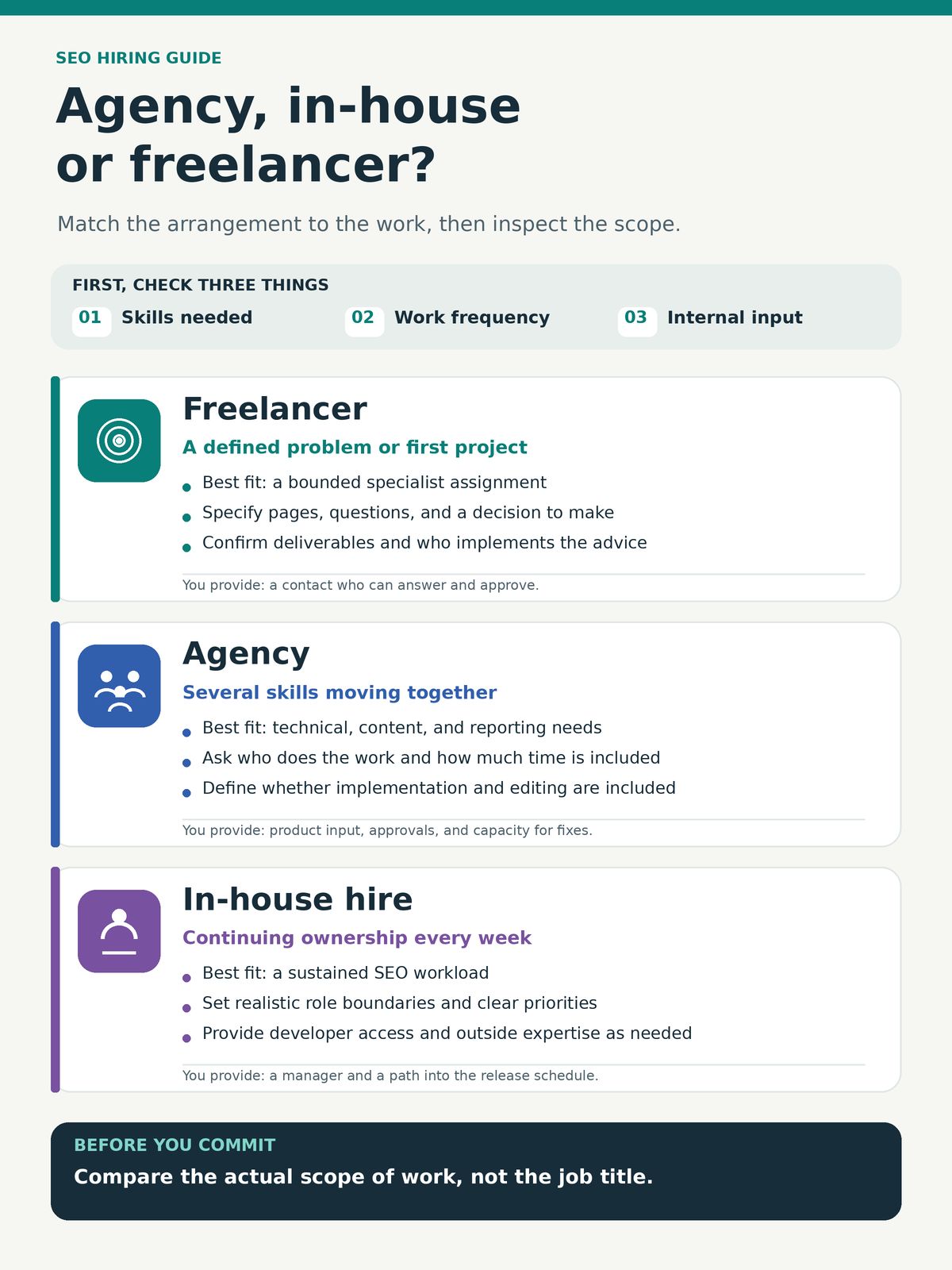
Think about three things: the range of skills required, how often the work arises, and how closely it depends on people inside your business. Then look at what a particular candidate will deliver. Job titles and agency labels are poor substitutes for a scope of work.
A freelancer is often the best first hire for a defined problem
A small team with one pressing question rarely needs to build an SEO department to answer it. A freelancer with the right specialty might review a group of service pages, investigate an indexing issue, plan content around a product category, or advise on a coming redesign.
Make the assignment specific enough to judge. “Improve our SEO” invites a broad report. “Review these 25 service pages, identify where they overlap, and recommend which to update or combine” gives the specialist a decision to work toward.
Find out where their work ends. Will a content specialist provide topic suggestions, detailed briefs, edited drafts, or published pages? Will a technical specialist write instructions for your developer and check the finished fix? Those differences can change the true cost of a project.
A freelancer also needs a dependable contact in the business. Someone must answer product questions, approve priorities, and arrange implementation. Without that person, even good advice can wait weeks for a reply.
For many small teams that have not established a steady SEO workload, a bounded specialist project is the most sensible first purchase. It provides a clearer picture of the work ahead without committing the business to an ongoing arrangement before it knows what that arrangement should cover.
An agency makes sense when work needs several skills at once
An agency becomes more compelling when technical SEO, content planning, writing, editing, and reporting all need to move together. Buying those services through one team may be easier than managing several separate specialists.
The proposal still needs close reading. Ask who will work on your account after the sale, not just who presents the pitch. Who sets priorities? Who writes or checks the content? Who handles technical questions? How much of each person’s time is included?
Pay particular attention to words such as implementation and content support. One agency may identify site issues and hand your developer a report. Another may prepare developer tickets and test the changes after release. Similarly, content support might stop at a keyword list or extend to edited copy ready for approval. Both can be reasonable services; they are not the same service.
An agency cannot supply your product knowledge or approve claims on your behalf. If every page needs input from a busy founder and every technical change waits in a development queue, a larger retainer may produce a larger backlog. Ask the agency how it would plan around those constraints.
An in-house hire is strongest when SEO needs continuing ownership
An employee has the chance to learn the business in detail: which customer questions matter, why a page exists, how products change, and what the sales team hears. That knowledge is useful when SEO affects decisions every week rather than during occasional projects.
The role needs boundaries. A single hire may be able to lead priorities and improve content, while still needing a developer for site changes or a specialist for a complex migration. Writing a job description that expects equal expertise in every part of SEO makes it harder to hire well and harder to judge the person fairly afterward.
Consider an employee when the workload is sustained and the business is ready to support the role. Give them a manager who can resolve competing priorities, a way to request development work, and room to bring in outside expertise when necessary. Being present at every meeting does little good if their recommendations never make it into the release schedule.
Compare what it costs to get work live
The cheapest quote is not always the least expensive way to complete a project. Nor is a larger retainer automatically poor value. Compare the total work required from your business alongside the fee.
For a proposed quarter of SEO work, ask:
- What will the provider or employee deliver?
- Who will write, edit, develop, approve, and publish anything outside that scope?
- Which tools or access will the work require?
- How much time will our team spend providing information and reviewing it?
- Which deliverables can realistically go live during the quarter?
Suppose 40 product pages need updating. An audit could identify the pages and explain the changes, but leave every rewrite to your team. A proposal that includes edited drafts may cost more and save considerable staff time. If your company cannot verify product details or approve either set of drafts, both proposals will stall.
Ask candidates to show what a typical month would produce against your brief. “Ongoing optimization” is hard to compare. A list of proposed page reviews, drafts, technical tasks, decisions needed from you, and follow-up checks gives you something concrete.
Do not let a ranking guarantee settle the choice. No provider can promise the top position in Google Search. Site changes can take varying amounts of time to appear in results, and some will have no noticeable effect. A credible candidate should be able to discuss likely benefits and uncertainty in the same conversation.
Test candidates with one real problem
A limited problem reveals more than a generic sales presentation. Share enough context for a useful discussion without requesting a full unpaid audit.
For example: “Search visits to our main service pages have fallen, and we plan to redesign the site next quarter. What would you check before recommending new pages or changing our URLs?”
Notice which questions come back. Does the candidate ask when the decline began and which pages are affected? Do they want to know whether those pages bring enquiries? Do they ask what the redesign will change and who can make technical decisions?
The strongest response may be cautious at first. A candidate should distinguish the information they have from what they need to investigate. Be wary of someone who immediately prescribes a fixed number of articles or promises to restore traffic without examining the problem.
Before making a choice, ask who will do the work, how changes will be documented, what depends on your team, and how progress will be assessed. Request relevant examples and references. You should also be able to understand why a proposed change is needed. If the explanation rests on a claimed secret technique or a special relationship with Google, keep looking.
Put implementation and handover in writing
An SEO task is rarely finished when a recommendation appears in a report. Someone must decide whether to act on it, prepare the change, approve it, release it, and check that it worked as intended.
The agreement should identify who owns each of those steps. For technical work, ask whether you will receive developer-ready instructions and a check after implementation. For content, clarify whether you are buying ideas, briefs, drafts, edited copy, or pages published in your CMS.
Keep a simple record of completed changes, decisions, and blocked tasks. Reporting can then answer useful questions: What went live? What is waiting on us? Has a change produced an early signal worth investigating? A slide of ranking movements cannot answer those questions on its own.
Keep company control of your domain, website, analytics, Search Console property, and published content. For an initial audit, a candidate should receive only the view access needed to assess the site. Search Console has different permission levels; ownership is not required merely to examine performance data.
Set the handover terms before work begins, particularly with an outside provider. Decide where briefs and reports will be stored, who receives unfinished work, and who can use commissioned material. That preparation makes it easier to change providers without losing the reasoning behind earlier decisions.
A sensible starting point for four common situations
- You do not yet know what the site needs. Commission a limited diagnostic project from a qualified freelancer or agency. Ask for prioritized recommendations, the work required to carry them out, and an explanation of what should wait. A long list of issues without priorities is difficult for a lean team to use.
- You have recommendations but rarely implement them. Hire for the missing work. That might be an editor, developer, content producer, or someone who can coordinate all three. Review the existing recommendations before paying for another audit.
- You are redesigning or moving the site. Bring in relevant SEO expertise while decisions about pages, URLs, templates, and redirects are still open. A project specialist may be sufficient if your own team can implement and test the plan. Waiting until the new site is finished limits what the specialist can influence.
- SEO decisions arise throughout the month. Consider an in-house owner who can keep priorities tied to the business. Give that person access to freelance or agency support for work beyond their expertise.
You can change the arrangement later. A focused project may reveal a sustained workload that justifies an employee. An employee may need temporary specialist support during a migration. Hire for the work you can identify now, then reassess when its volume and complexity change.
Final Thoughts
For a small team, the SEO agency vs in-house vs freelancer choice is best made from an honest account of where work stops. If the problem is narrow, start with a scoped specialist. If several disciplines must deliver together, examine an agency’s actual team and deliverables. If SEO shapes decisions week after week, give it an internal owner.
Take your most important unfinished SEO task into the next hiring conversation. Ask each candidate how they would move it from a recommendation to a live, checked change. Their answer will tell you more than a package name or a promised ranking.
FAQs About SEO Agency vs In-House SEO vs Freelancer
Should a small business hire an SEO generalist or a specialist first?
Hire for the problem you can name. If a site migration is approaching, look for relevant technical experience. If useful pages remain unwritten, content expertise may be more valuable. A generalist becomes more useful when several kinds of SEO work need regular coordination.
Is a paid trial project worth doing before signing a longer contract?
Yes, when the project has a useful outcome of its own. A review of a small group of important pages can show how a candidate investigates problems, explains priorities, and works with your team. Agree on the deliverable, fee, and access before it starts. Avoid a trial so broad that it becomes an unpaid audit.
How do you judge an SEO provider before traffic improves?
Check the work you can verify now: whether agreed changes were delivered, approved, and published; whether technical fixes were tested; and whether recommendations address valuable pages. Review search performance over time, but do not treat an early ranking change as proof that the whole engagement has succeeded or failed.
When should you change your SEO provider?
Start with a direct review of the scope and unresolved blockers. A provider should be able to show what they completed, explain delays, and adjust priorities when evidence changes. Consider switching if work repeatedly misses the agreed scope, recommendations remain unexplained, or you cannot obtain a clear record of changes made to your site.