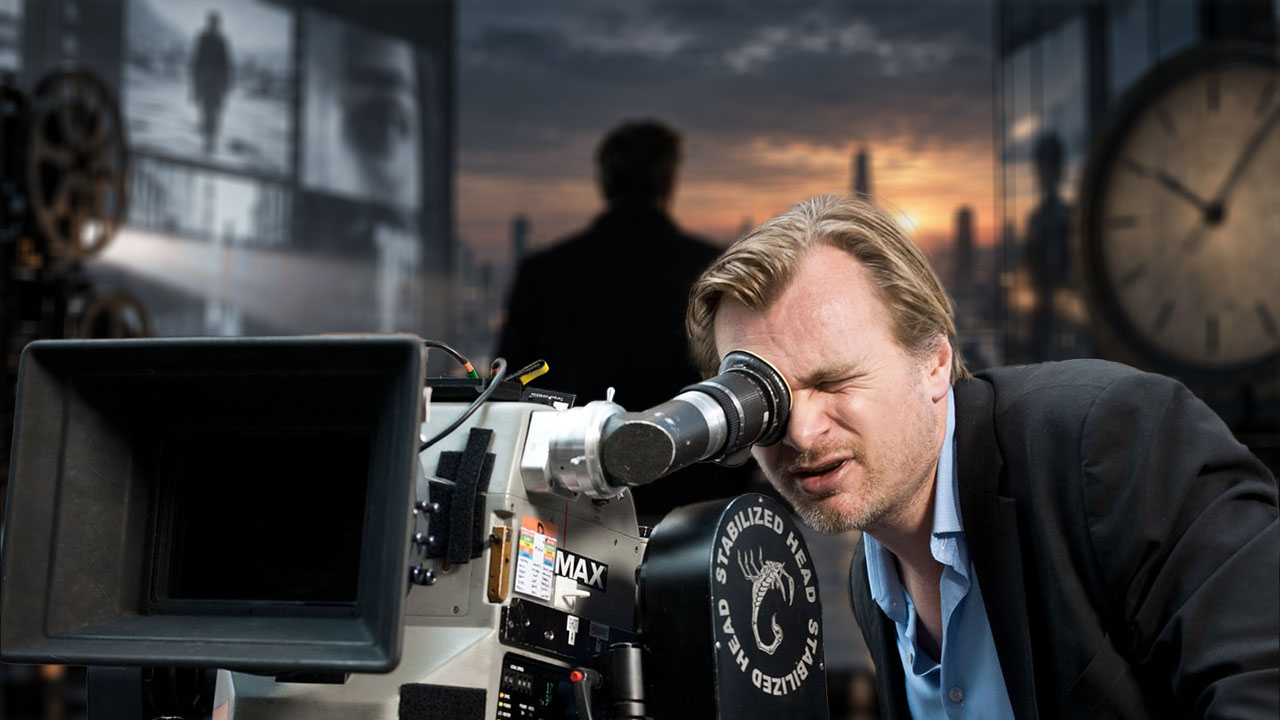
There are 13 movies directed by Christopher Nolan so far. The first was Following in 1998, and the latest is The Odyssey, released in the United States and United Kingdom on July 17, 2026. I’ve watched nine of them, and this guide is built on those nine viewings.
Nolan is my favorite director. That doesn’t mean I think he’s flawless. My honest take: he’s a great filmmaker but a middling writer. He reuses the same plot tricks because he can’t tell a straight, linear story at a level that matters. That view shapes everything below. If you want to compare notes, here’s my IMDb profile.
Movies Directed by Christopher Nolan in Order
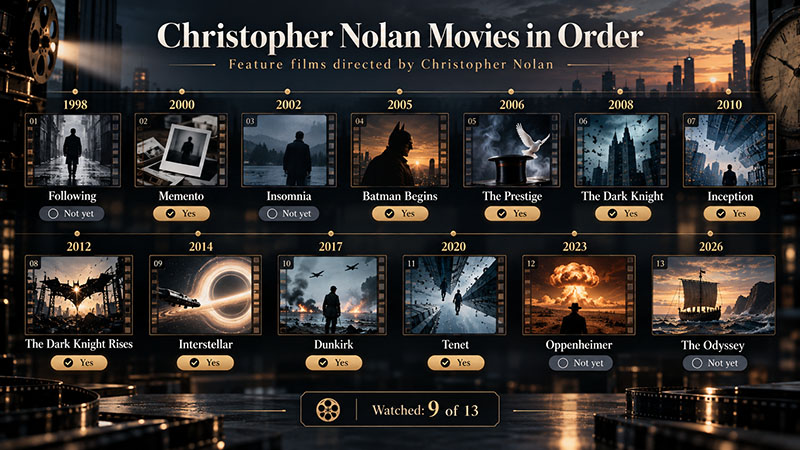
Here are all the movies made by Christopher Nolan as a feature director, sorted by release year. The last column shows where I stand.
| Year | Movie | Seen it? |
|---|---|---|
| 1998 | Following | Not yet |
| 2000 | Memento | Yes |
| 2002 | Insomnia | Not yet |
| 2005 | Batman Begins | Yes |
| 2006 | The Prestige | Yes |
| 2008 | The Dark Knight | Yes |
| 2010 | Inception | Yes |
| 2012 | The Dark Knight Rises | Yes |
| 2014 | Interstellar | Yes |
| 2017 | Dunkirk | Yes |
| 2020 | Tenet | Yes |
| 2023 | Oppenheimer | Not yet |
| 2026 | The Odyssey | Not yet |
If you watch Christopher Nolan movies in order, you’ll see the budgets grow while the obsessions stay put: memory, time, guilt, and men who lie to themselves.
Christopher Nolan’s First Movie: Where the Movies Directed by Christopher Nolan Began
Christopher Nolan’s first movie is Following (1998). He shot it on weekends over about a year while the cast and crew held regular jobs, working with a $6,000 budget, mostly natural light, 16mm film, and amateur actors. It’s a 70-minute crime story about an out-of-work writer who gets pulled into a burglary scheme after tailing strangers for story ideas.
I haven’t seen it yet. But the setup already tells me the pattern started on day one: a con, a man chasing clues, and a timeline that doesn’t run straight.
My Take on the Movies Directed by Christopher Nolan I’ve Watched
I’ve grouped my nine by the kind of trick each one pulls.
Memento and The Prestige: The Twist Movies Directed by Christopher Nolan
Memento (2000) is the one where Nolan’s backwards structure truly earns its place. Leonard, played by Guy Pearce, can’t form new memories, so the story runs in reverse and you share his confusion. The structure isn’t decoration. It is the movie. Nolan wrote it from a short story by his brother Jonathan, and the script got an Oscar nomination.
The Prestige (2006) follows two rival magicians in Victorian London, played by Hugh Jackman and Christian Bale. The film is built like a magic act, with a setup, a turn, and a reveal. This is where my “plot tricks” complaint goes soft, because a movie about tricks should be full of them.
The Dark Knight Trilogy: The Batman Movies Directed by Christopher Nolan
Batman Begins (2005) is mostly a straight origin story once the early flashbacks settle. It’s grounded and a bit slow, but it rebuilt Batman as someone who could exist in a real city.
The Dark Knight (2008) is the closest Nolan has come to proving me wrong. It moves forward from start to finish, and it still hits hard. Heath Ledger’s Joker won him a posthumous Oscar, and he carries a lot of the story’s weight. I’d still argue the filmmaking does more work than the script: the pace, the practical stunts, the IMAX shots of Gotham.
The Dark Knight Rises (2012) is bigger and messier. Tom Hardy’s Bane and Anne Hathaway’s Catwoman are fun, but the plot skips over things, like how Bruce gets back into a locked-down Gotham.
Inception, Interstellar, and Tenet: The Time-Bending Movies Directed by Christopher Nolan
This group is where my main complaint comes from. All three stretch or reverse time, and all three stop to explain their rules.
Inception (2010) is a heist inside dreams, where time stretches longer at each deeper level. The spinning hallway fight and the spinning top ending are great. Still, a big chunk of the film is characters explaining the rules to each other.
Interstellar (2014) has the strongest emotional pull of the nine, thanks to the bond between Cooper (Matthew McConaughey) and his daughter, Murph. The water planet scene, where one hour equals seven years on Earth, is Nolan at his best. The ending, though, leans on another time loop.
Tenet (2020) is where the habit goes too far. Inverted bullets and backward car chases look amazing, but the characters mostly exist to deliver instructions, and many viewers struggled to hear the dialogue over the sound mix.
Dunkirk: The Leanest of the Movies Directed by Christopher Nolan
Dunkirk (2017) has almost no backstory and very little dialogue. It cuts between three timelines: a week on the beach, a day at sea, and an hour in the air. Yes, even here he chops time into pieces. The difference is that nobody has to explain it. Hans Zimmer’s ticking score does the job. It shows what Nolan can do when the script gets out of the way.
The Plot Tricks That Keep Coming Back in Movies Directed by Christopher Nolan
Watch nine of his films close together and the repeats get hard to miss:
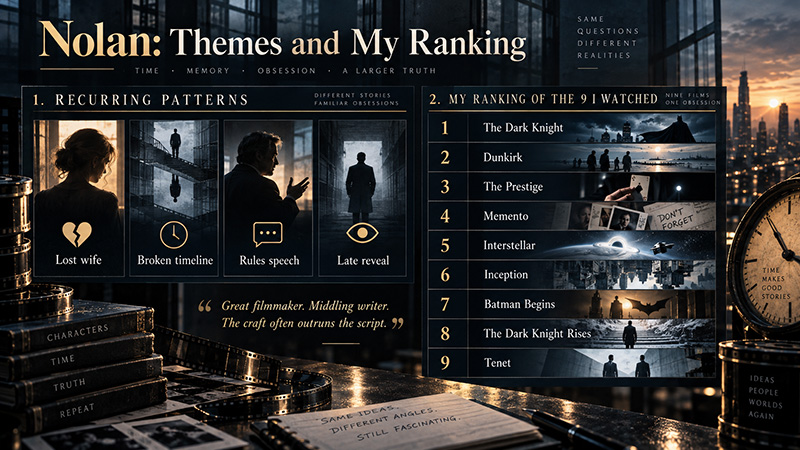
- The lost wife. Memento, The Prestige, Inception, and Interstellar all hang the hero’s pain on a wife who is dead or gone.
- The broken timeline. Memento, The Prestige, and Dunkirk all shuffle the order of events.
- The rules speech. Inception, Interstellar, and Tenet each pause so someone can explain how the world works.
- The late reveal. Memento, The Prestige, The Dark Knight Rises, and Tenet all save a twist that reframes what you just watched.
None of these is bad on its own. It’s the reuse that bothers me.
Christopher Nolan Best Movies: How I Rank the Movies Directed by Christopher Nolan
- The Dark Knight: A near-linear story that still matters.
- Dunkirk: Pure filmmaking with almost no talking.
- The Prestige: The only film where the tricks are the subject.
- Memento: The best use of his backwards structure.
- Interstellar: Huge heart, shaky last act.
- Inception: Great ideas, too many explanations.
- Batman Begins: Solid setup, slow in places.
- The Dark Knight Rises: Big moments, weak plot logic.
- Tenet: All puzzles, no people.
Movies Directed by Christopher Nolan I Haven’t Seen Yet
Insomnia (2002) is the one I’m most curious about. It stars Al Pacino and Robin Williams, and it’s the only feature he directed without a writing credit. For someone with my opinion of his writing, that makes it a test case.
Oppenheimer (2023) won seven Oscars, including Best Picture and Nolan’s first Best Director win. It earned about $975 million worldwide, a huge number for a three-hour historical biopic.
The Odyssey (2026) stars Matt Damon as Odysseus. It’s the first feature shot entirely with IMAX film cameras, and its worldwide gross has passed $1.7 billion. It’s now Nolan’s biggest movie ever, and it passed Deadpool & Wolverine to become the highest-grossing R-rated film of all time. If you’re planning a theater trip, check our list of movies coming out in September 2026 too.
Christopher Nolan Net Worth and the Money Behind the Movies Directed by Him
Christopher Nolan’s net worth is estimated at about $250 million. Treat that as an estimate, since no one publishes his finances. Much of it comes from “first-dollar gross” deals, meaning he takes a share of ticket sales from the start. For Dunkirk, he reportedly got $20 million up front plus 20% of the gross, for about $73 million total.
His films have grossed more than $7 billion combined. He runs the production company Syncopy with his wife, producer Emma Thomas. In 2024 he was knighted for his services to film, and Thomas was made a Dame for her work as a producer.
Final Thoughts on the Movies Directed by Christopher Nolan
If you’re new to the movies directed by Christopher Nolan, start with Memento and The Dark Knight. Those two show both sides of him: the puzzle builder and the big-screen craftsman. Then watch Inception and Interstellar. Save Tenet for last, once you’re used to his rules.
And if all the time tricks wear you out, try films that tell their story straight. Persian cinema and Hungarian movies are good places to start, and our guide to Tubi free movies covers something cheaper for a quiet night.