My nephew Zayan is five and has not started school yet. He has no interest in letters or numbers. He has enormous interest in football. He plays all day, scores against his brothers, and celebrates every goal with Ronaldo’s siu, arms down, chin up. He plans to play for Portugal. Most of the mistakes parents make when teaching alphabet skills come from trying to pull a child away from that instead of using it.
I help build a letter-tracing and phonics app, Alphabet Magic Trace and Phonics. So I watch this from two sides: thousands of children tapping letters on a screen and one child at home who would rather be outside. Here are the eight mistakes I keep running into, including two of my own.
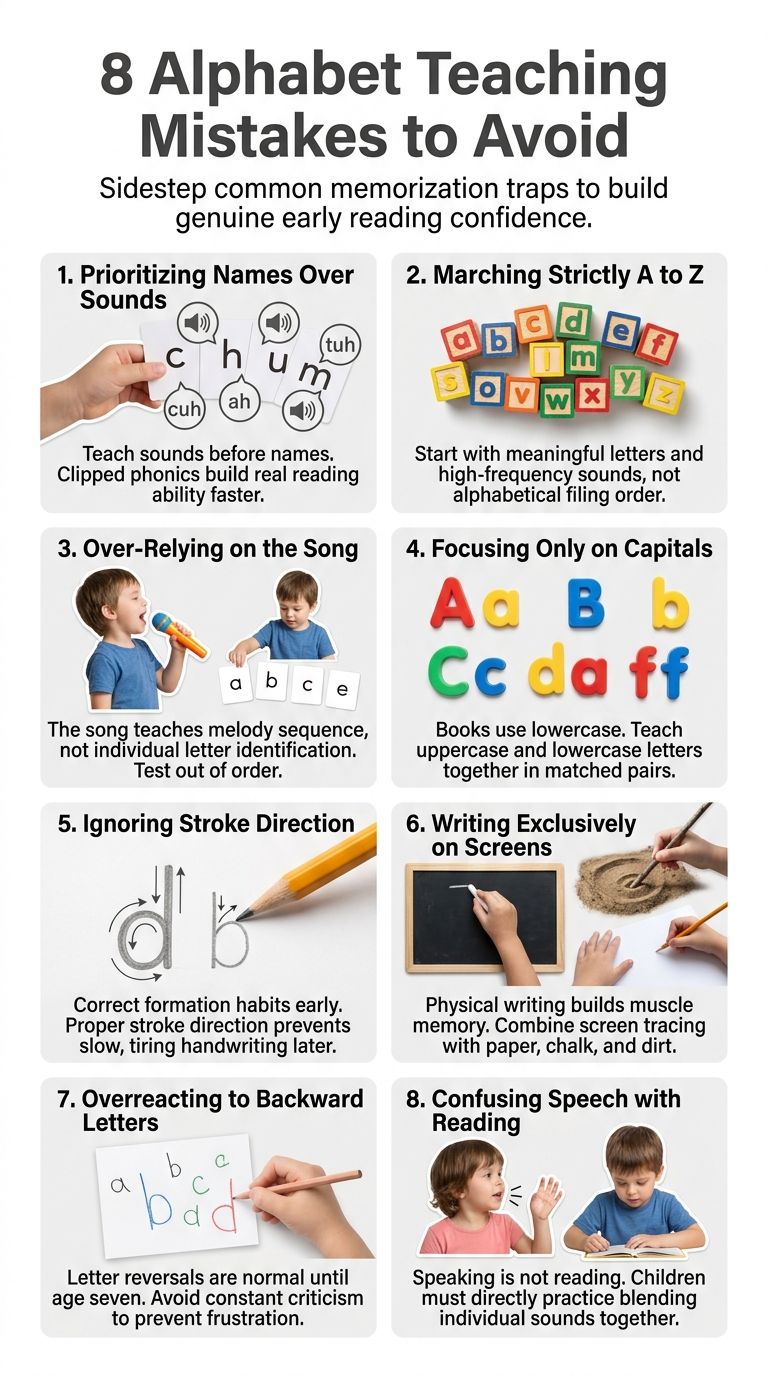
1. Teaching Letter Names but Not Sounds: The Biggest of the Mistakes Parents Made
Every letter has a name and a sound. The name is a label. The sound is the part that actually runs on.
This is not a small distinction, and Zayan is the proof. G is one of his two hardest letters, and the reason is sitting in plain sight. The name of the letter G is “jee.” It starts with the sound J makes. So a child who learns names first has been taught, quite logically, that G says /j/. Then he meets the goal, green, glove and none of it works. He is not confused. He is doing exactly what we taught him.
His favorite letters are C and S, and I think I know why: Cristiano and siu. That is useful, but C carries its own trap. C says /k/ in Cristiano and /s/ in city, which is the sound S already owns. So I teach C as /k/ only for now. Cristiano, cup, kick the ball with C. The second sound can wait a year.
One more thing most of us get wrong without noticing. We say “buh” for b and “tuh” for t. “Buh-a-tuh” will never blend into bat. Clip the sound short.
2. Starting at A and Marching to Z
A to Z is a filing order. It is how we look things up. It is not how a child learns.
Zayan’s name starts with Z. In alphabetical order, the most meaningful letter in his life arrives twenty-fifth. That is an absurd way to run it.
The letters worth teaching first are the ones already loaded with meaning. For him that list writes itself: C for Cristiano, S for Siu, R for Ronaldo, P for Portugal, and Z and A for his own name. Then the workhorse letters that build simple words early are s, a, t, p, i, and n. With those a child reads sat, pat, tin, and nap within weeks, and reading one real word changes how he feels about the whole project.
Starting at A means starting with a letter that has two common sounds; inside words he cannot read yet. You lose him somewhere around F.
If your child already learned them in order and none of it stuck, our guide on how to rebuild alphabet skills covers the reset.
3. Letting the Alphabet Song Do the Teaching
Zayan learns best through songs, rhymes and games. I am not arguing against that. I am arguing against what the song alone actually delivers.
Children sing “elemenopee” as one word. They are storing a melody, not 26 separate shapes. And look where M sits. It is buried in the middle of that blur, between L and N, with no edge to grab. Zayan’s second hard letter is hard partly because the song hides it. He has sung M hundreds of times and has never once heard it on its own.
The test takes ten seconds. Point at a letter out of order and ask what it is. If he can only answer by singing from the beginning until he arrives at it, he has learned a sequence, not the letters.
So keep the songs and break the order. Sing a chant that goes C, S, R, P. Make the rhyme about the thing he cares about. Games do this naturally, which is the real case for how games teach the alphabet better than repetition.
4. Teaching Capitals Only: One of the Quietest Mistakes Parents Made
Capitals are easier. Straight lines, simple curves, bigger shapes. They are also everywhere in Zayan’s world. CR7. SIU. The name across the back of a shirt. YouTube thumbnails. Football hands a child the uppercase alphabet for free.
Then he opens a book and almost every letter on the page is lowercase. He has mastered the version he will see least.
Lowercase is genuinely harder, and it is where children stall. Some letters change completely between cases. A and a share nothing. Neither do G and g, or E and e. These have to be learned as pairs, not guessed.
We built uppercase and lowercase tracing as two separate activities in our app for exactly this reason. Lowercase needs its own time, not a quick pass at the end of the session.
5. Watching the Shape, Not the Stroke
This one is invisible unless you are standing over his shoulder.
Most of us check the finished letter. Does it look like an M? Fine, move on. But he may have drawn it as two hills, starting at the bottom, in three separate pieces. The letter looks right and the habit is wrong, and two years later it shows up as slow, tiring handwriting that is far harder to undo than to teach.
Notice that both of Zayan’s hard letters are also hard to draw. M is four strokes that must go top, down, up, and down. G is one long curve that stops and turns in at the end, and children almost always break it into pieces. Neither letter is difficult to recognize. They are difficult to produce.
I will be straight about our own record. In August a parent reviewed our app and pointed out that some letter formations in the tracing game were wrong, including a lowercase s shaped like a capital S. That criticism is fair, and it matters more in a tracing tool than anywhere else, because the child copies the guide exactly. A wrong model teaches a wrong stroke faster than no model at all.
What a tracing tool should and should not do is covered in our breakdown of alphabet app features that aid learning.
6. Making the Screen the Only Place He Writes
I build an app, so take this in the spirit it is meant.
Zayan’s spoken vocabulary is genuinely impressive, and he got most of it from YouTube. Screens gave him words. They have not given him a single letter he can write, because watching requires nothing from his hands.
Writing letters by hand builds better letter recognition than typing them, and the gap is widest on the letters children confuse most. The likely reason is that the hand stores the movement, and that stored movement helps the eye decide which way a letter faces.
A finger on glass sits in between. It keeps the movement, which is why tracing apps work at all. It removes the resistance and leaves nothing behind. So use both. For a boy like Zayan, the second half is easy: draw the letter on the ball before he kicks it, in dust with a stick, or with chalk on an outside wall. Write the 7 on his hand.
7. Coming Down Hard on the Letters That Look Alike
Parents worry about backwards letters more than almost anything, and it is usually nothing. Reversing letters is common until around age seven, and on its own it is not a sign of dyslexia. Most children who reverse letters at five never turn out to be dyslexic.
It happens because some letters are one shape in several positions. Everyone knows B and D. The set Zayan is dealing with is M, W and N, which is the second reason M gives him trouble. Turn M over and it is W. Take a leg off and it is close to N. A brain that spent five years learning that a ball is a ball from every angle now has to learn that letters do not work that way.
What does damage is sharp correction every time. He stops wanting to write at all, and avoidance costs far more than a backwards letter.
Teach one of the pair properly and leave the other alone for a while. Get M solid, through the movement rather than a visual trick, before W appears. If reversals are still frequent past seven or eight, and he is also struggling to sound out words, that is the point to raise it with a teacher.
8. Thinking a Big Vocabulary Means He Is Ready to Read
This is the mistake I made. Zayan talks well. He knows words I did not know at five. So I assumed the letters would be quick, and when they were not, I read it as a lack of interest.
Speaking and reading are different systems. A large spoken vocabulary hides the gap instead of closing it, because the child sounds ready long before he is. Knowing 26 letters is not reading either. The next skill is blending, holding /s/, /a/, and /t/ in order and pushing them together into sat, and most children need that taught directly.
The related error is turning practice into a test. Flashcards, one question after another, right or wrong every time. A five-year-old who is not in school yet reads that as an exam and stops volunteering answers. You said Zayan responds sometimes, and I would bet the sometimes lines up with the sessions that felt like play.
So keep it short and put it inside the game. One letter per goal. Shout the sound, not the name, during the siu. Ten minutes beats thirty, and the difference shows up in whether he comes back tomorrow. That is the honest argument for gamified learning platforms: not that games teach faster, but that they keep the child in the room.
Final Thoughts
All eight share one root. Each is an adult shortcut. Alphabetical order, capital letters, the song, the flashcard, the finished shape, and the assumption that a talkative child is an early reader. Every one of them is convenient for the person teaching, and none is built around how a five-year-old actually stores a letter.
If you change three things this week, change these. Teach the sound before the name, and clip it short. Start with the letters he already loves instead of the letter that comes first. Put the practice inside the thing he would be doing anyway.
Zayan will learn G eventually. He is far more likely to learn it as the first sound in goal than as the twenty-first item in a list.