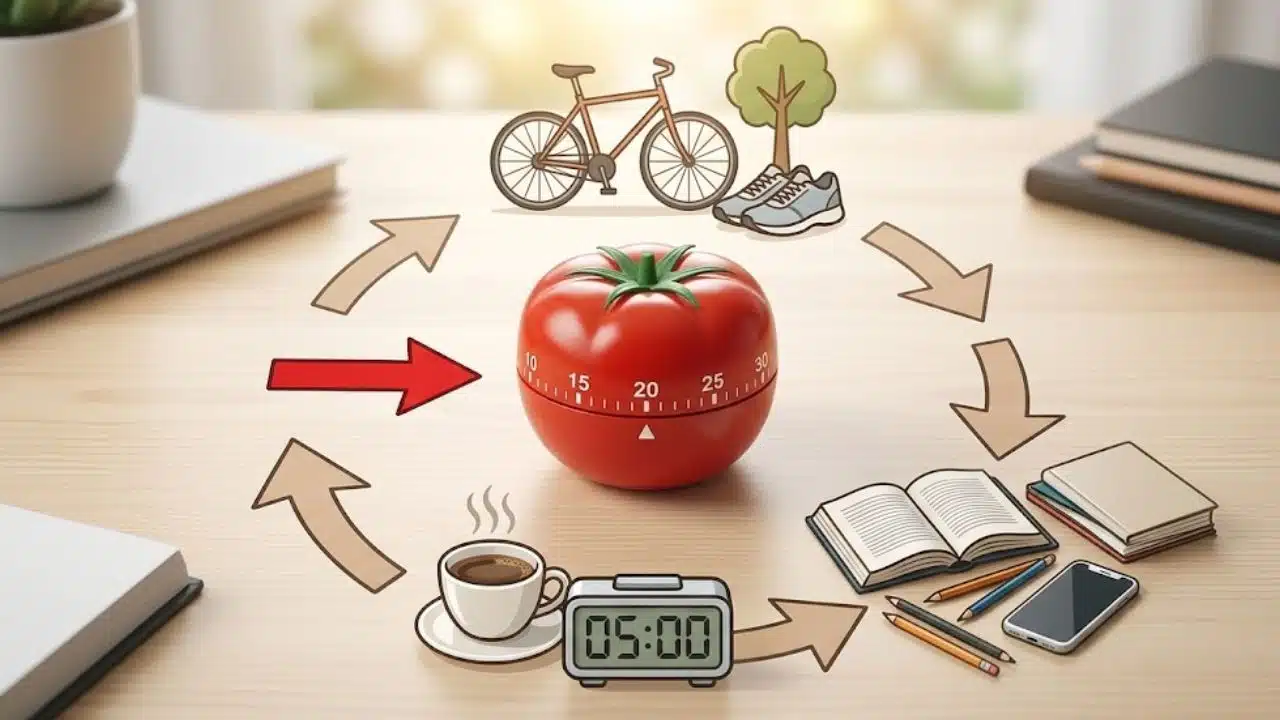
Pomodoro Technique can make an avoided task feel less intimidating. It can also turn into a relentless scoreboard: finish one timer, rush the break, start another, then feel unproductive because the daily count looks low. Using the Pomodoro Technique without burnout means refusing that second version. The timer should protect attention and recovery, not push work into every available hour.
The familiar 25-minute work period and five-minute break are a starting structure. They are not a universal law of concentration. Useful timing changes with the task, the person’s energy, and the interruptions that come with work, study, or caregiving.
More Than a Timer
Francesco Cirillo created the Pomodoro Technique as a wider time-management system. The standard sequence is simple: select one task, work for 25 minutes, record the session, and take a five-minute break. After four rounds, take a longer break of roughly 15 to 30 minutes.
Cirillo’s current materials also emphasize daily planning, effort estimates, interruption management, and review. Those parts are easy to overlook, but they make the timer useful. Planning is central to a Pomodoro Technique without burnout because it connects each session to a result instead of a quota.
“Work on the report” is too vague. “Draft the opening and list three findings that need evidence” gives the session a boundary. A student can replace “study chemistry” with “review one section and answer five practice questions.” If a task is too large for one interval, decide which visible piece will move forward.
What Research Actually Shows
A 2022 systematic review and meta-analysis combined 22 independent study samples from 19 publications, covering 2,335 participants. Micro-breaks of up to 10 minutes produced small improvements in vigor and fatigue, but no statistically significant improvement in overall performance. Longer breaks were associated with better performance, and demanding cognitive work might need more than a brief pause.
Direct evidence on Pomodoro timing remains limited. A 2025 study compared Pomodoro, Flowtime, and self-regulated breaks in a two-hour online session involving 94 university students. It found no significant group differences in overall productivity, task completion, flow, fatigue, or motivation. Motivation declined faster with Pomodoro and Flowtime, while fatigue rose faster with Pomodoro.
The study was short, student-only, and partly based on self-reported measures. It cannot prescribe a focus interval for everyone. It supports a cautious principle: a Pomodoro Technique without burnout treats 25/5 as a pattern to test, not a rule to defend.
Adjust the Pomodoro Technique without Burnout
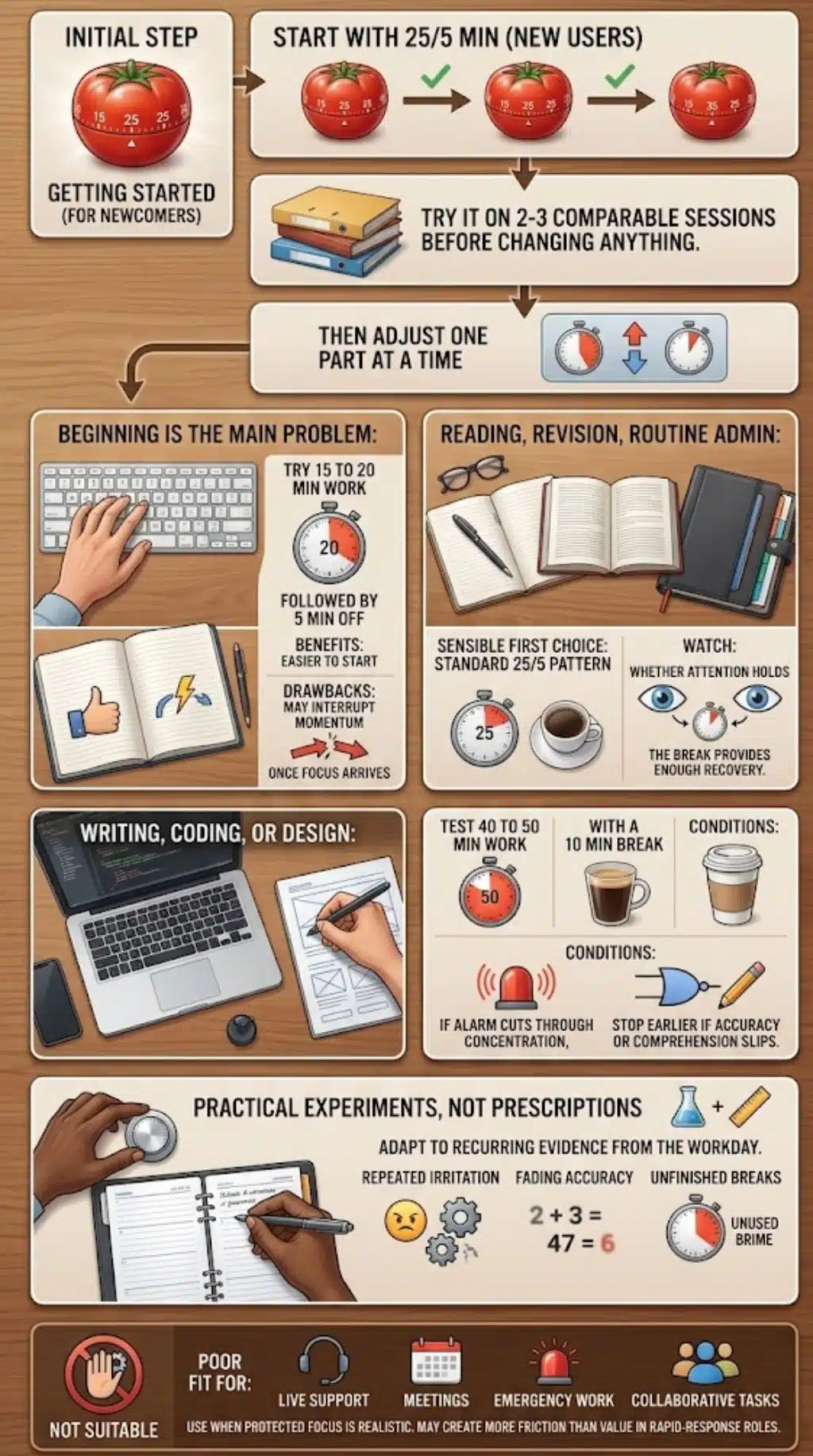
Start with 25/5 if the method is new. Try it on two or three comparable sessions before changing anything. Then adjust one part at a time.
- When beginning is the main problem: Try 15 to 20 minutes of work followed by five minutes off. It is easier to start, though it may interrupt momentum once focus arrives.
- For reading, revision, or routine administration: The standard 25/5 pattern is a sensible first choice. Watch whether attention holds and the break provides enough recovery.
- For writing, coding, or design: Test 40 to 50 minutes with a 10-minute break if the alarm repeatedly cuts through concentration. Stop earlier if accuracy or comprehension slips.
These are practical experiments, not established prescriptions. A Pomodoro Technique without burnout should adapt to recurring evidence from the workday. One difficult afternoon proves little, but repeated irritation, fading accuracy, or unfinished breaks signals a poor fit.
Timed intervals fit live support, meetings, emergency work, and some collaborative tasks poorly. Use them when protected focus is realistic. In a rapid-response role, they may create more friction than value.
Make Breaks Real
Email, Slack, and “one quick task” keep the mind in work mode. A useful break changes both posture and attention. Stand up, walk briefly, refill water, stretch comfortably, or look away from the screen. Avoid activities that are difficult to stop; a social feed can easily consume the next work period.
After four rounds, take the longer break rather than immediately starting another set. Food, medication, prayer, movement, and bathroom needs should not be postponed to protect a timer streak. In a Pomodoro Technique without burnout, breaks are part of the schedule, not rewards earned through enough work. If five minutes repeatedly feels insufficient, extend it. Demanding tasks may need more recovery.
Track Work, Not Self-Worth
Pomodoro totals are weak measures of output. Four sessions spent tracing a difficult software bug cannot be compared fairly with four sessions of routine data entry. Meetings, customer requests, caregiving, and low-energy days also change what a realistic total looks like.
Record only what improves future planning: the task, the sessions required, major interruptions, and whether the interval felt too short or too long. Review the pattern weekly. A Pomodoro Technique without burnout uses session counts to improve estimates, not rank good and bad days.
Streaks and badges are optional. Disable them if they create guilt or encourage unnecessary work. A phone, browser, or kitchen timer is enough for most people; a dedicated app is worth considering only when task history, distraction blocking, or synchronization solves a specific problem.
Handle Interruptions Calmly
Keep a small “later” list beside the current task. When you remember a bill, want to search for something, or think of another assignment, write it down and return. This keeps the thought from becoming an open browser tab and a ten-minute detour.
For an urgent matter, stop the timer and deal with it. Restart when conditions allow. The method must leave room for responsibilities that cannot wait; one interruption does not invalidate completed work.
A Timer Cannot Fix Burnout
Burnout is more serious than feeling tired after a focused afternoon. The World Health Organization describes it as an occupational phenomenon resulting from chronic workplace stress that has not been successfully managed. Its three dimensions are exhaustion, greater mental distance or cynicism toward one’s job, and reduced professional efficacy. WHO does not classify burnout as a medical condition, and this definition applies specifically to work.
A timer may improve pacing. It cannot correct an unreasonable workload, constant after-hours demands, unsafe conditions, or a lack of control. Persistent exhaustion, detachment, sleep problems, or difficulty functioning calls for attention beyond a productivity adjustment. Depending on the circumstances, that may include a workload discussion with a manager or educator and support from a qualified health professional.
The distinction is important. A Pomodoro Technique without burnout can remove avoidable timer pressure, but it cannot replace changes to harmful working conditions or serve as treatment.
Run a One-Week Test
For the first two days, use 25/5 on one or two suitable tasks. After each round, note what moved forward, how focused you felt, and whether the break was sufficient. On days three and four, adjust either the work period or the break—not both. Use the remaining days to match different patterns to different kinds of work.
Set a finishing time before the first session starts. Otherwise, efficient intervals can quietly expand into an unlimited workday. By the end of the week, a Pomodoro Technique without burnout should be easier to begin, sustain, and stop. Keep only the rules that support those outcomes.
Final Thoughts
Start with one avoided task, two focus periods, and a protected stopping time. That is enough to learn whether the method helps. A Pomodoro Technique without burnout should make work easier to enter and easier to leave. If the timer adds strain or hides a deeper workload problem, adjust it—or put it away.
Frequently Asked Questions (FAQs)
Do I need a Pomodoro app?
No. Any reliable timer works. Pay for an app only if task history, blocking, or syncing solves a clear problem; features and prices can change.
Should I stop the moment the timer rings?
Finish the sentence, save the file, or leave a brief note showing where to resume. Do not let every 25-minute period become an unplanned 40-minute session. If the alarm consistently arrives too early, choose a longer interval before starting the next round.
Can Pomodoro help someone with ADHD?
Research reviewed here does not establish Pomodoro as an ADHD treatment. A visible timer may help some people, while rigid alarms may distract others. Adjust the method, and seek professional guidance when symptoms impair work, study, or daily life.