
Learning how to measure personal productivity sounds straightforward until the measurement starts changing the way we work. Hours become something to accumulate. Small tasks become attractive because they are easy to complete. A long streak begins to matter more than the result it was meant to support.
I do not think the answer is to stop measuring productivity. Tracking can reveal patterns that memory and intuition miss. The problem begins when a useful signal becomes a score we feel compelled to maximize.
A more honest approach is to measure a small combination of outcomes, quality, process, sustainability and context. No single number can capture these reliably across every kind of work.
What Personal Productivity Actually Means
Productivity is traditionally understood as output relative to input. That works reasonably well when both sides can be counted, such as units produced per hour. Personal and knowledge work is rarely that tidy.
A writer can produce thousands of words that are not publishable. A manager can attend meetings all day without resolving the problem holding up a project. A student can spend six hours reading and remember little the following week. The activity is real, but its value is uncertain.
I find this working definition more useful: Personal productivity is meaningful progress toward an intended outcome, completed at an acceptable level of quality, with a reasonable and sustainable use of time and attention.
Each part protects the measurement from a different weakness:
- Meaningful progress prevents trivial tasks from carrying the same weight as important work.
- Intended outcomes connect activity to a real purpose.
- Acceptable quality exposes errors, shortcuts and incomplete work.
- Reasonable use of resources keeps efficiency visible.
- Sustainable effort recognizes that today’s output should not destroy tomorrow’s capacity.
This definition is less convenient than counting tasks, but it is much harder to fool.
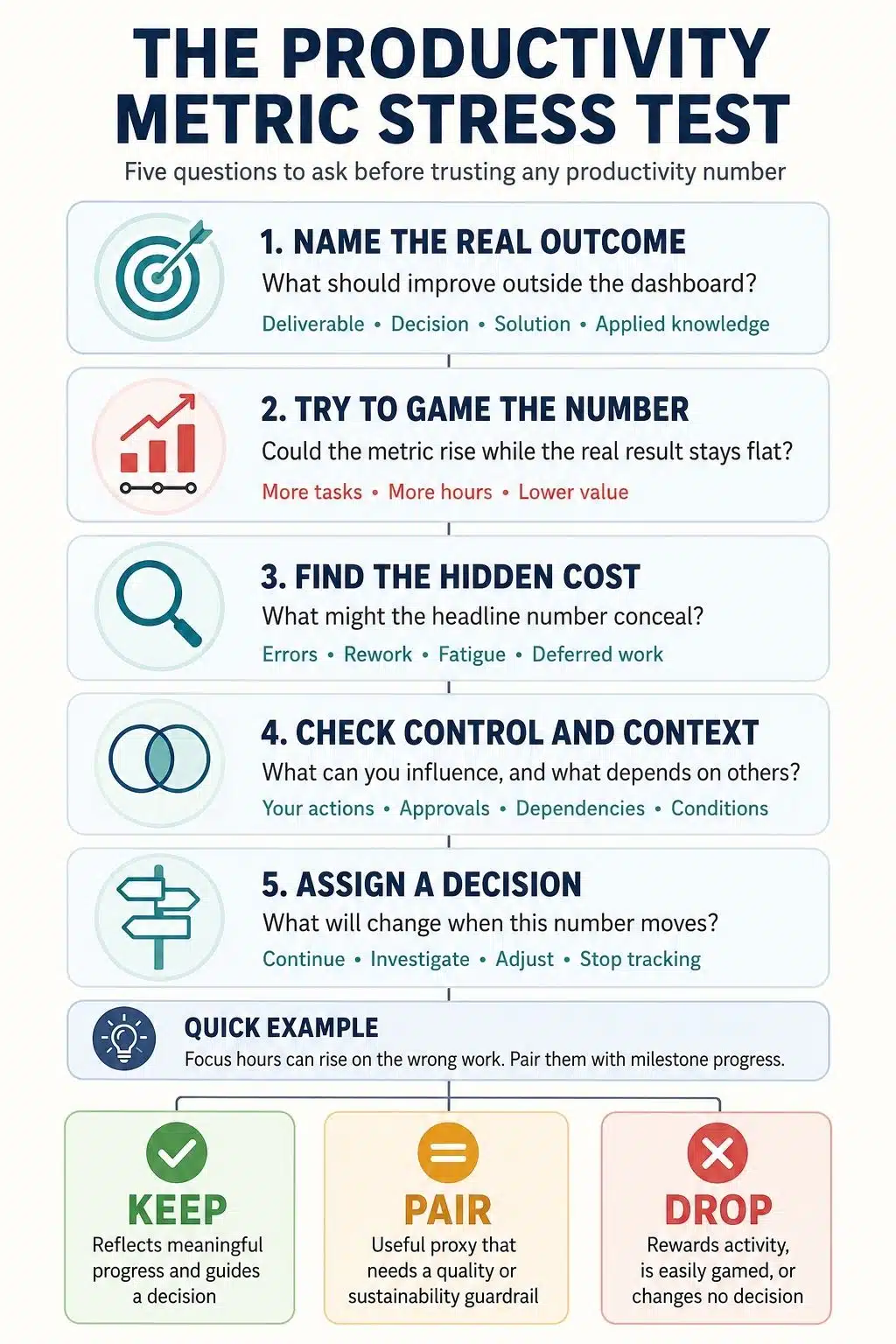
Why Common Productivity Metrics Mislead Us
Most productivity metrics are not useless. They are simply incomplete.
- Hours worked: It shows how much time I used, not whether I used it well. Hours can help with billing, workload planning and identifying where time disappears, but they remain an input.
- Tasks completed: It treats “reply to an email” and “finish the financial analysis” as equivalent units. A high completion count can hide the fact that the most important task never moved.
- Focus hours: This indicates protected concentration, but they do not reveal whether I focused on the right problem. Quietly polishing an unnecessary detail is still unnecessary work.
- Words, calls, messages and commits: It describes activity within particular roles. More words do not guarantee a better article, just as more sales calls do not guarantee better prospects.
- Streaks: This can support consistency, but they can also punish reasonable flexibility. When protecting a streak becomes more important than responding to illness, changing priorities or recovery needs, the metric has taken control.
The same problem appears in all these examples: the metric records one visible part of the work and quietly ignores the rest.
How We End Up Gaming Our Own Metrics
Gaming a metric means improving the number without producing an equivalent improvement in the underlying goal. It does not always involve deliberate dishonesty.
I may choose an easy task because I want the satisfaction of marking something complete. I might continue working after the useful work is finished because stopping would reduce my recorded hours. I could postpone an important project because its progress will be slow, uncertain and difficult to display.
Common forms of personal metric gaming include:
- Dividing one task into several smaller entries.
- Prioritizing work that is easy to measure.
- Lowering the definition of “done.”
- Counting the same result in multiple categories.
- Ignoring corrections or future rework.
- Excluding difficult days from the record.
- Choosing a convenient target after seeing the result.
- Sacrificing rest to preserve a streak.
- Completing work that looks productive while postponing work that matters.
Goodhart’s Law is often summarized as the idea that a measure can lose its usefulness once it becomes a target. The point is not that every target will fail. The warning is that people begin adapting their behavior to whatever the system rewards.
The solution is not to search for a magical, ungameable metric. It is to make the hidden trade-offs visible.
The Five Parts of an Honest Productivity Measure
Honest productivity measures include one meaningful outcome, one quality guardrail, one useful process signal and whether the pace is sustainable. Record important context, review the measures weekly and never combine them into a single productivity score.
1. Start With the Intended Outcome
Before choosing a metric, I ask a more important question: What should be different when this work is successful?
A useful answer describes a result or observable milestone:
- The proposal is ready for a decision.
- The article is accurate, edited and submitted.
- The customer’s problem is resolved.
- The project has passed an agreed milestone.
- I can recall and apply the material without consulting my notes.
“Work on the proposal” is an activity. “Submit the proposal for approval” is an outcome.
For longer projects, intermediate milestones are better than repeatedly marking the work as “in progress.” Completing the research, securing approval or producing a usable first version can each provide meaningful evidence of movement.
Some outcomes depend partly on clients, colleagues, markets or algorithms. In those situations, I separate my contribution from the final result. A writer controls research quality and delivery, but not every editorial decision or change in search traffic.
2. Add a Quality Guardrail
Every quantity metric needs something that reveals whether quality is deteriorating.
Depending on the work, that guardrail might be:
- Errors or corrections.
- Revision rounds.
- Reopened tasks.
- Failed acceptance criteria.
- Returns or complaints.
- Client or editor approval.
- Accuracy on a delayed test.
- Rework created for the following week.
Quality does not always need a numerical score. A short checklist or clear acceptance standard can be enough.
If I finish quickly but someone has to redo the work, the speed metric should not be allowed to declare an uncomplicated success.
3. Track One Useful Process Signal
Outcomes can take time to appear, and some depend on factors outside my control. A process measure can show whether I performed an action likely to support the intended result.
Useful process signals include:
- Completing a planned research session.
- Starting the highest-priority task before reactive work.
- Practising retrieval instead of simply rereading notes.
- Sending required information before a deadline.
- Recording a decision and its next action.
- Limiting the number of unfinished projects.
Research supports progress monitoring as a self-regulation tool. A meta-analysis of 138 randomized studies involving almost 20,000 participants found that encouraging people to monitor their progress improved goal attainment on average.
That does not mean every action needs to be logged. A process metric earns its place only when it helps me decide what to continue, change or stop.
4. Check Whether the Pace Is Sustainable
A system is not truly productive if it produces impressive results for one week and leaves me unable to maintain the pace.
A sustainability check can look for:
- Repeated late work.
- Rising fatigue.
- Declining concentration.
- Errors linked to exhaustion.
- Work consistently spilling into protected personal time.
- A pace that cannot continue without a recovery period.
Research on time management also supports this broader view. Its relationship with well-being appears at least as important as its relationship with performance.
I would use sustainability measures as boundaries, not as another set of scores to maximize. The purpose is to notice when the method is consuming more capacity than it creates.
5. Record Relevant Context
Numbers lose meaning when separated from the conditions that produced them.
A delayed outcome may reflect missing information, illness, care responsibilities, emergency work, a changed deadline or dependence on another team. Recording that context is not the same as making excuses. It helps distinguish a personal execution problem from a system problem.
This matters particularly in collaborative work. A team result cannot always be divided accurately among individual contributors. In those cases, it is more honest to record my contribution separately from the shared outcome.
Match the Metric to the Work
Different kinds of work require different evidence. A universal productivity score would flatten those differences.
| Type of work | Weak headline metric | Better result measure | Quality guardrail |
| Writing | Words written | Publishable section or article completed | Corrections and revision required |
| Management | Meetings attended | Decision made or blocker removed | Reopened decisions or stakeholder confusion |
| Studying | Hours spent reading | Ability to recall and apply the material | Errors on delayed self-testing |
| Software development | Commits or lines of code | Useful change delivered or problem resolved | Defects, rollback and rework |
| Sales | Calls or emails sent | Qualified opportunity, sale or renewal | Returns, churn and poor-fit customers |
| Freelance work | Billable hours alone | Accepted client deliverable | Revision rounds and client acceptance |
The pattern remains consistent: activity can help explain a result, but it should not replace the result.
How to Make Productivity Metrics Harder to Game
- Define “done” in advance: Decide what evidence will count as completion before seeing the result. Otherwise, it is easy to lower the standard and call unfinished work complete.
- Pair a metric with its likely cost: Track speed with quality, output with rework and focus time with milestone progress.
- Observe a baseline first: A short observation period reveals normal variation before an arbitrary target begins influencing behavior.
- Use ranges where possible: Some measures only need to reach an adequate level. Once I have enough protected time to complete the important work, maximizing focus hours further may add little value.
- Review trends, not isolated days: Weekly or rolling patterns reduce the temptation to treat one unusually good or bad day as a complete judgment.
- Compare against a relevant personal baseline: Cross-person comparisons become unreliable when responsibilities, support, tools and task complexity differ.
- Keep a qualitative check: Ask what the numbers missed, what improved without creating real value and what future cost the current output produced.
- Retire unhelpful metrics: Stop tracking a number when it no longer changes a decision, encourages the wrong behavior or costs more attention than the insight is worth.
What the Numbers Cannot Capture
Even a balanced system will miss part of the story. It may undervalue preventing a problem, helping a colleague, learning from an unsuccessful attempt or thinking through a decision that should not be rushed. Maintenance often looks uneventful precisely because it worked. Creative work may not reveal its value until much later.
That is why an honest review still needs human judgment. One useful question is: What important contribution did the numbers fail to show? This is not permission to ignore evidence. It is a reminder that evidence and judgment work together.
When Tracking Becomes the Productivity Problem
Measurement has gone too far when:
- Organizing the system takes substantial time away from the work.
- I avoid valuable activities because they are difficult to count.
- My mood depends on maintaining a daily score or streak.
- I keep changing definitions to protect the numbers.
- The dashboard grows, but my decisions do not improve.
- I spend more time proving that I worked than examining what the work achieved.
At that point, the answer is not another app or a more complicated formula. I would reduce the system to one meaningful outcome, one quality check and one next decision.
Measure for Better Decisions, Not Better Scores
The purpose of measuring productivity is not to produce a flattering record of activity. It is to understand whether my time and attention are helping me create results that matter.
A useful metric should reveal a problem, confirm progress or guide an adjustment. It should leave room for quality, context and recovery. Most importantly, it should never become a substitute for judgment.
That is how I approach measuring personal productivity without gaming the metrics: keep the system small, connect it to meaningful outcomes and remain willing to question the numbers themselves.
Frequently Asked Questions on How to Measure Personal Productivity
1. What is the best way to measure personal productivity?
Measure progress toward a meaningful outcome, then check the quality of the result, the process that supported it and whether the pace was sustainable. Avoid depending on one score.
2. How many productivity metrics should I track?
There is no universal number. Start with a few signals covering outcome, quality, process and sustainability. Remove any measure that does not help you make a decision.
3. Should I track the number of hours I work?
Hours can help diagnose workload, estimate effort or support billing. They should not be treated as proof of productivity because they measure time used, not value created.
4. How often should I review my productivity?
A brief daily record can capture useful details, but a weekly review is usually better for judging meaningful progress. Longer projects may also benefit from a monthly outcome review.
5. Can a productivity app calculate my real productivity?
An app can record time, tasks, habits and activity. It cannot reliably decide which work mattered, whether the quality was acceptable or whether the result justified the effort. Those decisions still require human judgment.