Joint media engagement happens when a child and another person watch, play, read, listen to, search, or create media together. The important word is engagement. Sharing a room or looking at the same screen is not necessarily the same as sharing the experience.
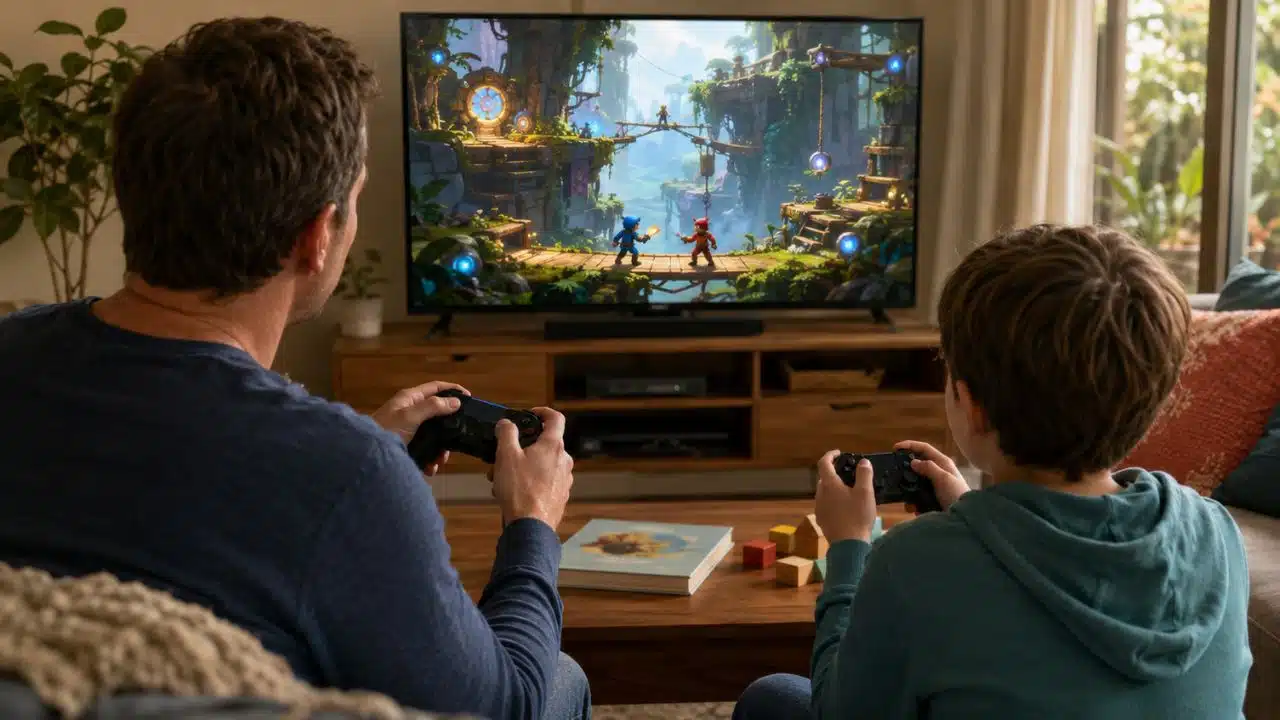
Co-playing is one of the most active forms of joint media engagement. Instead of leaving a child to navigate a game alone, a parent, caregiver, teacher, sibling, or other trusted person joins in. They might play as a team, take turns, discuss decisions, offer help, or simply pay close attention to what the child is doing.
I do not think every moment of screen use needs to become an educational exercise. Children should be allowed to play because they enjoy it. Still, there is a meaningful difference between treating a game as a digital babysitter and occasionally stepping into that world with genuine interest.
What Does Joint Media Engagement Really Mean?
Joint media engagement, often shortened to JME, grew from the older idea of co-viewing television. As digital media became more interactive, watching together was no longer a broad enough description.
JME can now include:
- Watching and discussing a program
- Playing a video game together
- Taking turns with an app
- Sharing an e-book
- Listening to a podcast
- Searching for information
- Creating digital art, music, stories, or videos
- Connecting media with an offline activity
It can be planned, such as a weekly family gaming session, or spontaneous. A child might ask an adult to help with a level, explain a favorite character, or show how something works.
The interaction can also continue after the screen is turned off. Talking about a game, recreating something from it, or applying an idea to real life can all extend the shared experience.
Co-Viewing and Co-Playing Are Not the Same
Co-viewing usually means watching the same content together. A parent and child might sit beside each other during a film without discussing it. That shared presence can still be enjoyable, but the interaction may remain limited.
Co-playing asks more from both people. Games require decisions, responses, movement, strategy, or cooperation. This creates natural openings for conversation and shared problem-solving.
Researchers sometimes distinguish between basic and active joint media engagement. Basic engagement may involve watching or using media together with little conversation. Active engagement includes discussion, encouragement, explanation, turn-taking, or collaboration.
This does not mean an adult must talk through every second of a game. Constant questions can become distracting. Active engagement is about responding when there is something useful to add, while still giving the child room to think and play.
Why Co-Playing Matters
I see co-playing as more than sitting beside a child while a game runs. When adults participate without taking over, games can create natural opportunities for conversation, problem-solving, teamwork, and connection while helping them understand what the child is experiencing on screen.
It turns media into common ground
Children’s digital interests can be difficult to understand from the outside. A game may appear repetitive or confusing until the child explains what they are building, collecting, solving, or trying to achieve.
Once an adult joins, both people have a shared point of reference. They have seen the same challenge, decision, character, or unexpected result. This can make conversation feel more natural than broad questions such as, “What did you play today?”
For some children, particularly older ones, talking while doing something together can feel easier than sitting down for a direct conversation.
It allows adults to support without taking over
Children may need help understanding instructions, using controls, solving a puzzle, or handling the frustration of repeated failure. Joint play gives an adult an opportunity to provide that support at the moment it is needed.
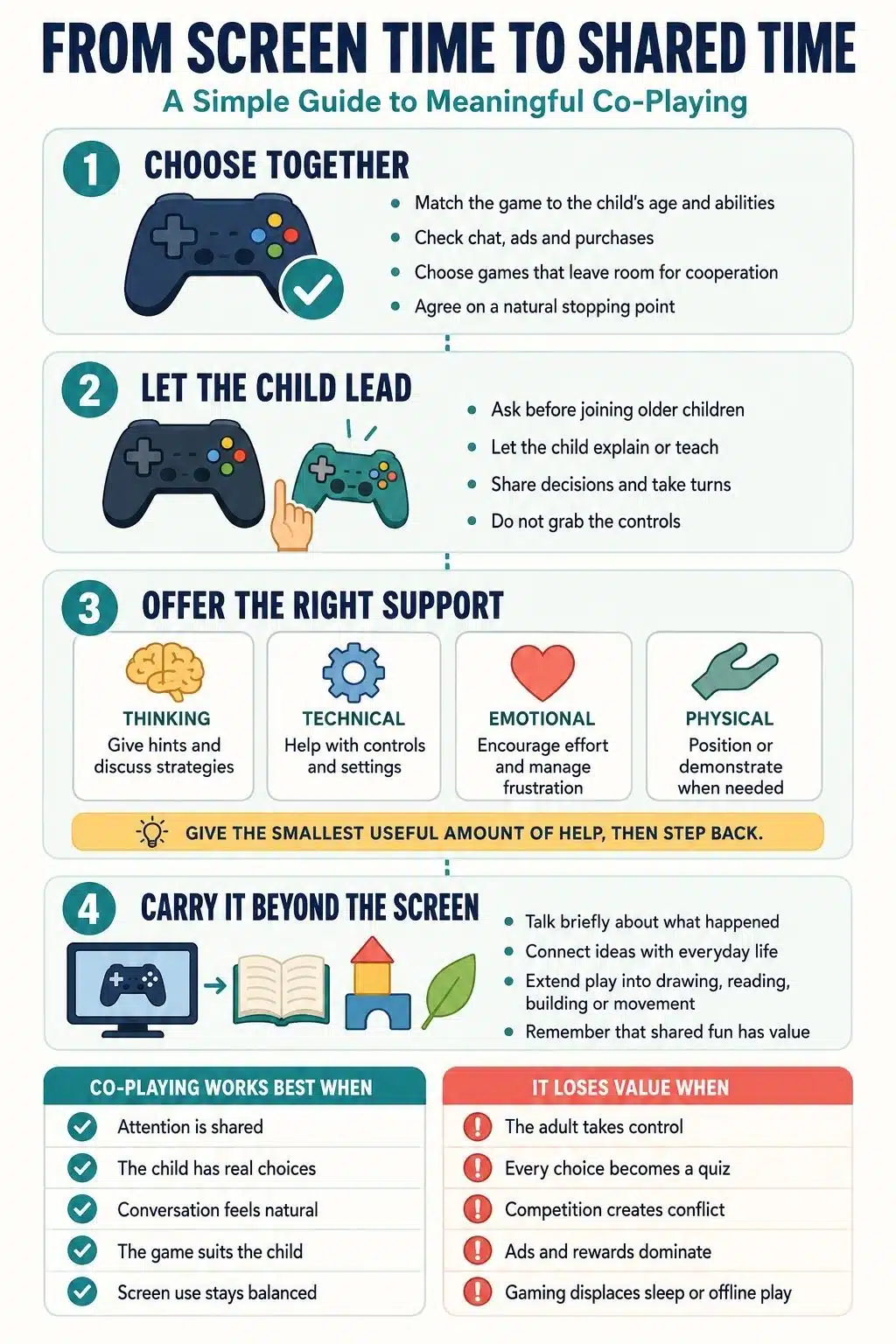
Support can take several forms:
- Cognitive support: explaining an idea, offering a hint, or helping the child compare possible solutions
- Technical support: helping with controls, menus, settings, or navigation
- Physical support: positioning a device or demonstrating a movement
- Emotional support: encouraging the child, naming frustration, or helping them recover from a mistake
The goal is not to remove every difficulty. Struggle is often part of learning and play. I would offer the smallest useful hint, allow another attempt, and step back when the child no longer needs help.
Taking over the controller may solve the immediate problem, but it can also take away the child’s chance to solve it.
It can improve learning from some media
Research suggests that adult-child media use can support learning, especially for younger children. A 2024 meta-analysis covering 17 studies and 1,288 children found a small positive relationship between adult participation and learning from digital media.
The word small matters. Co-playing can improve the conditions for learning, but it does not transform every app or game into an educational tool.
A separate review of 44 studies found generally favorable results for task performance and language development. Findings related to broader cognitive and social-emotional development were mixed.
The most accurate conclusion is that joint media engagement may support learning when the content is appropriate and the adult participates constructively. The child’s age, the difficulty of the task, the quality of the media, and the nature of the interaction all influence what happens.
It helps connect screens with real life
Young children can struggle to apply something seen on a two-dimensional screen to a real object or situation. They may recognize a shape or action in a game but fail to use that knowledge away from the device. An adult can help build the connection.
After a sorting game, a parent might sort socks or toys with the child. A game about animals could lead to a library book or a walk outside. A story about friendship might open a conversation about something that happened at school.
Research involving young children has found that adult support can improve learning from screen-based demonstrations. However, children may still learn more effectively from direct, hands-on demonstrations.
That limitation is important. Digital play can inspire real-world learning, but it should not replace direct experience.
It gives children a place to practise cooperation
A well-designed cooperative game can require players to divide responsibilities, explain plans, listen to each other, wait for a partner, and recover from mistakes.
The game does not automatically teach these skills. The players’ behavior determines whether the experience becomes cooperative or chaotic.
An adult can model how to disagree without becoming hostile, how to respond when a plan fails, and how to let another player contribute. A child can practise asking for help, explaining an idea, or adjusting a strategy.
Competitive games can offer useful lessons too, particularly around fairness and handling disappointment. However, they may not be the right choice when competition repeatedly causes arguments or when one player’s skill advantage makes the experience frustrating.
It can create meaningful family time
Research has found associations between family co-playing, satisfaction, and feelings of closeness. That does not prove video games automatically strengthen relationships. Families that already enjoy spending time together may simply be more likely to play together.
I see co-playing as a setting in which connection can develop. The controller itself does not create the bond. The laughter, attention, teamwork, and conversation do.
A level completed together can become part of a family’s shared history, much like a favorite board game, film, or bedtime story.
Children Can Be the Experts
Adults are not always the most skilled players. A school-age child may understand the controls, strategies, characters, and gaming culture far better than the parent. That role reversal can be valuable.
When an adult asks a child to explain the game, the child has to organize their thoughts and communicate clearly. It also shows that their knowledge and interests deserve attention.
The parent can still guide conversations about behavior, balance, privacy, purchases, and online safety without pretending to understand everything.
With older children and teenagers, I would ask before joining. Co-playing works better when it feels like sincere interest rather than disguised surveillance.
Co-Playing Helps Adults See the Full Experience
A game’s title, screenshots, or “educational” label cannot reveal everything about it. Joining the child helps an adult notice:
- What behavior the game rewards
- How it handles mistakes and failure
- Whether advertisements interrupt play
- How strongly it promotes purchases
- Whether it uses streaks, timers, or endless rewards to prolong sessions
- Whether children can communicate with strangers
- What personal information it requests
- Whether the difficulty suits the child
- How the child feels before, during, and after playing
Parental controls remain useful, but they cannot replace understanding. Occasional co-playing gives adults information that settings and time limits alone may not provide.
How to Co-Play Without Taking Control
Good co-playing does not require a complicated routine.
Before starting, check the game’s age rating, content, communication features, advertisements, and purchase settings. Agree on a session length or a natural stopping point, such as the end of a round or level.
While playing:
- Let the child make meaningful choices.
- Ask occasional open questions.
- Offer hints before giving answers.
- Take turns fairly.
- Notice effort and strategy, not only winning.
- Allow quiet moments for concentration.
- Model a calm response to losing or making mistakes.
- Let the child teach when they know more.
Useful questions might include:
- “What are we trying to do?”
- “Why did you choose that?”
- “What could we try next?”
- “Can you show me how this works?”
- “Was that reward fair?”
- “How do you think that character feels?”
These questions should feel like part of the game, not a test. If the child has to explain every choice, play quickly starts to feel like homework.
Afterward, a brief conversation may be enough. Ask what was enjoyable, difficult, surprising, or unfair. If the content lends itself to something offline, follow that connection. Draw a character, build a level with blocks, look up an unfamiliar animal, or act out part of the story.
Not every session needs an extension. Sometimes shared fun is enough.
How Co-Playing Changes With Age
Young children generally need more direct support. Adults can name objects and actions, explain simple cause and effect, connect screen content with familiar experiences, and choose media with a manageable pace.
For early elementary children, the adult can shift toward being a partner. Turn-taking, cooperative challenges, and strategy discussions become more appropriate. This is also a useful age for introducing conversations about advertising, purchases, fairness, and online behavior.
Older children and teenagers usually need more autonomy. The adult’s role is less about explaining the game and more about listening, showing interest, and remaining available for conversations about digital choices.
The strongest research on learning-related JME focuses on young children. Claims about older children should therefore center more carefully on communication, trust, shared interests, and media guidance.
When Co-Playing Does Not Help
Joint media engagement is not automatically positive. It can become counterproductive when the adult:
- Corrects every minor mistake
- Takes over whenever the child struggles
- Turns the entire session into a lesson
- Criticizes the child’s interests
- Talks so much that the child cannot concentrate
- Uses the activity primarily to monitor or interrogate
- Becomes overly competitive
- Pays more attention to another device
The design of the media also matters. Studies comparing digital activities with books, toys, and other forms of play have produced mixed results. In some cases, adults and children talked less during digital activities or spent more time discussing the device than the actual story or idea.
Small screens, distracting animations, constant sound effects, advertisements, and automated prompts can draw attention away from the people who are supposed to be playing together.
An adult’s presence cannot rescue poor content. It does not remove manipulative design, inappropriate material, privacy risks, or pressure to spend money.
Co-playing may improve the quality of a media experience, but it is still screen use. It should not consistently displace sleep, movement, face-to-face conversation, school responsibilities, friendships, outdoor activities, or imaginative play.
Current pediatric guidance encourages families to look beyond a single screen-time number. The American Academy of Pediatrics uses five considerations: the child, the content, the use of media for calming, what media may be crowding out, and family communication.
I find this more useful than treating every minute of screen use as identical. A cooperative game played with a caregiver is different from an hour of unattended autoplay. Still, a positive digital experience does not remove the need for other activities.
Families will not be able to join every gaming session, and they should not be made to feel guilty about that. Adults have work, household responsibilities, and their own need for rest. They can still stay involved by selecting appropriate content, checking in occasionally, or discussing the experience later.
The aim is meaningful involvement, not perfect supervision.
I see joint media engagement as a practical middle ground between treating screens as harmless babysitters and treating them as enemies of childhood. Digital media are already part of many children’s lives. The more useful question is how adults can help children use them thoughtfully.
Co-playing matters because it gives an adult a chance to enter the child’s digital world, understand what is happening there, and turn some screen time into shared time. It cannot make every game educational or remove every risk. But with suitable content, responsive participation, and room for the child to lead, it can add something no device can provide by itself: a meaningful human connection.
Frequently Asked Questions on Joint Media Engagement
1. Is joint media engagement the same as co-viewing?
Not exactly. Co-viewing usually means watching content together. Joint media engagement is broader and can include playing, reading, listening, searching, discussing, and creating with media.
2. Do parents need to understand video games before co-playing?
No. Asking a child to explain the controls or teach the game can become a valuable part of the interaction. Genuine interest matters more than expertise.
3. Does co-playing still count as screen time?
Yes. Sharing the game may improve the quality of the experience, but it does not stop it from being screen use. Sleep, movement, offline play, and other responsibilities still need protection.
4. Are cooperative games better than competitive games?
Cooperative games often make teamwork easier, but competitive games are not necessarily harmful. The better choice depends on the child’s temperament, skill level, age, and response to winning or losing.
5. Does an adult need to join every gaming session?
No. Regular, meaningful involvement is more realistic than constant participation. An adult can play occasionally, watch for a few minutes, help choose content, or discuss the game afterward.