
Predictions About AI Worth Taking Seriously ignore dramatic timelines and focus on real business drivers: operating costs, security limits, regulatory shifts, and infrastructure capacity. For leaders making budget, product, or team decisions, future-proof strategy relies on practical constraints rather than sci-fi hype.
These 10 pragmatic AI predictions focus on structural shifts over the next three to five years, highlighting clear directions to guide what your organization should buy, build, and measure right now.
What Neat AI Forecasts Usually Miss
A capable model is only one component of a working system. A successful demonstration must still survive data restrictions, security testing, integration work, employee training, legal review, and the uncomfortable question of who is responsible when it fails.
That explains why adoption can look contradictory. A company may use AI extensively to summarize customer conversations but prohibit it from making hiring, credit, or medical decisions. Technical capability moves quickly; operational permission usually does not. Forecasts that ignore this gap tend to overstate both the speed and the uniformity of adoption.
10 Predictions About AI Worth Taking Seriously
These Predictions About AI Worth Taking Seriously are grounded in developments already shaping budgets, products, security, regulation, and work. Rather than guessing when a dramatic breakthrough might arrive, the list focuses on changes with practical evidence behind them and consequences for businesses deciding where to invest, prepare, or proceed cautiously.
1. AI Spending Will Face Much Harder ROI Tests
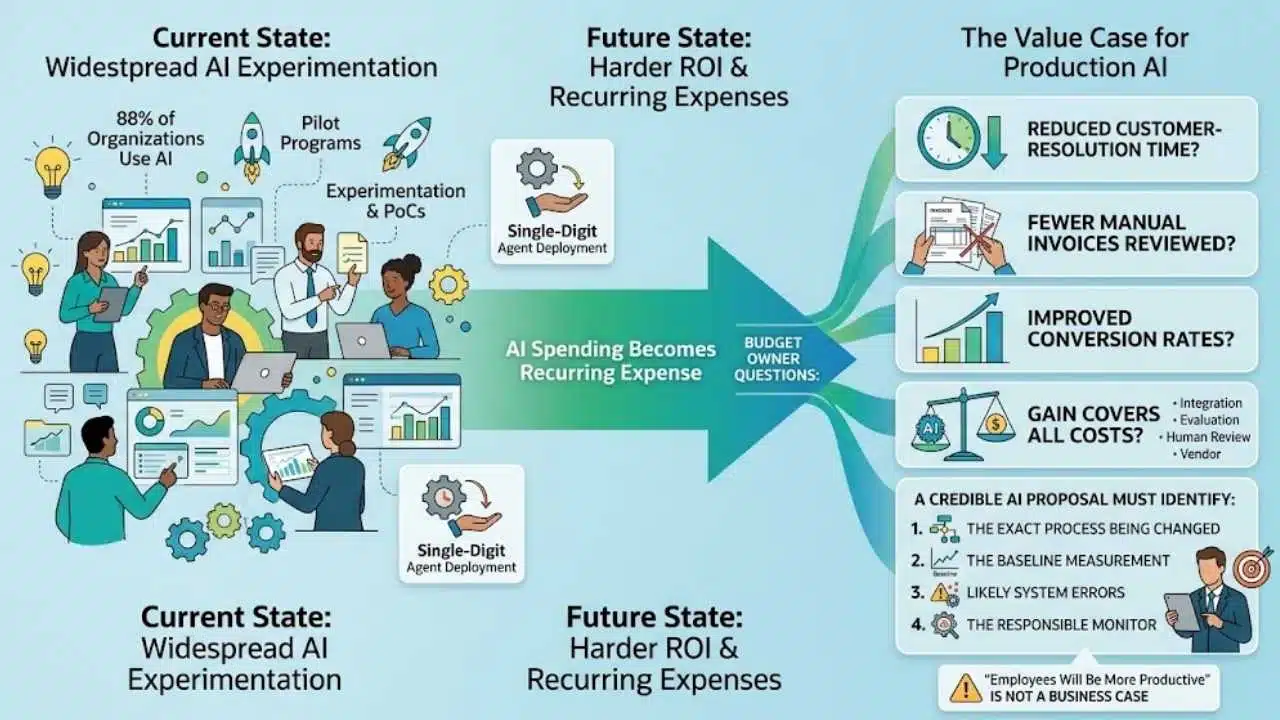
The 2026 Stanford AI Index reports that 88% of surveyed organizations used AI, while agent deployment remained in the single digits across nearly all business functions. Experimentation is widespread. Dependable production use is much less so.
As pilot programs become recurring expenses, budget owners will ask what changed after an AI system was introduced. Did customer-resolution time fall? Were fewer invoices reviewed manually? Did conversion rates improve? Was the gain large enough to cover integration, evaluation, human review, and vendor costs?
A credible AI proposal should identify:
- The exact process being changed
- The baseline against which improvement will be measured
- The errors the system is likely to make
- The person responsible for monitoring the result
“Employees will be more productive” is not a business case. Projects built on that level of vagueness may survive an innovation budget, but they will struggle during an ordinary financial review.
2. AI Agents Will Spread, but Most Will Remain Supervised
AI agents are improving at computer-based tasks. On the controlled OSWorld benchmark, agent accuracy reached 66.3%. That is meaningful progress, but it also leaves roughly one in three tasks unsuccessful. A benchmark cannot reproduce every ambiguous instruction, permission problem, outdated record, or malicious document found inside a company.
The more credible near-term model is bounded autonomy. An insurance agent might gather claim documents, identify missing information, and draft a case summary. Letting the same system reject the claim without review would introduce a different class of legal and financial risk.
Most serious deployments will therefore include approval gates, access limits, activity logs, spending caps, and ways to reverse actions. An agent that connects to everything may look impressive in a demonstration. In production, broad access is often a design flaw.
3. AI Governance Will Become Part of Ordinary Procurement
AI compliance is moving out of policy presentations and into vendor questionnaires, contracts, product specifications, and internal audits.
The EU AI Act became broadly applicable on August 2, 2026, although important high-risk requirements have later deadlines. Rules covering listed sensitive uses, including certain employment, education, biometric, and credit applications, apply from December 2, 2027. Requirements for AI embedded in regulated products apply from August 2, 2028.
Companies buying AI services will need clearer answers about where data is processed, which models receive it, whether prompts are retained, how outputs are tested, and how incidents are reported. Procurement teams should also ask whether a vendor can provide the documentation required for the buyer’s own risk assessment.
This is one of the predictions about AI worth taking seriously even for businesses that never train a model. Buying an AI-enabled recruitment, finance, healthcare, or education product does not automatically transfer every governance responsibility to the supplier.
4. Companies Will Use Portfolios of Models
The most capable model is often unnecessary for routine classification, extraction, or summarization. It may cost more, respond more slowly, or create approval problems when sensitive data is involved.
Companies will increasingly route straightforward requests to smaller models and reserve expensive systems for tasks that genuinely require stronger reasoning or larger context windows. Sensitive workloads may use private infrastructure or on-device processing, while lower-risk work remains in the public cloud.
Relying on one provider is convenient at the beginning and expensive when circumstances change. Prices, rate limits, model availability, and usage policies do not remain fixed. Products built with a replaceable model layer will age better than workflows tied tightly to one vendor.
5. Entry-Level Work Will Change Before Professions Disappear
The ILO estimates that 24% of jobs worldwide have some degree of exposure to generative AI. Exposure is not the same as elimination. Most occupations combine automatable tasks with work requiring context, accountability, physical action, or human interaction, making job transformation more likely than complete replacement.
The immediate pressure is likely to fall on tasks commonly assigned to junior employees: preparing basic reports, documenting code, processing forms, conducting preliminary research, and answering routine support questions.
This creates a problem that headcount forecasts often miss. Basic work is also how people learn to recognize poor work. If AI absorbs much of the apprenticeship layer, employers will need a new way to develop judgment.
Asking an inexperienced employee to verify a report they could not produce independently is not meaningful oversight. The entry-level training problem deserves more attention than sweeping predictions about entire professions disappearing.
6. Security Will Limit Agent Adoption More Than Intelligence
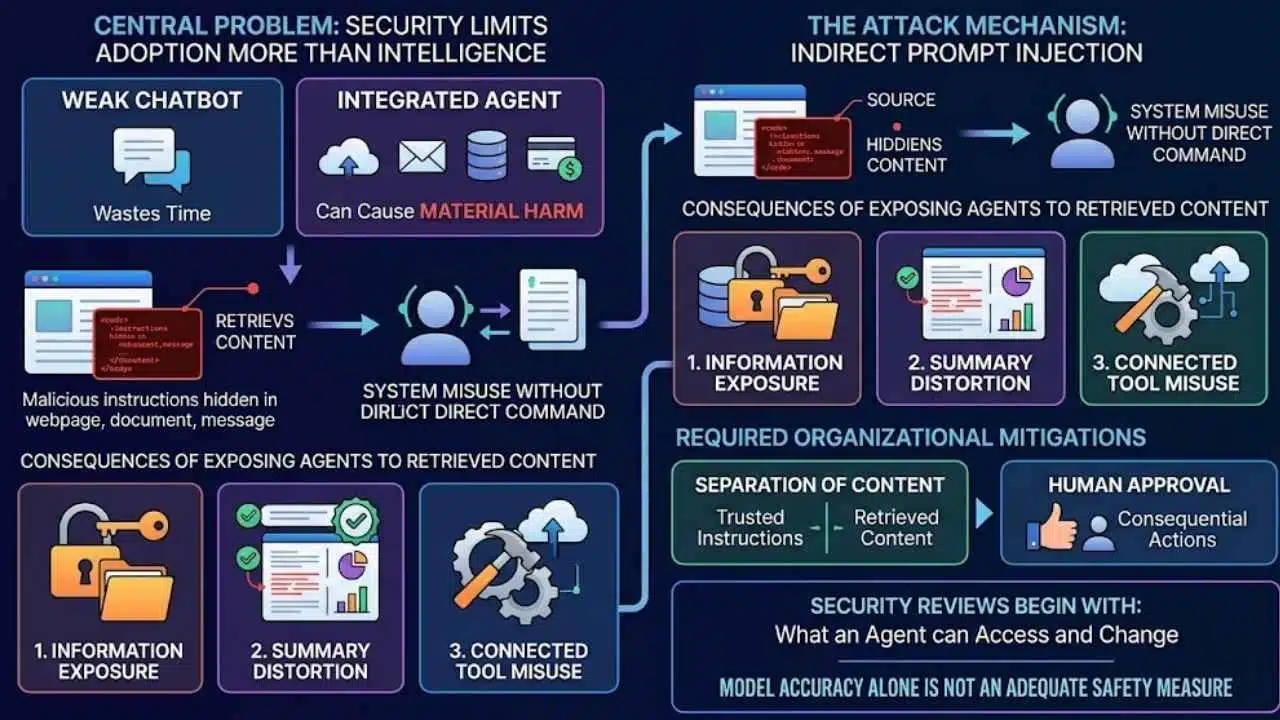
A chatbot that gives a weak answer wastes time. An agent connected to email, cloud storage, customer records, or payment tools can cause material harm.
NIST identifies indirect prompt injection as a real attack category. Malicious instructions can be hidden in a webpage, document, or message retrieved by an agent. The system may then expose information, distort a summary, or misuse a connected tool without receiving a direct command from the attacker.
Organizations will need strict permissions, validated tool calls, separation between trusted instructions and retrieved content, and human approval for consequential actions. Security reviews should begin with what an agent can access and change. Model accuracy alone is not an adequate safety measure.
7. Cheaper AI Will Produce More Spending
AI use has become cheaper as models, hardware, and supporting software improve. Total company spending may still rise.
Lower unit costs make it economical to process more documents, run more evaluations, serve more users, and place AI inside features that previously could not justify the expense. Consumption can grow faster than the cost of each request falls.
Teams will need model routing, caching, shorter prompts, sensible context limits, and conventional software for predictable rules. Adding a model call to every interaction is not automatically better product design.
8. Electricity and Grid Access Will Shape AI Competition
AI infrastructure requires chips, cooling, land, network capacity, and dependable electricity. Software efficiency can reduce the burden, but it cannot remove these physical requirements.
The IEA’s updated central projection sees data-center electricity use rising from approximately 485 TWh in 2025 to 950 TWh in 2030, close to 3% of global electricity demand. That remains a projection rather than a fixed outcome. Financing conditions, model efficiency, chip availability, energy constraints, and actual demand could all change the result.
The global percentage also hides the local problem. Data centers are concentrated in particular regions, while grid connections and new generation can take years to build. Power availability will influence where facilities are approved, how quickly computing capacity expands, and what that capacity costs.
For many AI companies, access to electricity may become as strategically important as access to advanced chips.
9. Content Provenance Will Become Standard Infrastructure
Deepfake detection receives more attention, but provenance may prove more useful. Instead of guessing how a finished file was produced, provenance records can preserve information about its origin and editing history.
C2PA Content Credentials can attach tamper-evident information to digital assets, including details about modifications and AI involvement. EU transparency rules are also increasing pressure to identify or label certain AI-generated material.
The limitation matters. Content Credentials are optional, may be removed, and can contain incomplete histories. They can help show that signed information has not been altered, but they cannot determine whether an image, recording, or statement is factually honest.
Provenance is evidence, not a universal truth label. Publishers and platforms will still need source verification, editorial review, and clear correction procedures.
10. Copyright and Training Data Will Become Product Questions
Copyright disputes are not confined to model developers and creative professionals. Enterprise customers also need to know whether generated material can be used safely in commercial products.
The US Copyright Office has examined digital replicas, copyright protection for AI-assisted work, training data, licensing, and potential liability. Its reports offer influential policy analysis, but they do not settle every court case or create one global standard. Treatment can differ by jurisdiction and by the amount of human authorship involved.
Before adopting a generative system, a commercial buyer should ask what data trained or customized it, whether customer inputs are reused, what contractual protection the provider offers, and how human contributions can be documented.
A vendor that cannot answer those questions clearly presents a commercial risk, even if its model performs well on public benchmarks.
The Practical Takeaway
The predictions about AI worth taking seriously do not require a company to predict the arrival of AGI or guess which model provider will lead next year. They require much more ordinary discipline.
Choose one consequential workflow. Record its current cost, speed, and error rate. Decide which data an AI system may access, where human approval remains mandatory, and who owns the result when something goes wrong. Then test whether the improvement survives the full cost of deployment. AI strategy becomes far more useful once it stops being a collection of forecasts and starts becoming a series of accountable decisions.