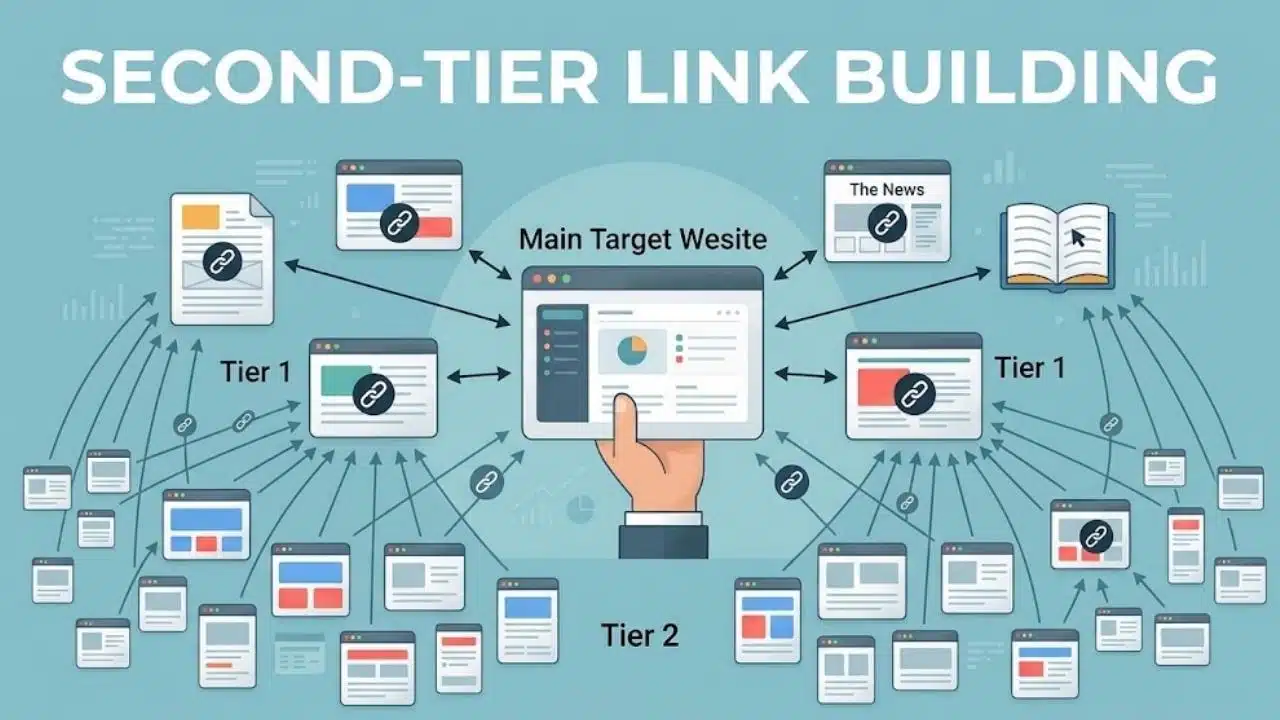
One strong backlink can look impressive in a report and do little in practice. The article containing it may attract few visitors, receive no links of its own, or disappear into an archive. Second-Tier Link Building tries to strengthen that placement by earning links to the third-party page that already links to you.
The defensible version promotes a useful article, interview, review, or research summary that happens to cite your site. The riskier version relies on automated links, thin guest posts, directories, and comments. The indirect route does not protect a manufactured pyramid from search-engine spam policies.
How Second-Tier Link Building Works
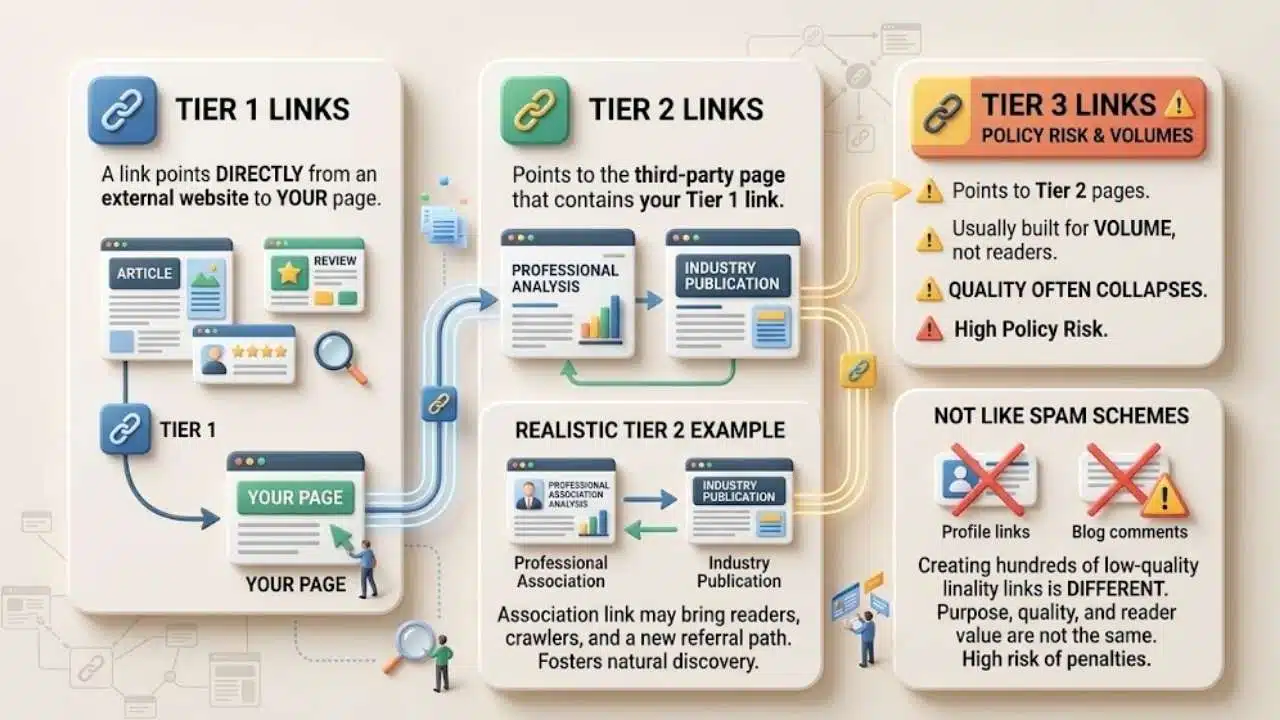
The “tier” terminology is an SEO planning model, not a label that search engines assign to links.
- A Tier 1 link points directly from another website to your page.
- A Tier 2 link points to the third-party page containing that Tier 1 link.
- Some schemes add Tier 3 links pointing to Tier 2 pages. This extra layer is usually built for volume rather than readers, which is where quality often collapses and policy risk increases.
Consider a software company whose original security survey is cited by an industry publication. That citation is Tier 1. A professional association later links to the publication’s analysis because it explains the findings clearly. The association link is Tier 2. It may bring readers to the analysis, give crawlers another path to it, and add a legitimate referring domain. Some readers may then follow the original citation.
That is different from creating hundreds of profile and blog-comment links to the article. The diagram may look similar, but the purpose, quality, and reader value are not.
What the Second Tier Can Realistically Add
Google uses links to understand pages, discover URLs, and help determine useful results. Its link analysis systems include PageRank, although links are only part of a much larger ranking system.
The first possible gain is discovery. A link can give crawlers and readers another route to a useful Tier 1 article that is buried or weakly linked within a large publication. If the page is already prominent and regularly crawled, that benefit may be negligible.
Referral traffic can be more concrete. A trade association page, respected newsletter, or industry article may put the original coverage in front of people who would never find it through the publisher’s navigation. Independent coverage can also carry more credibility than another link to a commercial landing page.
The SEO case is less certain. Legitimate citations improve the Tier 1 page’s backlink profile and connect it more closely to the wider web, but any effect on your own rankings is indirect and difficult to isolate.
Second-tier links cannot rescue an irrelevant Tier 1 placement, turn a paid link into an editorial endorsement, or guarantee higher rankings. Domain Authority, Domain Rating, and similar scores are proprietary tool metrics, not Google scores. They can support comparisons, but a change is not proof of better search performance.
The Policy Risk Is About Purpose, Not Distance
Under Google’s published spam policies, link spam includes creating links to or from a site primarily to manipulate rankings. Its examples include automated link creation, low-quality directory or bookmark links, excessive exchanges, optimized links in forum comments, and low-value content made mainly to influence linking signals. Bing’s webmaster guidance takes a similar position on link schemes and artificial promotion intended to inflate authority.
An extra step between those links and your domain is not a policy shield. Google says it detects violations through automated systems and, when needed, human review. A site that violates its spam policies may rank lower or disappear from Google Search results.
Paid promotion needs careful handling. Google asks publishers to mark paid placements with rel=”sponsored”; nofollow remains acceptable, while user-generated links should generally use rel=”ugc”. Google treats these attributes as processing hints, not simple on-off switches. A qualified link may send referral traffic, but it should not be bought on the promise of ranking credit.
A useful test is whether the Tier 2 page deserves to exist without the backlink. The link should help someone understand or find the Tier 1 resource. If the page was commissioned only to carry an optimized anchor, the campaign has already moved into questionable territory.
Is Second-Tier Link Building Worth It?
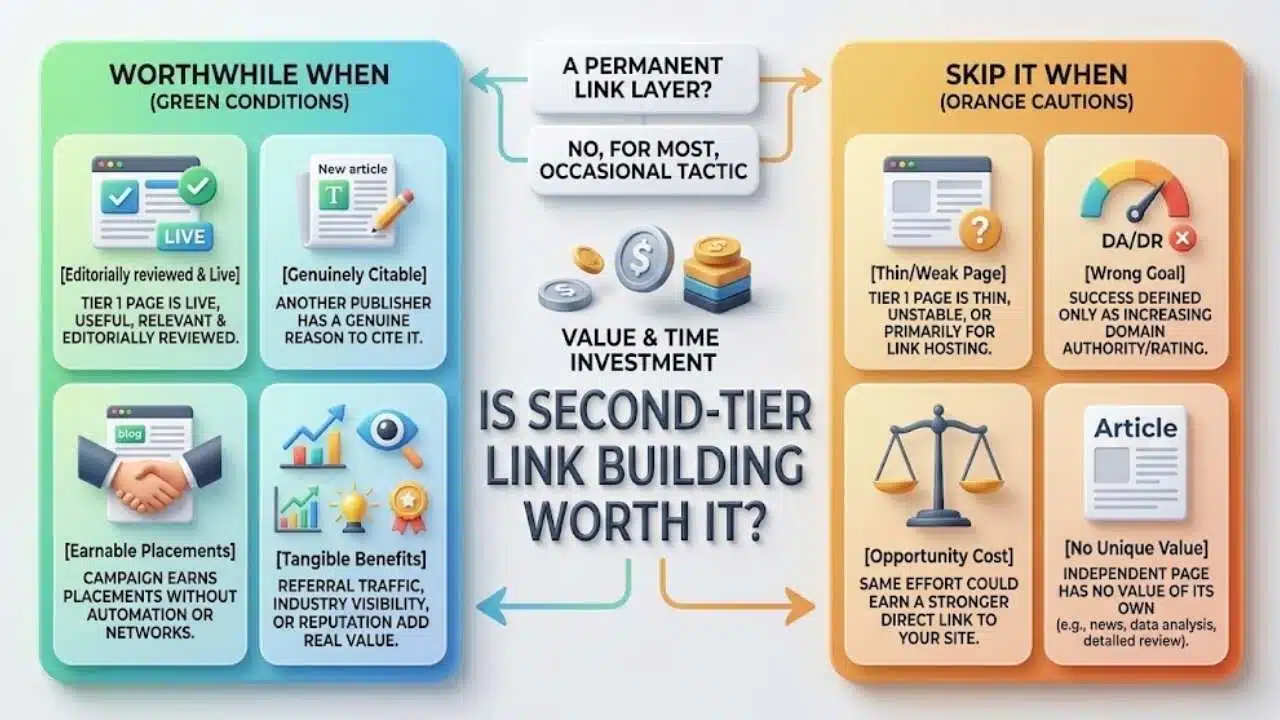
For most websites, this should be an occasional tactic, not a permanent link-building layer. It is most defensible when:
- the Tier 1 page is relevant, editorially reviewed, live, and useful to readers;
- another publisher has a genuine reason to cite it;
- the campaign can earn a few relevant placements without automation or controlled site networks; and
- referral traffic, industry visibility, or reputation would still make the work worthwhile if rankings did not move.
Skip it when the Tier 1 page is thin, unrelated, unstable, or published mainly to host a link. The same applies when success is defined only as increasing Domain Authority or Domain Rating. Those figures can be useful diagnostic metrics, but they are weak campaign goals on their own.
There is also an opportunity-cost question. If the same outreach could earn a legitimate direct citation to a strong resource on your site, the direct link is usually the better investment. Secondary promotion earns its place when the independent page has value of its own, such as a detailed review, original news report, interview, data analysis, or respected industry resource.
A Practical, Controlled Setup
Start with an inventory of existing Tier 1 pages. Google Search Console exports external-link data, while commercial backlink crawlers maintain separate indexes. Their lists will not match, and none shows a perfect view of the web. Use them to find candidates, then open each important page yourself.
Check the page itself, not just the publisher’s domain score:
- Does the URL return a normal page, or does it redirect, show an error, or require a login?
- Does the source include noindex or a canonical tag pointing elsewhere? A page can look normal while signalling that another URL should be indexed.
- Is your link still present in a crawlable <a href> element, and what rel attribute does it use?
- Is the surrounding section genuinely relevant to your page?
- Does the article have useful content, internal links, or signs of a real audience?
- Is the URL likely to remain stable, or is it a short-lived campaign page?
The strongest candidates are usually original reporting, research coverage, expert interviews, useful tutorials, and evergreen resources. A generic guest post with little readership is rarely worth another campaign. A page marked noindex, canonicalized elsewhere, or likely to be removed is also a poor target, regardless of the publisher’s domain score.
The next step is finding a real distribution angle. A newer report might cite the earlier analysis. A conference resource page could link to a speaker interview. A trade newsletter might include a strong industry guide. A partner may reference an independent case study that explains shared work. In each example, the destination is useful without the backlink being its sole reason to exist.
Keep anchor text concise and descriptive. Brand names, article titles, and natural topic phrases usually make more editorial sense than repeated commercial keywords. Google’s link guidance recommends relevant, contextual anchor text and warns against forcing keywords. Do not prescribe an exact-match anchor to every publisher; that creates an unnatural pattern and weakens the editorial reason for the link.
Record the placement date and check periodically that both links remain live. Measure referral visits and review the target page’s search impressions, clicks, and relevant rankings. Do not claim causation from one movement; direct backlinks, competitors, content changes, and indexing shifts may affect the same page. Attribution is especially difficult when the intervention happens on a page you do not control.
Mistakes That Undermine the Strategy
The most common error is lowering quality standards at each tier. If a link would look embarrassing in a client report with its source fully disclosed, it does not become acceptable merely because it points to someone else’s website.
Other mistakes include boosting every backlink instead of selecting durable pages, repeating exact-match anchors, paying for links that pass ranking credit, and adding another tier when the first experiment has no measurable audience benefit. Teams also overreact to “toxic” labels in third-party tools. Google says most sites do not need its disavow tool. Its published threshold is much narrower: a considerable number of spammy, artificial, or low-quality links, plus a manual action or a likely manual action. Using the tool carelessly can harm search performance.
Before funding a secondary campaign, check the simpler work: improve the target page, strengthen its internal links, reclaim a lost backlink, update the original research, or pitch new direct citations. These changes are easier to control and usually have clearer value.
Final Thoughts
Second-Tier Link Building is worth considering when a strong third-party page already supports your brand and deserves wider distribution. It should look and function like promotion of that page, not a hiding place for links you would hesitate to point directly at your site.
Begin with a small pilot around one durable, relevant Tier 1 asset. Earn secondary mentions that make sense to their own readers, qualify paid relationships correctly, and watch both referral and search performance. If the plan requires secrecy, disposable sites, or large volumes of weak placements, stop. A credible direct link or a stronger piece of original content is usually the better long-term asset.