
Most of the advice on how to sell SaaS to enterprises assumes you have a sales team. You probably do not. If you are like us, you have a handful of engineers, one person who answers support email, and a founder who also writes the pricing page.
That does not disqualify you. I work as a chief technical advisor on two products — ImagineLab.art, which is live, and RankPilot.ai, which is still in development — and I have learned that small teams lose enterprise deals for boring reasons, not big ones. They lose because a document was missing. They lose because nobody could answer a question about data flow. They lose because the buyer could not figure out how to pay them.
Those are fixable problems. Here is what I have learned about fixing them.
The Deal is Slow But That is Normal
Before you blame yourself, look at the numbers. The median B2B SaaS sales cycle in 2026 sits around 84 days. Enterprise deals above $100,000 in yearly value run 90 to 180 days, and the biggest ones stretch past a year. The average buying group now has close to seven people in it. Real enterprise deals often carry eight to thirteen named decision makers.
Security review alone adds two to six weeks. Procurement adds more time after that, just to argue about payment terms.
So a six-month deal is not a failing deal. But a six-month deal that dies in month five over a missing security document is a waste of your entire quarter. Most of the delay you can control sits in the technical and paperwork stages, which is good news for a team of engineers.
One more number worth remembering: roughly 70 to 80 percent of the buyer’s research happens before they ever contact you. By the time someone emails you, they have already read your site, poked at your product, and formed an opinion. Your public pages are doing the first half of the selling whether you like it or not.
What Killed Our First Serious Enterprise Conversation
ImagineLab.art is an AI creative suite. It generates images, video, voice, and vector graphics. Under the hood, we route work through several model providers, including Google Vertex AI and Fal.ai.
That architecture is fine. Explaining it was not.
An enterprise prospect asked a simple question on a call: when our team uploads a brief, where does that text go, and who else sees it? I gave an accurate answer. I also gave a long one. I talked about routing, providers, and fallbacks. What the buyer heard was that their content leaves our system and goes somewhere they had not approved.
We lost the momentum in that call. Not the deal, but the momentum, and momentum is most of what a small team has.
The fix took an afternoon. I wrote a one-page data flow document. It listed every subprocessor by name, what data reaches each one, which region it is processed in, and how long anything is retained. No marketing language. Just a table and a diagram.
I now send that page before the technical call instead of explaining it during the call. The conversation changed completely. Instead of defending the architecture, we spend the call discussing which parts they want changed.
If you sell any product built on third-party AI models, write that page this week. Enterprise buyers are not scared of subprocessors. They are scared of surprises.
How to Sell SaaS to Enterprises Before You Have SOC2
This is the question I get asked most by other small founders, so I will answer it directly.
A full SOC2 Type II costs real money. Audit fees for a small SaaS company usually land somewhere between $15,000 and $50,000, and the all-in first year—readiness work, tooling, engineering hours, and remediation—commonly runs $25,000 to $80,000. For a team of six, that is not a line item. That is a decision about whether you hire someone.
You do not need it to start. You need it to scale.
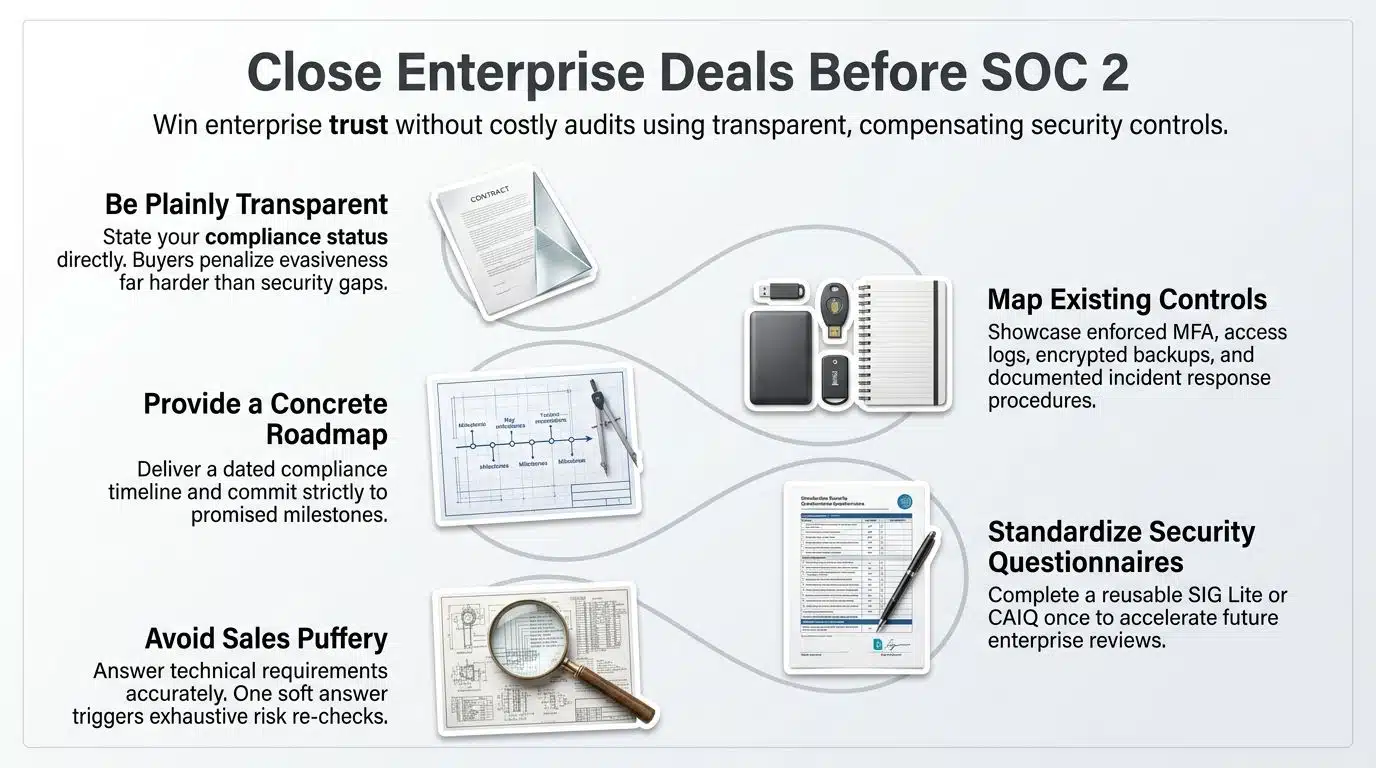
What has actually worked for us is a compensating-control answer. When a buyer asks for SOC 2 and we do not have it yet, we do three things.
First, we say so plainly. No hedging, no “we are SOC 2 aligned.” Buyers can tell the difference and they punish the Dodge harder than the Gap.
Second, we show the controls we do have, mapped to what the report would cover. Enforced multi-factor authentication. Access logs. Encrypted backups with a documented restore test. A written incident response process. Least-privilege access with a named owner per system.
Third, we give a dated roadmap and stick to it.
Then we ask what their risk team actually needs. Often it is not the report. It is a completed SIG Lite questionnaire, which runs around 128 questions, or a CAIQ. Filling one out honestly, once, and keeping the answers in a reusable document is the single highest-return week of work a small SaaS team can do. Every future deal gets faster.
A word of caution from experience: do not answer a security questionnaire the way you answer a sales question. If multi-factor authentication covers email but not your admin panel, write that. A risk reviewer who catches one soft answer starts re-checking all of them.
The Billing Problem Nobody Warns You About
This one surprised me more than the security work. ImagineLab Art runs on a token system. Users buy Editorialge Tokens and spend them on generation. It suits creators very well. We also support payment methods that matter in our region, including bKash and UPI alongside card payments, because our users are not all in North America.
Enterprises cannot buy tokens.
Their finance team needs a quote, then a purchase order, then an invoice against that purchase order, then net-30 or net-60 terms. They need a fixed annual number they can put in a budget. A consumption balance that goes up and down does not fit into any of those boxes. One buyer told me his procurement system would simply reject it.
We had built a payment model that worked beautifully for the customers we had and blocked the customers we wanted.
The answer was not to rebuild billing. It was to add a second path on top of the same system: a yearly commitment, invoiced once, converted into a token pool for the account, with usage reporting the buyer’s finance team can read. The engineering work was small. Realizing it was needed took far too long.
If you are planning how to sell SaaS to enterprises, check your billing before you check your feature list. A missing feature loses you a deal in month three. A payment method they cannot process loses you the deal after you have already won it.
Building RankPilot.ai With Those Questions Answered First
RankPilot.ai is our SEO product, and it is still being built. That gives me something I did not have with ImagineLab — the chance to answer enterprise questions before anyone asks them.
The choices are deliberately unexciting.
Data sits in Postgres. Files sit in S3-compatible storage that any provider can read. We are avoiding provider-specific services until traffic actually forces the issue, so moving regions later is a weekend of work instead of a rewrite. That matters because a European buyer will eventually ask for data residency, and “we can host in your region” is a much better answer than “we will look into it.”
Two things went into the schema from the first migration rather than as later additions: an audit log of who did what and when and a proper roles table. Both are standard asks in enterprise review. Both are painful to bolt on after you have real customers, because backfilling history you never recorded is impossible.
Single sign-on is on the roadmap, not in the build. That is a conscious call. It is the most requested enterprise feature and also the easiest one to waste three months on before you have anyone to sell to.
I would not call this a finished playbook. It is a bet that a small amount of boring foundation work now saves a very expensive scramble later.
The Advantage Small Teams Keep Wasting
Enterprise buyers assume a small vendor is a risk. Sometimes they are right. But they also know something else: with a small vendor, they get the people who actually build the thing. Use that.
When I join a technical call, I am the person who can change the code. If a buyer asks whether we can add a webhook or restrict a data field, I do not say I will check with the product team. I say yes or no, and if it is yes, it can be done that week. Large vendors physically cannot do this. Their answer goes into a roadmap queue.
The mistake is hiding it. A lot of small teams try to sound bigger—fake department names in email signatures, a support alias that pretends to be a team of twenty, etc. Buyers see through it, and then they wonder what else you exaggerated. Being small and fast is a real position. Being small and pretending otherwise is just a weak version of being big.
What I do hide, honestly, is nothing about the team. What I make visible is response time. We answer support emails within a few hours on business days, and I say that in writing during the evaluation because it is a claim we can keep.
Before You Take the Call
A short list I run through now, in order:
- Do you have a one-page data flow document naming every subprocessor?
- Can you send a completed security questionnaire within 48 hours?
- Can you accept a purchase order and issue a proper invoice?
- Do you know your uptime for the last 90 days as a number?
- If they ask for data in their region, what is your honest answer?
- Who on your side has authority to say yes to a contract change on a call?
If four of these are ready and two are not, the two you skipped are the ones that will stall the deal in month four.
Final Thoughts
Learning how to sell SaaS to enterprises as a small team is mostly preparation work, not sales skills. The deals I have watched go badly were not lost on price or features. They were lost on a document nobody had written, an invoice we could not issue, or an answer that sounded evasive because we had not thought about it in advance.
Pick one gap this week. Write the data flow page, or fill in a SIG Lite, or check whether your billing system can produce an invoice against a purchase order. Each one is a day of work, and each one removes a reason for a buyer to stop.
The enterprise buyer is not looking for a big vendor. They are looking for a vendor who has already thought about the hard questions. A team of six can do that. It just has to do it before the call, not during it.