Signing vendor agreements without careful legal and operational review exposes organizations to hidden costs, data loss, and operational lock-in. Identifying key red flags in saas contracts before executing an agreement protects corporate budgets, preserves flexibility, and ensures your company retains control over its data.
| Contract Red Flag | Primary Business Risk | Financial Impact | What to Push For |
| 1. Strict Auto-Renewal Windows | Automatic rollover without review | Unbudgeted annual license fees | 60–90 day written notice opt-out |
| 2. Uncapped Annual Price Increases | Compound cost inflation at renewal | 10% to 30% unexpected cost spikes | Price increase cap (3%–5% maximum) |
| 3. Asymmetrical Liability Caps | Limited vendor accountability for breaches | Unrecoverable data loss damages | Mutual liability capped at 12–24 months of fees |
| 4. Weak SLAs Without Remedies | Downtime disrupts operations without compensation | Lost business revenue | Tiered service credits for missed uptime |
| 5. Ambiguous Data Ownership | Loss of IP rights or customized work | Vendor lock-in & legal disputes | Explicit full ownership of customer data & outputs |
| 6. Exorbitant Data Offboarding Fees | High cost to extract data upon exit | Thousands in unexpected migration fees | Free standard format data export upon termination |
| 7. Unilateral Terms Modification | Vendor changes pricing or features at will | Loss of contractual guarantees | 30-day advance notice + termination right |
| 8. Broad Vendor Audit Rights | Surprise compliance true-up fees | Disruptive audits & heavy penalties | Annual audit limit with 30-day advance notice |
| 9. Opaque Security & Breach Notice | Delayed response to data compromises | Regulatory fines & reputation damage | 24–48 hour breach notification mandate |
| 10. Rigid Governing Law & Venue | High legal fees litigating out-of-state | Increased litigation overhead | Local jurisdiction or neutral arbitration |
10 Dangerous Red Flags in SaaS Contracts
1. Strict Auto-Renewal Clauses with Short Cancellation Windows
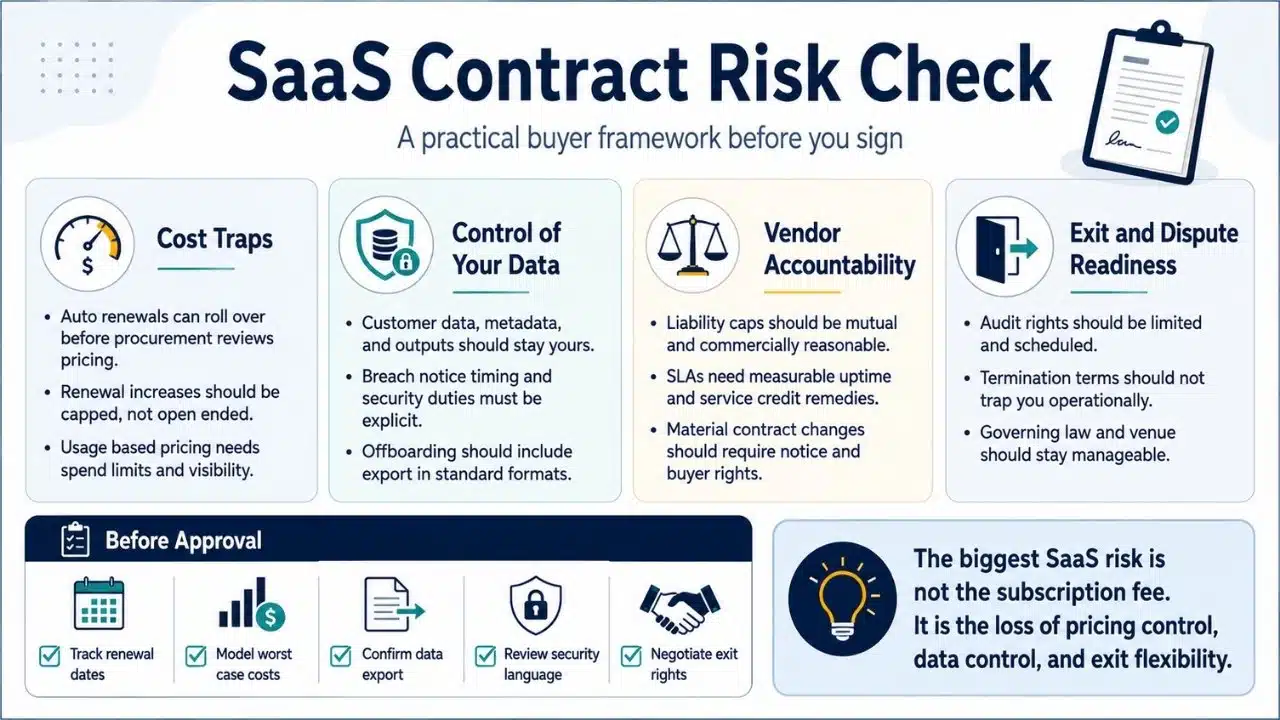
Vendors frequently insert auto-renewal language requiring written cancellation 60 to 90 days before the contract end date. If your team misses this narrow window by even a single day, you are locked into another full term. Negotiate for mandatory vendor renewal reminders 60 days prior to the deadline and push for an opt-in renewal structure whenever possible.
2. Uncapped Annual Escalation Rates
A fixed initial contract price means little if the vendor reserves the right to increase rates arbitrarily upon renewal. Without a contractual cap, vendors can raise prices by 15% to 30% annually once your operations are fully embedded in their system. Incorporating insights from established technology procurement strategies helps buyers secure annual price hike caps tied to CPI or capped at 3% to 5%.
3. Asymmetrical Limitations of Liability
Contracts often cap vendor liability at the amount paid over the preceding 3 to 6 months, while excluding indirect or consequential damages altogether. If a vendor breach causes a major data exposure, your recovery is severely constrained. Ensure liability caps are mutual, capped at a minimum of 12 to 24 months of total contract value, and exclude gross negligence or data security breaches from standard liability caps.
4. Weak Service Level Agreements (SLAs) Without Financial Remedies
A commitment to “99.9% uptime” is meaningless if the agreement lacks clear penalties for outages. Review the SLA section to confirm that missed availability thresholds trigger automatic service credits against future invoices. Following enterprise software risk frameworks ensures your contract defines measurable downtime metrics and clear financial recourse.
5. Ambiguous Customer Data Ownership Terms
Your agreement must state unambiguously that your company retains exclusive ownership of all uploaded data, metadata, and generated outputs. Watch out for broad vendor language claiming non-exclusive licenses to “aggregate, analyze, or commercialize” your proprietary information, as this allows vendors to train AI models or build competing products using your company’s data.
6. Unreasonable Data Offboarding and Migration Fees
Some software agreements obligate vendors to host your data but charge exorbitant fees to export it when the contract ends. Ensure the contract includes a explicit transition clause requiring the vendor to return all customer data in a standard, accessible format (such as JSON or CSV) within 30 days of termination at no additional charge.
7. Unilateral Modifications to Contract Terms
Beware of clauses stating that the vendor may modify terms of service, acceptable use policies, or features at any time simply by posting updates on their website. Demand language requiring the vendor to provide written notice of material changes, along with the right to terminate the contract without penalty if changes adversely affect your business.
8. Broad Vendor Audit Rights and Heavy Penalty True-Ups
Vendors frequently reserve the right to audit your software usage at any time and demand retroactive fees if license counts are exceeded. Reviewing corporate contract management standards helps procurement teams restrict audits to once per calendar year, require 30 days written notice, and establish clear fee caps for unintentional user overages.
9. Opaque Security Protocols and Delayed Breach Notifications
If a software vendor suffers a security incident, your company needs immediate visibility to protect internal systems and satisfy regulatory requirements. Reject agreements that fail to detail security standards or allow the vendor more than 24 to 48 hours to notify your security team following a confirmed or suspected security incident.
10. Strict Out-of-State Governing Law and Venue Clauses
Vendors typically draft contracts designating their home state or country as the exclusive legal jurisdiction. Resolving disputes in a distant jurisdiction adds substantial legal expenses and travel costs. Require governing law to reflect your company’s local state or agree on neutral arbitration locations to keep dispute resolution manageable.
The Uncomfortable Realities of Enterprise Software Agreements
The software procurement industry relies heavily on asymmetrical information. Vendors understand that once your team completes onboarding, integrates APIs, and trains staff on a platform, switching costs become prohibitively high. This reality leads to one of the most uncomfortable truths in B2B software: standard contract terms are almost never written to protect the buyer.
Looking ahead, the rapid shift toward AI-assisted software and usage-based pricing models will make contract review even more complex. Vendors are increasingly moving away from simple seat pricing to multi-variable meters based on tokens, API calls, and automated actions. Without clear contractual safeguards against consumption spikes and data scraping rights, buyers risk facing unmanageable operational expenses and intellectual property exposure. Software procurement can no longer be treated as a routine administrative task—it requires aggressive negotiation before committing signatures to paper.
Frequently Asked Questions (FAQs) About Red Flags in SaaS Contracts
What is the most dangerous red flag in SaaS contracts?
Uncapped annual price increases combined with strict auto-renewal terms represent the most immediate financial danger. This combination forces buyers into paying significantly inflated rates without the operational time needed to migrate to an alternative vendor.
How far in advance should you give notice to cancel a SaaS contract?
Most standard agreements require 30 to 90 days written notice before the renewal date. You should establish an internal tracking alert at least 120 days prior to contract expiration to evaluate software usage and negotiate terms effectively.
Can a vendor change SaaS terms during an active contract?
Only if the agreement includes a unilateral modification clause. Buyers should explicitly reject language allowing vendors to alter terms or functionality without advance written notice and a corresponding right to terminate the agreement.
What is a standard limitation of liability cap in SaaS contracts?
A typical vendor-drafted cap limits liability to 3 to 6 months of fees paid. Buyers should push for mutual liability caps equal to 12 to 24 months of total contract fees, with higher caps for data breaches and confidentiality violations.
How do I ensure our company data is returned when a SaaS contract ends?
Include an explicit data transition clause requiring the vendor to export all raw data and metadata in a standard format (such as CSV or JSON) within 30 days of contract termination at no extra cost.