Maintaining a consistent email newsletter schedule is one of the most reliable strategies for audience retention, but creator fatigue is inevitable. On low-energy weeks, trying to write a 1,500-word deep dive from scratch often leads to missed deadlines or subpar writing.
Having a reliable roster of newsletter ideas when uninspired allows digital creators to protect their publishing momentum on platforms like Substack, maintain audience trust, and deliver concise value without experiencing burnout.
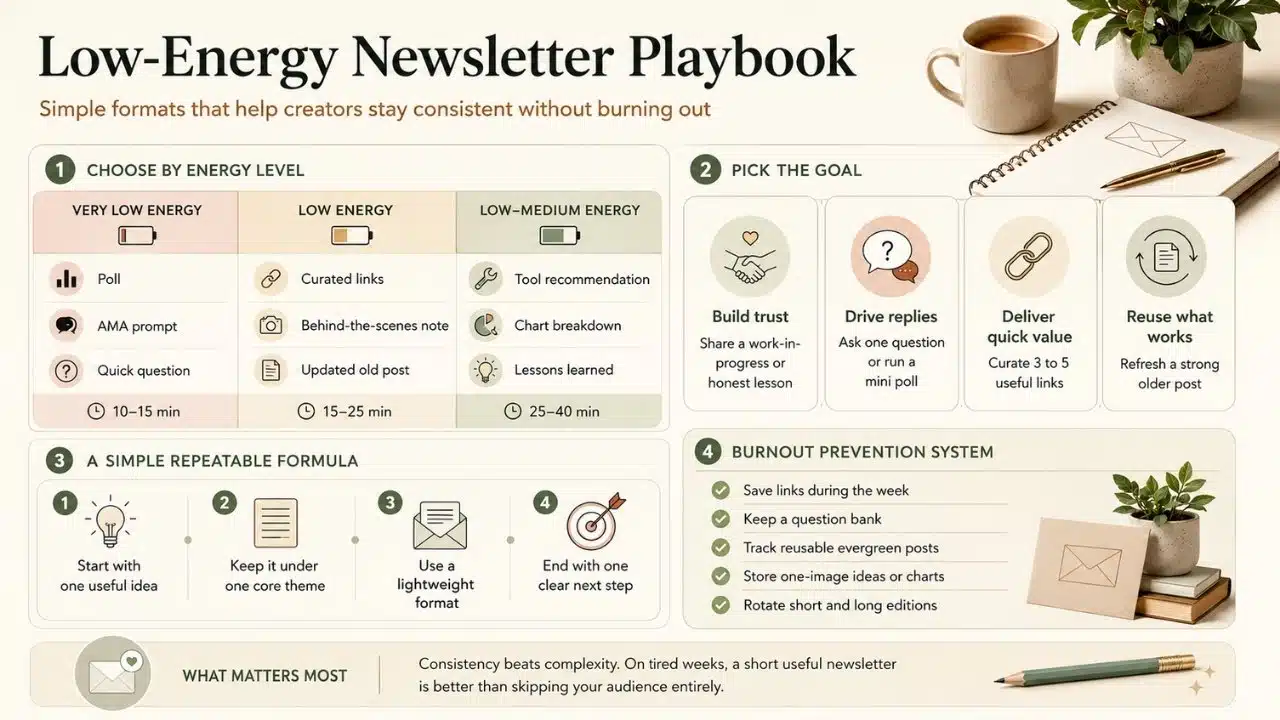
| Newsletter Idea | Effort Level | Primary Format | Average Execution Time | Best For |
| 1. The Curated Resource Digest | Low | Bulleted Links | 20–30 mins | Sharing external value without heavy writing |
| 2. The Repurposed Q&A / Mailbag | Low | Question + Answer | 15–25 mins | Answering common audience questions |
| 3. The “Tool of the Week” Review | Low-Medium | Short Review | 25–35 mins | Software & productivity recommendations |
| 4. Behind-the-Scenes / WIP Peek | Low | Narrative + Image | 15–20 mins | Building authentic personal connection |
| 5. The Lessons-Learned Postmortem | Medium | Mini-Case Study | 30–40 mins | Sharing raw reflections on a past mistake |
| 6. The “Ask Me Anything” Prompt | Very Low | Short Callout | 10–15 mins | Driving direct subscriber email replies |
| 7. The Single-Graphic Breakdown | Low | Image + Commentary | 15–20 mins | Visual insights and diagram analysis |
| 8. The Evergreen Vault Remaster | Low | Updated Repost | 15–25 mins | Repurposing top-performing past posts |
| 9. The Quick Poll / Survey | Very Low | Interactive Question | 10–15 mins | Gathering subscriber feedback and data |
9 Newsletter Ideas for Weeks You Feel Uninspired
1. The Curated Resource Digest
Instead of creating original commentary, act as a filter for your audience. Share 3 to 5 high-quality articles, podcasts, videos, or tools you consumed throughout the week. Implementing proven content curation strategies requires only a 1–2 sentence takeaway under each link explaining why it is worth your subscribers’ time.
2. The Repurposed Q&A / Mailbag
Scour your inbox, social media DMs, or past comment sections for a question an audience member previously asked you. Copy the question directly into your newsletter header and spend three short paragraphs providing your direct, actionable answer.
3. The Single “Tool of the Week” Recommendation
Highlight one software tool, book, browser extension, or framework that has simplified your workflow recently. Explain the problem it solves, how you use it, and link directly to it. Readers love concrete, single-utility recommendations.
4. A Behind-the-Scenes / Work-in-Progress Peek
Show the unpolished side of your project, business, or creative routine. Share a screenshot of a rough draft, a photo of your messy workspace, or an outline of a product launch you are currently planning. Unfiltered transparency builds deep reader intimacy.
5. The “Mistake & Lesson Learned” Postmortem
Reflect on a recent minor error, failed experiment, or miscalculation. Outline what went wrong in two sentences, state the key takeaway, and give readers one piece of advice to avoid making the same mistake themselves.
6. The “Ask Me Anything” (AMA) Crowd-Sourcing Prompt
Turn your lack of inspiration into an engagement opportunity. Send a brief 3-paragraph email asking your readers what challenges they are currently facing in your niche. Use their replies to generate topic ideas for future newsletters when your energy returns.
7. The Single-Graphic or Chart Breakdown
Find a compelling visual, chart, or infographic related to your industry. Embedded media breaks up text-heavy inboxes. Add three bullet points beneath the image explaining what the data means and why it matters for your readers.
8. The “Evergreen Vault” Remaster
Select a top-performing newsletter or blog post from 6 to 12 months ago that newer subscribers likely haven’t seen. By repurposing existing content, you can update outdated statistics or links, write a fresh introductory paragraph, and deliver immediate value with minimal writing.
9. The One-Question Poll or Survey
Keep your message under 150 words by asking your readers a single, relevant question or running an embedded poll (e.g., “What is your biggest hurdle with remote work this quarter?”). This requires minimal drafting while generating valuable market research.
Harmonizing Human Intuition and Algorithmic Scale
Artificial intelligence and human intelligence represent two fundamentally different approaches to problem-solving. While AI systems dominate in raw computational speed, data processing, and high-volume pattern recognition, human minds remain unmatched in emotional nuance, ethical accountability, sample-efficient learning, and genuine creative intent.
Rather than viewing artificial intelligence as a direct substitute for human cognition, high-performing organizations treat AI as an intellectual force multiplier. The most resilient technical workflows keep humans in the loop—combining machine speed and precision with human empathy, contextual judgment, and strategic oversight to drive responsible, long-term innovation.
Frequently Asked Questions (FAQs) on Newsletter Ideas When Uninspired
Keep a dedicated swipe file of interesting links, reader questions, and past top-performing emails. Having a pre-filled content repository ensures you always have actionable newsletter ideas when uninspired ready to deploy without starting from a blank page.
Varying your email formats keeps your publication dynamic. Occasional short digests or single-question emails are often preferred by busy readers, provided the content remains relevant and high-quality.
Should I admit to my subscribers that I feel uninspired?
Transparency builds trust, but avoid sounding overly negative or unprofessional. Frame your message around brevity or experimentation—for instance, “Today’s email is short, sweet, and focused on one key resource.”
How do I prevent long-term creator burnout?
To avoid severe newsletter burnout, build a content bank or swipe file during high-energy weeks. Having a pre-filled repository eliminates the pressure of staring at a blank screen.