
“Improve customer experience” sounds like a sensible goal. So do “grow revenue,” “strengthen the brand,” and “make the product easier to use.” The problem is that none of them tells a team what success will look like.
Whenever I hear a broad workplace goal, my first question is: What should be different by the end of the agreed period, and what evidence will prove it?
That is the purpose of this article with enough practical detail to help a team use them. Objectives and Key Results can turn a general ambition into a shared, measurable commitment. They can also become planning theatre if leaders treat them as a task list, an employee scorecard, or a document to revisit only at the end of the quarter.
The framework grew out of goal-setting practices developed by Andy Grove at Intel and was later introduced to Google by John Doerr. Its central idea remains useful: decide what should change, agree on the evidence, and keep reviewing what the evidence says.
What Is OKRs?
OKR stands for Objectives and Key Results. Each OKR contains two connected parts:
- The Objective describes what the team wants to achieve.
- The Key Results measure whether that change happened.
A simple way to express the structure is: We will achieve [Objective], as measured by [Key Results].
For example:
Objective: Make the first month more valuable for new customers.
Key Results:
- Increase onboarding completion from 62% to 80%.
- Reduce median time to a customer’s first completed project from five days to two.
- Reduce first-month customer churn from 9% to 6%.
The Objective provides direction. The Key Results define the evidence. They do not prescribe every action the team should take.
OKRs, KPIs, Initiatives, and Tasks Are Different
Much of the confusion around OKRs comes from mixing different levels of work. I find this distinction useful:
| Element | What it does | Example |
| Objective | Describes the desired change | Make onboarding easier for new customers |
| Key Result | Measures evidence of that change | Increase onboarding completion from 62% to 80% |
| KPI | Monitors ongoing performance | Monthly onboarding completion rate |
| Initiative | Describes work intended to influence a result | Redesign the onboarding flow |
| Task | Defines a specific action | Rewrite the welcome email |
A KPI can become a Key Result when a team commits to changing it during a defined period. “Customer retention rate” is a KPI. “Increase 90-day retention from 82% to 90% this quarter” can be a Key Result.
Initiatives and tasks sit below the OKR. They are the team’s current bets about how to achieve the result. If an initiative fails, the team can replace it without abandoning the outcome it is pursuing.
From a Vague Goal to a Working OKR
Consider the goal “grow the product.” It is too broad to guide a decision. Even “grow among small-business customers” leaves success open to interpretation.
Here is an entirely illustrative alternative:
Objective: Make the product valuable enough that more small-business customers stay beyond their first month.
Key Results:
- Increase 30-day activation from 48% to 65%.
- Reduce median time to the first completed workflow from four days to one.
- Increase 90-day retention from 70% to 78%.
- Reduce first-month cancellations attributed to setup difficulty from 28% to 15%.
The team might simplify account setup, add role-specific templates, rewrite onboarding emails, or introduce an in-product checklist. Those are possible initiatives. Shipping them does not prove that the Objective was achieved.
Write an Objective That Helps People Choose
A useful Objective describes a meaningful future state without packing every metric into the sentence. It should help the team decide which work matters and which work can wait.
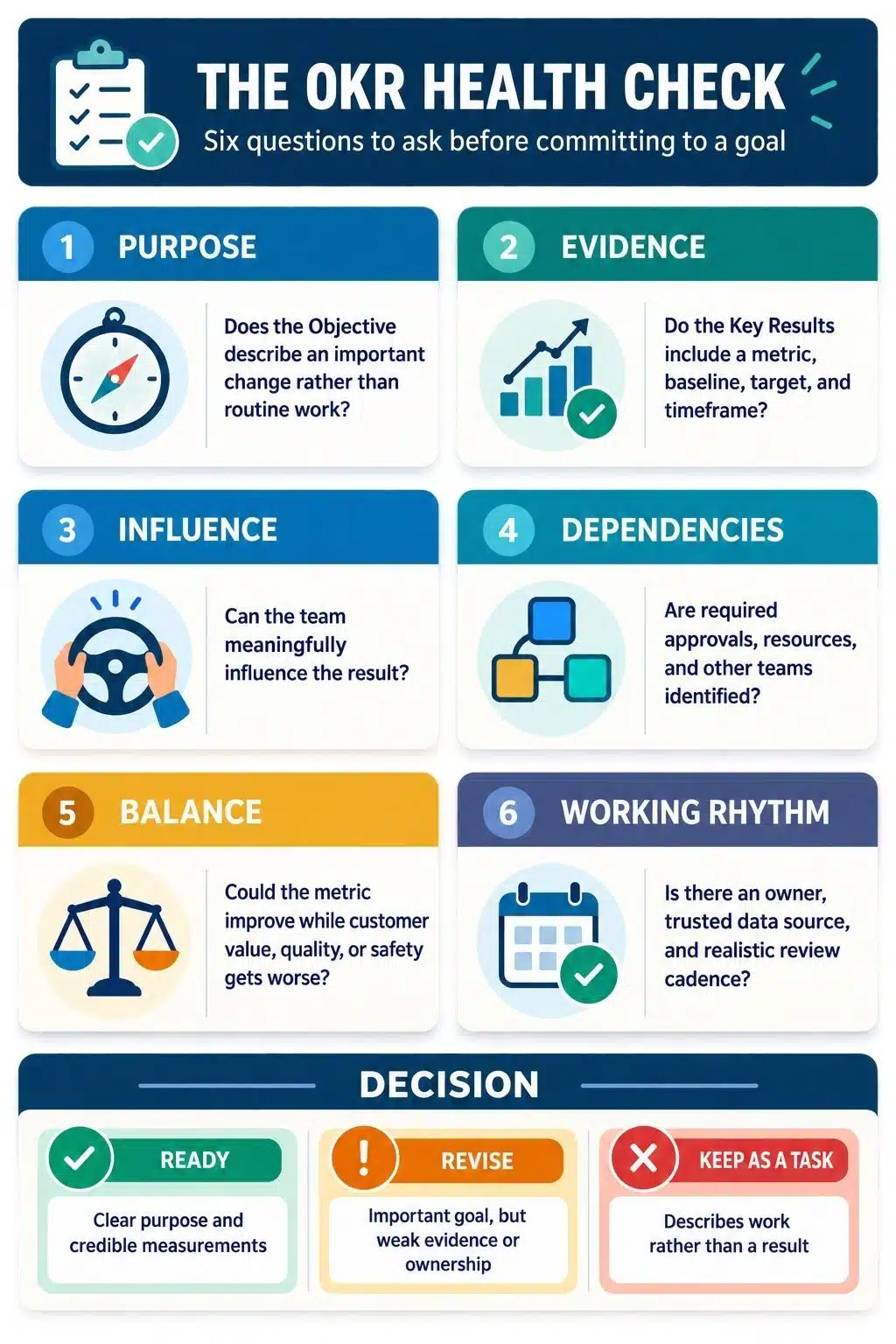
I would test it with four questions:
- Does it describe a change rather than routine work?
- Can the team explain why it matters now?
- Is it clear enough to guide trade-offs?
- Does the team have enough influence and resources to pursue it?
“Maintain customer service” describes business as usual. “Restore customer trust after a difficult product migration” gives the team a destination.
Restraint matters. For a team new to OKRs, one to three serious objectives will usually be more useful than eight competing ones. An OKR list is not supposed to document everything the team does.
Give Each Key Result a Real Measurement
The most practical Key Results usually contain a metric, a baseline, a target, and a deadline or defined cycle: Change [metric] from [baseline] to [target] by [deadline].
The baseline reveals the size of the intended improvement. “Increase retention to 90%” means very different things when the current rate is 89% and when it is 55%.
Before approving a Key Result, the team should agree on the data source, metric definition, reporting owner, and update frequency. It should also ask whether the number could improve while the real outcome gets worse. A support team could reduce handling time by rushing customers off calls. Pairing a speed target with a quality measure would make that harder to hide.
Outcomes Usually Tell Us More Than Outputs
“Publish 20 help articles” is measurable, but it proves only that 20 articles were published. “Reduce monthly setup-related support requests from 400 to 250” measures the result the content is supposed to influence.
Outputs are not automatically bad Key Results. They may be appropriate for a fixed delivery, regulatory requirement, migration, or learning project. The mistake is presenting completed activity as evidence of impact when the Objective promises a change for customers or the business.
The OKR Cycle Is Where the Method Earns Its Keep
Writing an OKR is the easy part. The method becomes useful only when it affects priorities and decisions throughout the cycle.
Set and Align
Leadership needs to communicate strategic priorities and constraints, while teams need room to shape the results they are expected to pursue. A purely top-down process can ignore operational knowledge. A purely bottom-up process can produce sensible goals that do not add up to a coherent strategy.
Alignment should not become a rigid cascade in which every company Key Result is copied into a department Objective. A team may support only one company priority, and its best contribution may use different language and measures.
Dependencies also belong in this conversation. If a team needs engineering capacity, legal approval, or data from another department, that reliance should be visible before the cycle begins, not saved for the end-of-quarter explanation.
Review the Evidence
Weekly or biweekly reviews are practical for many teams, but there is no mandatory cadence. The right frequency depends on how quickly the metric moves and how soon the team can respond.
A useful check-in covers the current measurement, confidence in reaching the target, new obstacles, cross-team needs, and what the team will change next. It does not always require another meeting. A concise update in an existing team review may be enough.
Adjust the Work Without Rewriting History
When an initiative fails, the team should replace it. The OKR defines the intended result, not an untouchable plan.
Sometimes an OKR itself becomes obsolete because strategy, regulation, market conditions, or resources change. Revising or closing it can be responsible. Quietly lowering the target to improve the score is not. The decision and its reason should remain visible.
Score and Reflect
Teams can use percentages, red-amber-green status, achieved/not achieved, or a 0.0-to-1.0 scale. Consistency and honest interpretation matter more than mathematical sophistication.
Google is closely associated with the 0.0-to-1.0 scale and the idea that roughly 0.6 or 0.7 can represent a healthy result for a genuinely aspirational OKR. This is not a universal rule. A committed security fix or contractual delivery should not be celebrated at 70% simply because someone labelled it an OKR.
The final review should explain the score. Which assumption was wrong? What worked? What should stop, continue, or change? Unfinished work may carry forward, but it should not do so automatically.
Committed, Aspirational, and Learning OKRs
The type of OKR changes how its result should be judged.
- Committed OKRs: It covers outcomes that must be delivered, such as a contractual obligation, regulatory deadline, or critical security remediation. These normally call for full completion.
- Aspirational OKRs: It pushes beyond predictable performance. Partial attainment may still represent valuable progress if everyone understood from the beginning that the goal was a stretch.
- Learning OKRs: It reduces uncertainty when the team lacks enough evidence to promise a business outcome. A team exploring a new market might define interview, pilot, cost-estimation, and go/no-go decision criteria.
The label should be agreed upon before work starts. A missed commitment cannot conveniently become an aspirational success after the deadline.
Where OKRs Usually Break Down
- They become task lists: “Launch a campaign” and “redesign the pricing page” describe work, not its effect. Keep initiatives in the project plan and use Key Results to measure what changed.
- There are too many priorities: A long OKR list often means leaders avoided making difficult choices. If everything is strategic, the team has no practical basis for saying no.
- The easiest metric wins: Followers, downloads, impressions, and page views may be useful signals, but they can rise without improving qualified demand, retention, revenue, or customer value.
- The data cannot support the target: A precise-looking number built on inconsistent definitions creates false confidence. If the baseline cannot be trusted, fixing measurement may need to come first.
- Ownership is confused with control: An owner coordinates and reports a result but may not control customer behaviour, market conditions, or another team’s work. Those limits should inform planning and scoring.
- Scores are tied mechanically to pay or ratings: When bonuses depend on hitting every target, conservative goals become rational. OKR results can inform a performance conversation, but they cannot fully measure judgment, collaboration, contribution, or changing circumstances.
- Software is expected to fix the process: A spreadsheet or shared document is enough for many small teams. Specialist software can improve visibility and reporting at scale, but it cannot create clear strategy or honest conversations.
The Messy Reality Behind a Polished OKR
A team can produce a beautifully written Objective and perfectly formatted Key Results while lacking the budget, authority, reliable data, or cooperation needed to achieve them.
OKRs also force uncomfortable decisions. Which worthwhile work will the organization stop doing? Can someone mark a result as at risk without being punished? Will leaders keep adding urgent requests while insisting that the original priorities remain unchanged? Are two departments quietly pursuing conflicting targets?
No goal-setting method can compensate for unclear strategy or a culture that rewards optimism over honesty. That is when OKRs become administrative theatre: the numbers are updated, the status colors change, and the real decisions happen somewhere else.
A Sensible Way to Start Using OKRs
I would start with one team and one meaningful change rather than launch a company-wide scoring system immediately:
- Write a clear Objective for the next cycle.
- Add two to four Key Results with baselines and targets where possible.
- Confirm the data source, owner, dependencies, and OKR type.
- Review progress weekly or biweekly.
- Change initiatives when the evidence calls for it.
- Score the result and record what the team learned.
One cycle will reveal more about the method’s value and friction than a long policy document. The team does not need specialist software to run that test.
Final Thoughts
Once OKRs are explained this way, their real purpose becomes clearer. They are not ordinary goals with numbers attached. They are agreements about what should change, what evidence will demonstrate progress, and which work deserves priority.
That agreement helps only when the goals remain visible, the data is trustworthy, and people can report setbacks honestly. Under those conditions, OKRs can connect strategy to everyday decisions. Without them, even polished OKRs are just well-organized intentions.
Frequently Asked Questions About OKRs
1. What Is a Simple Example of an OKR?
Objective: Make customer support more dependable. Key Results: Reduce median first-response time from eight hours to three, raise first-contact resolution from 68% to 80%, and maintain the agreed customer-satisfaction threshold.
2. What Is the Difference Between an OKR and a KPI?
A KPI monitors ongoing performance, such as retention or system uptime. An OKR defines a change the team wants to produce during a set period. A KPI becomes a possible Key Result when it has a target and supports a specific Objective.
3. How Many OKRs Should a Team Set?
There is no universal number. One to three Objectives with two to four Key Results each is a practical starting point. If the list is too long to remember or discuss regularly, it is probably too long to guide priorities.
4. Is Achieving 70% of an OKR Successful?
It can be a strong result for a clearly labelled aspirational OKR. A committed OKR usually calls for full completion. Teams should decide which type they are setting before the cycle begins, not after seeing the score.
5. Should OKRs Be Used in Performance Reviews?
They can provide useful context, but they should not become a mechanical scorecard for ratings, promotions, or bonuses. A fair review also considers goal difficulty, dependencies, individual contribution, collaboration, judgment, and changing conditions.