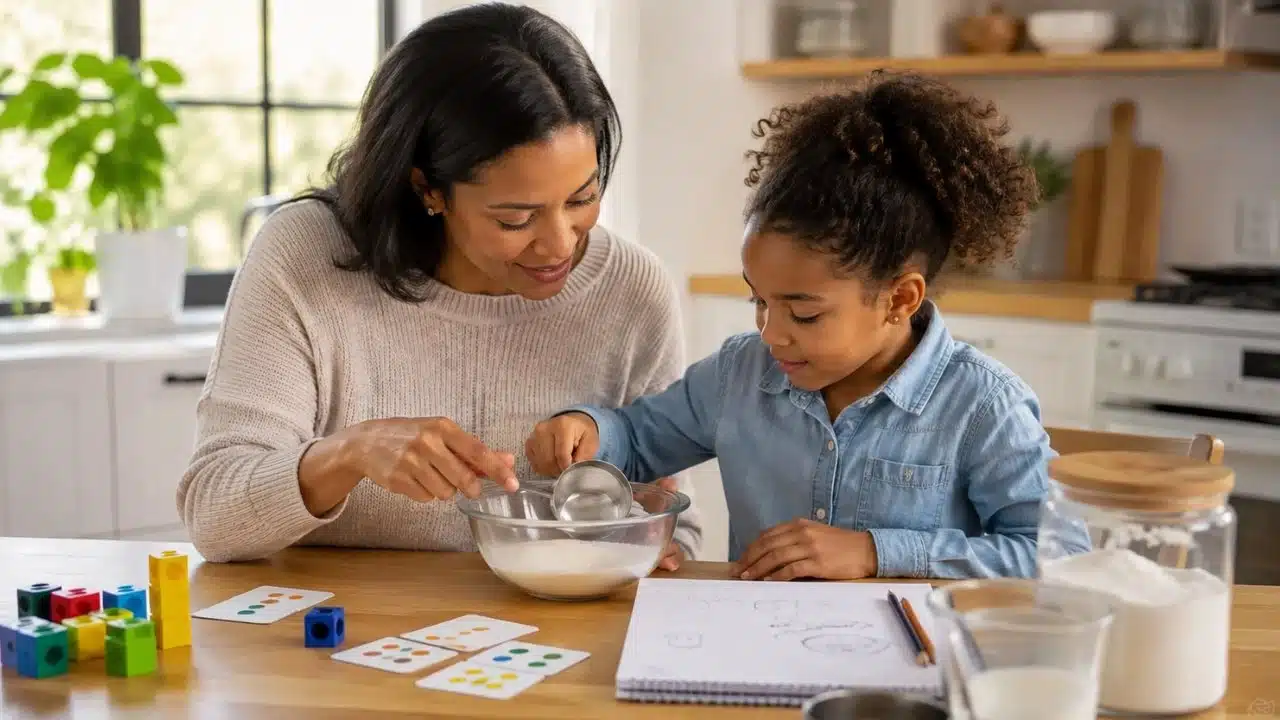
Children internalize their parents’ attitudes toward numbers long before they encounter formal algebra. Actively modeling positive math habits in daily family life shifts the perception of mathematics from a stressful academic chore into a natural, empowering problem-solving tool.
By eliminating phrases like “I was never a math person” and demonstrating curiosity when facing numerical challenges, parents build a resilient growth mindset in math that lasts a lifetime.
| Math Habit | Core Focus | Real-World Example | Primary Benefit |
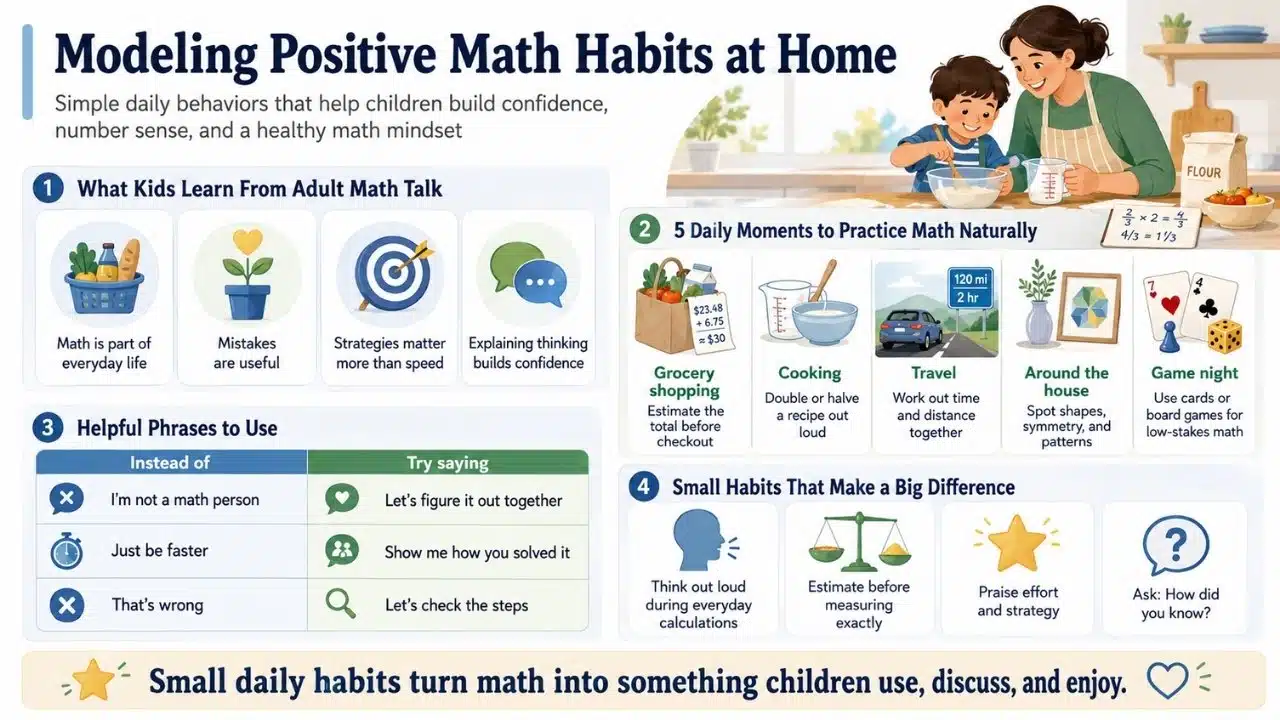
| 1. Verbalizing Calculations | Everyday Mental Math | Calculating discounts or doubling recipe portions out loud | Shows math as an active, daily tool |
| 2. Embracing Mistakes | Growth Mindset | Re-checking a miscalculated budget item calmly | Destigmatizes errors and builds resilience |
| 3. Estimating Before Measuring | Number Sense | Guessing distance, weight, or total cost before measuring | Develops intuitive spatial and quantitative reasoning |
| 4. Praising Strategy Over Speed | Metacognition | “I like how you drew a diagram to solve that” | Values problem-solving process over memorization |
| 5. Finding Math in Nature & Design | Pattern Recognition | Pointing out symmetry, tessellations, or geometric shapes | Connects abstract concepts to visual reality |
| 6. Playing Strategic Number Games | Informal Reasoning | Playing card games, dominoes, or spatial board games | Fosters low-stakes, joyful math practice |
| 7. Asking “How Did You Know?” | Mathematical Fluency | Inviting your child to explain their step-by-step logic | Strengthens verbal reasoning and conceptual depth |
7 Practical Ways of Modeling Positive Math Habits
1. Talk Through Everyday Calculations Out Loud
Rather than computing numbers silently on a phone, verbalize your reasoning during routine activities. Compare unit prices at the grocery store, scale ingredient amounts while cooking, or calculate arrival times based on traffic. Hearing adults break down numbers into manageable steps demystifies mental arithmetic for young listeners.
2. Normalize and Celebrate Mistakes
When you make a calculation error—such as misjudging change at a store or misreading a measurement—react with curiosity rather than frustration. Say, “That didn’t turn out right, let me re-trace my steps to see where I went wrong.” Demonstrating that mistakes are valuable feedback loops helps reduce math anxiety in children.
3. Estimate Quantities Before Calculating Exactly
Before weighing produce, measuring a room’s dimensions, or checking a receipt, make a friendly guess out loud and invite your child to do the same. Estimating builds intuitive number sense, helping kids recognize whether a calculated final answer is reasonable or way off target.
4. Praise Strategic Effort Rather Than “Smartness”
Avoid labeling anyone as inherently “good” or “bad” at math. When your child solves a problem, highlight the specific method they used rather than speed or raw talent. Complimenting persistence (“You kept trying different ways until it worked”) reinforces that mathematical ability grows through effort and practice.
5. Highlight Patterns, Geometry, and Symmetry Around You
Math extends far beyond numbers on a page. Point out geometric tessellations in tile floors, architectural symmetry in neighborhood buildings, or Fibonacci spirals in pinecones and sunflowers. Connecting mathematical concepts to physical environments nurtures spatial intelligence and visual appreciation.
6. Integrate Low-Stakes Card and Board Games
Incorporate informal math practice into family game nights. Classic card games (like Yahtzee, Cribbage, or Uno) and spatial board games involve counting, probability, pattern matching, and strategic planning. Playing games places mathematical logic inside a fun, collaborative context.
7. Ask Open-Ended Questions About Thinking Processes
When your child shares a math result, resist the urge to simply say “correct” or “wrong.” Instead, ask, “How did you figure that out?” or “Is there another way we could solve this?” Prompting children to explain their logic deepens conceptual understanding and strengthens mathematical communication.
Integrating Healthy Tech: A Vetted Digital Math Tool
Modeling positive math habits also extends to how families manage technology. Pairing daily real-world math talk with intentional, high-quality screen time demonstrates to children that devices can be valuable tools for active learning rather than passive distraction.
123 Magic Number Fun
Available on both Google Play and the App Store, 123 Magic Number Fun by Edutorial bridges the gap between everyday math conversations and guided digital practice. It offers parents a structured, safe environment to introduce early numerical concepts.
-
Google Play Teacher Approved: Holds an official badge verifying compliance with strict educational standards, safety protocols, and age-appropriate design.
-
Targeted Early Math Skills: Features guided number tracing for digits 1 through 50, interactive counting puzzles, and number recognition mini-games.
-
Confidence-Building Design: Uses high-contrast visual pathways and instant prompts to foster independent problem-solving, self-paced learning, and positive digital habits.
What to Do Next
Pick one routine task today—such as estimating your grocery total or measuring a DIY project—and talk through your mathematical thinking out loud with your child. Small, consistent shifts in daily conversations turn math into a natural, enjoyable part of everyday life.
Frequently Asked Questions (FAQs) on Modeling Positive Math Habits
What if I personally struggle with math anxiety?
You do not need advanced mathematical knowledge to model positive habits. Focus on demonstrating curiosity, openness, and a willingness to learn alongside your child. Avoiding negative statements about your own math abilities is the single most impactful step you can take.
At what age should parents start modeling positive math habits?
You can begin modeling math awareness during toddlerhood. Simple practices—like counting steps out loud, sorting laundry by shape and color, and comparing object sizes—lay the foundation for formal numerical literacy.
How does modeling positive math habits impact academic performance?
Research consistently shows that parental attitude directly influences a child’s academic confidence and perseverance. Children who observe adults using math calmly and constructively develop greater problem-solving resilience and achieve higher long-term proficiency.