Every calendar date carries its own unique tapestry of human triumph, discovery, political upheaval, and artistic creation. August 20 stands as one of the most intellectually and politically vibrant days in the global archive. From the laboratory benches of British India where the transmission of malaria was unlocked, to the launching pads of Cape Canaveral sending humanity’s robotic ambassadors into interstellar space, August 20 has repeatedly altered our understanding of both our planet and the cosmos.
Simultaneously, this date marks moments of profound political courage and sovereign defiance: the dawn of the Bengal Renaissance, the heroic sacrifice of a pilot during the 1971 Bangladesh Liberation War, the restoration of Estonian sovereignty during the collapse of the Soviet Union, and the tragic suppression of democratic dreams in the streets of Prague.
Below is an in-depth retrospective of the milestones, cultural turning points, celebrated births, and somber memorials that define August 20 throughout world history.
August 20 at a Glance
| Year | Event / Milestone | Category | Historical Significance |
| 1794 | Battle of Fallen Timbers | Military / US History | Decisive US victory ending the Northwest Indian War; led to the Treaty of Greenville. |
| 1828 | Foundation of Brahmo Sabha | Social / Bengal Renaissance | Raja Ram Mohan Roy and Dwarkanath Tagore initiate Bengal’s socio-religious reform movement. |
| 1877 | Discovery of Mars’ Moon Phobos | Astronomy | American astronomer Asaph Hall discovers Phobos at the US Naval Observatory. |
| 1897 | Discovery of Malaria Transmission | Medicine / Global Health | Sir Ronald Ross confirms mosquitoes transmit the malaria parasite; celebrated as World Mosquito Day. |
| 1920 | First Commercial Radio News Broadcast | Media & Technology | Station 8MK (now WWJ) in Detroit begins regular daily news broadcasts. |
| 1940 | Assassination Attack on Leon Trotsky | Geopolitics / Cold War Precursor | Soviet agent Ramón Mercader attacks exiled revolutionary Leon Trotsky in Mexico City. |
| 1960 | Independence of Senegal | Decolonization / Africa | Senegal withdraws from the Mali Federation to become a sovereign independent republic. |
| 1968 | Soviet Invasion of Czechoslovakia | Cold War / Geopolitics | Warsaw Pact forces invade Czechoslovakia to extinguish the democratic reforms of the Prague Spring. |
| 1971 | Flight Lt. Matiur Rahman’s Sacrifice | Bangladesh Liberation War | Bengali pilot attempts daring aircraft interception, earning Bangladesh’s highest military honor, Bir Sreshtho. |
| 1975 | Launch of Viking 1 | Space Exploration | NASA launches the first mission to successfully land and operate on Mars. |
| 1977 | Launch of Voyager 2 | Space Exploration | NASA launches Voyager 2 on a “Grand Tour” of the outer solar system and interstellar space. |
| 1991 | Estonia Restores Independence | European History | Estonia officially proclaims full restoration of independence amidst the Soviet coup attempt. |
| 2013 | Assassination of Dr. Narendra Dabholkar | Social Justice / India | Anti-superstition campaigner shot dead in Pune, galvanizing rationalist legislation across India. |
The Bangalee Sphere & Indian Subcontinent
The Indian subcontinent, and the Bengali cultural sphere in particular, has witnessed seismic social, intellectual, and liberation milestones on August 20.
The Inception of the Brahmo Samaj (1828)
On August 20, 1828 (the 6th of Bhadra in the Bengali calendar), Raja Ram Mohan Roy and Dwarkanath Tagore established the Brahmo Sabha in Calcutta (modern-day Kolkata). Holding its inaugural public meeting in a rented house on Chitpur Road, the movement marked the institutional dawn of the Bengal Renaissance.
The Brahmo Sabha—later evolving into the Brahmo Samaj—rejected polytheism, idolatry, and rigid caste hierarchies, advocating for a rationalist, monotheistic philosophy rooted in the Upanishads. Ram Mohan Roy utilized this platform to build intellectual and moral momentum against social evils such as Sati (the immolation of widows), child marriage, and polygamy, while championing modern English education, scientific inquiry, and property rights for women.
The social ripple effects of August 20, 1828, reverberated through subsequent generations of Bengali polymaths, directly influencing figures such as Debendranath Tagore, Keshub Chandra Sen, and Ishwar Chandra Vidyasagar.
The Martyrdom of Flight Lieutenant Matiur Rahman (1971)
During the height of the 1971 Bangladesh Liberation War, August 20 witnessed one of the most daring acts of individual patriotism in South Asian military history. Flight Lieutenant Matiur Rahman, an instructor pilot in the Pakistan Air Force stationed at the Masroor Airbase in Karachi, orchestrated a plan to commandeer a military aircraft to aid the Mukti Bahini (Bengali liberation forces).
Rahman boarded a Lockheed T-33 trainer jet piloted by trainee Rashid Minhas. After attempting to gain control of the aircraft to fly it into Indian airspace, a physical struggle ensued in the cockpit. The aircraft crashed in the Thatta desert near the Indo-Pakistani border, killing both men.
Matiur Rahman sacrificed his life in a desperate effort to supply the nascent Bangladesh Air Force with a modern combat trainer. Following independence, he was posthumously decorated with the Bir Sreshtho (The Most Valiant Hero)—Bangladesh’s highest military award for wartime gallantry. In 2006, his remains were repatriated from Pakistan to Bangladesh with full military honors and interred at the Martyred Intellectuals Memorial in Mirpur, Dhaka.
Birth of Rajiv Gandhi & Sadbhavana Diwas (1944)
August 20, 1944, marks the birth of Rajiv Gandhi, who became the youngest Prime Minister of India in 1984 at the age of 40 following the assassination of his mother, Indira Gandhi. His tenure catalyzed India’s modern telecommunications revolution, laid the foundational infrastructure for its emerging information technology sector, and established the Panchayati Raj constitutional amendments decentralizing rural administrative power.
In India, August 20 is officially observed as Sadbhavana Diwas (Harmony Day). The day is dedicated to fostering communal harmony, national integration, peace, and non-violence among citizens of all religious, regional, and linguistic identities.
Science, Space, and Groundbreaking Discoveries
August 20 holds an extraordinary place in the annals of scientific inquiry, planetary exploration, and modern communication.
Sir Ronald Ross and the Malaria Breakthrough (1897)
On August 20, 1897, at the General Hospital in Secunderabad, British India, British army surgeon Dr. Ronald Ross made a monumental medical breakthrough. Looking through his microscope at the dissected stomach tissue of a dappled-winged Anopheles mosquito that had fed on a malaria-infected patient days prior, Ross observed the pigmented cells of the malaria parasite (Plasmodium).
This discovery definitively solved one of humanity’s oldest medical mysteries: mosquitoes, not foul marsh air (mal-aria), were the vector transmitting the deadly disease. Ross penned a celebrated verse in his notebook that very night:
“This day relenting God / Hath placed within my hand / A wondrous thing; and God / Be praised. At His command, / Seeking His secret deeds / With tears and toiling breath, / I find thy cunning seeds, / O million-murdering Death.”
Ross was awarded the Nobel Prize in Physiology or Medicine in 1902. His discovery saved tens of millions of lives and transformed tropical medicine, entomology, and global epidemiology.
Exploration of the Cosmos: Phobos, Viking 1, and Voyager 2
August 20 has repeatedly served as a launchpad for exploring the solar system:
-
Discovery of Phobos (1877): American astronomer Asaph Hall discovered Phobos, the largest and innermost moon of Mars, using the 26-inch “Great Equatorial” refracting telescope at the United States Naval Observatory in Washington, D.C. Hall had discovered Mars’ outer moon, Deimos, just eight days earlier.
-
Launch of Viking 1 (1975): NASA launched the Viking 1 spacecraft from Cape Canaveral aboard a Titan IIIE/Centaur rocket. In July 1976, Viking 1’s lander touched down on Chryse Planitia, becoming the first spacecraft to successfully land on the Martian surface, operate over a prolonged period, and transmit high-resolution color imagery and atmospheric data back to Earth.
-
Launch of Voyager 2 (1977): NASA launched Voyager 2 on an ambitious “Grand Tour” to exploit a rare planetary alignment occurring once every 175 years. Voyager 2 remains the only spacecraft to have visited all four gas and ice giants: Jupiter (1979), Saturn (1981), Uranus (1986), and Neptune (1989). Today, Voyager 2 travels through interstellar space, carrying the Golden Record as a cosmic greeting card from Earth.
Global Geopolitics: Revolutions, Conflicts & Sovereignty
The Crushing of the Prague Spring (1968)
Late in the evening of August 20, 1968, approximately 200,000 troops and 5,000 armored vehicles from the Soviet Union and its Warsaw Pact allies (Poland, Hungary, and Bulgaria) crossed the borders into Czechoslovakia. Code-named Operation Danube, this military intervention aimed to crush the Prague Spring—a wave of political liberalization, freedom of the press, and democratic decentralization initiated by First Secretary Alexander Dubček under the slogan “Socialism with a human face.”
The invasion resulted in the immediate arrest of Czechoslovak leadership, the death of over 100 non-violent civilian protesters, and the installation of a hardline pro-Moscow regime. The events of August 20, 1968, led to the formulation of the Brezhnev Doctrine (which asserted the USSR’s right to intervene in any socialist state drifting toward capitalism) and deeply alienated Western European communist parties from Moscow.
The Assassination Attack on Leon Trotsky (1940)
In his fortified compound in Coyoacán, a suburb of Mexico City, exiled Marxist revolutionary and co-founder of the Soviet Union Leon Trotsky was fatally struck with a modified mountaineering ice axe on August 20, 1940. His assassin, Ramón Mercader, was a Spanish communist operative recruited by the Soviet secret police (NKVD) acting under direct orders from Joseph Stalin.
Trotsky struggled with Mercader, preventing further strikes, but succumbed to severe brain trauma the following day, August 21. Trotsky’s assassination marked the bloody culmination of Stalin’s Great Purges and the elimination of his most prominent ideological rival.
Restoration of Estonian Independence (1991)
On the evening of August 20, 1991, amidst the chaos of the hardline communist military coup attempt in Moscow against Mikhail Gorbachev, the Supreme Council of the Republic of Estonia took a historic step. Defying the presence of Soviet military columns advancing on Tallinn, the council voted unanimously to adopt the Resolution on the National Independence of Estonia, declaring immediate restoration of de facto sovereignty based on legal continuity from its pre-1940 statehood.
Within days, European nations, the United States, and eventually the collapsing Soviet Union recognized Estonia’s sovereignty, igniting the rapid liberation of the Baltic states.
International Observances and National Celebrations
World Mosquito Day
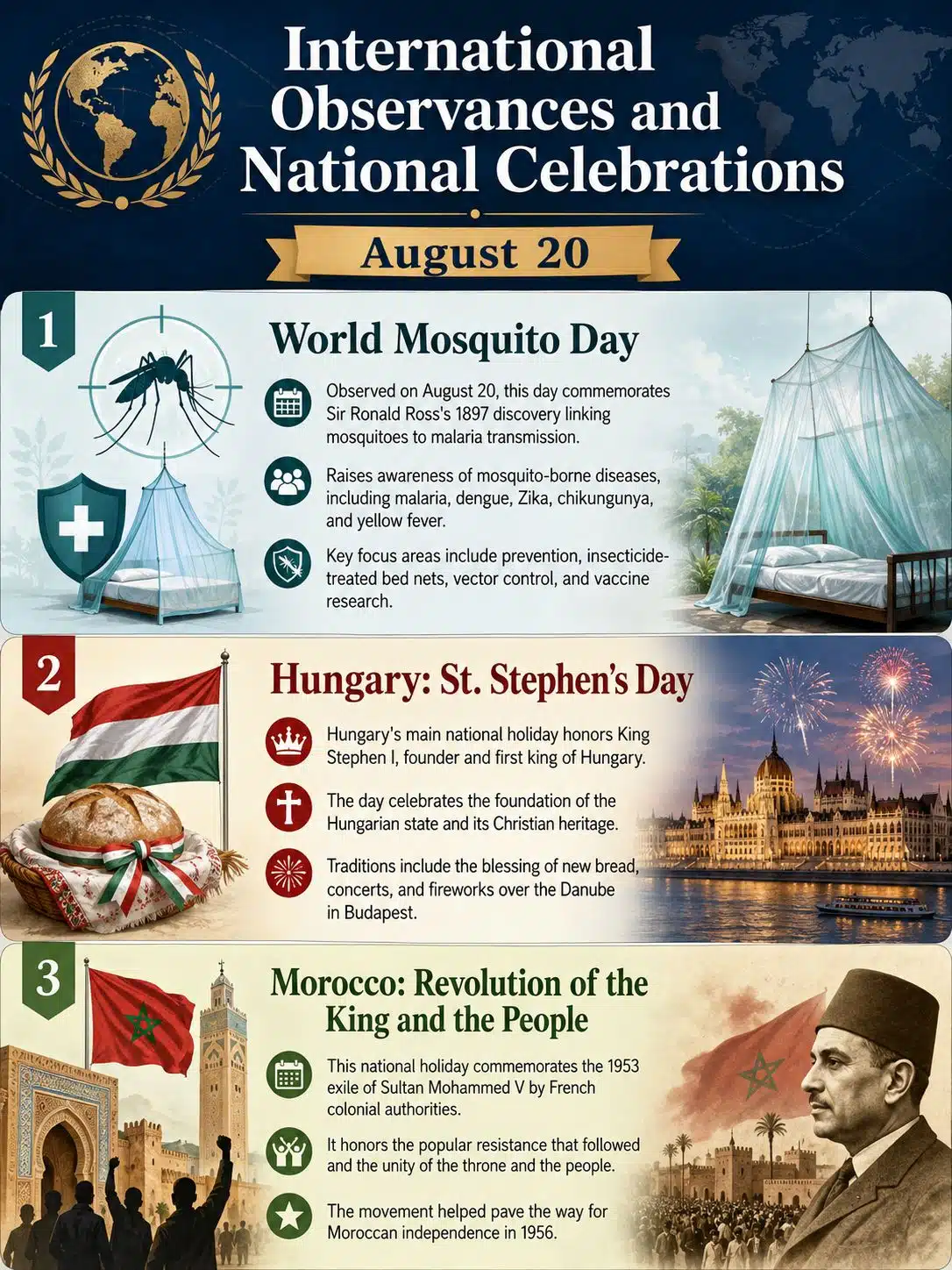
Commemorating Sir Ronald Ross’s 1897 discovery, World Mosquito Day is observed annually on August 20 by international health organizations, the World Health Organization (WHO), and NGOs. The day raises global awareness regarding the persistent threats posed by mosquito-borne diseases—including malaria, dengue fever, Zika virus, chikungunya, and yellow fever—while highlighting advances in mRNA vaccines, genetic vector control, and insecticide-treated bed nets.
Hungary: St. Stephen’s Day (State Foundation Day)
August 20 is Hungary’s primary national holiday (Szent István ünnepe). It honors King Stephen I (St. Stephen), who united the Magyar tribes, converted the realm to Christianity, and was crowned the first King of Hungary on Christmas Day in 1000 AD. The day is marked by the blessing of the new harvest bread, classical music concerts, and an iconic fireworks display across the Danube River in Budapest.
Morocco: Revolution of the King and the People
Morocco marks August 20 as a national holiday celebrating the nationalist uprising against French colonial authorities following the forced exile of Sultan Mohammed V (King Mohammed V) in 1953. This resistance hastened the end of the French protectorate and led to Moroccan independence in 1956.
Notable Global Birthdays
August 20 has gifted the world some of its most influential political leaders, literary innovators, iconic performers, and visionary thinkers.
| Name | Born | Nationality | Profession / Legacy |
| Jöns Jacob Berzelius | 1779 | Swedish | Chemist; devised modern chemical formula notation and discovered cerium, selenium, and thorium. |
| Benjamin Harrison | 1833 | American | 23rd President of the United States; signed the Sherman Antitrust Act and facilitated forest conservation. |
| H. P. Lovecraft | 1890 | American | Master of cosmic horror fiction; creator of the Cthulhu Mythos and weird fiction literature. |
| Eero Saarinen | 1910 | Finnish-American | Renowned modernist architect; designed the St. Louis Gateway Arch and TWA Flight Center at JFK. |
| Jacqueline Susann | 1918 | American | Novelist and pop-culture pioneer; author of the record-shattering bestseller Valley of the Dolls. |
| Ron Paul | 1935 | American | Physician, author, and twelve-term US Congressman; prominent figure of the modern American libertarian movement. |
| Slobodan Milošević | 1941 | Serbian | Former President of Serbia and FR Yugoslavia; central figure in the Yugoslav Wars of the 1990s. |
| Rajiv Gandhi | 1944 | Indian | 6th Prime Minister of India; telecommunications modernizer and reformer of rural local governance. |
| Robert Plant | 1948 | British | Legendary rock vocalist and songwriter; iconic frontman of Led Zeppelin. |
| Al Roker | 1954 | American | Longstanding television personality, meteorologist, and author on NBC’s Today Show. |
| Amy Adams | 1974 | American | Acclaimed six-time Academy Award-nominated actress (Arrival, American Hustle, The Master). |
| Andrew Garfield | 1983 | British-American | Tony and Golden Globe-winning actor (Hacksaw Ridge, The Amazing Spider-Man, Tick, Tick… Boom!). |
| Demi Lovato | 1992 | American | Grammy-nominated singer, songwriter, and mental health advocate. |
Spotlights on Transformative Figures Born on August 20
H. P. Lovecraft (1890 – 1937)
Born in Providence, Rhode Island, Howard Phillips Lovecraft fundamentally redefined 20th-century speculative fiction. Lovecraft pioneered the concept of cosmic horror—the philosophical premise that humanity is an insignificant, fragile speck within a vast, uncaring cosmos populated by ancient, incomprehensible extraterrestrial entities.
Though he lived in relative poverty and received minimal recognition during his lifetime, his posthumous impact on literature, cinema, tabletop roleplaying, and modern video game narratives is immense. Authors from Stephen King to Neil Gaiman cite the Cthulhu Mythos as foundational to modern horror.
Eero Saarinen (1910 – 1961)
Born in Kirkkonummi, Finland, before emigrating to the United States, Eero Saarinen was one of the mid-20th century’s most daring architects. Saarinen rejected rigid, box-like functionalism in favor of sweeping, organic, and sculptural curves.
His masterworks include the 630-foot stainless-steel Gateway Arch in St. Louis, the soaring TWA Flight Center at New York’s JFK Airport, Washington Dulles International Airport’s main terminal, and the ubiquitous “Tulip Chair” in industrial design.
Notable Deaths & Lasting Legacies
August 20 also marks the passing of prominent scientists, religious leaders, artists, and social reformers whose work continues to shape our modern world.
| Name | Died | Nationality | Known For / Historical Legacy |
| William Booth | 1912 | British | Methodist preacher; co-founder and first General of The Salvation Army. |
| Pope Pius X | 1914 | Italian | Head of the Catholic Church (1903–1914); canonized as a saint in 1954. |
| Paul Ehrlich | 1915 | German | Nobel Laureate physician and immunologist; pioneered the “magic bullet” concept and treatment for syphilis. |
| Adolf von Baeyer | 1917 | German | Nobel Laureate chemist; successfully synthesized indigo dye and created barbiturates. |
| Flight Lt. Matiur Rahman | 1971 | Bangladeshi | Military pilot; sacrificed his life for Bangladesh’s liberation; awarded Bir Sreshtho. |
| Jerry Lewis | 2017 | American | Actor, comedian, filmmaker, and humanitarian; famed for his slapstick comedy and Muscular Dystrophy telethons. |
| Dr. Narendra Dabholkar | 2013 | Indian | Rationalist and physician; assassinated in Pune for leading the campaign against superstitious exploitation. |
Legacies of Key Figures Who Passed on August 20
Paul Ehrlich (1854 – 1915)
German physician and scientist Paul Ehrlich laid the foundations of hematology, immunology, and chemotherapy. Ehrlich hypothesized that if a chemical could selectively target a disease-causing pathogen without harming the host human cells, it would function as a “magic bullet” (Zauberkugel).
His laboratory discovered Salvarsan in 1909, the first effective chemical cure for syphilis, revolutionizing pharmacological research. Ehrlich was awarded the 1908 Nobel Prize in Physiology or Medicine for his groundbreaking work on serum immunology and antibody formation.
Dr. Narendra Dabholkar (1945 – 2013)
A trained medical doctor, Narendra Dabholkar founded the Maharashtra Andhashraddha Nirmoolan Samiti (Committee for Eradication of Superstition). For over two decades, he traveled through rural and urban India exposing fraudulent godmen, black magic scams, and exploitative occult practices.
On August 20, 2013, he was assassinated by unidentified gunmen while on his morning walk in Pune. His death ignited widespread public outrage and forced the state government to pass the landmark Anti-Superstition and Black Magic Act, creating legal protections against superstitious exploitation.
Fascinating “Did You Know?” Historical Trivia
-
Voyager 2 Launched Before Voyager 1: Despite its name, Voyager 2 was launched on August 20, 1977, sixteen days before Voyager 1 took off on September 5, 1977. Voyager 1 was placed on a faster trajectory that allowed it to reach Jupiter and Saturn ahead of its sibling.
-
The Impending Fate of Phobos: Discovered by Asaph Hall on August 20, 1877, Mars’ moon Phobos orbits closer to its host planet than any other moon in the solar system—just 3,700 miles above the surface. Planetary scientists estimate that due to tidal deceleration, Phobos will either crash into Mars or shatter into a planetary debris ring within the next 30 to 50 million years.
-
The Birth of Commercial Radio News: On August 20, 1920, station 8MK in Detroit, Michigan (operated by The Detroit News and later renamed WWJ) made history by transmitting the first regular, daily news broadcast over commercial airwaves. The broadcast announced local primary election results to an astonished public.
Quote of the Day
“Let us all work together for a strong, united, and prosperous nation, where peace and communal harmony reign supreme.”
— Rajiv Gandhi (Born August 20, 1944)
Final Thoughts
August 20 serves as a remarkable testament to the varied forces that shape human history. It reminds us that progress is rarely linear: the same date that witnessed Sir Ronald Ross solve the transmission of malaria and humanity launch its furthest-reaching spacecraft to explore deep space also saw the suppression of democratic hope in Prague and the violent assassination of reformers and visionaries.
Whether celebrating the early stirrings of social renaissance in 19th-century Bengal, honoring the sacrifices of national liberation, or reflecting on the cosmic perspective provided by our interplanetary probes, August 20 challenges us to appreciate both the fragility of peace and the boundless potential of human curiosity and courage.