You have the idea. It feels good. Your fingers are already itching to open the code editor and start building. I know that pull very well, and I have learned to distrust it. Almost every builder I know has at least one finished product sitting in a folder that nobody uses. It works. It looks fine. It solved a problem that turned out to be theirs alone. The building was never the hard part. Figuring out whether anyone else actually wanted the thing.
Over the past couple of years I have helped ship a handful of small tools and one much bigger platform. The tools that survived all had one thing in common, and it had nothing to do with the code. So if you are trying to work out how to validate a SaaS idea before writing a line of code, the honest answer is that most of the real work happens away from the keyboard. This is the part I actually enjoy now, and it is the part I want to walk you through.
Why I Stopped Trusting My Own Excitement
Excitement is a terrible signal. It tells you the idea is fun. It tells you nothing about whether it is needed.
The first version of most of my ideas is bigger, cleverer, and more complicated than what eventually goes live. When I am excited, I add features nobody asked for and imagine users who do not exist. The whole point of validation, for me, is to slow that down and check the idea against reality before it costs anything.
There is a comfortable version of “validation” that a lot of people do, where they ask a few friends if the idea sounds good and everyone politely says yes. That is not validation. That is applause. Your friends do not want to hurt your feelings, and a nod over coffee will never tell you whether someone would open your tool a second time.
What follows is what I do instead. It is not complicated, and you do not need a budget for it.
Being My Own First User
The single habit behind every tool I have built is simple: I make myself the first user before I make anything at all.
I do not mean I imagine being a user. I mean I sit with the actual problem in my own life and pay attention to it. If I am the person who has the problem, I already know what I would expect, what would annoy me, and what would make me come back. That instinct is more useful than any survey.
From there I do two more things. I go and find the tools that already try to solve this, and I use them properly, not just glance at their landing pages. Then I look at where they leave me frustrated. Those frustrations are the gap. On top of that, I check whether the problem is something more people are running into over time or something that is quietly fading. A real problem that is growing is worth building for. A problem only I have is a hobby.
That is the whole method. Be the user, study the tools that already exist, find the gap, and check the direction of the trend. Everything below is just that method applied to real products.
The Caffeine Break Calculator Started as a Health Scare, Not a Business
This one is personal, so I will tell it plainly.
I am a heavy coffee drinker. Five or six mugs a day was normal for me for years. Then I was diagnosed as diabetic, along with a few other health complications, and my doctor told me something that sounded almost too simple: I needed to sleep properly. The problem was that my coffee habit would not let me. Cup after cup, right into the evening, and then I would lie awake wondering why.
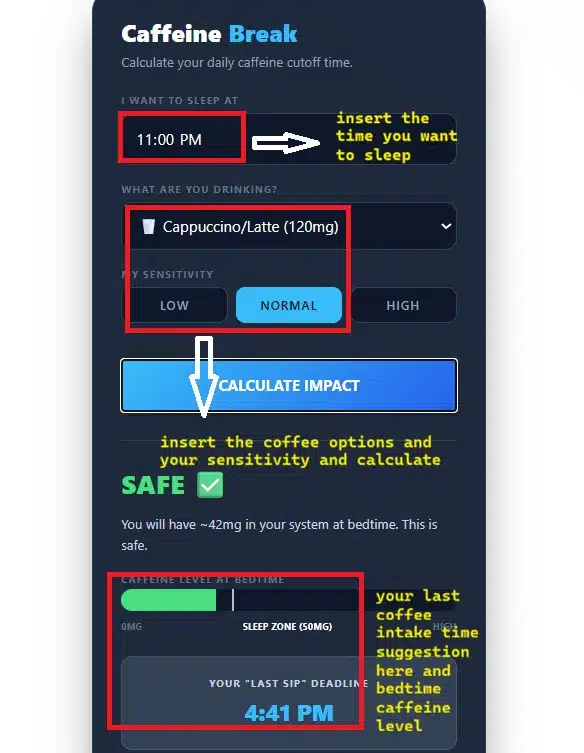
So I started cutting back, and I quickly ran into a very ordinary question that turned out to be surprisingly hard to answer. If I have a coffee now, when is it actually safe to have the next one if I still want to fall asleep tonight? I did not want a lecture about caffeine. I wanted a straight answer for my own day.
That gap is where the Caffeine Break Calculator came from. I did not decide to build a product and then go looking for a problem. The problem found me in a doctor’s office, and I was the first and most motivated user it would ever have. Before any code, I already knew the answer to the questions that usually take founders months to figure out: Who is this for? When would they use it? Would they come back? The answer to all three was sitting in my own kitchen.
That is the strongest kind of validation there is. When you are genuinely the user, you stop guessing.
Two SEO Tools That Passed the Test Before Any Code
The next two came from my day job rather than my health, but the process was the same.
I work in SEO constantly, so the pain points are not theoretical for me. Two of them nagged at me often enough that they turned into tools.
The first is the Semantic Gap Finder. In plain terms, it looks at an article and shows you the sub-topics and questions it is missing compared to the pages already ranking. It finds the holes in your content. I built it because I was doing that comparison by hand, over and over, and hating every minute of it.
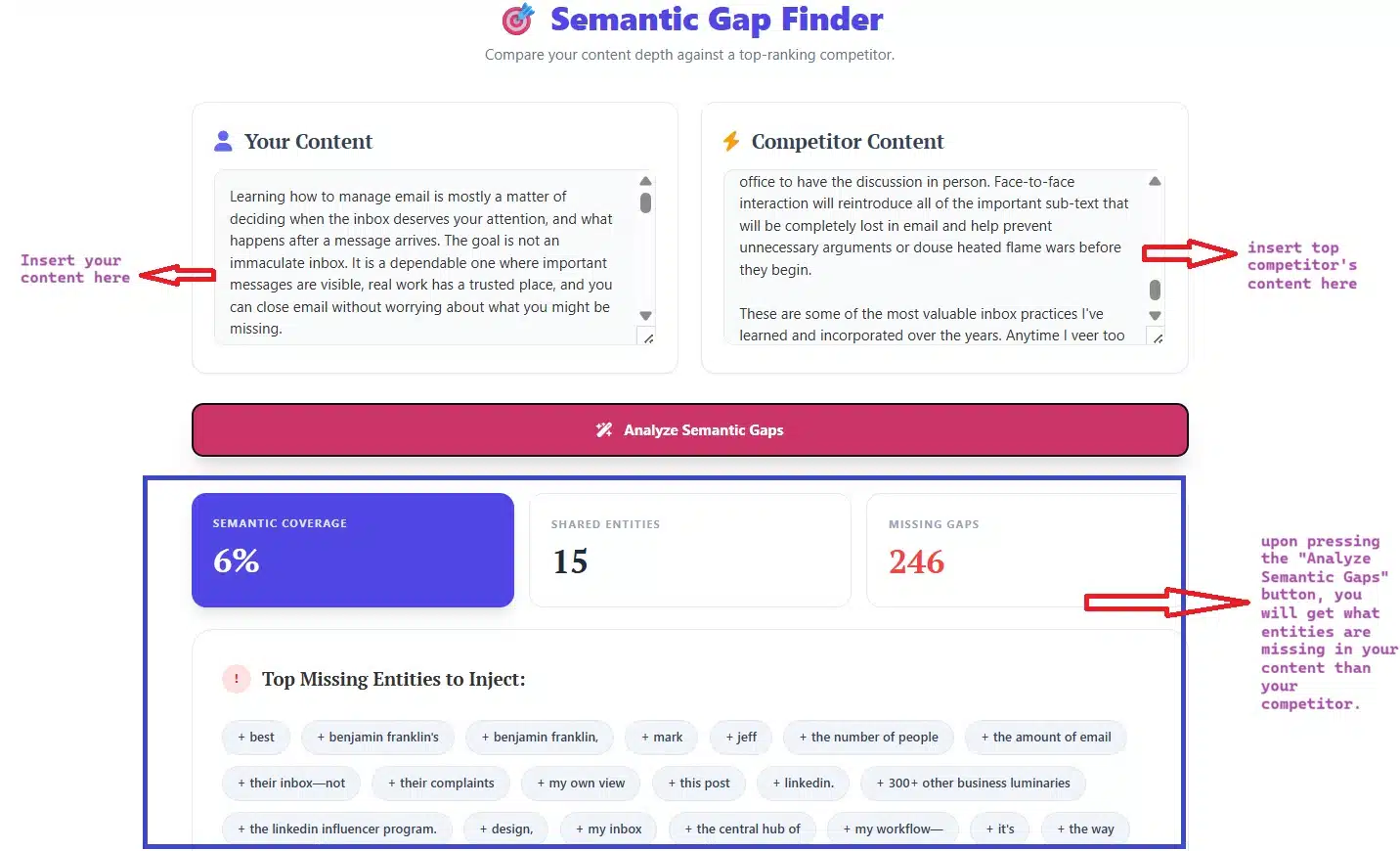
The second is the Cannibalization Compass. This one spots when two of your own pages are quietly competing for the same search term and dragging each other down. It is a mistake that is easy to make and painful to untangle later, and I had made it enough times to want a tool that just told me where it was happening.
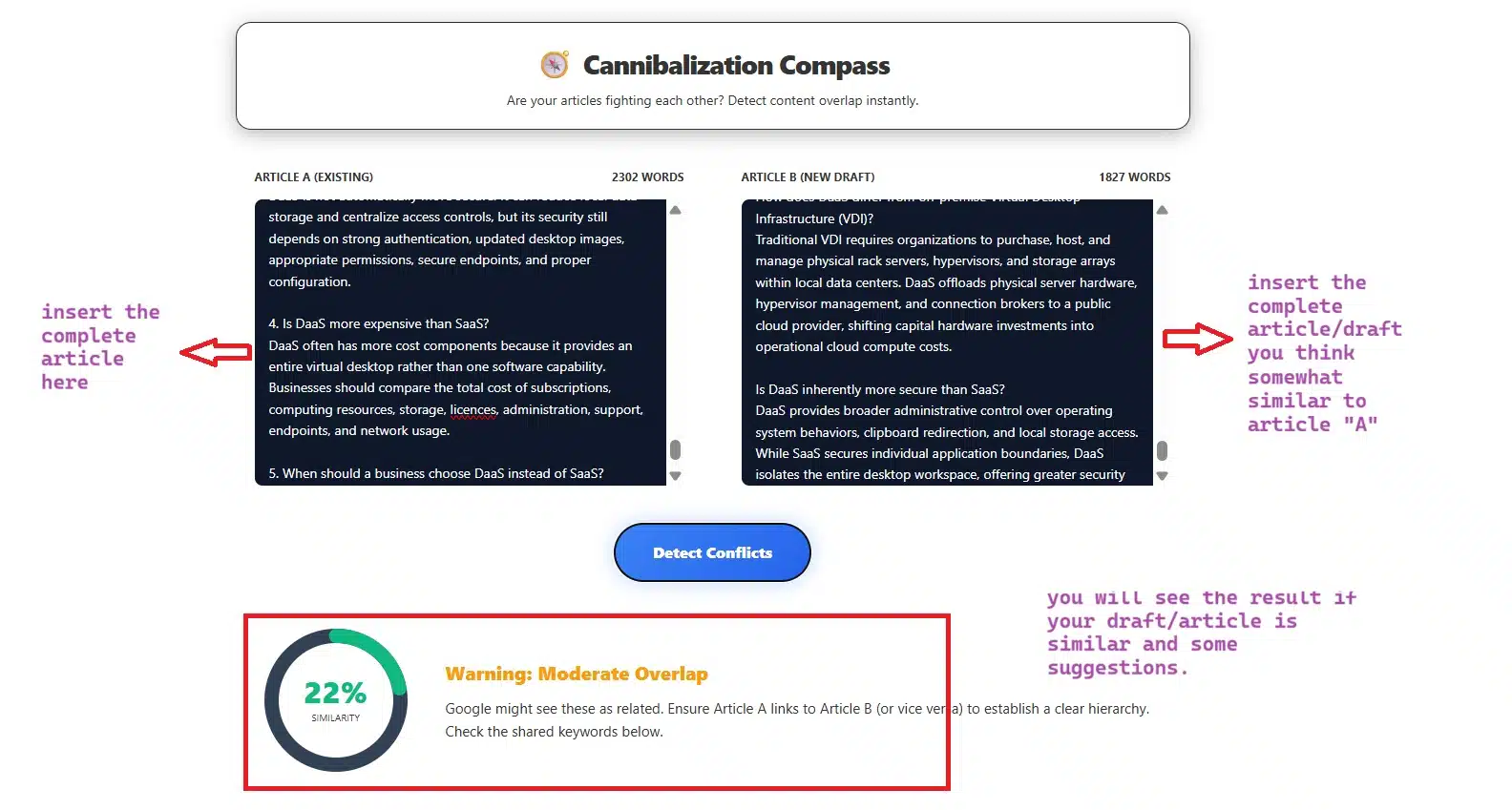
Notice what did not happen here. I did not sit in a meeting brainstorming “SaaS ideas in the SEO space.” I felt two specific, repeated frustrations in my own work, and then I went and checked what already existed. Some of the existing tools were good. But each left a gap that mattered to me, and when I am the one feeling that gap every week, I trust it far more than I trust a market report. That is the quiet test at the center of how I validate a SaaS idea: Would I, personally, use this tomorrow, and does anything out there already do it well enough that I would not bother?
For both tools, the answer was yes to the first and no to the second. That is the green light.
ImagineLab.art: Pressure-Testing a Bigger Bet as a Team
The three tools above were mine to feel and mine to decide. ImagineLab.art was different, and I want to be clear about that.
The idea was not mine. It came from our founder and CEO, Sukanta Kundu, and the credit for it belongs to him. My role, and the role of the rest of the team, was to help pressure-test it before it became real. ImagineLab.art is our in-house unified platform, and part of what made it worth building was a realization we all shared: if it worked, it could cut down the effort in our own daily work. Once again, we were among the first users.
But a platform is a much bigger commitment than a calculator, and you cannot validate it by one person having a good hunch in their kitchen. So we did it slowly and together. We went back and forth on the features more times than I can count. We looked hard at who the users would be and what the market actually wanted. We worked through the API choices, tested and compared pricing models, and spent real time fine-tuning the prompts until the output was something we would trust. None of that involved committing to the full build. It was all the cheap, reversible thinking that comes before you ask developers to spend months on it.
Only after that stretch of analysis, when the answers kept holding up instead of falling apart, did we hand it to our developers and build it properly. The lesson from ImagineLab is not that big ideas need less validation. They need more. The difference is that a team can carry that weight together, question each other, and catch the flaws a single excited founder would miss.
How to Validate a SaaS Idea Without Guessing
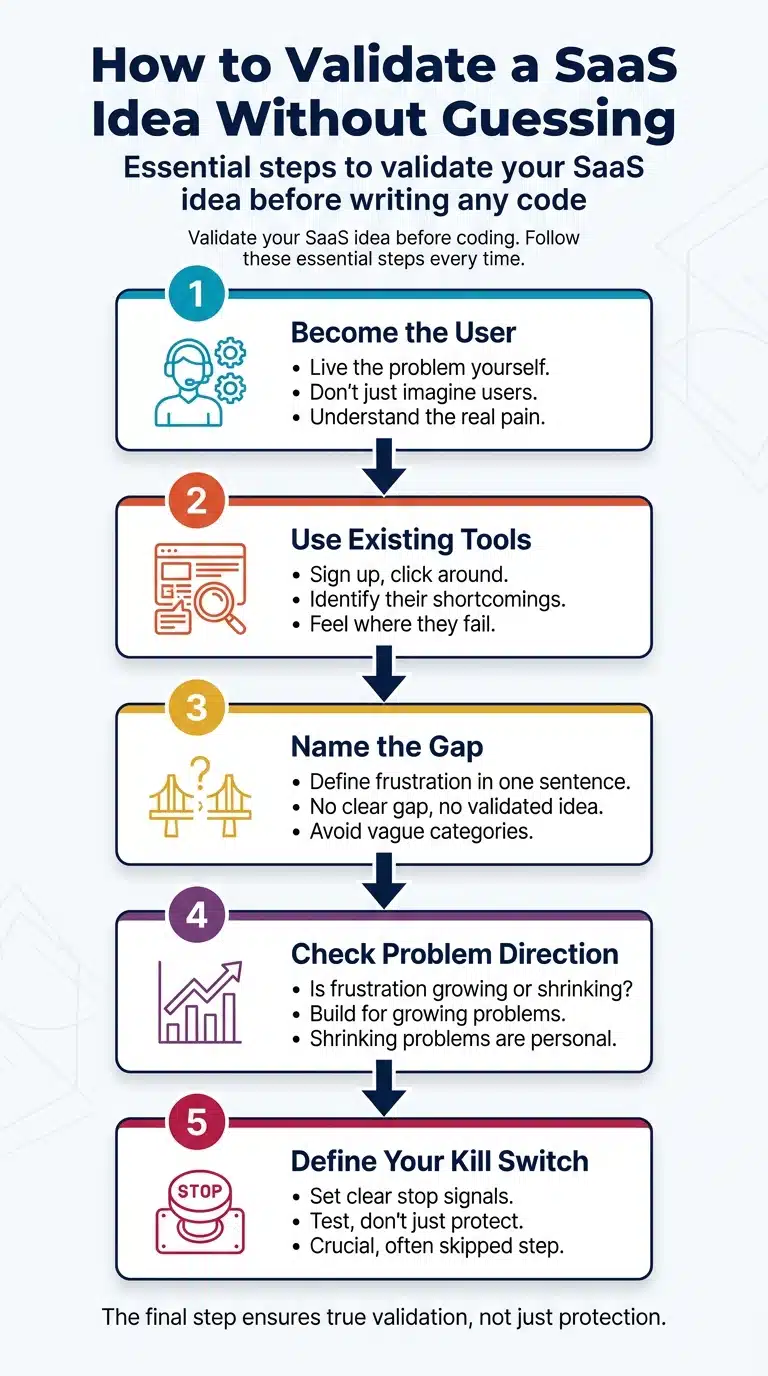
If I pull all of that into something you can actually follow, here is how to validate a SaaS idea before you write any code. It is the same handful of steps every time.
- Become the user first. Do not imagine the user. Find the version of the problem in your own life or work and live with it for a while. If you cannot, be very honest about whether you understand this problem at all.
- Use what already exists. Properly. Sign up; click around, and try to get the job done with current tools. The point is not to copy them. It is to feel exactly where they let you down.
- Name the gap in one sentence. If you cannot describe the specific frustration your tool removes in a plain sentence, you do not have a validated idea yet. You have a category you find interesting.
- Check the direction of the problem. Is this something more people are running into over time, or is it quietly shrinking? A growing frustration is worth building for. A rare one is a personal project, and that is fine, as long as you know that is what it is.
- Decide what would make you kill it. Before you build, write down the signal that would tell you to stop. If nothing could ever make you walk away, you are not testing an idea. You are protecting it.
That last step matters more than the others, and it is the one most people skip.
The Ideas and Features I Walked Away From
Not everything survived this process, and I think that is the real proof it works.
For every tool I have mentioned, there were features, and sometimes whole versions, that I dropped once they failed the simple test. My first sketch of a tool is almost always more elaborate than what ships, and being my own first user is brutal on that. If I would not actually use a feature, it goes away. A few concepts never made it past the second step at all, because once I sat with the tools that already existed, I realized they solved the problem well enough that mine would just be noise.
Walking away used to feel like failure. Now it feels like the method is doing its job. Every idea I killed cheaply is one I did not spend months building for no one. That is the whole reason you validate before you code: so that the “no” costs you an afternoon instead of a quarter.
Final Thoughts
You do not need funding, a big audience, or a clever framework to learn how to validate a SaaS idea. You need to be honest about whether you are truly the user, willing to use the tools that already exist without flinching, and clear about the exact gap you are filling. The Caffeine Break Calculator came from a health scare. The SEO tools came from work I was already doing by hand. ImagineLab.art came from a founder’s idea that a whole team then tested to pieces before trusting it. Different sizes, same discipline.
So before you open the editor, sit with the problem a little longer. Be your own first user, find the real gap, and decide in advance what would make you stop. If the idea still holds up after all that, then go ahead and build it. By then you will not be guessing anymore, and that is the entire point.
Frequently Asked Questions (FAQs)
1. Do I need an audience or a following to validate a SaaS idea?
No. Every tool I have talked about was validated by me being the user, not by a big audience voting on it. An audience helps you launch later. It is not what tells you the idea is real.
2. How long should validation take before I start building?
For a small tool it can be as short as honestly living with the problem and testing a few existing options, which might be a week. For something the size of a platform, expect a much longer stretch of back-and-forth. The size of the bet should decide the size of the check.
3. Can I really validate a SaaS idea without spending money?
Mostly, yes. The core steps, being the user, trying existing tools, naming the gap, and reading the trend, cost time and honesty rather than cash. Money comes into it much later, once you already know the idea is worth building.
4. What if I am the only person with this problem?
Then you have a useful personal project, and there is nothing wrong with that. The trouble only starts when you assume a problem that is rare is actually common. Checking whether the frustration is growing or shrinking is what keeps you honest about that.